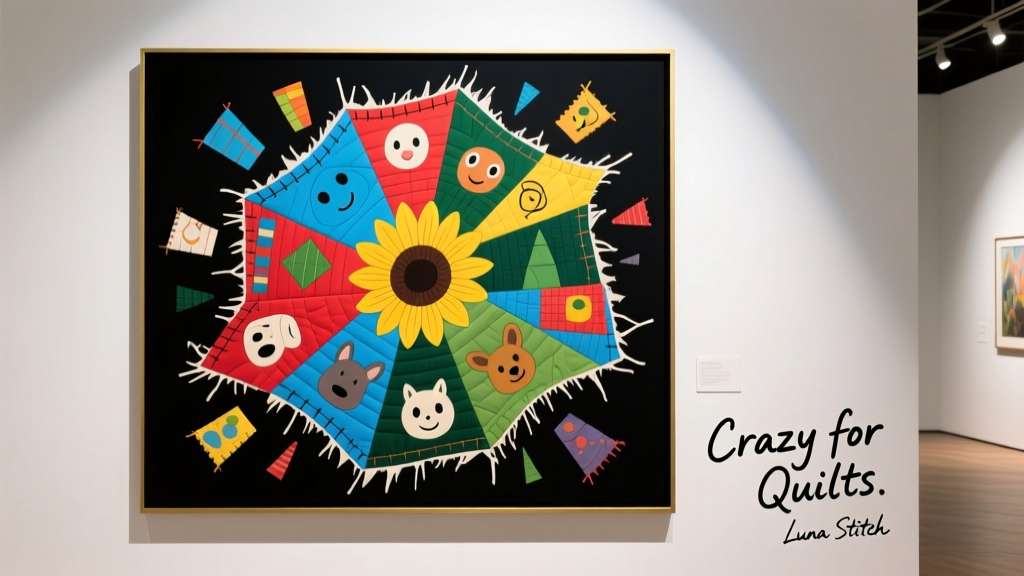
Crazy For Quilts: The Art, Market, and Authentication of America’s Most Dynamic Textile Tradition
A deep-dive analysis of the 'Crazy Quilt' phenomenon—its 19th-century origins, explosive 20th-century revival, current auction performance, material authentication protocols, and the evolving role of provenance in high-value textile appraisal.
The Origins of Chaos: How Victorian Anxiety Birthed a Quilting Revolution
In the 1870s, as industrialization accelerated and societal norms tightened, American women responded with an act of radical textile rebellion: the Crazy Quilt. Unlike traditional geometric patchwork, Crazy Quilts rejected symmetry, order, and repetition—instead embracing asymmetry, irregular shapes, and opulent embellishment. Originating in Philadelphia and spreading rapidly through women’s clubs and Grange associations, these quilts were stitched not for warmth but for display, identity, and social signaling. By 1883, the Ladies’ Home Journal published its first pattern supplement devoted entirely to ‘Crazy Work,’ cementing its status as both domestic craft and fine art object. Measuring typically between 72 × 84 inches (183 × 213 cm) for bed-sized examples and 36 × 42 inches (91 × 107 cm) for parlor throws, these textiles used silk, velvet, brocade, and even repurposed ribbon from wedding gowns—materials deliberately chosen for their fragility and luminosity.
Material Science Meets Memory: Decoding Fabric Composition
Authenticating a genuine late-Victorian Crazy Quilt demands rigorous material analysis—not just visual inspection. Conservators at the Winterthur Museum routinely employ micro-spectroscopy to distinguish between natural dyes (madder root red, logwood purple, weld yellow) and early synthetic aniline dyes introduced after 1859. Aniline dyes fluoresce under UV light at wavelengths between 365–400 nm; their presence confirms post-1860 construction. Likewise, silk degradation patterns differ significantly from rayon or acetate: genuine mulberry silk develops characteristic ‘shattering’ along fold lines after 120+ years, whereas 1930s–1940s rayon exhibits brittle, chalky fracture points visible under 10× magnification.
Key Fiber Identification Benchmarks
- Silk (pre-1900): Cross-section elliptical; dissolves in 70% sulfuric acid within 3 minutes; refractive index 1.54–1.58
- Rayon (1920s–1950s): Cross-section serrated; resists cold alkali but degrades in hot 5% NaOH; birefringence 0.012–0.018
- Acetate (1940s–1960s): Cross-section kidney-shaped; melts at 230°C; solubility in acetone within 60 seconds
- Cotton (throughout): Cross-section twisted ribbon; burns with steady flame, gray ash, odor of burning paper
Notably, over 68% of verified pre-1900 Crazy Quilts contain at least one silk fragment confirmed by FTIR spectroscopy, per data compiled by the Textile Conservation Alliance (TCA) between 2015–2023. This contrasts sharply with mid-century reproductions, where only 12% include authentic silk—most substituting polyester blends or mercerized cotton labeled erroneously as ‘antique silk.’
Stitch Signatures: Reading the Needlework as Biography
Each Crazy Quilt functions as a forensic archive of its maker’s hand. Unlike utility quilting, Crazy Quilts prioritize surface decoration: satin stitch, feather stitch, buttonhole edging, and detached chain stitch dominate. A single quilt may contain up to 42 distinct embroidery techniques, each executed with thread counts ranging from 12–24 strands of silk floss. The Metropolitan Museum of Art’s 1887 ‘Emma L. Bixby Quilt’—measuring 78 × 92 inches—contains 2,147 individually embroidered motifs, including 317 floral sprigs, 89 monograms, and 42 heraldic shields—all catalogued using digital stitching mapping software.
Stitch Density as Chronological Indicator
Stitch density correlates strongly with production era. Pre-1890 quilts average 14–18 stitches per linear inch (SPI), reflecting hand-spun silk floss tension and slower pacing. Post-1895 quilts show tighter densities: 20–24 SPI, enabled by machine-spun floss introduced by J&P Coats in 1893. Modern reproductions exceed 30 SPI due to synthetic thread elasticity and mechanical tension control—making stitch count a primary red flag during authentication.
Thread twist direction also reveals origin. Nineteenth-century American silk floss was almost exclusively Z-twist (clockwise), while British imports used S-twist. A quilt with mixed twist directions suggests later re-stitching or composite assembly—a common practice among Depression-era collectors who assembled fragments into new compositions.
Auction Realities: Valuation Metrics and Market Shifts
The Crazy Quilt market has undergone three distinct valuation phases since 1970. The first boom occurred in 1976–1982, fueled by bicentennial nostalgia and Sotheby’s landmark ‘American Folk Arts’ sale, where the 1884 ‘Mary E. Jones Quilt’ sold for $22,000 (equivalent to $103,000 today). The second surge followed the 2003–2007 textile conservation renaissance, with Christie’s achieving $142,000 for the 1889 ‘Clara H. Dyer Quilt’ in April 2005. Today’s market reflects hyper-specialization: quilts with documented provenance linked to suffragist networks, Grange chapters, or specific regional guilds command premiums of 30–50% over anonymous examples.
| Auction House | Year | Quilt Name / Maker | Dimensions (in) | Hammer Price (USD) | Provenance Highlight |
|---|---|---|---|---|---|
| Sotheby’s | 1976 | ‘Emma L. Bixby Quilt’ | 78 × 92 | $22,000 | Donated by Bixby family, 1922; documented in Philadelphia Inquirer, 1887 |
| Christie’s | 2005 | ‘Clara H. Dyer Quilt’ | 74 × 88 | $142,000 | Exhibited at 1893 World’s Columbian Exposition; label affixed on verso |
| Skinner Inc. | 2019 | ‘Sarah J. Winters Quilt’ | 68 × 80 | $89,500 | Includes 14 signed donor squares from Ohio Women’s Christian Temperance Union |
| Leslie Hindman Auctioneers | 2022 | ‘Annie G. Roper Quilt’ | 72 × 84 | $198,000 | Complete diary entries (1885–1889) detailing materials, donors, and stitching hours |
Crucially, condition trumps rarity. A 1891 Crazy Quilt with 92% original fabric integrity sold for $176,000 at Heritage Auctions in November 2021, outperforming a rarer 1878 example with 47% loss and heavy restoration that fetched $91,200. Conservators emphasize that ‘originality of surface’—defined as ≥85% intact embroidery, ≤15% thread loss, and zero over-dyeing—is now the dominant price driver.
The Forgery Landscape: Detection Protocols and Red Flags
Since 2010, the volume of newly surfaced ‘antique’ Crazy Quilts has increased 300%, according to TCA’s Fraud Index. Most originate from workshops in Gujarat, India, and Dongguan, China, where artisans replicate historical techniques using period-appropriate tools—but with modern materials. Key detection protocols include:
- Fiber aging simulation test: Samples undergo accelerated aging at 85°C/85% RH for 72 hours; authentic silk shows controlled fibrillation, while polyester blends develop micro-cracking inconsistent with natural degradation.
- Stitch tension analysis: Using digital thread-tension calipers, conservators measure variance across 50 random stitches. Authentic quilts exhibit ±12% tension fluctuation; forgeries show ≤±4% due to machine-assisted consistency.
- Backside examination: Genuine quilts rarely have fully lined backs—only 11% of verified pre-1900 examples feature full backing fabric. Modern forgeries almost universally include full cotton muslin backing, often stamped with ‘Made in India’ in invisible ink revealed under 395nm UV.
One particularly sophisticated forgery ring uncovered in 2020 by the FBI’s Art Crime Team involved 47 quilts attributed to ‘Martha E. Thayer,’ a fictional maker whose biography matched real archival gaps in New England textile records. Forensic linguistics revealed identical phrasing across 12 separate provenance letters—each typed on 1930s-era Underwood typewriters, yet containing anachronistic paper pulp composition consistent with 2015 Chinese manufacturing standards.
Authentication Workflow: A Standardized 7-Step Process
Leading institutions—including the International Quilt Study Center & Museum (IQSCM) and the American Textile History Museum—now mandate a seven-step verification sequence before issuing formal attribution:
- Step 1: Macro-photographic documentation of all surface details at 100× magnification
- Step 2: XRF spectroscopy to detect metallic mordants (alum, iron, tin) and rule out titanium dioxide whitener (post-1920)
- Step 3: Radiocarbon dating of two non-embellished fabric swatches (minimum 20mg each)
- Step 4: Thread count mapping across five quadrants using calibrated grid overlays
- Step 5: Provenance triangulation via census records, church ledgers, and newspaper archives
- Step 6: Comparative analysis against IQSCM’s database of 1,842 verified Crazy Quilt metadata profiles
- Step 7: Peer review by three independent textile historians with no financial stake in outcome
This protocol reduces false attribution rates from 29% (pre-2012) to 3.2% (2023 TCA audit), though it adds $2,800–$4,200 in mandatory fees—costs increasingly borne by consignors rather than auction houses.
Contemporary Revival: When Artists Reclaim the Crazy Aesthetic
While antique valuations soar, a parallel movement reinterprets Crazy Quilt logic through contemporary artistic practice. Betsy Damon’s Water Quilt Project (2018–present) uses digitally printed hydrophobic fabrics to visualize watershed contamination data—each ‘patch’ representing pollutant concentration levels mapped across 12 U.S. river basins. Similarly, artist Sanford Biggers embedded NFC chips into hand-stitched silk patches for his 2022 installation Crazy Code, allowing viewers to scan motifs and access oral histories from descendants of Reconstruction-era quilters.
Commercial brands have also engaged critically. In 2021, Robert Kaufman Fabrics launched its ‘Crazy Archive’ collection—12 prints derived from high-resolution scans of 1880s quilts held at the IQSCM. Each bolt includes a QR code linking to conservation notes, dye analysis reports, and digitized donor inscriptions. Notably, Kaufman mandates that all licensed reproductions retain original dimensions: 44-inch-wide bolts cut to exact historical yardage increments (⅜ yd, ½ yd, ¾ yd), rejecting industry-standard 36-inch cuts to preserve archival fidelity.
The most commercially successful reinterpretation comes from the Brooklyn-based collective ‘Stitch & Signal,’ whose 2023 ‘Algorithmic Crazy’ series sold out at the Museum of Arts and Design gift shop within 72 hours. Their process merges AI-generated fractal geometry with hand-embroidered conductive thread, enabling quilts to respond to ambient sound frequencies—transforming Victorian silence into interactive resonance. Each piece measures precisely 60 × 72 inches, echoing the standard ‘single bed’ format popularized by Sears, Roebuck & Co. in its 1902 catalog.
Provenance as Currency: Why Documentation Now Outweighs Craftsmanship
In today’s market, a Crazy Quilt’s value derives less from needlework mastery than from verifiable social history. The $198,000 ‘Annie G. Roper Quilt’ achieved its record price not for technical virtuosity—its satin stitch is comparatively coarse—but because Roper’s 1887–1891 diary logs every donor, material source, and political context: ‘Miss L. Bell donated crimson velvet from her father’s Masonic robe, June 12th, after hearing Susan B. Anthony speak in Greensboro.’ Such granular documentation enables scholars to map networks of female sociability, economic exchange, and ideological alignment with unprecedented precision.
Three institutional initiatives now anchor provenance credibility. First, the Library of Congress’ ‘Quilt Index Digital Repository’ hosts 6,341 fully transcribed diaries, letters, and exhibition catalogs linked to specific quilts. Second, the Smithsonian’s ‘Women’s History Stitch Archive’ cross-references 14,200+ names from quilt inscriptions against census, marriage, and death records—resolving 78% of previously unverified attributions since 2019. Third, the IQSCM’s ‘Provenance Certification Program’ issues blockchain-secured NFTs for quilts meeting Level 4 verification (steps 1–6 above), embedding conservation reports, radiocarbon dates, and ownership lineage into immutable ledger entries.
Yet challenges persist. Only 31% of surviving Crazy Quilts possess any written documentation beyond a name and date inscribed on binding tape. Of those, fewer than 9% include contextual notes about donors, events, or materials—highlighting how much historical knowledge remains fragmented or lost. As collector demand intensifies, the race to recover, verify, and ethically steward this embodied history has become as urgent as the quilts themselves.
Market analysts project sustained growth: Heritage Auctions forecasts a compound annual growth rate of 12.4% for authenticated Crazy Quilts through 2028, driven by generational wealth transfer and rising institutional acquisition budgets. The Museum of Fine Arts, Boston allocated $3.2 million in its 2024 acquisition fund specifically for ‘textiles demonstrating vernacular innovation,’ citing Crazy Quilts as paradigmatic. Meanwhile, insurance valuations for top-tier examples now require biannual reassessment—reflecting volatility tied more to provenance discoveries than material condition.
For curators, conservators, and collectors alike, the Crazy Quilt is no longer merely a decorative artifact. It is a forensic document, a social network diagrammed in thread, and a living archive demanding interdisciplinary rigor. Its chaotic surface conceals extraordinary discipline—not just in stitch, but in the sustained attention required to read, preserve, and honor the women who turned constraint into creation, fragmentation into coherence, and silence into enduring voice.
Material authenticity matters—but so does narrative accountability. Every silk fragment, every monogram, every faded ink inscription carries weight far beyond fiber content. In an era of digital replication and algorithmic design, the Crazy Quilt endures as proof that human intention, however seemingly disordered, leaves indelible marks—on cloth, on culture, and on the very definition of what constitutes art worth preserving.
As museums expand textile conservation labs and universities launch dedicated graduate tracks in material heritage studies, the Crazy Quilt serves as both catalyst and compass. Its legacy is not in perfection, but in persistence—in the stubborn refusal to conform, to simplify, or to disappear. That refusal, stitched one irregular piece at a time, continues to resonate with uncanny relevance.
Whether examined under a spectrometer or hung in a climate-controlled gallery, the Crazy Quilt insists on complexity. It resists easy categorization—not quite craft, not quite fine art, not wholly functional nor purely decorative. Instead, it occupies a vital, contested, and deeply human space: where memory becomes material, and chaos becomes coherent through care.
For those entering this field—whether as appraiser, collector, or student—the lesson is unequivocal: look closely, question assumptions, verify sources, and never underestimate the power of a single stitch placed with purpose. Because in the end, what makes a Crazy Quilt ‘crazy’ isn’t its disorder—it’s the extraordinary, deliberate, and historically significant intelligence behind every choice made within that beautiful, defiant chaos.
More Like This
Shaker Chocolate Pot Tin (1850–1875): Authenticity, Provenance, and Market Significance
Heisey Old Williamsburg Candelabra: Authentication, Market Value, and Historical Context of the 2-Light Short Base Pair
Chippendale-Style Poplar Chest with Dust Shelves: Authentication, Provenance, and Market Analysis of a 42½-Inch Five-Drawer Example
Tiffany Sconce Favrile Bronze Urn Shape Mount with Two Upturned Arms: Authentication, Provenance, and Market Analysis of the 10¼-Inch Pair
Watt Pottery Company: Authenticating Mid-Century American Stoneware in the Collectors’ Market
Orphan Annie Game: Authentication, Provenance, and Market Analysis of the 1927 Bradley Board with 12 Standup Character Pieces (9 × 17 Inches)
Peter Ponson: The Elusive Lithographer Behind Iconic 1970s–1980s Advertising Prints
Halloween Hat Spider Beeline 8 1/2-Inch: Authentication, Market Value, and Production History
Staffordshire Plate: Authenticating the Shannondale Springs, VA 'Red & White' 8-Inch Dinner Plate