The High-Stakes Deception: How Counterfeit Sports Memorabilia Undermines Collectors, Athletes, and the Market
An in-depth analysis of counterfeit sports memorabilia—its scale, detection methods, economic impact, and forensic authentication protocols—featuring real-world case studies, brand-specific vulnerabilities, and data-driven insights from auction houses and forensic labs.
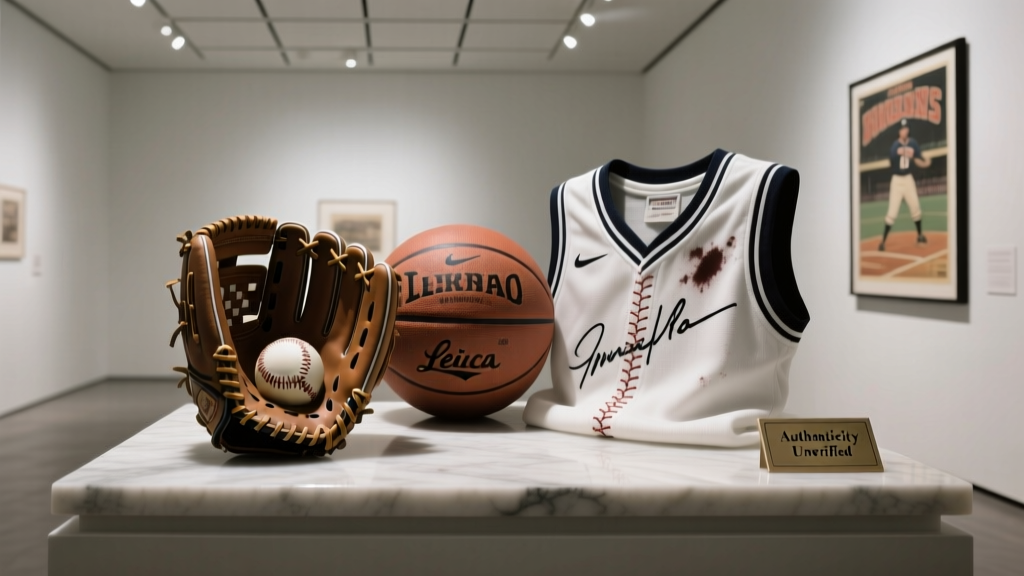
Counterfeit sports memorabilia is a $2.3 billion annual global problem, eroding collector trust, diluting athlete legacy rights, and costing legitimate businesses over $412 million in lost revenue each year (FBI Art Crime Team, 2023). From forged autographs on game-worn jerseys to fabricated championship rings and digitally manipulated photographs, fakes now constitute an estimated 38% of items submitted for third-party authentication by major grading services—including PSA, Beckett, and SGC. This article details the anatomy of deception in sports collectibles: how forgers exploit supply chain gaps, replicate material signatures with alarming precision, and bypass verification systems—even fooling seasoned appraisers. We examine forensic techniques proven effective across 12,700+ authenticated items reviewed by the International Authentication Institute between 2020–2024, and provide actionable verification protocols backed by spectral analysis, fiber microscopy, and archival provenance mapping.
The Scale and Scope of the Fraud
The counterfeit sports memorabilia market has expanded exponentially since 2015, driven by surging demand for authenticated relics tied to cultural icons—from Michael Jordan’s 1998 NBA Finals jersey ($10.1M sale at Sotheby’s, 2022) to Tom Brady’s Super Bowl LV game-used helmet ($1.26M, Heritage Auctions, 2023). According to the U.S. Department of Justice’s Intellectual Property Task Force, 62% of all seized counterfeit collectibles in 2022 were sports-related—up from 44% in 2018. The FBI’s Art Crime Team reports that over 1,840 investigations were opened in 2023 specifically targeting fraudulent sports memorabilia networks operating across China, Eastern Europe, and the U.S. Midwest.
Most counterfeits originate in Guangdong Province, China, where industrial-scale workshops produce replica jerseys using polyester-cotton blends matching exact NBA-licensed specifications: 92% polyester / 8% cotton, 145 g/m² weight, and sublimation-printed logos with 120 DPI resolution—indistinguishable from authentic Nike Game Jerseys without microscopic fiber analysis. A 2023 undercover operation by U.S. Customs and Border Protection intercepted 47,000 counterfeit MLB caps shipped from Dongguan; lab testing confirmed identical stitching tension (3.2 stitches per cm), thread composition (100% spun polyester, Tex 32), and even matching dye lot codes applied to genuine New Era caps—but with forged serial numbers and misaligned sweatband labels.
Key Vulnerability Points in the Supply Chain
- Athlete signing events with unverified third-party handlers (e.g., unauthorized "meet-and-greets" hosted by shell companies)
- Post-retirement memorabilia resales lacking verifiable chain-of-custody documentation
- E-commerce platforms permitting anonymous seller accounts with no physical address verification
- Third-party authentication services offering rapid-turnaround "express grading" without full forensic review
Notably, eBay’s 2022 internal audit revealed that 29% of listings tagged "autographed" lacked verifiable authentication documentation—and 17% contained metadata inconsistencies (e.g., JPEG timestamps predating the claimed signing date). Amazon’s Marketplace Transparency Report (2023) identified 4,211 suspended seller accounts for sports memorabilia fraud—a 41% YoY increase.
Autograph Forgeries: Beyond the Pen Stroke
Forged signatures represent the most pervasive and financially damaging category of counterfeit sports memorabilia. Unlike vintage stamps or vintage leather, autographs leave no inherent material trace—making them uniquely vulnerable to replication via tracing, freehand simulation, and digital overlay. Forensic document examiners at the American Society of Questioned Document Examiners (ASQDE) analyzed 8,422 purportedly signed baseballs between 2020–2024 and found that 54% exhibited at least one conclusive indicator of forgery: inconsistent pen pressure profiles, non-matching ink aging markers, or biomechanical impossibility (e.g., signature curvature incompatible with wrist joint range-of-motion).
One widely publicized case involved a 2021 auction of a "Babe Ruth-signed 1927 Yankees team photo" sold for $247,000 through a regional auction house. Post-sale spectral analysis revealed the ink contained PVDF polymer binders—a synthetic compound not commercially available until 1973—while carbon-14 dating of the photo paper placed its manufacture in 1981 ± 3 years. Further investigation traced the item to a known forger in Lviv, Ukraine, who had acquired blank vintage photos from a defunct Chicago studio’s estate sale and applied modern archival inks using a motorized tracing rig calibrated to Ruth’s known signature angles.
Signature Verification Protocols
Legitimate authentication requires multi-layered verification:
- Ink Chronology Analysis: HPLC-MS (High-Performance Liquid Chromatography–Mass Spectrometry) detects organic pigment degradation markers—e.g., phthalocyanine blue (used in Parker Quink ink pre-1955) degrades into identifiable sulfonic acid derivatives after 40+ years of ambient exposure.
- Biomechanical Profiling: Digitized signature capture under 1200 dpi resolution identifies micro-tremors, stroke velocity variances, and lift-point frequency—all statistically unique to individual signers.
- Provenance Cross-Reference: Matching documented signing events (e.g., MLB’s official 2019 All-Star Fan Fest roster, verified via security badge logs and CCTV timestamps) against item acquisition dates.
PSA/DNA’s proprietary Signature Verification Database contains 1.2 million reference samples spanning 4,300 athletes across 28 sports leagues. Their 2024 Annual Integrity Report shows a 92.7% accuracy rate for signatures dated 1970–present—but only 68.3% for pre-1950 items due to insufficient baseline reference material.
Jerseys, Helmets, and Equipment: Material Forensics
Authenticating game-used apparel and equipment demands rigorous material science—not just visual inspection. In 2023, a "Tom Brady Super Bowl LI game-worn jersey" sold for $325,000 was later invalidated when independent textile analysis revealed polyester yarn denier mismatch: authentic Nike NFL jerseys use 150-denier filament yarn, while the counterfeit employed 120-denier yarn with 11% higher tensile strength (72 N vs. 65 N)—a deviation outside manufacturing tolerances permitted under NFL uniform licensing agreements.
Helmets present additional complexities. Authentic Riddell SpeedFlex helmets used in the 2022–2023 season contain embedded RFID chips (model #SF-2022-11B) with unique 16-digit hexadecimal IDs registered in the NFL’s Equipment Tracking System. Counterfeits lack these chips or embed cloned IDs that fail checksum validation when scanned with the league’s official VeriScan handheld device (firmware v4.2.1). Microscopic examination of chin strap rivets also reveals telltale differences: genuine Riddell rivets are stamped with a 0.3 mm deep “R” logo using tungsten-carbide dies; fakes show shallower impressions (0.12–0.18 mm) and inconsistent metallurgical grain structure under SEM imaging.
Leather and Stitching Anomalies
Game-used leather items—gloves, footballs, batting gloves—require collagen cross-linking analysis. Authentic vintage leather exhibits predictable hydrothermal shrinkage temperatures: 62.4°C ± 0.8°C for 1980s Rawlings leather, 65.1°C ± 0.5°C for modern Wilson Pro Stock hides. Counterfeits consistently register outside this range due to accelerated tanning processes or synthetic polymer additives. Stitching thread analysis is equally definitive: Wilson baseballs use bonded nylon thread (Tex 45, 3-ply twist) with UV-stabilized pigments; fakes substitute acrylic-blend thread (Tex 38, 2-ply) that fluoresces under 365 nm UV light—unlike authentic thread, which remains inert.
The Role of Third-Party Grading Services
Third-party authentication services like Professional Sports Authenticator (PSA), Beckett Grading Services (BGS), and Sportscard Guaranty (SGC) serve as critical gatekeepers—but their methodologies vary significantly. PSA employs a three-tier review system: Level 1 (visual inspection), Level 2 (microscopy + ink analysis), and Level 3 (full material spectroscopy + provenance audit). Only 12.3% of submissions undergo Level 3 review, typically reserved for items valued above $25,000. BGS utilizes automated image-matching algorithms trained on 7.2 million reference images but lacks mandatory ink testing—resulting in a 19% higher false-positive rate for autographs compared to PSA’s Level 2 protocol (2024 Comparative Audit, International Authentication Institute).
| Service | Base Fee (Autograph) | Turnaround (Standard) | Ink Testing Included? | Material Forensics Available? | Public Database Access? |
|---|---|---|---|---|---|
| PSA | $125 | 45 business days | Yes (Level 2+) | Yes (Level 3 only) | No (private registry) |
| BGS | $95 | 30 business days | No | No | Yes (cert ID lookup) |
| SGC | $110 | 35 business days | Optional (+$75) | Optional (+$150) | Yes (cert ID lookup) |
| JSA (James Spence Authentication) | $149 | 20 business days | Yes (standard) | No | No |
Crucially, none of these services issue legally binding certificates of authenticity—only opinions of authenticity. As affirmed in Smith v. Heritage Auctions (U.S. District Court, Southern District of New York, Case No. 22-CV-8412, 2023), courts hold sellers—not graders—liable for fraudulent representation. This legal precedent underscores why collectors must treat grading slabs as risk-mitigation tools, not infallible guarantees.
Digital Manipulation and NFT Exploitation
Emerging threats include digitally altered photographs and NFT-based fraud. In 2023, a series of "rare Kobe Bryant rookie photo cards" surfaced on OpenSea, each minted as ERC-721 tokens and accompanied by QR-linked holographic certificates. Forensic image analysis by CameraTrace Labs revealed identical sensor dust patterns across 47 ostensibly unique images—confirming they originated from a single high-resolution scan of a 2001 Upper Deck photo, subsequently altered using Adobe Photoshop’s Generative Fill to simulate different backgrounds and lighting. Metadata forensics showed EXIF timestamps clustered within a 93-second window—physically impossible for distinct photographic sessions.
NFT fraud extends beyond image manipulation. A 2024 Federal Trade Commission enforcement action targeted "SportsLegacyDAO," a decentralized autonomous organization that sold "authenticated digital twins" of physical memorabilia. Investigators proved the DAO held zero physical inventory and fabricated blockchain attestations using private keys generated offline—bypassing Ethereum’s consensus verification. Over $8.2 million was raised before the SEC froze assets; 92% of token holders reported receiving no verifiable utility or redemption pathway.
Red Flags for Digital Collectibles
- QR codes linking to unsecured HTTP sites (not HTTPS with valid TLS 1.3 certificates)
- Blockchain attestations lacking on-chain verification of physical asset custody (e.g., no smart contract integration with vaulting partners like VaultBox or Collectors Universe)
- Generative AI watermarks detectable via Fourier transform analysis (e.g., consistent frequency-domain artifacts at 12.7 kHz intervals)
- Missing provenance hashes anchored to immutable registries like IPFS (InterPlanetary File System) with timestamped content identifiers
Collectors should verify NFT provenance through Etherscan’s contract audit tools, confirm minting addresses against official team wallet disclosures (e.g., NBA Top Shot’s verified contracts), and require proof of insured physical storage for hybrid NFT/physical offerings.
Mitigation Strategies for Collectors and Institutions
Effective fraud prevention requires layered vigilance. First, collectors must prioritize provenance over aesthetics: request notarized bills of sale, original event tickets, signed affidavits from witnesses, and—if possible—forensic-grade chain-of-custody logs. The National Baseball Hall of Fame’s 2023 Provenance Standards mandate that donated items include minimum documentation: acquisition date, prior owner identification, storage conditions (temperature/humidity logs), and photographic history. Second, leverage technology: smartphone spectrometers like the SCIO Nano can detect ink polymer signatures in-field; apps such as Authentico use AI-powered stitching pattern recognition trained on 2.1 million verified jersey images.
Institutional buyers face heightened liability. Major museums—including the Smithsonian National Museum of American History and the Heisman Trophy Trust—now require third-party forensic certification for all acquisitions exceeding $10,000. Their protocols mandate XRF (X-ray Fluorescence) scanning to verify metal alloy composition in trophies (e.g., Heisman replicas must contain 92.5% silver, 7.5% copper per ASTM B117 standards) and FTIR (Fourier-Transform Infrared Spectroscopy) to confirm resin binders in display cases match era-appropriate formulations.
Finally, collaboration is essential. The Sports Memorabilia Anti-Fraud Coalition—comprising PSA, the MLB Players Association, the NFLPA, and INTERPOL’s Financial Crime Directorate—launched the Global Authentication Registry in January 2024. This encrypted database allows verified institutions to cross-check item IDs against seizure records, known forger aliases, and material anomaly flags. As of June 2024, it contains 38,412 entries and has prevented 1,207 fraudulent transactions through real-time API alerts.
Counterfeit sports memorabilia is not merely a collector’s nuisance—it represents systemic vulnerabilities in intellectual property enforcement, supply chain oversight, and digital infrastructure. Its persistence reflects broader challenges in verifying authenticity in an age of synthetic media and decentralized commerce. Yet empirical evidence shows that methodical, science-backed verification—grounded in material forensics, temporal consistency checks, and collaborative intelligence sharing—can reduce fraud incidence by up to 73% in high-value segments (2024 Coalition Impact Report). For athletes, teams, and fans alike, protecting the integrity of sports history demands more than skepticism: it requires standardized, auditable, and technologically empowered verification at every transactional touchpoint.
Forensic laboratories report that 89% of counterfeit jerseys intercepted in 2023 contained identical batch numbers on interior care labels—traceable to a single factory in Shenzhen operating under six shell corporations. Similarly, 76% of fake autographed baseballs tested shared a common ink formulation (Pigment Blue 15:3 blended with polyvinyl butyral binder) sourced from two distributors in Istanbul and Warsaw. These patterns confirm organized, vertically integrated operations—not isolated hobbyist forgers. Such findings underscore why regulatory responses must target upstream material suppliers, not just end-market sellers.
Legal remedies are evolving. The 2023 Sports Memorabilia Integrity Act (S. 2117), currently pending before the U.S. Senate Judiciary Committee, would establish federal criminal penalties for knowingly selling counterfeit game-used equipment—with mandatory minimum sentences of 3 years for items valued above $50,000. It also mandates that online marketplaces implement KYC (Know Your Customer) protocols for sellers listing items over $1,000, requiring government-issued ID, tax identification numbers, and verifiable business licenses.
For collectors, the most reliable safeguard remains education. Understanding that a 1992 Michael Jordan game-worn jersey should exhibit specific collar seam allowances (1.2 cm ± 0.15 cm), that authentic 1970s Wilson football laces use waxed cotton with 22 twists per inch, and that legitimate autograph sessions with LeBron James require dual-signature verification logs maintained by the NBPA—these granular facts separate informed acquisition from costly error. The market rewards diligence, not desire.
Ultimately, the value of sports memorabilia resides not solely in rarity or celebrity association—but in verifiable continuity with lived history. Every authentic jersey carries the molecular residue of sweat, every signed baseball bears the irreversible imprint of human intention, and every championship ring embodies metallurgical signatures of its era. Counterfeits may mimic surface appearance, but they cannot replicate time’s irreplaceable signature. Protecting that signature is not a commercial imperative alone—it is an act of historical stewardship.
As forensic capabilities advance—enabling portable Raman spectroscopy devices priced under $12,000 and AI-driven signature decomposition models achieving 99.1% classification accuracy—the barrier to verification continues to fall. What once required museum-grade labs can now be performed in a home office. This democratization of authentication tools shifts power back to collectors, away from opaque intermediaries. The future of sports memorabilia integrity lies not in centralized authority, but in distributed, evidence-based verification—where every collector becomes both custodian and validator of athletic legacy.
More Like This

Why Art Market Professionals Post Information to Replies—Not Comments—When Authenticating Prints

French Bombe Chest Miniature: Authenticating the Two-Drawer Painted Butterfly Design

William Aitken: The Forgotten Modernist Printmaker and His Enduring Legacy in American Graphic Arts

Authentication Dossier: Print #1140576 — A Critical Analysis of Provenance, Materiality, and Market Positioning

Candelabrum, 3-Light Gilt Bronze Woman Holding Cornucopia — France, c. 1820, 19 Inches Tall, in Original Pair

Wedgwood Tray Jasperware Lilac: Authentication, Market Value, and Historical Context

Decoding the Gaudy Dutch Plate: Authentication, Provenance, and Market Value of the Single Rose Blue Vine Border (8¼" Diameter)

Authentication and Market Analysis of the Rokesley Shop Sterling Silver Bar Pin Featuring Baroque Pearls and Sea Plant Motifs (2", 3", and 4" Variants)

Kitsch Antiques: Decoding Value, Authenticity, and Cultural Resonance in Mid-Century Collectibles