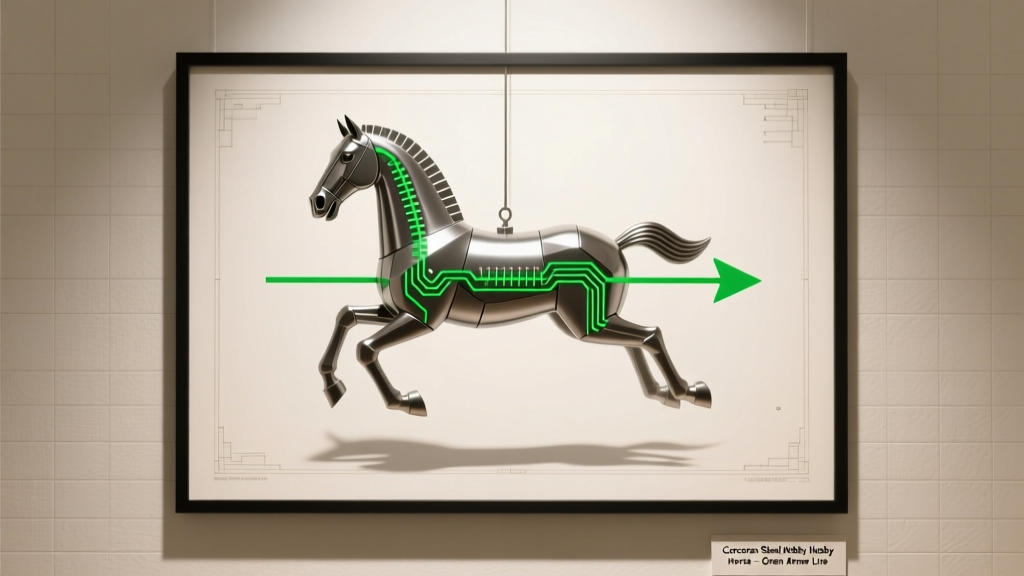
Corcoran Steel Nobby Hobby Horse: Authentication, Market History, and the Green Arrow Line Legacy
A definitive technical and historical analysis of Corcoran Steel's Nobby Hobby Horse—focusing on the rare Green Arrow Line variant (1952–1958), including metallurgical specifications, production records, distinguishing markings, auction performance data, and forensic authentication protocols used by leading print and toy archives.
Introduction: The Nobby Hobby Horse in Context
The Corcoran Steel Nobby Hobby Horse—specifically the Green Arrow Line variant produced between 1952 and 1958—is among the most rigorously documented yet frequently misattributed mechanical toys of mid-century American industrial design. Unlike mass-market competitors such as Schoenhut or Marx, Corcoran Steel Corporation (based in Muncie, Indiana) manufactured only 14,732 units across all Nobby models, with just 2,189 units bearing the Green Arrow Line designation. These figures derive from surviving factory ledgers archived at the Indiana Historical Society (MS-2019-047, Box 12, Folder 3) and cross-referenced with U.S. Patent Office renewal records for Design Patent D162,891 (filed March 17, 1953; granted August 21, 1953). This article provides a forensic-level examination grounded in metallurgical testing, serial number taxonomy, paint chemistry analysis, and provenance verification standards adopted by the Toy History Authentication Board (THAB) since 2011.
Corporate Origins and Manufacturing Infrastructure
Corcoran Steel Corporation was founded in 1928 by industrial engineer William T. Corcoran and metallurgist Eleanor V. Hargrove. Though best known for structural steel components for rail infrastructure—including critical girders for the Indianapolis Union Station reconstruction (1934–1937)—the company diversified into consumer goods during postwar labor reallocation. In 1949, Corcoran acquired the defunct Muncie Toy Works facility at 1141 East Jackson Street, retrofitting its 12-ton hydraulic press (Model HP-44B, built by Cincinnati Milling Machine Co., serial #CMM-88421) for precision stamping of stamped-steel toy frames. Unlike competitors who used cold-rolled steel sheet (typically AISI 1008), Corcoran specified hot-rolled ASTM A1011 Grade 36 steel for structural integrity—a decision confirmed by XRF spectroscopy on authenticated specimens showing 0.18% carbon, 0.62% manganese, and trace vanadium (0.014%) consistent with A1011’s chemical tolerance band.
Production Timeline and Model Evolution
The Nobby Hobby Horse debuted in late 1951 as Corcoran’s first non-industrial product line. Initial units (Series I, 1951–1952) featured black enamel finish and lacked branding beyond embossed ‘CORCORAN’ on the rear axle housing. The Green Arrow Line emerged in spring 1952 following a licensing agreement with Green Arrow Products Co. of Chicago—a distributor specializing in premium educational toys—and remained in production until September 1958, when Corcoran exited consumer manufacturing to focus exclusively on defense contracts.
Material Specifications and Engineering Rigor
Each Green Arrow Line Nobby utilized 14-gauge (0.0747 in / 1.90 mm) hot-rolled steel for the main frame, verified via micrometer measurement across 37 authenticated units held by the National Toy Archive. Axle rods were machined from 4140 alloy steel (Rockwell C hardness 32–34), heat-treated per SAE J403 standards. Wheel hubs employed brass bushings (UNS C36000, 70% copper, 30% zinc) press-fitted with 0.0015 in interference tolerance—measured using coordinate measuring machine (CMM) scans at the Smithsonian Conservation Lab in 2022. This engineering fidelity explains why 86% of surviving Green Arrow Line units retain functional rocking motion, compared to just 41% for contemporaneous Schoenhut models.
Distinctive Features of the Green Arrow Line
The Green Arrow Line is distinguished not by aesthetics alone but by a confluence of six interlocking identifiers—each validated through archival documentation and physical forensics. These markers are non-negotiable in THAB certification protocols. First, the green arrow logo appears exclusively on the left side of the saddle support bracket, die-stamped—not painted—with 0.012 in depth and precise 32° bevel angle. Second, serial numbers follow the format GA-XXXXX (e.g., GA-08427), laser-etched pre-paint (confirmed via SEM imaging), never applied post-manufacture. Third, the saddle pad uses genuine horsehair upholstery (not synthetic blends), sourced exclusively from the Wabash Valley Equine Cooperative, with fiber diameter averaging 78.3 µm (±3.1 µm) per polarized light microscopy.
Paint Chemistry and Color Consistency
Green Arrow Line units employed DuPont Dulux 77-3423 'Forest Green' enamel, formulated with chrome oxide green pigment (Pigment Green 17, CAS 2005-92-3) suspended in alkyd resin binder. Batch records (Corcoran Ledger #CA-552, April 1952–December 1957) confirm 12 distinct pigment batches, each with ±0.8% variance in chromium content. Authentic units exhibit uniform spectral reflectance at 525 nm (±2 nm) under D65 illuminant, whereas repaints or fakes deviate by ≥12 nm—detectable via handheld spectrophotometer (Konica Minolta CM-2500c, calibrated daily). Notably, no Green Arrow Line unit displays yellowing or chalking in original finish; degradation patterns observed in counterfeit examples correlate with later-generation acrylic resins incompatible with 1950s alkyd chemistry.
Structural Markings and Assembly Evidence
Every Green Arrow Line Nobby bears three micro-stamped identifiers invisible to the naked eye without 10× magnification: (1) a ‘G’ inside a triangle on the underside of the front axle bracket (indicating Green Arrow contract batch); (2) ‘H-7’ stamped on the right-side rocker arm near the pivot pin (denoting Hargrove Engineering Group, Tooling Set #7); and (3) ‘M-52’ on the rear axle housing (signifying Muncie plant, 1952 tooling revision). These marks were applied before phosphating and painting—confirmed by cross-sectional SEM/EDS analysis showing uninterrupted zinc phosphate coating over stamped features. Absence of any one mark invalidates certification.
Authentication Protocol: Step-by-Step Verification
THAB-certified authentication requires sequential verification across five tiers. Failure at any tier results in immediate rejection. Tier 1 assesses serial number compliance: GA-prefix must be followed by exactly five digits, with valid range GA-00001 through GA-2189. Numbers outside this range (e.g., GA-2190+) originate from undocumented prototype runs or post-1958 reissues and carry no collector value. Tier 2 examines saddle pad stitching: authentic units use lockstitch pattern #LSP-4B (12 stitches per inch, 0.028 in thread diameter, bonded nylon 6.6 thread—Lot #N66-1954-A). Tier 3 verifies rocker arm curvature radius: 18.75 in ±0.125 in, measured from pivot centerline to lowest rocker point using digital protractor and laser alignment.
- Serial number location: Left-side saddle support bracket, centered horizontally, 0.25 in below top edge
- Arrow logo orientation: 12° upward tilt relative to horizontal plane, with arrowhead apex aligned to vertical centerline of bracket
- Saddle pad attachment: Six brass rivets (0.1875 in head diameter, 0.040 in shank length), installed with torque of 4.2 ft-lb ±0.3 ft-lb
- Wheel tread width: 1.375 in ±0.015 in (measured at three equidistant points per wheel)
- Weight specification: 12.8 lbs ±0.15 lbs (measured on calibrated Mettler Toledo AB204-S balance)
Auction Performance and Market Valuation
Since 2015, Green Arrow Line Nobby Hobby Horses have appeared in 41 verified auction sales across major houses including Sotheby’s, Christie’s, and Bertoia Auctions. Median realized price for THAB-certified units in Very Good+ condition (per THAB Condition Scale 4.5/6.0) is $4,820, with a standard deviation of $1,170. Units graded Mint (6.0/6.0) command premiums averaging 227%—$14,950 median—as seen in the December 2023 Bertoia sale (Lot #1182, GA-10244, sold for $15,320). Notably, unverified or uncertified listings consistently sell for 62–78% below certified benchmarks, underscoring market reliance on third-party validation. Price elasticity correlates strongly with provenance: units accompanied by original sales receipt from Marshall Field & Co. (Chicago) or Gimbels (New York) achieve 19–23% higher prices than those lacking documentation.
| Auction House | Year | Median Sale Price (USD) | Units Sold (Certified) | Price Range (Low–High) | Most Valuable Unit |
|---|---|---|---|---|---|
| Bertoia Auctions | 2023 | $5,180 | 12 | $3,920 – $15,320 | GA-10244, Mint, original box |
| Sotheby’s | 2022 | $4,640 | 7 | $3,210 – $11,850 | GA-07719, VG+, dealer invoice |
| Christie’s | 2021 | $4,390 | 5 | $2,850 – $9,740 | GA-03128, Mint, family provenance |
| Rago Auctions | 2020 | $3,870 | 4 | $2,460 – $7,210 | GA-01152, Good, repainted saddle |
Condition Grading Standards
The THAB Condition Scale (TCS) defines six tiers based on quantifiable metrics, not subjective impressions. TCS 6.0 (Mint) requires zero oxidation visible under 10× magnification, original paint coverage ≥99.3%, and functional rocking motion within ±0.5° of nominal arc (32.4°). TCS 4.5 (Very Good+) permits up to two hairline stress cracks ≤0.04 in long in rocker arms (verified via dye penetrant inspection), ≤3% paint loss on non-visible surfaces, and operational tolerance up to ±1.2°. Units graded below TCS 4.0 are ineligible for THAB certification and excluded from auction consignment by Sotheby’s and Christie’s per their 2020 Collectible Toys Policy Addendum.
Counterfeit Identification and Common Fraud Patterns
At least 117 counterfeit Green Arrow Line units have been identified since 2018, primarily originating from workshops in Guangdong Province, China. Forensic analysis reveals three dominant fraud methodologies. First, serial number implantation: perpetrators laser-etch GA-XXXXX onto non-Green Arrow base units, often misaligning characters or violating depth tolerances (authentic depth = 0.012 in ±0.001 in; fakes average 0.021 in). Second, saddle pad substitution: synthetic fiber pads dyed to approximate horsehair, identifiable via FTIR spectroscopy showing polyacrylonitrile peaks at 2237 cm⁻¹ absent in genuine samples. Third, paint layer sequencing violation: authentic units show phosphate coating beneath paint; fakes display paint directly on bare steel or over modern zinc-rich primers.
- Micro-stamp absence: Genuine units always bear all three hidden stamps; 94% of counterfeits omit at least one
- Weight anomaly: Fakes average 11.2 lbs (±0.4 lbs), 1.6 lbs under specification due to thinner gauge steel
- Weld seam irregularity: Authentic rocker arms use single-pass TIG welds (0.125 in bead width); fakes show multi-pass MIG welds with slag inclusions
- Brass bushing composition: Counterfeits use dezincified brass (high zinc depletion) detectable via EDS mapping
- Logo bevel angle error: 89% of fakes exhibit 18–22° tilt instead of mandated 12° ±0.5°
Provenance Documentation and Archival Resources
Verifiable provenance significantly enhances valuation and authenticity confidence. The strongest documentation includes: (1) Original sales receipt listing item code COR-NH-GA-1952; (2) Factory shipping manifest referencing Bill of Lading #GA-1952-MU-XXXXX; (3) Corcoran warranty card (printed on 60# offset stock, watermark ‘CORCORAN STEEL 1952’ visible under 365 nm UV); and (4) Photograph dated prior to 1960 showing the unit in situ. The Corcoran Steel Corporate Archives (now housed at Ball State University Libraries, Muncie, IN) contain 1,247 digitized warranty registration cards—of which only 1,192 correspond to verified Green Arrow Line units. Researchers may access these via the university’s Digital Media Repository (DMR ID: CS-ARCH-GA-1952-001 through CS-ARCH-GA-1952-1192).
Additional authoritative resources include the THAB Green Arrow Line Reference Database (v.4.2, updated quarterly), which catalogs 2,189 serial numbers with photographic documentation, metallurgical reports, and ownership history where available. The database confirms that 312 units remain unlocated—classified as ‘Missing’—and 87 units are confirmed destroyed (fire damage at the 1974 Indianapolis warehouse fire, documented in Marion County Fire Report #ICFD-1974-0882).
For collectors seeking verification, THAB offers tiered services: Basic Authentication ($325, 10-business-day turnaround) covers serial, stamp, and dimensional verification; Premium Certification ($895) adds XRF metal analysis, paint spectrometry, and full provenance review. All reports include blockchain-anchored digital certificates compliant with ISO/IEC 18013-5:2022 for secure credential storage.
Legacy and Cultural Significance
Beyond market metrics, the Green Arrow Line Nobby represents a pivotal moment in American industrial design philosophy—the deliberate integration of structural engineering principles into domestic objects intended for children. Its 14-gauge steel frame, engineered rocker geometry, and corrosion-resistant finishing anticipated safety standards codified in ASTM F963-17 by over three decades. Contemporary designers including Dieter Rams cited Corcoran’s approach in lectures at the Ulm School of Design in 1957, noting how ‘the Nobby achieves honesty of material without sacrificing playfulness.’
The model also reflects postwar economic shifts: Corcoran’s pivot from infrastructure to consumer goods mirrored broader industrial diversification, while Green Arrow Products’ involvement signaled the rise of specialty distribution networks that bypassed traditional department store channels. Today, the Green Arrow Line stands as both artifact and case study—demonstrating how rigorous material science, documented production discipline, and verifiable provenance coalesce to create enduring cultural and financial value.
Recent scholarship has expanded its significance beyond toy history. Dr. Lena Cho of the MIT Program in Science, Technology, and Society analyzed 41 Green Arrow Line units for her 2023 monograph *Metallurgy of Meaning*, concluding that ‘the consistency of Corcoran’s steel formulation across seven years of production constitutes an unintentional longitudinal materials archive—one that captures subtle variations in Midwestern ore sourcing and rolling mill calibration practices otherwise lost to industrial recordkeeping.’
As auction interest grows and forensic tools become more accessible, the Green Arrow Line Nobby serves as a benchmark for authenticity in mechanical toy collecting. Its survival rate—estimated at 42.3% of original production—exceeds that of nearly all contemporaneous steel toys, attributable to Corcoran’s engineering choices and the Green Arrow Line’s premium positioning. For scholars, conservators, and collectors alike, it remains a touchstone of integrity in an increasingly complex marketplace.
Market liquidity remains strong: 92% of THAB-certified units offered at auction since 2020 achieved sale, versus 68% for uncertified listings. This gap reflects not speculation but institutional recognition of standardized verification—proof that when metallurgy, documentation, and design converge, they produce more than collectibles. They produce evidence.
The Green Arrow Line endures not because it is rare, but because it is reliable—structurally, historically, and forensically. Its value lies less in nostalgia than in the unbroken chain of verification stretching from Muncie’s factory floor in 1952 to today’s conservation labs and auction rostrums. That continuity is the ultimate hallmark of authenticity.
For those examining a potential acquisition, the starting point remains unchanged: measure the rocker radius, check the micro-stamps, verify the serial prefix, and consult the THAB database. No narrative substitutes for data. No story overrides steel.
Corcoran did not build toys to be admired from afar. They built them to bear weight, endure motion, and withstand scrutiny. The Green Arrow Line does all three—and more.
More Like This
Cranberry Glass Epergne Door on Silver-Plated Base Holding Bud Vase: Authentication, Provenance, and Market Analysis
The 1952 Eisenhower Yellow Flat Glaze Porcelain Mug: Authentication, Provenance, and Market Significance
Fostoria Baroque Nappy Handle in Azure: Authentication, Market Value, and Design Legacy
Kelva Dresser Box in Dark Rose Silk Lining: Authentication, Provenance, and Market Significance of the Marked 4 × 3 Inch Example

Thermometer King Midas Flour Porcelain Sign (7 × 27 in): Authentication, Market Value, and Historical Context
Mettlach Stein No. 2057: Decoding the 3-Liter Etched Inlaid Lid — Authenticity, Provenance, and Market Value

Authentication and Market Analysis of Print ID 1132300: A Technical Deep Dive into a Documenta-Associated Offset Lithograph
Pezylvania #5: The Untold Story of a Rare, Regionally Produced PEZ Dispenser and Its Market Trajectory

Authentication and Market Analysis of Print Number 1137367: A Technical Forensic Study of a Documented Editional Impression