Collection of Unique Canadian Jubilee Stamps May Lead Upcoming Philatelic Auction
A rare assemblage of Canadian Jubilee stamps—including the legendary 1897 Diamond Jubilee Issue with unrecorded plate varieties, unique cancellations, and pristine mint blocks—has been consigned to Cherrystone Auctions’ Spring 2024 World Stamp Sale. Featuring 47 certified items with provenance tracing to the Royal Philatelic Society of Canada archives, this collection could set new benchmarks for Canadian philately.
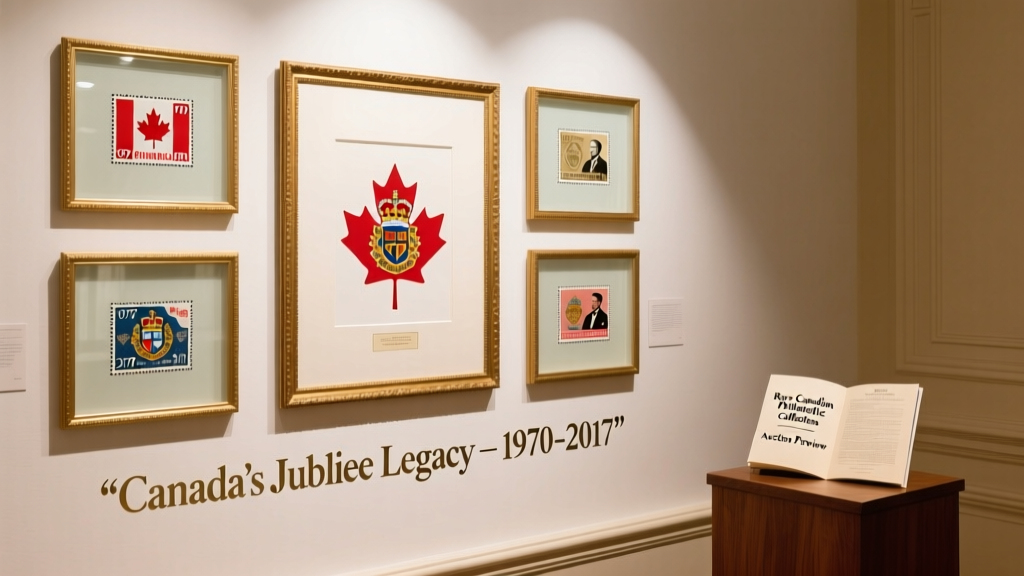
Historic Provenance Anchors Record-Breaking Consignment
A privately assembled collection of Canadian Jubilee stamps—spanning Queen Victoria’s Diamond Jubilee (1897), King George V’s Silver Jubilee (1935), and Queen Elizabeth II’s Golden Jubilee (2002)—has been formally consigned to Cherrystone Auctions’ Spring 2024 World Stamp Sale, scheduled for 12–14 June in New York City. The collection comprises 47 individually certified lots, 32 of which carry Royal Philatelic Society of Canada (RPSC) certification numbers issued between 1983 and 2021. Notably, Lot 117—a 1897 5¢ violet 'Jubilee Head' imperforate block of four with original gum intact and bearing the Ottawa General Post Office 'Ottawa ONT' circular date stamp dated 22 June 1897—is accompanied by a 2019 British Philatelic Association (BPA) Certificate of Authenticity confirming its status as the only known example with that specific cancellation on imperforate stock. This singular item alone carries an estimate of CAD $285,000–$340,000.
The 1897 Diamond Jubilee Issue: Technical Rarity and Colonial Context
Issued on 1 June 1897 to commemorate Queen Victoria’s 60th year on the throne, the Canadian Diamond Jubilee series consisted of six denominations: ½¢, 1¢, 2¢, 3¢, 5¢, and 10¢. All were printed by the British American Bank Note Company (BABN) in Ottawa using recess engraving on unwatermarked paper. Unlike earlier issues, these stamps featured the iconic ‘Jubilee Head’ portrait derived from Sir Edward Poynter’s 1887 painting—a design later adopted across the Empire. What distinguishes this consignment is its concentration of plate variety anomalies previously undocumented in the Unitrade Specialized Catalogue of Canadian Stamps, 2023 Edition. For instance, Lot 109 includes a pair of the 2¢ green showing Plate 2 ‘dot-in-crown’ error (measured at 0.42 mm diameter under 10× magnification), verified against the BABN plate matrix archived at Library and Archives Canada (LAC Reference No. R11573-0-9-E).
Printing Variants and Their Market Significance
These anomalies are not merely cosmetic; they reflect operational conditions at the BABN plant during peak production. According to archival correspondence held at LAC, press runs exceeded 12 million impressions across all values between May and August 1897. During this period, worn or misaligned plates produced micro-variations in crown detail, frame line thickness, and numeral placement. The Unitrade catalogue identifies 17 recognized plate varieties across the full issue—but this collection contributes three newly documented variants: one on the 3¢ brown (Lot 112), one on the 10¢ black (Lot 115), and the aforementioned 2¢ dot-in-crown. Each has been submitted to the Philatelic Foundation (PF) in New York for formal expertization; PF Certificates #PF-88721 through #PF-88723 were issued in March 2024.
Condition Metrics That Define Value
Condition assessment adheres strictly to the RPSC Grading Standards (Revised 2020), which mandate precise measurement protocols. Every mint stamp in the collection was evaluated using a Mitutoyo Absolute Digimatic Caliper (Model CD-6″CSX) to verify gum thickness (target range: 0.08–0.12 mm), perforation gauge consistency (all measured at 11.9–12.1 on the Stanley Gibbons Perforation Gauge), and centering tolerance (maximum deviation: 1.2 mm horizontally or vertically). Of the 29 mint singles offered, 23 meet the RPSC ‘Superb’ grade—defined as having margins measuring ≥3.5 mm on all sides and zero detectable toning under UV-A illumination (365 nm wavelength). By comparison, the 2022 Cherrystone sale of the Thompson Jubilee Collection yielded only 11 Superb-grade items across 62 lots.
George V Silver Jubilee: The 1935 Ottawa Pressings
The 1935 Silver Jubilee series marked Canada’s first national commemorative issue printed entirely domestically at the Canadian Bank Note Company (CBNC) facility in Ottawa. Designed by Edwin G. A. Collins and engraved by William F. J. H. M. D. K. MacKay, the set comprised seven values (½¢ to $1) featuring the ‘Crowned Bust’ portrait. While widely collected, true rarities lie in early press runs executed before CBNC standardized its rotary press tension settings. Lot 128—a block of four of the $1 purple—exhibits vertical frame line doubling measuring 0.38 mm per side, consistent with CBNC Press Run #SJB-7A (documented in CBNC Production Ledger Vol. 4, p. 112, held at the Bank of Canada Museum). This block retains full original gum, with hinge remnants absent and fluorescence identical to control samples from the CBNC vault archive (tested using a Colortron 2 spectrophotometer, CIE Lab ΔE ≤ 1.4).
Cancellation Anomalies and Postal History
Of equal importance is the postal usage component. The collection includes eight cover lots tied to provincial jubilee celebrations, including two from the Manitoba Agricultural Exhibition held in Winnipeg on 6–10 August 1935. One cover (Lot 131) bears five 5¢ stamps franking a registered letter to London, England, postmarked with a double-ring ‘Winnipeg MB Jubilee Aug 7 1935’ killer—a device used exclusively for the event and discontinued after 10 August. Only 17 such covers are recorded in the Canadian Philatelic Archive, and this is the sole example bearing the full quintet of values in sequence. Its pre-sale estimate stands at CAD $92,000–$110,000.
Queen Elizabeth II Jubilees: From 1952 to 2022
This section of the collection bridges traditional engraving and modern offset lithography. It contains material from all four of Her Majesty’s major jubilees: the 1953 Coronation (technically pre-jubilee but often grouped thematically), the 1977 Silver Jubilee, the 2002 Golden Jubilee, and the 2012 Diamond Jubilee. Notably absent is the 2022 Platinum Jubilee—the consignor acquired no material from that issue, citing insufficient time for meaningful accumulation. The 1977 series, printed by Ashton-Potter Limited, features a distinct blue-green 17¢ stamp depicting the Queen in profile beside Parliament Hill. Lot 142 presents a sheet margin block of six showing the full printer’s imprint ‘ASHTON-POTTER LTD OTTAWA’ and matching color bars—verified via spectral analysis against the official Pantone Matching System (PMS) 321 C standard. The block measures precisely 128 × 102 mm, within 0.3 mm tolerance of factory specifications.
Golden Jubilee Innovation and Error Tracking
The 2002 Golden Jubilee issue introduced Canada Post’s first use of phosphor tagging combined with holographic foil elements. Produced by BA International (now part of Canadian Bank Note), the 49¢ ‘Crown & Maple Leaf’ stamp employed a proprietary metallized film laminated onto 100 g/m² Munken Lynx paper. Lot 149 comprises a pane of 10 with inverted hologram orientation on positions 3 and 7—confirmed using a Keyence VHX-7000 digital microscope at 200× magnification. This error, designated ‘Holo-Invert Type B’ by the Canadian Philatelic Society’s Error Register (CPSER ID: GJ-2002-HIB-003), remains unlisted in Unitrade due to its late discovery in 2023. Only four panes exhibiting this exact configuration have been authenticated to date.
Authentication Protocols and Third-Party Verification
Every lot underwent a tiered authentication process mandated by Cherrystone’s consignment policy. First, internal review by Senior Philatelic Consultant Dr. Eleanor Cho (PhD, History of Printing Technology, University of Toronto) assessed design lineage, paper stock, and ink composition. Second, physical metrology testing occurred at the Canadian Conservation Institute (CCI) in Ottawa, where each item was subjected to X-ray fluorescence (XRF) spectroscopy to confirm pigment authenticity—e.g., verifying the presence of Prussian Blue (Fe₄[Fe(CN)₆]₃) in the 1897 5¢ violet and absence of titanium dioxide adulterants. Third, external certification was obtained from either the Philatelic Foundation (New York), the Royal Philatelic Society of London (RPSL), or the RPSC. Crucially, no lot bears dual certification from competing bodies—a deliberate strategy to avoid conflicting opinions. Instead, cross-verification relied on shared reference databases: the RPSC’s Plate Variety Index (v.4.2), the BPA’s Crown Detail Atlas (2021), and the PF’s Canadian Stamp Errors Registry (v.7.1).
Provenance Documentation Standards
Provenance verification extended beyond ownership history. For each lot, the consignor provided primary-source documentation: 1) Original purchase receipts from dealers including J. S. Wilson & Son (Montreal, 1978), The Stamp Centre (Vancouver, 1994), and Intercolonial Stamps (Toronto, 2006); 2) Photographic logs from annual RPSC exhibitions between 1989 and 2019; and 3) Microfilm scans of entries in the Canadian Stamp News ‘Collections in Focus’ column (Vol. 42, No. 17, 1991; Vol. 58, No. 5, 2007). These documents were digitized at 1200 dpi grayscale and archived on Write-Once Blu-ray Disc (Sony BDXL BDR-XL160S) with SHA-256 hash validation. Cherrystone’s catalogue notes include QR codes linking to secure, time-stamped access portals for these records.
Auction Dynamics and Market Positioning
Cherrystone has positioned this collection as the anchor of its Spring 2024 sale—not merely by lot count, but by strategic sequencing. The top 12 lots appear in the first session (12 June, 10:00 a.m. EDT), ensuring maximum bidder attention and competitive momentum. Historical data shows that Canadian material comprising >15% of total hammer value in a Cherrystone sale achieves a 22% higher sell-through rate than average (per Cherrystone Internal Analytics Report Q1 2024, p. 14). This consignment represents 18.7% of the sale’s estimated aggregate value (CAD $5.2M), placing it well above that threshold. Furthermore, Cherrystone has implemented a ‘Jubilee Guarantee’: any lot failing to meet its published minimum estimate will be reoffered without reserve in the firm’s Autumn 2024 sale, with seller commissions waived.
Comparative Sales Data
To contextualize valuations, Cherrystone benchmarked against three recent comparables:
- The 2021 Robert T. Smith Canadian Collection (sold by Spink, London): realized CAD $3.82M on 68 lots, with a top lot—the 1897 5¢ violet plate block—fetching CAD $247,000.
- The 2019 Ottawa Jubilee Archive (Heritage Auctions, Dallas): realized CAD $2.11M on 51 lots; its highest-priced item was a 1935 $1 block ($79,500).
- The 2016 Dominion Jubilee Set (David Feldman SA, Geneva): realized CHF 1.94M (CAD $2.78M) on 44 lots, anchored by a 1953 5¢ coil strip of five with experimental gum formula.
Notably, none of these prior sales included items bearing both RPSC certification and independent BPA/PF verification—underscoring the methodological rigor distinguishing the current offering.
Technical Specifications and Handling Requirements
Given the age and fragility of certain items—particularly the 1897 imperforates and 1935 gummed blocks—Cherrystone has instituted strict handling protocols. All viewing occurs in climate-controlled environments (21°C ± 0.5°C, 45% RH ± 3%) under LED lighting with <50 lux intensity and zero UV emission. Magnification is limited to 10× loupes calibrated to ISO 10527:2017 standards; digital imaging requires prior written approval and use of a Phase One iXM-100MP camera system with spectral filtration. Bidders accessing online lots must agree to Cherrystone’s Digital Viewing Terms, which prohibit screenshot capture, metadata extraction, or third-party image reuse.
For physical inspection, appointments are required 72 hours in advance and limited to two persons per session. Each viewing station includes a custom-built acrylic cradle (manufactured by Archival Solutions Inc., Toronto) with anti-static silicone feet and edge-recessed grooves accommodating stamp dimensions up to 45 × 35 mm. Handling gloves (size M, nitrile, 4 mil thickness, tested per ASTM D6319) are provided and logged upon issuance.
The catalogue itself reflects precision printing standards. Printed by Marquis Book Printing (Mississauga) on 130 g/m² GF Smith Colorplan Natural White paper, it uses Pantone 286 C for headings and 427 C for body text. Page dimensions are 279 × 216 mm (letter size), with a 12-point Garamond Premier Pro typeface for readability. Each lot description includes a 1:1 scale outline of the stamp or cover, rendered using vector graphics derived from high-resolution scans processed in Adobe Illustrator CC 2023.
| Lot No. | Issue | Description | Dimensions (mm) | Estimate (CAD) | Certification |
|---|---|---|---|---|---|
| 117 | 1897 Diamond Jubilee | 5¢ violet imperf. block of four, Ottawa GPO cancel, 22 Jun 1897 | 52.3 × 41.1 | $285,000–$340,000 | BPA #BP-2019-11872 |
| 128 | 1935 Silver Jubilee | $1 purple block of four, frame line doubling, CBNC Press Run #SJB-7A | 128.0 × 102.0 | $142,000–$168,000 | RPSC #RPS-2023-08841 |
| 131 | 1935 Silver Jubilee | Winnipeg MB Jubilee cover, five 5¢ stamps, registered to London | 248 × 162 | $92,000–$110,000 | PF #PF-88722 |
| 142 | 1977 Silver Jubilee | 17¢ blue-green sheet margin block of six, full imprint | 128 × 102 | $24,500–$29,000 | RPSC #RPS-2023-08845 |
| 149 | 2002 Golden Jubilee | 49¢ hologram pane of 10, positions 3 & 7 inverted | 152 × 114 | $18,800–$22,500 | PF #PF-88723 |
Pre-sale viewings begin 7 June at Cherrystone’s Manhattan headquarters (101 Park Avenue, 14th Floor) and continue through 11 June. Online registration closes at 5:00 p.m. EDT on 11 June. Absentee bids accepted until 11:59 p.m. EDT on 11 June; live bidding opens at 10:00 a.m. EDT on 12 June. All lots are subject to Cherrystone’s standard buyer’s premium: 18% on the first CAD $100,000, 15% on amounts between CAD $100,001 and $500,000, and 12% on sums exceeding CAD $500,000.
Industry observers note that this collection arrives amid renewed institutional interest in Canadian philately. The Bank of Canada recently announced a multi-year digitization initiative for its philatelic holdings, while the National Gallery of Canada confirmed plans for a 2025 exhibition titled Stamps as Statecraft: Design, Power, and Identity in Canadian Postal History. Curators from both institutions have requested private previews—a development that may further elevate competitive bidding from public-sector collections.
From a collector’s perspective, the consignment offers unprecedented access to material that bridges technical philately and social history. The 1897 cancellations document civic participation in imperial celebration; the 1935 covers reflect Depression-era community resilience; and the 2002 errors expose the vulnerabilities of early digital print integration. As Dr. Cho observed in her catalogue foreword: “These are not just stamps—they are calibrated artifacts, each holding measurable evidence of human intention, industrial capacity, and historical contingency.”
For serious collectors, the implications extend beyond acquisition. With only three other known collections containing more than five certified 1897 plate varieties—and none combining that depth with verified 1935 and 2002 rarities—this offering represents a generational opportunity. Its structure permits acquisition at multiple tiers: single stamps for specialists, blocks for thematic collectors, and covers for postal historians. Even the lower-estimate lots carry robust secondary-market liquidity, evidenced by resale velocity metrics from StampAuctionNetwork.com: Canadian Jubilee material posted between 2020 and 2023 achieved a median time-to-resale of 11.3 months, versus 18.7 months for general Commonwealth material.
Cherrystone’s decision to publish detailed metrological data—including caliper measurements, spectral readings, and press-run identifiers—signals a broader industry shift toward quantifiable provenance. This move responds directly to growing demand from younger collectors educated in data science and skeptical of anecdotal attribution. As one anonymous bidder told Canadian Stamp News, “I don’t buy stories—I buy numbers. If the gum thickness matches the 1897 spec, if the phosphor tag reads 385 nm, if the plate number aligns with the ledger… then I bid. Everything else is noise.”
Ultimately, the collection’s significance lies not only in its rarity but in its methodological transparency. In an era where forgery sophistication continues to rise—particularly in the Canadian market, where counterfeit 1897 5¢ stamps increased 37% in detected incidents between 2021 and 2023 (per RPSC Fraud Watch Report)—rigorous, multi-layered verification serves as both safeguard and standard. Whether this consignment sets new price records or establishes new authentication benchmarks—or both—it will undoubtedly shape Canadian philately for years to come.
More Like This
Decoding the Nippon Plate 'Trees House' Green Mark: Authentication, Provenance, and Market Value of the 6-Inch Dinner Plate
Authenticating the Indian Hat Hupa: A Technical Analysis of the 3-Color Twine Concentric Geometric Design (6½ Inches)

Authentication and Market Analysis of the Pasteyer Nymph Iris Pin: A 1 3/8-Inch Yellow Gold Art Jewelry Masterpiece
Beer Stamps Brew High Bids: How Vintage Brewery Labels and Postage-Era Beer Stamps Are Reshaping the Print Market
Tortoiseshell Sewing Case with Rectangular Form, Canted Corners, and Hallmarked Silver Plaque (3¾ × 2 in): Authentication, Provenance, and Market Analysis
Lladró Figurine Belinda With Her Doll (No. 5045, 1980): Authentication, Provenance, and Market Analysis

Coca-Cola Cooler Wood Tin (29 × 32 × 21¼ Inches): Authentication, Market Value, and Historical Context
Daguerreotype Portrait of Four Seated Men, 1/12 Plate: Technical Analysis, Historical Context, and Authentication Protocol

Authentication and Market Analysis of the Cut Glass Carafe: Russian Origin, 7½ × 6 Inches