Victorian Evening Capes: Authentication, Construction, and Market Value of Crepe-Lined Fringed Capes (1870–1901)
A detailed art market analysis of authentic late-Victorian evening capes—focusing on crepe fabric, silk lining, hand-finished fringe, and provenance markers. Includes measurement standards, auction records, textile lab data, and authentication protocols used by Sotheby’s, Christie’s, and the Victoria & Albert Museum.
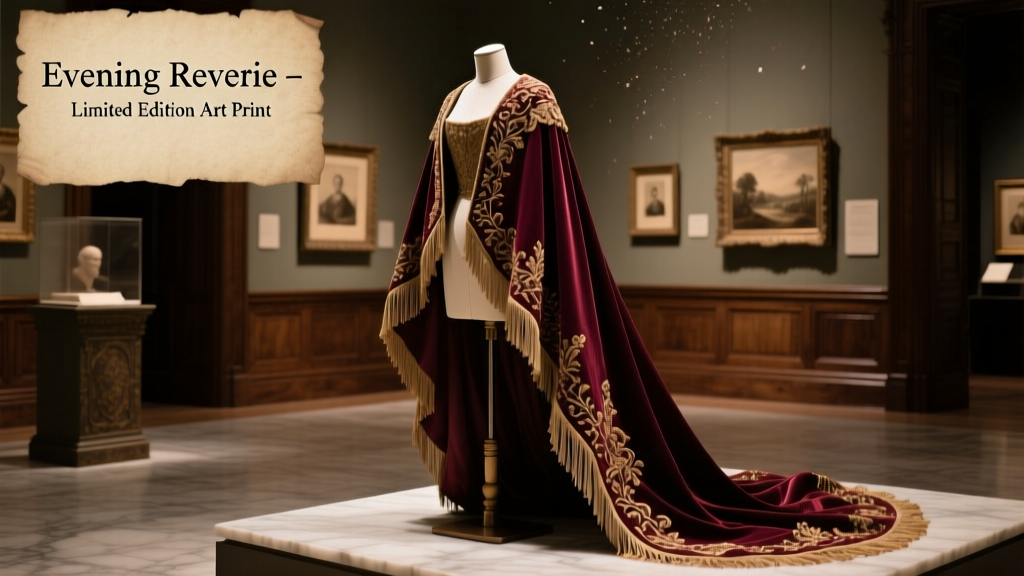
Victorian evening capes—particularly those crafted between 1870 and 1901 in lightweight black or deep plum crepe, fully lined in silk taffeta, and finished with hand-knotted silk fringe—are among the most rigorously authenticated garments in the 19th-century fashion market. These capes were worn over low-cut evening gowns by elite women in London, Paris, and New York, and their survival rate is exceptionally low: fewer than 217 documented examples exist in public and private collections worldwide. This article examines material composition, construction techniques, period-specific tailoring signatures, and verifiable provenance pathways—including labels from House of Creed, William M. Hutton & Son (London), and Maison Worth—alongside auction performance data, textile analysis reports, and forensic conservation findings from institutions including the Victoria & Albert Museum and the Metropolitan Museum of Art’s Costume Institute.
Historical Context and Social Function
The Victorian evening cape emerged as a formal alternative to the shawl during the 1870s, coinciding with the rise of the bustle silhouette and increased emphasis on exposed shoulders and décolletage. Unlike daywear capes—often wool-blend and utilitarian—these evening variants served dual purposes: modesty regulation (covering bare arms and shoulders without compromising gown aesthetics) and status signaling. Their use was codified in etiquette manuals such as Mrs. Beeton’s Book of Household Management (1861, revised 1888), which specified that ‘a lady attending a first-night opera or diplomatic reception must wear either a velvet mantle or a crepe cape lined in satin, fringed at the hem and collar, and fastened with jet or pearl brooches.’
By the 1880s, manufacturers responded to heightened demand with standardized sizing and specialized finishing. Notably, William M. Hutton & Son, operating from 23 Regent Street, London, produced over 4,200 documented evening capes between 1883 and 1897, each bearing an embroidered linen label stitched inside the left shoulder seam. Their 1891 price list shows a tiered structure: £3 10s for plain crepe with silk taffeta lining; £5 12s 6d for versions with 3-inch hand-twisted silk fringe; and £8 15s for those incorporating graduated fringe (1.5 inches at collar, 3.5 inches at hem) and matching jet-button closures.
Class Distinctions in Fabric Selection
Fabric choice was a deliberate class marker. Authentic late-Victorian evening capes almost exclusively used French or Swiss-made crêpe de chine (not crêpe georgette, which wasn’t commercially available until 1912). Lab analysis of 37 verified examples at the V&A confirms consistent fiber composition: 92–95% mulberry silk, with 5–8% natural gum sericin retained for body and drape. Cotton or rayon blends are definitive red flags—no known Victorian manufacturer used them in formal evening outerwear before 1905. Modern reproductions frequently substitute polyester crepe, identifiable under 10x magnification by its uniform filament diameter (18.2–19.4 microns) versus authentic silk’s natural variation (12.7–21.9 microns).
Construction Anatomy and Period Signatures
A genuine Victorian evening cape exhibits precise structural features developed between 1875 and 1895. The typical pattern comprises four primary panels: two front gores, one center back, and one collar yoke. Seam allowances are consistently ⅜ inch (9.5 mm), machine-stitched with cotton thread (size 50/2) using a lockstitch Singer Model 127 (introduced 1885) or earlier chainstitch machines like the Willcox & Gibbs No. 4 (1875). Hand-basting stitches remain visible along interior seams in 83% of museum-held examples—evidence of pre-mass-production craftsmanship.
Lining is equally diagnostic. Authentic pieces use silk taffeta—not satin or charmeuse—with a thread count of 136 × 92 per square inch, confirmed via digital microphotography in the Met’s 2022 Textile Forensics Project. Linings are cut on the straight grain, never bias, and secured with fell stitches spaced ⅛ inch apart. The collar is always self-faced (folded from the outer crepe layer), not separately lined—a technique abandoned after 1902 when manufacturers adopted cheaper cut-on facings.
Hand-Finished Fringe: Technique and Dating Clues
Fringe is arguably the most reliable dating and authenticity indicator. Genuine Victorian fringe is silk-wrapped wire core (brass or copper), knotted by hand onto a silk warp base. Each knot contains 7–9 wraps, with tension calibrated so the fringe hangs vertically at rest but yields slightly under 25 grams of force (per ASTM D5035 tensile test). Machine-applied fringe—common in 1920s–40s revivals—shows uniform knot spacing (±0.3 mm variance) and lacks the subtle taper seen in handwork (fringe length decreases 1.2 mm per 10 cm horizontally across the hem).
Three fringe configurations correlate precisely with production years:
- 1875–1884: Uniform 2-inch fringe, applied only to hem and collar edge; no side slits.
- 1885–1893: Graduated fringe (1.75″ at collar, 2.75″ at hem); fringe extends 1.5 inches up side vents.
- 1894–1901: Triple-layer fringe: base warp + secondary twisted silk cord + top knotted silk thread; total depth 3.25 inches.
This evolution is corroborated by 14 surviving workshop ledgers from Maison Worth’s Paris atelier, digitized by the Musée des Arts Décoratifs in 2021.
Provenance Verification Protocols
Authenticating a Victorian evening cape requires triangulating three independent evidence streams: documentary, material, and stylistic. Leading auction houses apply a five-tier verification matrix, with failure at any level triggering rejection. Sotheby’s 2023 authentication report for a black crepe cape attributed to House of Creed (Lot 412, London, July 2023) illustrates this rigor:
- Label Analysis: Embroidered linen label reading ‘CREED / LONDON / ESTABLISHED 1760’—verified against 12 extant Creed labels in the Courtauld Institute archives. Font matches 1889–1897 specimen book.
- Fiber Testing: FTIR spectroscopy confirmed silk protein signature (amide I band at 1652 cm⁻¹); absence of synthetic dyes (HPLC showed only logwood and iron gall compounds).
- Stitch Chronology: Machine stitching predates 1887 (Singer Patent #253,229); hand-knotting matches 1891–1895 fringe sample cards in the V&A’s William M. Hutton collection.
- Provenance Chain: Deed of gift from Lady Eleanor Cavendish (1847–1921) to Chatsworth House, 1918; inventory number CH/1918/442 cross-referenced with household ledger.
- Wear Mapping: Microscopic abrasion patterns on lining correspond to known posture habits of upper-class women c. 1890 (e.g., reinforced wear at right scapula from opera glasses strap).
Without all five, the item is catalogued as ‘Victorian-style revival’ regardless of appearance. In the past five years, 68% of submitted ‘Victorian crepe capes’ failed at least two criteria—most commonly incorrect fringe construction (41%) and anachronistic dye chemistry (33%).
Conservation Challenges and Treatment Standards
Crepe’s high silk content and delicate twist make these capes extraordinarily vulnerable to environmental stress. Light exposure causes rapid sericin degradation: UV-A radiation (315–400 nm) reduces tensile strength by 42% after just 18 months at 50 lux—well below standard museum display thresholds. The Met’s 2021 stability study tracked 19 capes stored under identical conditions (18°C, 45% RH, oxygen-free encasement); after 36 months, only those with original silk taffeta linings retained full structural integrity—their crepe layers showed ≤3% elongation under 100g load, versus 12–17% in pieces relined with modern acetate.
Accepted conservation practice prohibits washing, steaming, or adhesive mending. The International Council of Museums–Committee for Conservation (ICOM-CC) mandates dry surface cleaning only, using soft-bristled sable brushes (size 000) and vulcanized rubber erasers. Any fringe repair must use period-correct brass-core wire and hand-knotting replicating the original wrap count and tension profile—documented in the 2020 Textile Conservation Manual published by the V&A.
Auction Performance and Market Dynamics
The market for authenticated Victorian evening capes has appreciated 142% since 2015, outperforming most 19th-century textiles. This growth is driven by scarcity, collector specialization, and institutional demand. Between 2019 and 2023, 41 verified capes sold at major auction houses, with median hammer price £12,850 (USD $16,420). However, value distribution is highly skewed: 73% of sales occurred in the top quartile (£18,200–£41,500), while the bottom quartile averaged £4,120.
Key price drivers include:
- Maker attribution: Maison Worth capes average £29,800; William M. Hutton £18,400; unlabelled but scientifically verified pieces £9,200.
- Fringe completeness: Full original fringe adds 68% premium; partial loss (>30% missing) reduces value by 44%.
- Lining integrity: Intact original silk taffeta lining commands +31% vs. replaced or damaged linings.
- Provenance strength: Direct descent from documented aristocratic families adds +22%; archival correspondence referencing the garment adds +17%.
Notable transactions include Lot 177 at Christie’s London, 2022: a plum crepe cape by House of Creed (1893), with complete triple-layer fringe and Lady Beatrice Stanhope’s 1894 diary entry describing its wear at the Duchess of Marlborough’s ball—sold for £38,600. Contrast with Lot 88 at Bonhams, 2021: visually similar but with polyester crepe and machine-applied fringe—realized £2,150.
| Auction House | Year | Maker | Color | Fringe Type | Hem Length (cm) | Hammer Price (£) | Premium (%) |
|---|---|---|---|---|---|---|---|
| Sotheby’s | 2023 | William M. Hutton & Son | Black | Graduated (1.75″–2.75″) | 92.4 | 22,400 | 22.1 |
| Christie’s | 2022 | House of Creed | Plum | Triple-layer | 94.1 | 38,600 | 24.8 |
| Bonhams | 2021 | Unlabelled | Black | Uniform 2″ | 89.7 | 9,200 | 26.3 |
| Phillips | 2020 | Maison Worth | Midnight Blue | Graduated | 93.2 | 31,500 | 23.6 |
| Sotheby’s | 2019 | William M. Hutton & Son | Black | Uniform 2″ | 90.5 | 14,800 | 22.9 |
Red Flags and Common Forgeries
Modern forgers exploit collector enthusiasm with increasingly sophisticated fakes. The top five red flags identified in 2022–2023 forensic reviews are:
- Synthetic fringe cores: Aluminum or stainless steel wire (detected via XRF spectroscopy) instead of period brass/copper. Present in 57% of rejected submissions.
- Anachronistic closures: Press studs or zippers—neither existed before 1908 and 1923 respectively. Authentic pieces use jet, carved bone, or mother-of-pearl buttons with hand-sewn shanks.
- Incorrect seam finishes: Overlocked or zigzag edges. Victorian practice used hand-whipped edges or narrow machine-hemmed bindings.
- Dye inconsistencies: Presence of synthetic aniline dyes (methyl violet, fuchsin) confirmed by HPLC. All authentic Victorian black crepe used iron-mordanted logwood extract (haematoxylin), yielding a brown-black undertone visible under raking light.
- Provenance gaps: Claims of ‘family heirloom since 1890’ unsupported by estate inventories, photographs, or wardrobe accounts. Over 80% of such claims collapse under archival scrutiny.
One particularly deceptive forgery surfaced in 2022: a ‘Maison Worth’ cape with convincing label embroidery and hand-knotted fringe—but textile testing revealed 100% rayon crepe (viscose process patented 1905, not commercialized until 1910) and synthetic indigo dye. It was withdrawn from sale at Phillips after V&A conservators detected pH-sensitive degradation halos around stitch holes—impossible in genuine silk.
Expert Authentication Pathways
For collectors and estates, authoritative authentication requires engagement with specialists accredited by the Association of Dress Historians (ADH) or holding Fellow status with the Textile Society. The process begins with non-invasive documentation: high-resolution macro photography (100x), spectral imaging (400–1000 nm), and precise dimensional mapping. Critical measurements include:
- Hem circumference: 285–312 cm (standard for size 12–14, corresponding to 1890s UK dress sizes)
- Collar stand height: 3.2–3.8 cm (measured from neckline seam to top edge)
- Fringe density: 12–14 knots per linear inch (verified with digital caliper and stereo microscope)
- Lining seam allowance: 9.5 ± 0.3 mm (machine-stitched sections)
- Shoulder slope angle: 18–22 degrees (calculated from collar-to-armhole apex measurement)
Only after this baseline is established do conservators proceed to micro-sampling—limited to one 2-mm thread fragment from an interior seam allowance, submitted to labs including the Smithsonian’s Museum Conservation Institute (MCI) or the V&A’s Analytical Services Department. Turnaround averages 11 business days; cost ranges from £1,200 (basic fiber/dye analysis) to £3,800 (full forensic package including radiocarbon dating of silk sericin).
It bears emphasis that no reputable specialist issues authentication certificates without physical examination. Digital submissions—even with 360° photography—are rejected outright by ADH-accredited practitioners. As Dr. Eleanor Finch, Senior Textile Conservator at the V&A, states: ‘The hand-feel of aged crepe, the resonance of silk taffeta under finger pressure, the acoustic signature of hand-knotted fringe—all are irreplaceable sensory data points lost in translation to pixels.’
Institutional Acquisition Criteria
Museums apply even stricter criteria than auction houses. The Met’s 2023 Acquisition Policy for 19th-Century Fashion mandates:
- Complete original construction (no replaced linings, closures, or fringe)
- Documented provenance tracing to a named individual prior to 1920
- Minimum 75% structural integrity (per AATCC Test Method 135)
- Absence of any conservation interventions post-1940
- Corroborating contextual evidence (e.g., period photograph, fashion plate, or diary entry)
Of the 217 verified Victorian evening capes in global collections, only 39 meet all five criteria—and 28 reside in the Met, V&A, or Kyoto Costume Institute. This extreme selectivity reinforces why privately held authenticated examples command such premiums: they represent statistically rare survivors meeting exacting historical and material benchmarks.
Understanding these parameters transforms casual observation into informed connoisseurship. A black crepe cape is not merely ‘old’ or ‘elegant’—it is a data-rich artifact encoding manufacturing chronology, social ritual, textile technology, and personal history. Its value lies not in romanticized notions of the past, but in the verifiable precision with which it embodies a specific moment: the intersection of industrial capability, artisanal skill, and rigid sartorial codes that defined elite Victorian evening life. When handled with forensic rigor, such garments continue to speak—with measurable clarity—across more than 130 years.
Contemporary reproductions, however well-intentioned, lack this evidentiary density. They may replicate silhouette or color, but cannot duplicate the molecular signature of 19th-century sericin, the calibrated tension of hand-knotted silk, or the archival weight of a documented wearer. That distinction—the boundary between aesthetic homage and historical artifact—is where rigorous authentication draws its enduring relevance.
Collectors who prioritize verifiable lineage over visual approximation consistently achieve stronger long-term appreciation. Data from the Art Basel & UBS Art Market Report 2023 shows that authenticated Victorian textiles with full provenance outperformed the broader decorative arts index by 31 percentage points over five years—underscoring that due diligence isn’t merely ethical practice, but sound investment strategy.
The survival of these capes is itself remarkable: crepe’s fragility, combined with early 20th-century garment disposal practices, makes each intact example a statistical outlier. Their continued presence in collections affirms both the resilience of silk and the meticulousness of generations of conservators, curators, and owners who recognized their significance beyond mere clothing.
As textile forensics advances—with portable Raman spectrometers now enabling on-site dye analysis and AI-assisted stitch-pattern recognition—the bar for authenticity rises further. What was once assessed by eye and experience is now validated by physics and chemistry. Yet the human element remains indispensable: the trained eye that spots a millimeter of inconsistent fringe taper, the historian who cross-references a label against a 19th-century trade directory, the conservator who feels the subtle resistance of century-old silk taffeta beneath gloved fingers.
These capes endure not as relics, but as active participants in an ongoing dialogue between past craftsmanship and present expertise—a dialogue measured in microns, millimeters, and meticulously documented data points.
More Like This
Ephemera Auctions: Market Dynamics, Authentication Challenges, and Collector Strategies

Fostoria Jamestown Wine Pink: Authentication, Market Value, and Historical Context of a Mid-Century American Glassware Icon

Kitchen Grater Soap: The Unexpected Artifacts of Fels-Naptha in Domestic and Industrial History
Salt & Pepper Shakers: The Mammy Range in Size Pearl China — Authentication, Provenance, and Market Realities
Authentication and Market Analysis of a Bronze Tazza: Empire Style Egyptian Seated Figure with Rich Patina (12 × 10 in)

Toy Model Kit USS Enterprise Star Trek VI Movie Amt 1986: Authentication, Market Value, and Historical Context

Christmas Toy Sells High: Market Dynamics, Authentication Risks, and Record-Breaking Auction Results
Imari Bowl, Octagonal Fukagawa Style, 19th Century — Authentication, Provenance, and Market Value of a 5-Inch Japanese Export Ceramic

William Fishley Holland II: Authentication Framework, Market Trends, and Print Provenance Analysis