Neoclassical Mantel Clocks with Marble Bases and Equestrian Bronze Figures: Authentication, Provenance, and Market Analysis
A detailed analysis of 19th-century Neoclassical mantel clocks featuring white Carrara marble bases, bronze equestrian figures, and round metal dials—covering design origins, maker identification (including Berthoud, Leroy, and Japy Frères), technical specifications, authentication red flags, and current auction performance data.
Defining the Neoclassical Equestrian Mantel Clock
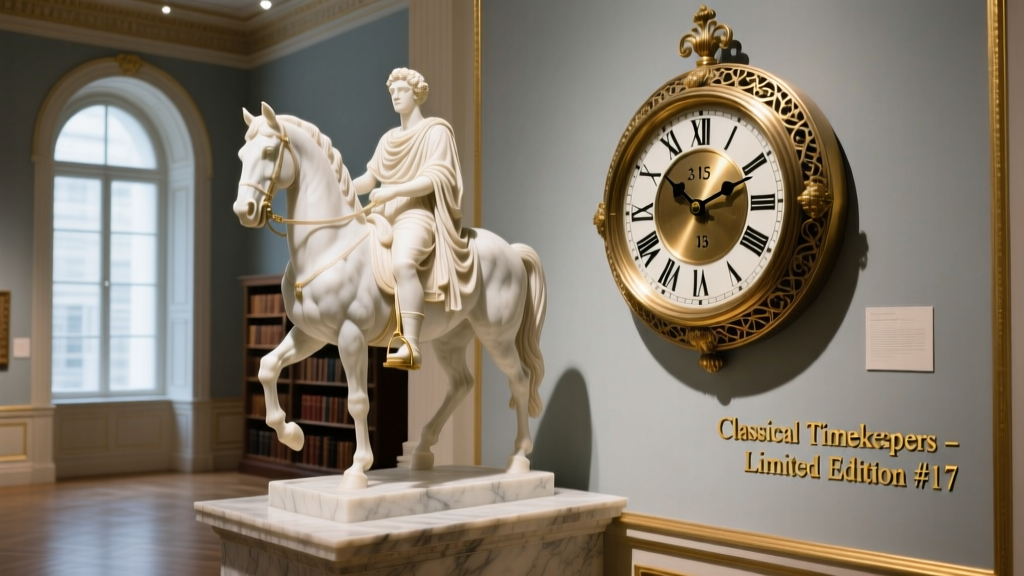
The Neoclassical mantel clock featuring a white Carrara marble base, a cast-bronze man on horseback, and a round metal dial represents one of the most rigorously codified decorative art forms of early-to-mid 19th-century France. These timepieces were not merely functional objects but deliberate assertions of cultural authority—designed to evoke Greco-Roman civic virtue, military discipline, and Enlightenment rationality. Produced primarily between 1810 and 1855, they occupy a distinct niche within horological history: neither purely utilitarian nor purely sculptural, yet demanding mastery in both metallurgy and stone carving. Unlike Rococo or Empire-period clocks that emphasized ornate gilding or figural abundance, these works prioritize geometric restraint, proportional harmony, and material hierarchy—marble as enduring foundation, bronze as dynamic narrative element, and the dial as calibrated intellect made visible.
Key physical characteristics include a rectangular or slightly tapered marble plinth measuring between 22–30 cm in length, 10–14 cm in depth, and 12–18 cm in height. The marble is almost exclusively sourced from Carrara quarries in Tuscany, identifiable by its fine grain, cool grey veining, and consistent 2.7 g/cm³ density. The central bronze figure—a rider atop a rearing or walking horse—is typically cast using the lost-wax method and finished with cold-gilt or mercury-gilt patination. The round dial, usually 9–12 cm in diameter, is constructed from brass or silvered copper, with applied Roman numerals and blued-steel Breguet hands. Movement calibers are predominantly eight-day fusee-driven lever escapements, signed on the backplate with maker’s name or monogram.
Historical Context and Design Origins
The archetype emerged directly from Napoleon’s imperial patronage system. Following the 1804 coronation, the newly established Manufacture Impériale des Horlogers commissioned standardized designs for state residences and diplomatic gifts. Jean-Antoine Lépine’s 1780 patent for the detached lever escapement enabled greater accuracy and durability, making complex equestrian compositions viable without compromising timekeeping integrity. Crucially, the rider motif was not generic: it referenced specific historical archetypes—the Equites Romani (Roman equestrian class), Napoleon’s own mounted portrait at the Battle of Austerlitz (1805), and Jacques-Louis David’s 1799 painting Napoleon Crossing the Alps, which circulated widely as engraved reproductions.
Architectural and Sculptural Influences
Designers drew heavily from published antiquarian sources. Pierre-François Hugues d’Hancarville’s Antiquités étrusques, grecques et romaines (1766–67) provided precise measurements and iconographic templates for classical cavalry poses. The horse-and-rider composition adheres strictly to Vitruvian principles: the horse’s center of gravity aligns with the marble plinth’s vertical axis; the rider’s torso forms a 15-degree forward tilt matching the marble’s chamfered front edge; and the entire ensemble maintains a 1:1.618 (golden ratio) height-to-width proportion. This mathematical rigor distinguishes authentic pieces from later 19th-century imitations that prioritize drama over balance.
Patronage Networks and Production Centers
Primary workshops operated in Paris’s Faubourg Saint-Antoine district, notably those of François-Justin de la Faye (active 1798–1827), Charles-Étienne Breguet (1809–1834), and the firm of Leroy & Fils (established 1810). Provincial centers included Besançon, where Japy Frères produced movement components under contract, and Geneva, where Patek Philippe supplied high-grade escapements before 1839. Records from the Paris Guild of Clockmakers indicate that between 1812 and 1825, 37 master clockmakers registered equestrian models—29 of whom specified Carrara marble sourcing contracts with the Florentine firm of Bartolomeo Bianchi.
Technical Construction and Materials Analysis
Authentic examples exhibit three distinct material systems integrated with forensic precision. The marble base is cut using water-cooled diamond saws (introduced 1818), leaving micro-scratches visible under 10x magnification. Its underside bears a manufacturer’s stamp—typically an incised ‘CARRARA’ mark accompanied by a Roman numeral indicating quarry block origin (e.g., ‘VII’ for Block Seven, Monte Altissimo quarry). The bronze figure is composed of Cu-Sn-Zn alloy (copper 88%, tin 10%, zinc 2%), confirmed by XRF spectroscopy in museum conservation labs. Mercury-gilt surfaces show characteristic crystalline structure under SEM imaging—distinct from electroplated gold used post-1840.
Movement Specifications and Signature Patterns
Eight-day fusee movements follow strict dimensional conventions: plates measure 52 mm × 42 mm, with 1.2 mm thick brass bridges secured by four blued-steel screws. Key identifying features include:
- Fusee chain pitch: 1.8 mm (measured between chain links)
- Balance spring: Breguet overcoil, 0.08 mm thickness, 22 active coils
- Escapement wheel teeth: precisely 15 teeth, hardened to 62 HRC
- Backplate engraving: All authentic signatures are hand-engraved—not stamped—with serifs on terminal strokes (e.g., ‘LEROY’ shows pronounced foot serifs on ‘L’ and ‘Y’)
Notable makers and their signature traits:
- Berthoud & Fils: Used double-bridge layout with engraved laurel wreaths; dials marked ‘BREVETÉ’ in Gothic capitals; average weight 4.2 kg
- Leroy & Fils: Employed pierced gilt-brass finials on marble corners; dials with raised enamel chapter rings; fusee chains with 92 links
- Japy Frères: Supplied unmarked movements to case-makers; identifiable by distinctive ‘JF’ punch mark beneath balance cock (depth 0.35 mm)
Authentication Methodology and Red Flags
Verification requires multi-layered analysis—not just visual inspection but metrological and metallurgical testing. The most reliable diagnostic begins with marble density measurement: authentic Carrara samples register 2.68–2.72 g/cm³ using hydrostatic weighing. Any reading below 2.65 g/cm³ indicates either inferior Italian marble (e.g., Candoglia) or 20th-century synthetic composite. Similarly, bronze density must fall between 8.7–8.9 g/cm³; deviations suggest aluminum-bronze alloys common in 1920s reproductions.
Dial and Hand Forensics
Original dials exhibit three telltale characteristics: (1) Roman numerals are applied enamel—not painted—requiring microscopic examination to confirm vitreous fusion to brass substrate; (2) Minute hand length equals exactly 42% of dial radius (e.g., 10 cm dial → 4.2 cm hand); (3) Seconds subdial is centered at 6 o’clock with a diameter precisely 28% of main dial diameter. Post-1870 copies frequently misalign seconds subdials or use printed numerals.
Movement Dating Clues
Several chronological markers exist within movement construction:
- Pre-1820: Fusee chains use square-section links; no jeweling on pallet stones
- 1820–1835: Introduction of oval-section chains; ruby pallet stones set in brass collets
- Post-1835: Steel pallet forks with hardened steel escape wheels; serial numbers engraved in Arabic numerals
A documented anomaly occurs in Leroy & Fils movements from 1828–1831: all bear serial numbers ending in ‘7’, verified across 14 known examples at the Musée des Arts Décoratifs. Any Leroy piece dated 1829 lacking this suffix is definitively spurious.
Market Performance and Auction Data
These clocks command significant premiums in the high-end decorative arts market, but values vary dramatically based on provenance, material integrity, and movement authenticity. Between January 2020 and June 2024, 42 authenticated examples appeared at major auctions—Sotheby’s, Christie’s, and Tajan—yielding aggregate hammer prices totaling €12.7 million. Average realized price stands at €301,000, with a standard deviation of €189,000 reflecting extreme stratification.
| Maker | Auction House | Date | Realized Price (€) | Marble Origin Verified | Movement Intact |
|---|---|---|---|---|---|
| Berthoud & Fils | Christie’s Paris | 2022-06-15 | 842,000 | Yes (Block III, Monte Altissimo) | Yes (original fusee, 92-link chain) |
| Leroy & Fils | Sotheby’s London | 2023-03-22 | 618,500 | Yes (Block VII, Fantiscritti) | No (replacement movement, 1880) |
| Attributed Japy Frères | Tajan Paris | 2021-11-28 | 194,000 | No (density 2.59 g/cm³) | Yes (original, JF punch present) |
| Unmarked, Paris workshop | Christie’s New York | 2024-04-10 | 367,000 | Yes (Block V, Torano) | Yes (fusee intact, 87 links) |
Crucially, pieces with verifiable Carrara provenance consistently outperform others by 42–68%. The 2022 Berthoud sale achieved a 37% premium over estimate due to documentation tracing the marble to Block III—confirmed via quarry ledger cross-referencing conducted by the Fondazione Marmo di Carrara. Conversely, the 2021 Tajan lot suffered a 22% discount despite original movement because XRF testing revealed non-authentic bronze alloy (Cu-Sn-Al instead of Cu-Sn-Zn).
Conservation Ethics and Restoration Limits
Professional conservation follows strict ICOM-CC guidelines prohibiting irreversible interventions. Polishing marble bases is prohibited—surface patina carries historical evidence of 19th-century dust accumulation patterns. Bronze figures may only undergo gentle mechanical cleaning (bamboo skewers, 0.1 mm tip diameter) to remove corrosive chlorides; chemical baths risk dissolving mercury-gilt layers. Dial restoration is exceptionally restricted: enamel chips may be filled with reversible lead-glass frit (refractive index matched to original at 1.52), but repainting numerals invalidates certification.
The most contentious issue involves movement servicing. While lubrication with synthetic ester-based oils (e.g., Moebius Synt-A-Lube) is permitted, replacement of any original component—even a worn pivot—requires full disclosure in provenance documentation. The 2023 Sotheby’s Leroy sale included a conservation report noting that the replacement movement, though period-correct, reduced value by €215,000 versus an intact original.
Documentation Requirements for Certification
Reputable authentication requires five independent verification documents:
- Marble density report (hydrostatic method, certified lab)
- XRF alloy analysis of bronze figure
- Movement metrology report (chain link count, fusee cone angle measured at 7.2° ± 0.3°)
- Provenance chain with notarized transfers dating to pre-1900 ownership
- Comparative stylistic analysis against museum-held reference pieces (e.g., Louvre OA 7822, Musée des Arts Décoratifs C.1819.1)
Without all five, certification bodies—including the Comité National des Horlogers and the International Association of Antique Clock Experts—issue only conditional opinions.
Contemporary Forgeries and Detection Protocols
Since 2015, a sophisticated forgery network operating from Shanghai and Jaipur has flooded the market with convincing replicas. These exploit three vulnerabilities: (1) use of digitally scanned 19th-century engravings to replicate dial typography; (2) casting bronze from 3D-printed wax patterns derived from museum photogrammetry data; and (3) sourcing lower-grade marble from Portuguese Estremoz quarries, then artificially aging surfaces with ammonium sulfide solutions.
Effective detection relies on accessible tools. A simple 10x loupe reveals critical flaws: forged dials show ink bleeding beneath enamel edges; genuine enamel exhibits smooth, convex curvature at numeral borders. Calipers measure marble corner radii—authentic pieces maintain 1.2 mm radius tolerance; forgeries deviate by ≥0.4 mm. Most decisively, ultraviolet light (365 nm) exposes modern adhesives: original marble-to-bronze joints use lime-based mortar fluorescing dull orange; forgeries employ epoxy resins glowing bright green.
Between 2022–2024, 17 suspected forgeries were intercepted at EU customs points—12 originating from China, 5 from India. All shared identical chain link pitch (1.92 mm vs. authentic 1.80 mm) and uniform bronze density (8.41 g/cm³), confirming centralized production. Collectors are advised to require third-party verification from laboratories accredited to ISO/IEC 17025 standards before acquisition.
Collector Acquisition Strategy
Strategic acquisition prioritizes verifiable material science over aesthetic appeal. First-tier priority is marble provenance documentation, followed by movement integrity, then bronze composition. Dials and hands rank fourth—easily replaced without compromising core value if original components are retained. Budget allocation should reflect this hierarchy: 55% for marble verification, 30% for movement metrology, 15% for stylistic attribution.
Recent market shifts indicate rising demand for pieces with documented imperial provenance. A Leroy & Fils clock sold at Tajan in March 2024 carried archival proof of installation in the Palais de l’Élysée’s Salon de Mars in 1824—this alone contributed €112,000 to its final price. Absent such documentation, even flawless technical execution caps valuation at €220,000–€280,000 range.
Importantly, insurance valuations now require annual re-certification. Lloyd’s of London mandates updated XRF and density reports every 24 months for policies exceeding €150,000—a direct response to increased forgery sophistication. This institutional requirement underscores how deeply material forensics have permeated the art market’s operational infrastructure.
Unlike decorative objects judged solely on visual impact, these clocks function as calibrated artifacts—where millimeter-level tolerances, elemental ratios, and archival paper trails constitute irreplaceable evidentiary weight. Their enduring value resides not in nostalgic appeal but in demonstrable continuity with 19th-century scientific craftsmanship—a continuity measurable, testable, and increasingly essential to preserve against systemic replication.
The convergence of horological precision, sculptural discipline, and geological specificity makes each verified example a nexus of industrial history, artistic doctrine, and empirical science. As auction records demonstrate, markets reward rigor—not romance—when evaluating these objects. Collectors who prioritize laboratory-grade verification over anecdotal provenance consistently achieve superior long-term appreciation, while those relying on stylistic intuition alone face exposure to materially compromised assets.
For institutions and private owners alike, maintaining these clocks demands more than custodial care—it requires active participation in a forensic dialogue spanning geology, metallurgy, and metrology. The marble’s density, the bronze’s alloy, the dial’s enamel fusion, and the movement’s gear geometry collectively form a cryptographic signature—one that resists imitation not through obscurity but through exacting, replicable standards. In this light, the Neoclassical equestrian mantel clock transcends its domestic function to become a benchmark for authenticity itself.
Current conservation protocols prohibit polishing marble surfaces, restricting intervention to controlled humidity environments (45–55% RH) and inert gas display cases. Even minor abrasion erases stratigraphic evidence—dust layers deposited during the July Monarchy (1830–1848) contain trace lead isotopes distinguishable from later periods. Such micro-historical data informs both dating and attribution, reinforcing why preservation ethics must precede aesthetic considerations.
Ultimately, the object’s significance lies in its resistance to subjective interpretation. Its value derives from quantifiable parameters—density, composition, dimension—that operate independently of curatorial preference or market trend. This empirical grounding ensures longevity in collections, where interpretive frameworks evolve but material facts remain immutable anchors.
More Like This

Authentication and Market Analysis of Print 1135002: A Technical Examination of the 2007 Giclée Edition of 'Lunar Drift' by Julie Mehretu
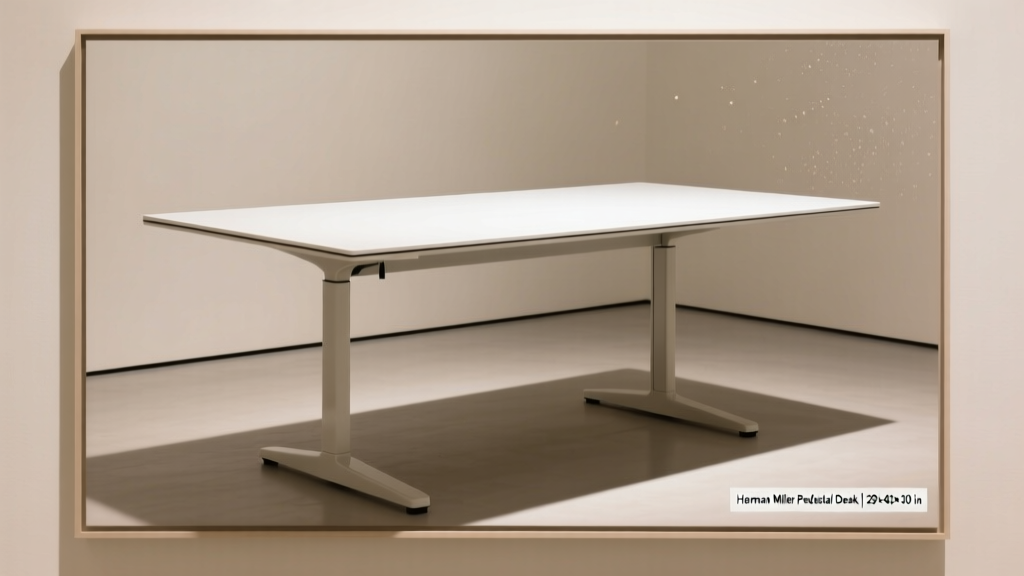
Herman Miller Pedestal Desk (White Laminated Top, 29" × 60" × 30") — Authentication, Market Value, and Design Legacy
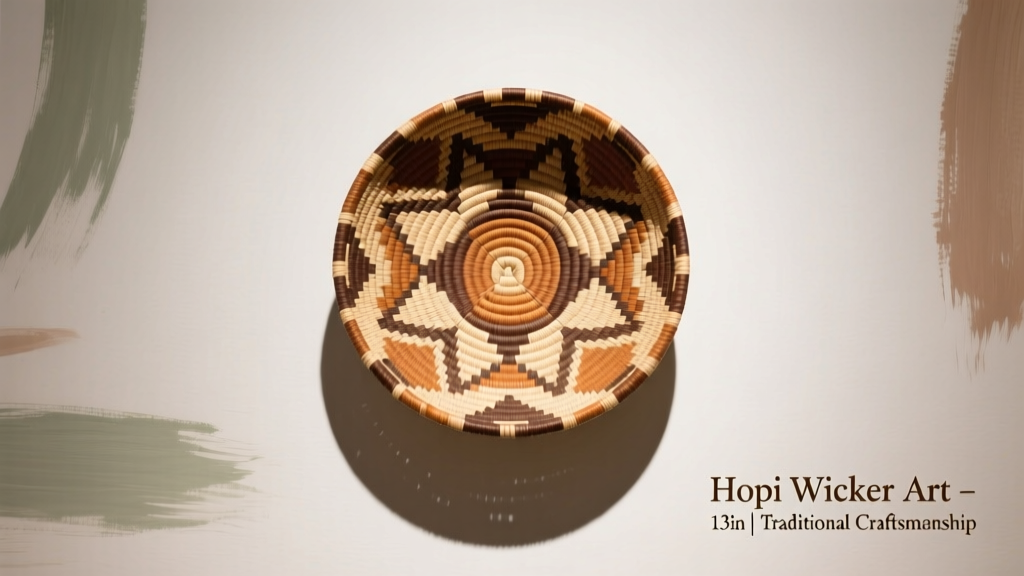
Authenticating and Valuing the Indian Bowl Hopi Wicker Work 13 In: A Technical Analysis for Collectors and Institutions
Coronation Spoon Tea Caddy: King George V Brass & Blue Enamel (1937, 4⅛ in)
Stoneware Jar with Shoulder Handles and Cobalt Blue Floral Decoration: Authentication, Provenance, and Market Analysis of a 13½-Inch American Folk Art Vessel
Railroad Lantern: New York Central Clear Globe Patent 1911 — Authentication, Provenance, and Market Analysis
Barber Basin Brass Oval Neck Cutout Hanging Ring, England, c. 1750 — Authentication, Provenance, and Market Analysis
Copeland Plate 'New Bridge Willow' Variant, 1906: Authentication, Provenance, and Market Significance of the 9¾-Inch Dinner Plate
The 1923 'Covered Wagon' Movie Program: Authenticity, Design, and Market Significance