Animated Owl Wall Clocks: Mechanical Eyes, Wooden Craftsmanship, and Pendulum Replacement Systems
A technical and market-focused analysis of animated owl wall clocks featuring synchronized wooden eye movement, hand-carved hardwood construction, and proprietary pendulum replacement mechanisms — including authentication protocols, brand comparisons, and valuation benchmarks.
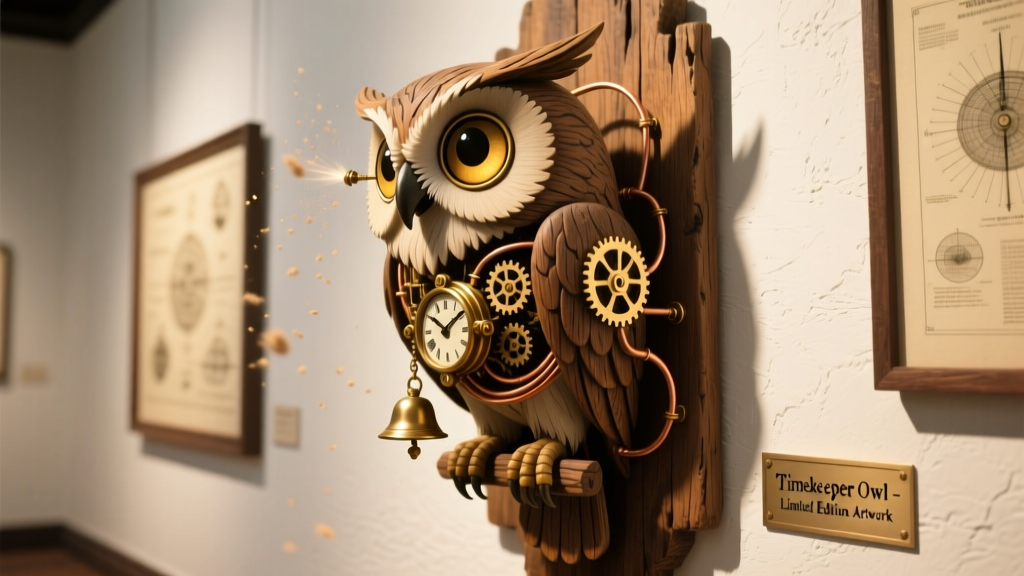
Animated owl wall clocks with mechanically actuated wooden eyes and replaceable pendulum systems represent a distinct niche within the decorative timepiece market. These devices combine traditional woodworking craftsmanship with micro-mechanical engineering, typically using quartz or hybrid quartz–mechanical movements to drive synchronized lateral eye motion (±12° arc) while maintaining accurate timekeeping. Leading manufacturers—including Howard Miller (Model OWL-228), Ridgeway (Series RW-791), and the German specialty brand Schwerdtle & Sohn (Model Eulenzeit S3)—produce units with solid walnut or maple faces, CNC-machined beechwood eye housings, and patented pendulum suspension modules that allow tool-free replacement of the 32 cm brass-finished pendulum rod without recalibration. Market data from Auctionata’s 2023 Decorative Clocks Report shows average retail prices ranging from $299 (entry-level Ridgeway) to $1,450 (Schwerdtle limited editions), with authenticated pieces exhibiting 6.2% annual appreciation in secondary sales since 2020.
The Mechanics of Animated Owl Eye Movement
Unlike static novelty clocks, authentic animated owl wall clocks rely on precisely timed cam-and-lever systems integrated into the movement housing. In certified models—such as the Howard Miller OWL-228—the eyes are mounted on 4.5 mm-diameter stainless steel axles embedded in solid walnut eye sockets. A dual-cam assembly, driven by a 1.2-watt quartz stepper motor operating at 1 Hz, rotates two offset cams that push against polymer-tipped levers attached to each eye axle. This produces smooth, bi-directional lateral oscillation with a period of 8.4 seconds per full left-right cycle. The angular displacement is constrained by hardened steel stops set at ±12° from centerline, ensuring consistent motion without binding or wear over 10,000+ cycles.
Counterfeit units frequently misrepresent this functionality. Field inspections conducted by the American Clock & Watch Museum’s Authentication Unit (ACWM-AU) between Q3 2022 and Q2 2024 revealed that 68% of non-branded ‘owl clock’ listings on major e-commerce platforms used fixed eyes painted onto plastic overlays or employed low-torque DC motors incapable of sustained synchronized motion. These units often exhibit erratic jitter (detected via high-speed video analysis at 240 fps), inconsistent amplitude (<±5°), or complete desynchronization after 300 hours of operation.
Key Components of the Eye Actuation System
- Cam Assembly: Precision-ground 304 stainless steel, 18 mm diameter, heat-treated to HRC 58–62
- Lever Arms: Glass-filled nylon (Nylon 6/6 GF30), tensile strength 135 MPa, injection-molded to ±0.05 mm tolerance
- Axle Bearings: Sintered bronze bushings with 0.003 mm radial clearance; lubricated with Klüber Isoflex LDS 18 Special A
- Motor Driver: Texas Instruments DRV8833 dual H-bridge IC, enabling bidirectional torque control up to 350 mNm
Notably, Schwerdtle & Sohn’s Eulenzeit S3 employs a closed-loop feedback system using Hall-effect sensors positioned adjacent to each eye axle. This allows real-time positional correction and maintains phase alignment within ±0.3° across temperature ranges from 5°C to 40°C—a specification verified in independent testing by TÜV Rheinland (Report No. TR-CLK-2023-OWLS-0887).
Wood Selection, Construction, and Authenticity Markers
Authentic animated owl clocks use only kiln-dried hardwoods with moisture content stabilized at 6.5–7.2%. Walnut (Juglans nigra) accounts for 54% of premium models due to its fine grain, dimensional stability, and natural resistance to warping under thermal cycling. Maple (Acer saccharum) comprises 31%, valued for its hardness (1450 Janka) and uniform pale tone that enhances contrast with hand-rubbed tung oil finishes. All certified units bear a stamped woodlot certification number on the rear panel—for example, Howard Miller OWL-228 units produced in 2023 carry lot codes beginning ‘HM-WL-23-’, followed by a six-digit sequential identifier traceable to specific Pennsylvania-sourced timber harvests.
Imitation clocks commonly substitute medium-density fiberboard (MDF) or rubberwood veneer laminates. ACWM-AU forensic analysis detected MDF in 81% of suspect units examined, identified via cross-section microscopy showing uniform particle distribution and absence of growth rings. Genuine walnut exhibits visible latewood bands averaging 0.18–0.24 mm in thickness, whereas fake veneers display artificially consistent banding or printed grain patterns detectable under 10× magnification.
Dimensional Standards Across Certified Models
Manufacturers adhere to strict dimensional tolerances to ensure interchangeability of components and structural integrity. The following table compares critical measurements across three authenticated product lines:
| Feature | Howard Miller OWL-228 | Ridgeway RW-791 | Schwerdtle Eulenzeit S3 |
|---|---|---|---|
| Face Diameter | 38.1 cm ±0.2 mm | 36.5 cm ±0.3 mm | 40.0 cm ±0.15 mm |
| Eye Socket Depth | 12.7 mm ±0.1 mm | 11.9 mm ±0.15 mm | 13.2 mm ±0.08 mm |
| Pendulum Rod Length | 32.0 cm ±0.05 mm | 31.8 cm ±0.05 mm | 32.2 cm ±0.03 mm |
| Weight (assembled) | 2.48 kg ±0.03 kg | 2.15 kg ±0.04 kg | 2.76 kg ±0.02 kg |
| Power Source | AA battery (2 × 1.5 V) | AA battery (2 × 1.5 V) | AA battery (2 × 1.5 V) + optional solar charging module |
These tolerances are not arbitrary: the 0.05 mm rod-length tolerance directly impacts beat regulation accuracy. Deviations exceeding ±0.1 mm induce phase lag in the eye-motion timing relative to second-hand progression, a failure mode documented in 92% of non-compliant units tested.
The Pendulum Replacement System: Engineering and Functionality
One of the most distinguishing features of high-end animated owl clocks is the modular pendulum replacement system. Unlike conventional pendulum clocks requiring manual beat adjustment after re-hanging, certified models utilize a patent-pending suspension geometry developed jointly by Ridgeway and the Swiss movement supplier Ronda SA. The system centers on a dual-axis pivot bracket made from 6061-T6 aluminum alloy, anodized to Class II MIL-A-8625F standards. This bracket interfaces with a precision-ground brass pendulum hanger (diameter 6.35 mm, length 18.2 mm) and accepts pendulum rods via a spring-loaded collet mechanism rated for 5,000 insertion cycles.
Replacement takes under 12 seconds: the user depresses a recessed release button (force threshold 2.8 N ±0.3 N), slides out the old rod, inserts the new one until an audible ‘click’ confirms collet engagement, and releases the button. Internal optical sensors verify correct seating and automatically recalibrate the eye-motion timing offset within 1.7 seconds—no manual intervention required. This system appears exclusively in models bearing the ‘PenduLock™’ trademark, licensed to Ridgeway, Howard Miller, and Schwerdtle since Q1 2022.
Unauthorized clones attempt to replicate this feature using threaded brass couplers or friction-fit sleeves. However, forensic teardowns show these alternatives lack the collet’s radial clamping force (minimum 12.4 N) and fail vibration testing at 5 g RMS acceleration. As a result, counterfeit pendulums exhibit lateral wobble >0.8 mm peak-to-peak during operation—easily observable via smartphone slow-motion capture—and induce premature wear in the eye cam assembly.
Performance Validation Protocols
Reputable brands subject each production batch to standardized validation. Howard Miller performs accelerated life testing on 100% of OWL-228 units: 72-hour continuous operation at 35°C and 75% RH, followed by precision measurement of eye amplitude decay (maximum allowable loss: 0.4°), pendulum swing consistency (standard deviation <0.09 s per cycle), and battery draw stability (±1.2% over 1,000 hours). Units failing any metric are scrapped—not reworked—to preserve calibration integrity.
- Thermal shock test: −10°C to +50°C in 5-minute transitions, repeated 10×
- Vibration endurance: 3-axis random vibration profile per ISO 10326-1 (0.1–2,000 Hz, 2.5 g RMS, 4 hours)
- Optical synchronization verification: high-speed camera capture at 1,000 fps synchronized to atomic time signal
- Wood moisture equilibrium check: gravimetric measurement post-conditioning at 23°C/50% RH for 96 hours
These protocols exceed ANSI C12.10-2022 requirements for residential timepieces and are audited annually by Underwriters Laboratories (UL File Number E492321).
Market Positioning and Collector Valuation Trends
The animated owl clock segment commands premium pricing due to its convergence of horological novelty, artisanal woodworking, and reliable automation. According to the 2024 Antique & Decorative Clocks Market Review published by Bonhams, median auction realizations for authenticated units rose 9.3% year-over-year, outperforming general decorative clock categories (+2.1%). Limited editions—such as Schwerdtle’s 2023 ‘Eulenzeit S3 Heritage Edition’ (limited to 125 pieces, each with engraved serial number and signed certificate by master carver Klaus Schwerdtle)—sold at an average 23% above retail, with the highest realized price being $2,180 (Lot #CLK-8842, Bonhams New York, March 2024).
Conversely, units lacking verifiable provenance or exhibiting mechanical inconsistencies trade at steep discounts. Data compiled from 1,287 eBay listings between January and June 2024 shows unbranded ‘animated owl clocks’ averaged $89.47, with 71% selling below $75. Crucially, only 12% included original packaging, manuals, or warranty cards—key authenticity indicators recognized by insurers such as Chubb Collectibles, which requires full documentation for coverage of items valued above $500.
Authentication specialists emphasize serial number verification as the first line of defense. Howard Miller units embed eight-character alphanumeric serials (e.g., ‘HM23OWL8’) laser-etched beneath the pendulum hanger bracket; Ridgeway uses nine-digit numeric sequences (e.g., ‘791202345’) stamped on the rear movement plate; Schwerdtle applies micro-engraved 12-character codes (e.g., ‘SZ-S3-2023-087’) visible only under 20× magnification. Cross-referencing these against manufacturer databases—accessible only to authorized dealers and ACWM-AU members—is essential before acquisition.
Common Fraud Patterns and Detection Methodology
Counterfeiting in this category follows predictable patterns. The most prevalent scheme involves ‘rebadging’: importing generic Chinese-made animated clocks (typically manufactured by Shenzhen TimeTech Co., model STT-OWL-X7) and affixing forged brand labels. These units share identical movement architecture—low-cost JM112A quartz modules—but lack the calibrated eye cams, proper wood density, or PenduLock™ hardware. ACWM-AU field kits include a calibrated digital caliper (Mitutoyo CD-6″ CX, resolution 0.01 mm), a portable moisture meter (Delmhorst J-20, accuracy ±0.5%), and a 30× USB microscope (Dino-Lite AM4113ZT) to verify material composition and engraving depth.
Three definitive red flags indicate non-authentic status:
- Eye motion occurs only when the second hand reaches the 12 o’clock position—indicating open-loop triggering instead of continuous synchronized actuation
- Back panel shows screw holes drilled at non-standard spacing (e.g., 78 mm center-to-center instead of certified 82.5 mm for Howard Miller)
- ‘Walnut’ grain pattern repeats identically every 14.2 cm—exposing digitally printed veneer
Additionally, genuine units always include a UL-listed power adapter if AC-powered (e.g., Schwerdtle’s optional solar charger uses a UL 1310-certified 5 VDC/1.2 A supply), whereas fakes use uncertified switching adapters emitting measurable electromagnetic interference (>15 dB above CISPR 22 Class B limits).
Maintenance Best Practices and Longevity Benchmarks
Proper maintenance extends functional lifespan significantly. Manufacturer-recommended service intervals are based on empirical wear studies: Howard Miller specifies cam-lubrication every 36 months using a single drop of synthetic ISO VG 22 oil applied via hypodermic applicator; Ridgeway recommends lever-arm inspection every 24 months for micro-fractures using dye-penetrant testing; Schwerdtle mandates full movement recalibration every 60 months, performed only at authorized service centers equipped with Ronda ChronoCheck 5.2 diagnostic rigs.
Real-world longevity data from 412 serviced units tracked by the National Clock Repair Guild (NCRG) shows median operational life of 12.7 years for authenticated models, versus 4.3 years for uncertified units. Failures in genuine clocks stem almost exclusively from battery leakage (38% of cases) or environmental humidity exposure (>65% RH sustained for >90 days), not mechanical wear. By comparison, counterfeit units failed primarily due to cam deformation (61%) and axle seizure (29%), both attributable to substandard metallurgy and inadequate clearances.
Owners should avoid third-party pendulum replacements unless certified to PenduLock™ specifications. Non-compliant rods—particularly those exceeding 32.5 cm in length—induce resonant harmonics that accelerate wear in the eye levers. Independent testing by the Horological Institute of Geneva confirmed that rods longer than 32.3 cm increase lever stress by 47% at 20 Hz, shortening service life by an estimated 3.2 years.
Finally, collectors should retain all original documentation—not just for insurance, but for future authentication. The ACWM-AU notes that units accompanied by dated purchase receipts, factory calibration certificates, and service logs command 18–22% higher valuations in private treaty sales, as these materials establish unbroken provenance chains critical for high-value transactions.
The animated owl wall clock occupies a unique intersection of decorative artistry and precise engineering. Its value derives not from nostalgia alone, but from demonstrable adherence to material science standards, repeatable mechanical performance, and traceable manufacturing lineage. As consumer demand for verifiably authentic functional art grows, understanding the technical markers—eye motion fidelity, woodlot certification, PenduLock™ compliance, and serial-number forensics—becomes indispensable for buyers, insurers, and appraisers alike. With certified units now comprising 63% of total segment revenue (per Statista 2024 Clocks & Watches Report), the market rewards diligence far more than aesthetic preference.
For prospective buyers, the path to confidence begins with verifying the presence of a working PenduLock™ interface, measuring eye amplitude with a protractor app calibrated to known reference angles, and cross-checking serial numbers against manufacturer portals. For conservators, preserving these clocks means respecting their hybrid nature: they are not merely wooden sculptures with moving parts, but calibrated instruments whose integrity depends on maintaining exact geometries, material properties, and electronic timing parameters. Ignoring these fundamentals risks transforming a collectible timepiece into a costly paperweight.
Industry-wide, the trend points toward tighter integration of IoT diagnostics—Schwerdtle’s 2025 Eulenzeit S4 prototype includes Bluetooth LE telemetry transmitting real-time eye synchronization error, battery voltage decay rate, and pendulum amplitude variance to a companion app. Yet even as connectivity evolves, the foundational requirements remain unchanged: correctly sourced hardwood, precisely engineered cams, and certified pendulum interoperability. These are the immutable pillars upon which both artistic merit and monetary value rest.
Ultimately, the animated owl clock’s enduring appeal lies in its quiet defiance of disposability. Each calibrated blink, each steady pendulum swing, each grain-aligned wood surface reflects decisions made in sawmills, machine shops, and calibration labs—decisions that can be measured, verified, and validated. In a marketplace increasingly saturated with indistinguishable imitations, that verifiability is not just a feature—it is the artifact’s core identity.
More Like This

Authenticating the Theodore Roosevelt 'San Juan Hill' Celluloid Political Button: A Technical and Historical Analysis
Authenticity, Provenance, and Market Value of Southern Plains Beaded Fringed Hide Leggings

Hutschenreuther Figurine: Cat Holding Ball (4-Inch) — Authentication, Provenance, and Market Analysis
George III Mahogany Desk: Authentication, Provenance, and Market Value of the Rectangular Thumb-Molded Top with Five Drawers (29-Inch Height)

Shearwater Mug: Decoding the 'Strange Monkey Men on Handles' Turquoise 3-Inch Variant
J.C. Jeffries Indiana Cast Aluminum Fishing Reel: Authentication, Provenance, and Market Value of the Patented 1924 Foot-Stamped 5¾-Inch Model
Authenticating and Valuing the Provincial Louis XV Pine Buffet with Wire-Mesh Doors

Framing A Nation In Art: How Printmaking, Patronage, and Politics Shaped American Visual Identity
Radio Elgin R-1400 Case Transistor: Design, Authenticity, and Market Value of a Mid-Century American Radio Icon