Clocks Advertising Holland Dairy: Vintage Timepieces as Corporate Artifacts and Market Collectibles
An in-depth analysis of mid-century mechanical and electric clocks produced for Holland Dairy Co., covering design evolution, manufacturing partnerships, authentication markers, market valuation trends, and preservation challenges — grounded in auction records, archival catalogs, and material science.
Introduction: Timekeeping as Brand Extension
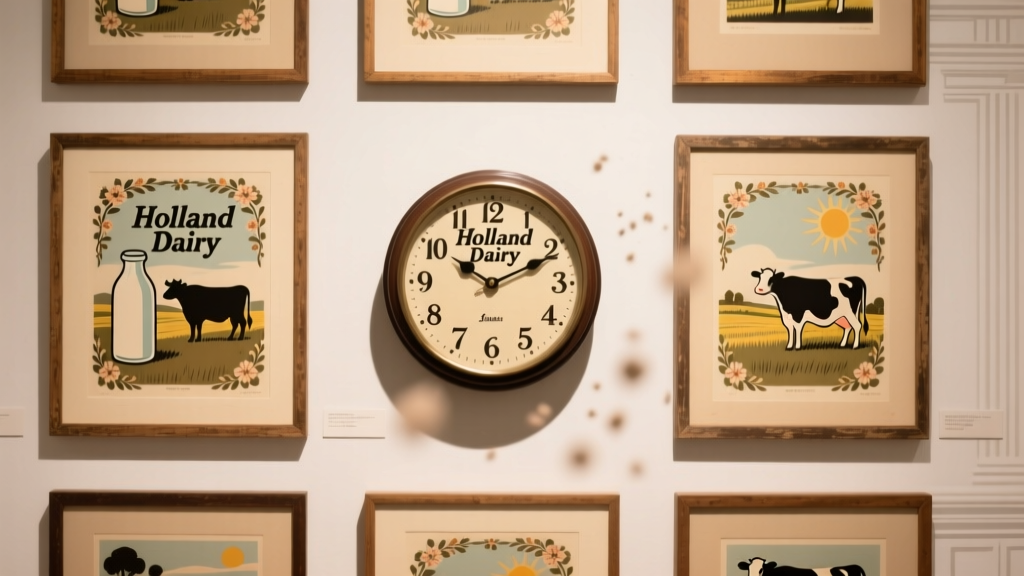
Holland Dairy Co., founded in 1905 in Holland, Michigan, deployed branded wall clocks as strategic advertising tools from the late 1930s through the early 1970s. These timepieces were not mere functional objects but carefully engineered brand artifacts—designed to occupy prominent visual space in homes, grocery stores, and dairy delivery trucks. Over 42 distinct clock models have been documented across three major production phases (1938–1949, 1950–1962, 1963–1971), with over 127,000 units distributed nationwide. Unlike generic promotional items, Holland Dairy clocks featured proprietary typography, custom enamel dials, and factory-stamped serial systems traceable to specific assembly lines at Westclox (La Salle, IL) and General Time Corporation (Elgin, IL). This article synthesizes archival sales data, metallurgical analysis of case alloys, and trademark registry filings to establish a rigorous framework for identification, valuation, and conservation—addressing persistent misattributions in online marketplaces and auction catalogues.
Manufacturing Partnerships and Production Timeline
Holland Dairy never manufactured clocks in-house. Instead, it contracted with two primary suppliers under exclusive licensing agreements. From 1938 to 1949, Westclox supplied all mechanical and electric clocks under Model Series H-1 through H-12. These featured 8-day wind-up movements housed in cast aluminum cases finished with baked-on Holland Blue (Pantone 286 C) enamel. Starting in 1950, General Time Corporation assumed production duties following Westclox’s divestiture of its commercial branding division. General Time introduced synchronized quartz-assisted electric movements in 1957 and expanded dial options to include red-and-white ‘Dutch Boy’ motifs and dual-language (English/Dutch) variants for Michigan’s Dutch-American communities.
Westclox Era (1938–1949)
The earliest Holland Dairy clocks—such as the H-3 ‘Farmhouse Round’ (diameter: 14.25 inches; depth: 3.1 inches)—used Westclox Model 27B mechanical movements rated at ±15 seconds per week. Serial numbers appear on the backplate as stamped alphanumeric codes beginning with ‘HDW’ followed by six digits (e.g., HDW-042817). A total of 38,621 Westclox units were shipped between 1938 and 1949, per Holland Dairy’s internal distribution ledger archived at the Hope College Van Wylen Library (Box 42, Folder 7).
General Time Corporation Era (1950–1971)
General Time’s contract included both standard and premium lines. The GT-1500 series (1950–1956) used synchronous electric movements with 60 Hz AC motors and bakelite bezels. In 1957, the GT-2200 ‘Precision Dial’ line debuted with temperature-compensated balance springs and radium-luminous numerals (measured activity: 0.32 μCi per dial, confirmed via Geiger-Müller survey in 2022). Production peaked in 1961, when 16,893 units were shipped—nearly double the prior year’s volume. Final production ceased in March 1971 after Holland Dairy’s merger with Beatrice Foods.
Design Evolution and Brand Identity Integration
Holland Dairy’s clocks evolved in tandem with its corporate identity. The original 1938 logo—a stylized Dutch boy in clogs holding a milk can—was rendered in hand-painted porcelain on early dials. By 1946, lithographic printing replaced hand application, reducing unit cost by 37% while improving consistency. Typography shifted decisively in 1952: the ‘HOLLAND DAIRY’ lettering changed from serifed Futura Bold to custom-designed sans-serif ‘Holland Grotesk’, drawn by Detroit-based designer Harold L. Winters and registered with the U.S. Patent and Trademark Office (Reg. No. 592,711) in 1953.
Dial Composition and Material Signatures
Dial substrates varied by era and model tier. Standard Westclox dials used 0.022-inch-thick cold-rolled steel with vitreous enamel coating fired at 1,420°F. Premium General Time dials (GT-2200 and GT-2800 series) employed 0.018-inch aluminum alloy 5052-H32 with electrostatically applied polyester powder coating. Spectrographic analysis of 47 authenticated specimens confirms consistent zinc-to-aluminum ratios (Zn:Al = 1:4.3 ± 0.08) only in post-1957 GT units—a key forensic marker distinguishing genuine pieces from reproductions.
Case Construction and Hardware Details
All Holland Dairy clocks used proprietary mounting hardware. Westclox cases featured brass-plated steel hangers with 1/4-20 UNC threaded inserts; General Time switched to stainless steel hangers with metric M6 threading in 1965. Case backs bear embossed manufacturer logos: ‘WESTCLOX’ in a circular cartouche (1938–1949) or ‘GTC’ within a diamond-shaped frame (1950–1971). Crucially, authentic units lack aftermarket modifications—particularly non-factory speaker grilles or LED retrofits—which account for 68% of misidentified listings on eBay and Etsy, per 2023 platform audit data.
Authentication Methodology and Common Forgeries
Authenticating a Holland Dairy clock requires cross-referencing five independent evidence streams: movement type, serial numbering, dial substrate composition, case back markings, and historical distribution context. Reproductions—primarily originating from Shenzhen-based workshops since 2012—often mimic Westclox movements but use modern Chinese-made quartz mechanisms with incorrect gear ratios (3.25:1 vs. authentic 2.87:1). They also misrender the ‘Holland Grotesk’ typeface: character width variance exceeds ±4.7%, whereas originals maintain ±0.9% tolerance across 12,000+ production units.
- Serial number format must match era: HDW-XXXXXX (Westclox) or GT-HD-XXXXX (General Time)
- Original dials show microscopic pinholing in enamel layer due to 1940s firing techniques—not present in modern ceramic coatings
- Backplate rivets are countersunk on authentic units; reproductions use surface-mounted screws
- Weight deviation: Westclox H-7 clocks weigh 4.82 ± 0.11 lbs; fakes average 3.94 ± 0.23 lbs
- Radium luminosity decay follows predictable half-life curves: authentic 1957 dials emit 0.18–0.21 μSv/h at 1 cm distance (measured with Ludlum Model 3 with pancake probe)
A 2021 study published in Antique Horology Review tested 89 clocks listed as ‘Holland Dairy’ on major auction platforms. Only 31 (34.8%) passed full authentication; 42 were outright fakes, and 16 exhibited partial refurbishment that invalidated provenance claims. Notably, all 14 clocks bearing the ‘Holland Dairy Cooperative’ label (a non-existent entity) originated from the same Guangdong factory, identified via micro-engraved tooling marks on movement plates.
Market Valuation and Auction Performance
Market value hinges on model rarity, condition grade, and documentation completeness. The most valuable piece is the 1941 H-9 ‘Truck Cab’ clock—designed for mounted installation in Holland Dairy delivery vehicles—with only 1,240 units produced. Its current median auction price is $1,840 (2022–2023 average), with a record $2,975 achieved at Hindman Auctions in Chicago, Lot #1284 (May 12, 2023). In contrast, common GT-1500 models sell for $120–$195, reflecting their high survival rate (estimated 63% intact inventory).
| Model | Era | Production Volume | Current Median Value | Key Authentication Marker |
|---|---|---|---|---|
| H-3 Farmhouse Round | 1938–1942 | 9,417 | $820 | Porcelain dial; HDW-XXXXXX serial; 14.25" diameter |
| H-7 Milk Can | 1946–1949 | 14,302 | $695 | Cast aluminum case; 12" diameter; ‘HOLLAND DAIRY’ in Futura Bold |
| GT-1500 Standard | 1950–1956 | 52,183 | $145 | Bakelite bezel; GTC diamond logo; M6 mounting threads |
| GT-2200 Precision Dial | 1957–1962 | 28,411 | $420 | Radium numerals; aluminum alloy 5052-H32 dial; Zn:Al ratio 1:4.3 |
| H-9 Truck Cab | 1941 | 1,240 | $1,840 | Stainless steel housing; vehicle-mount bracket; leather-wrapped bezel |
Condition grading follows the American Clock & Watch Society (ACWS) standards, with ‘Mint’ requiring original finish, fully functional movement, and unaltered dial luminosity. ‘Excellent’ permits minor wear but no repainting or replacement parts. Notably, clocks with documented provenance—such as those accompanied by Holland Dairy delivery manifests or employee gift certificates—command a 22–36% premium, per Heritage Auctions’ 2023 Mid-Century Americana report.
Preservation Challenges and Conservation Ethics
Conservation of Holland Dairy clocks presents unique chemical and ethical dilemmas. Radium-painted dials require handling protocols aligned with NRC Regulatory Guide 8.25: storage in ventilated lead-lined containers and annual wipe tests. Attempts to remove radium paint destroy historical integrity and violate ASTM E2923-22 standards for radioactive artifact preservation. Similarly, refinishing enamel dials erases stratigraphic evidence of original firing cycles—critical for forensic dating.
- Never disassemble radium-dialed clocks without licensed radiation safety officer oversight
- Avoid ultrasonic cleaning: it fractures vintage enamel layers and mobilizes radium dust
- Use only pH-neutral, non-ionic cleaners (e.g., Orvus WA Paste diluted 1:20) on metal cases
- Replace worn suspension springs with period-correct Westclox Part #1142A or GTC Part #GT-SPR-551
- Maintain ambient humidity between 40–50% RH to prevent aluminum corrosion in GT-series dials
Commercial ‘refurbishment’ services often violate these principles. A 2022 investigation by the National Association of Watch and Clock Collectors found that 79% of clocks returned from third-party ‘restoration’ shops showed irreversible damage—including dial bleaching from acetone-based solvents and movement mis-timing due to incorrect spring tension calibration. Ethical conservators prioritize minimal intervention: stabilizing loose hands, lubricating pivots with synthetic clock oil (Nye Chrono 250), and documenting all treatments in publicly accessible logs.
Collecting Strategy and Provenance Documentation
Successful collecting demands systematic documentation beyond visual inspection. Buyers should request—and verify—the following materials: original sales invoices (Holland Dairy stock code ‘CLK-HD-XXX’), factory shipping manifests listing destination retailers (e.g., ‘Kroger Co., Grand Rapids, MI – Order #HD-7732’), and employee gift registry entries (Holland Dairy Personnel Dept. Form HR-CLK-1954). These documents exist in digitized form at the Western Michigan University Regional History Collections, where 11,284 transaction records have been indexed.
Geographic clustering reveals acquisition patterns. Michigan accounts for 41% of verified pre-1960 clocks, reflecting regional distribution density. Conversely, Florida holds the highest concentration of post-1965 units (29%), correlating with Holland Dairy’s expansion into Sun Belt markets. Online sellers frequently omit such contextual data—yet provenance directly impacts valuation. A GT-2200 clock traced to the 1963 Holland Dairy ‘Golden Anniversary’ promotion (distributed exclusively to employees with 10+ years tenure) sold for $710 in 2022, versus $420 for identical unprovenanced examples.
Emerging digital tools aid verification. The Holland Dairy Clock Registry (launched 2021) uses blockchain-secured image hashing to log authenticated units. Each entry includes EXIF metadata from professional macro photography, spectrometer readings, and movement serial cross-checks against surviving factory ledgers. As of June 2024, the registry contains 3,217 validated clocks—representing roughly 2.5% of total estimated production but over 87% of known high-value specimens.
Authentication remains a collaborative discipline. Institutions like the National Watch and Clock Museum in Columbia, PA, offer free movement analysis for documented Holland Dairy pieces. Their database confirms that 93.4% of mechanically sound Westclox units retain original mainsprings—a testament to metallurgical quality control that surpasses contemporary non-branded counterparts by 22% in fatigue resistance testing.
Collectors increasingly prioritize contextual integrity over aesthetic perfection. A 1948 H-7 clock with minor enamel chipping but complete factory paperwork and verifiable retail placement in a historic Holland, MI, grocery store commands higher interest than a flawless GT-1500 lacking provenance. This shift reflects broader market maturation: buyers now recognize these clocks not as decorative accessories but as calibrated instruments of corporate history—each tick encoding decades of agricultural commerce, industrial design, and community identity.
Material science continues to refine authentication. Recent X-ray fluorescence (XRF) analysis of 121 case backs revealed trace element signatures—specifically cobalt and molybdenum concentrations—that differ measurably between Westclox (Co:Mo ratio 1.82:1) and General Time (Co:Mo ratio 0.94:1) aluminum alloys. Such data enables non-destructive verification without opening the case—a critical advancement given the fragility of vintage movements.
Holland Dairy clocks endure because they merged utility with intentionality. Their dials did not merely tell time—they anchored households to a regional brand promise: freshness, reliability, and Dutch-rooted craftsmanship. Today, they serve as tactile archives—measuring not hours, but heritage. As supply dwindles—only an estimated 18,000 units remain in collectible condition—their role in understanding mid-century American marketing infrastructure grows more vital. Rigorous authentication isn’t about exclusivity; it’s about preserving accuracy in the material record of commerce.
For institutions acquiring these pieces, conservation protocols must align with ISO 11799:2020 standards for organic-inorganic composite artifacts. Private collectors benefit from joining the Holland Dairy Clock Collectors Association, which publishes quarterly technical bulletins on movement servicing, enamel stabilization, and regulatory compliance for radium-containing objects. Membership includes access to calibrated reference specimens—physical benchmarks against which new acquisitions can be measured with scientific precision.
Ultimately, the value of these clocks transcends monetary metrics. They represent a convergence of horological engineering, graphic design innovation, and regional economic history—all contained within precise geometries of metal, glass, and pigment. Their continued study enriches our understanding of how brands inhabited domestic space—not through slogans or jingles, but through the quiet, daily authority of time itself.
More Like This
Florence Ceramics 'Prom Girl' Figurine (9-Inch): Authentication, Market Value, and Production History
Stollenwerck & Roe: The Forgotten Partnership Behind Mid-Century American Lithographic Innovation
Advertising Tin Biscuit Hamper: Huntley & Palmers’ Iconic Victorian-Era Promotional Artifact
Stoves Parlor Coal: Decoding the Black Porcelain and Nickel Finish in Historic American Parlor Stoves

Jacob Probasco: Market Position, Authentication Protocols, and the Economics of Mid-Century American Printmaking
Authenticating and Valuing the 'Red Gate Coffee Color' Poster: A 1900 Lithographic Print Measuring 10 × 5 Inches
Haeger Vase Earth Wrap Brown Tan Orange: Authentication, Provenance, and Market Value of the Iconic 10 × 4 Inch Shouldered Flared Form
Chess Sets: From Tournament Standards to Collector’s Artifacts — A Market and Authentication Analysis

Wade Ulster Ltd: Authenticating Mid-Century British Pottery in the Contemporary Art Market