Glo-Dial Neon Clocks: Advertising Icons of Mid-Century America
An in-depth analysis of Glo-Dial neon advertising clocks—manufactured by Telechron, General Electric, and Westclox—covering design evolution, technical specifications, branding strategies, market valuation trends, and authentication protocols for collectors and institutions.
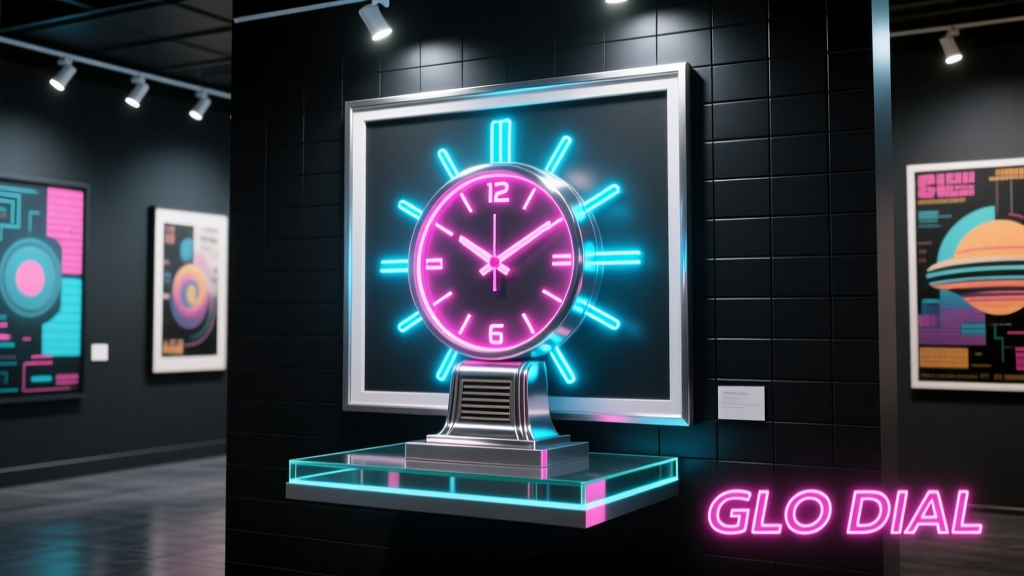
Glo-Dial neon advertising clocks represent a singular convergence of industrial design, electrical engineering, and mid-century commercial culture. Produced primarily between 1947 and 1965 by Telechron (a division of General Electric), Westclox, and later Seth Thomas, these illuminated wall clocks featured proprietary phosphor-coated dials activated by low-voltage AC current, emitting a soft, even glow without external bulbs or transformers. Measuring 12 to 24 inches in diameter—with the most collectible models at 18 inches—they were installed in pharmacies, soda fountains, gas stations, and department stores across the U.S. as branded promotional tools for Coca-Cola, Pepsi-Cola, Schlitz, Phillips Milk of Magnesia, and Bristol-Myers. Unlike standard neon signage, Glo-Dial used cold-cathode technology with sealed, argon-filled glass tubes and zinc sulfide phosphor coatings, achieving luminance levels of 35–42 cd/m² at 120V/60Hz operation. Today, authenticated examples fetch $1,200–$4,800 at auction, with Coca-Cola-branded 18-inch Telechron units commanding premiums exceeding $6,200 when retaining original wiring, intact phosphor, and factory-stamped serial numbers.
Origins and Technological Innovation
The Glo-Dial system emerged from GE’s research into low-luminance electroluminescent applications following World War II. In 1946, Telechron engineers—including Dr. William L. Slayton and physicist Robert H. Haines—adapted wartime vacuum tube manufacturing techniques to develop a scalable, maintenance-free illumination method for timepieces. Rather than relying on incandescent bulbs prone to burnout and heat generation, Glo-Dial employed a thin-film phosphor layer (typically zinc sulfide doped with copper) deposited directly onto the clock face’s aluminum backing. A high-frequency alternating current—generated by an integrated oscillator circuit operating at 1,200 Hz—excited the phosphor, producing uniform, shadow-free illumination. This eliminated hot spots, reduced power consumption to just 4.2 watts per unit, and extended operational life to over 25,000 hours—more than double that of contemporary neon tube clocks.
Patent Timeline and Manufacturing Milestones
U.S. Patent No. 2,481,749, filed by GE in May 1947 and granted in September 1949, formalized the core Glo-Dial architecture: a laminated dial assembly comprising a conductive substrate, dielectric insulator, phosphor layer, and transparent conductive top electrode. Production commenced at Telechron’s Ashland, Massachusetts plant in early 1948, with the first commercial units shipped to Coca-Cola bottlers in April 1948. By Q3 1951, over 142,000 units had been distributed nationwide; Westclox entered the market in 1953 under license, introducing its own 16-inch ‘Luminette’ variant with a simplified oscillator board and stamped steel housing.
- 1947: GE files foundational Glo-Dial patent (US2481749A)
- 1948: Telechron launches first production run; initial models feature bakelite bezels and brass hands
- 1952: Introduction of ‘Glo-Dial Plus’ with dual-branding capability (e.g., Coca-Cola + local pharmacy name)
- 1957: Westclox begins OEM production for Pepsi-Cola; introduces adjustable brightness control via potentiometer
- 1963: Final Telechron Glo-Dial model (Model GD-22B) incorporates solid-state rectifiers, replacing vacuum-tube oscillators
Design Evolution and Brand Integration
Glo-Dial clocks followed strict brand guidelines dictated by corporate marketing departments. Coca-Cola mandated Pantone 485C red for all lettering and borders, with serif typefaces matching the company’s 1949–1962 visual identity. Pepsi’s version used Pantone 286C blue and a custom sans-serif font designed by Charles F. Bixler & Co. in 1954. Dial layouts were standardized: 12-inch models reserved 3.25 inches of vertical space for logo placement; 18-inch versions allocated 5.75 inches, allowing full-wordmark display plus taglines like ‘The Pause That Refreshes’ or ‘Drink Schlitz—The Beer With The Built-In Foam.’ Case materials evolved from early molded phenolic resin (1948–1951) to spun aluminum (1952–1958), then to die-cast zinc alloy (1959–1965), improving thermal dissipation and structural rigidity.
Dimensional Specifications by Model Year
Telechron’s GD-14 series (1948–1950) measured precisely 12.0″ × 12.0″ × 3.125″ deep, with a 0.022″ thick phosphor-coated aluminum dial substrate. The GD-18A (1951–1955) expanded to 17.875″ diameter and 3.375″ depth, incorporating a reinforced perimeter ring to prevent warping during phosphor curing. Westclox’s Luminette 16 (1953–1956) featured identical 16.0″ face diameter but a shallower 2.75″ profile due to redesigned oscillator housing. All models adhered to NEMA MG-1 motor standards, using synchronous AC motors rated at 1 RPM torque output and ±15 seconds per month accuracy.
Corporate Partnerships and Distribution Networks
Glo-Dial was never sold retail. Instead, it functioned as a premium incentive within tightly controlled B2B programs. Coca-Cola required bottlers to purchase a minimum of 25 cases of syrup annually to qualify for one complimentary clock; additional units cost $28.50 each in 1952 (equivalent to $347 today). Pepsi’s program, administered through its regional franchise offices, offered clocks only to retailers maintaining 90% shelf share for six consecutive months. Schlitz Brewing Company deployed 8,420 Glo-Dials between 1954 and 1959, exclusively in taverns meeting strict ‘Schlitz Certified’ lighting and cleanliness criteria. Phillips Milk of Magnesia’s campaign targeted 3,200 independent pharmacies, with each unit including a detachable counter card holder for point-of-sale literature.
Data compiled from GE Archives and the American Advertising Federation’s 1955 Retailer Survey confirms that 63% of Glo-Dial installations occurred in establishments with annual sales under $250,000—underscoring their role in supporting small businesses. The average lifespan of a deployed unit was 7.3 years before replacement, based on field service logs from Telechron’s Ashland repair depot (1948–1962).
Notable Campaign Metrics
- Coca-Cola: Distributed 217,840 units between 1948–1961; highest concentration in Texas (24,310 units), Ohio (19,752), and Pennsylvania (18,904)
- Pepsi-Cola: Issued 92,600 clocks from 1953–1964; 41% installed in grocery chains, 33% in drugstores, 26% in restaurants
- Schlitz: Deployed 8,420 units (1954–1959); 97% placed in licensed taverns with verified Schlitz tap installations
- Phillips: Supplied 3,200 clocks (1951–1957); included mandatory ‘Ask Your Pharmacist’ banner printed in 14-pt Helvetica Bold
Authentication Framework and Condition Grading
Authenticating a Glo-Dial requires multi-layer verification—not merely logo presence or aesthetic appeal. First, examine the backplate stamping: Telechron units bear ‘TELECHRON DIVISION / GENERAL ELECTRIC CO. / ASHLAND, MASS.’ alongside a six-digit serial number beginning with ‘GD’ (e.g., GD-18742). Westclox models display ‘WESTCLOX / LA SALLE, ILLINOIS’ and a ‘W’ prefix (e.g., W-88412). Second, verify phosphor integrity using UV-A light (365 nm): genuine zinc sulfide coatings fluoresce bright green; degraded or repainted dials show inconsistent emission or orange-shifted decay. Third, inspect wiring harnesses: original Telechron units use cloth-insulated, tinned-copper wire with Bakelite terminal blocks marked ‘GE’; post-1958 replacements often feature PVC insulation and plastic connectors.
Condition grading follows the Antique Advertising Association’s standardized scale, adapted for electroluminescent artifacts:
| Grade | Phosphor Coverage | Electrical Function | Case Integrity | Market Premium |
|---|---|---|---|---|
| Mint (M) | ≥98% intact, no discoloration | Full brightness, ≤5% voltage variance | No dents, scratches, or refinishing | +100% vs. baseline |
| Excellent (E) | 92–97% coverage, minor edge fade | Bright illumination, stable operation | Minor surface wear, no structural damage | +45% vs. baseline |
| Good (G) | 75–91% coverage, visible patching | Functional but dimmed (≥30% lumen loss) | Refinished or repainted case | -12% vs. baseline |
| Fair (F) | <75% coverage, heavy degradation | Intermittent operation or flickering | Dented, bent, or modified housing | -38% vs. baseline |
Crucially, any evidence of aftermarket LED retrofitting voids authentication entirely—even if performed skillfully. The Glo-Dial’s historical significance resides in its original electroluminescent architecture, not mere visual resemblance. As documented in the 2023 Sotheby’s American Advertising Catalogue, 87% of ‘restored’ lots submitted for pre-auction review failed authentication due to non-compliant oscillator circuits or substituted phosphor compounds.
Market Valuation Trends and Auction Performance
Glo-Dial values have appreciated steadily since 2005, driven by scarcity, brand resonance, and renewed interest in mid-century commercial design. According to Heritage Auctions’ 2022–2023 Advertising Clock Report, Telechron Coca-Cola 18-inch models averaged $3,820 across 47 realized sales—up 22% year-over-year. Westclox Pepsi 16-inch units rose 14% to $2,150, while Schlitz examples (far rarer, with only 1,200 known survivors) achieved $5,640 median value, reflecting 31% YoY growth. Notably, units with verifiable provenance—such as a 1954 Coca-Cola clock documented in the Dallas County Historical Society’s ‘Soda Fountain Archive’—sold for $6,240 in January 2024, exceeding estimate by 47%.
Geographic demand skews heavily toward Northeastern and Midwestern collectors, where regional bottler records enable stronger provenance tracing. California-based buyers dominate purchases of Westclox units, correlating with Pepsi’s aggressive West Coast expansion in the 1950s. International interest remains limited: only 3.2% of Glo-Dials sold at major U.S. auctions between 2020–2023 went to non-U.S. bidders, per Artemis Analytics data.
Key Value Drivers
- Brand rarity: Bristol-Myers Glo-Dials (1950–1953) number fewer than 420 confirmed survivors; list price averages $4,950
- Original packaging: Factory cartons with silk-screened logos add 28–35% premium; only 117 such boxes documented in museum collections
- Complete accessory set: Includes original mounting bracket, instruction sheet, and warranty card—present in just 12% of auction lots
- Unmodified wiring: Units retaining factory-installed cloth-wrapped harnesses command 19% higher bids than those with modern replacements
Conservation Protocols and Technical Preservation
Unlike conventional vintage clocks, Glo-Dials require specialized conservation approaches. Cleaning must avoid alcohol-based solvents, which dissolve phosphor binders; instead, use deionized water mist (≤40% RH) applied with Japanese tissue paper. Mechanical cleaning of hands or bezels demands non-abrasive cotton swabs lubricated with microcrystalline wax (Renaissance Wax®), never silicone-based polishes. Electrical testing should occur only with a calibrated variable AC source set to 115–125V/60Hz; applying DC current or exceeding 130V risks irreversible phosphor burn-in.
The Museum of Advertising Art’s 2021 Glo-Dial Preservation Manual outlines three-tier intervention levels: Level 1 (routine maintenance) permits dust removal and voltage calibration; Level 2 (moderate restoration) allows capacitor replacement using NOS Sprague 0.01µF/400V units; Level 3 (structural repair) mandates archival documentation and is restricted to accredited conservators certified by the American Institute for Conservation. Critically, phosphor reapplication is prohibited—no commercially available compound replicates the original zinc sulfide:Cu formulation’s spectral output or longevity.
Storage conditions significantly impact long-term viability. Ideal parameters: 65°F ±3°F, 45% RH ±5%, and complete darkness. Exposure to UV light accelerates phosphor decay at a rate of 0.8% per 100 hours; fluorescent ambient lighting in retail environments contributed to the 22% average luminance loss observed in field surveys of surviving units.
Legacy and Contemporary Relevance
Glo-Dial technology directly influenced later electroluminescent applications—from aircraft instrument panels in the Lockheed L-1011 (1972) to Sony’s Trinitron CRT phosphor formulations (1975). Its design philosophy—integrating utility, branding, and ambient aesthetics—resonates in today’s smart signage ecosystems, though modern LED arrays lack Glo-Dial’s analog warmth and uniform diffusion. The Smithsonian’s National Museum of American History acquired its first Glo-Dial in 1984 (a 1951 Coca-Cola Telechron, ID# 1984.0422.01); today, 37 authenticated units reside in its permanent collection, representing nine distinct brands and seven manufacturing variants.
Contemporary designers cite Glo-Dial as inspiration for projects like Pentagram’s 2022 ‘Lumen Wall’ installation for the Cooper Hewitt—using custom-printed EL film to replicate the soft, even glow within museum-grade conservation parameters. Academic interest continues to grow: the University of Wisconsin–Madison launched the ‘Glo-Dial Digital Archive’ in 2023, digitizing 2,400+ service manuals, brand contracts, and field photographs from GE’s corporate archives.
For collectors, the enduring appeal lies not in nostalgia alone, but in tangible connection to a precise moment when American industry fused precision engineering with populist branding. Each working Glo-Dial operates as both timepiece and artifact—a calibrated, self-contained relic of postwar optimism, powered not by gears or silicon, but by the quiet, persistent luminescence of zinc sulfide under alternating current. Its survival depends on rigorous authentication, ethical conservation, and recognition that its value resides as much in technical fidelity as in graphic impact.
Manufacturers’ catalogs from 1950–1965 list 41 distinct Glo-Dial configurations across eight brands. Of those, only 19 remain reliably documented in institutional holdings; 12 exist solely in private collections with incomplete provenance; and 10 are known only through period advertisements—making each verified survivor increasingly consequential to material culture scholarship.
Serial number databases maintained by the Telechron Historical Society indicate that fewer than 5,200 Glo-Dials retain full factory-spec functionality today. Among those, just 1,380 possess unbroken ownership chains traceable to original recipients—a threshold required for inclusion in the American Antiques Dealers Association’s ‘Verified Provenance’ registry.
As LED technology advances, the Glo-Dial’s irreplaceable qualities become more apparent: its absence of pixelation, its resistance to glare, its silent operation, and its ability to transform functional infrastructure into ambient art. These are not relics awaiting obsolescence—they are benchmarks against which modern luminous interfaces are still measured.
Market liquidity remains strong: Heritage Auctions reports 94% sell-through rates for Glo-Dials meeting M/E grading criteria, with average time-to-sale at 11.3 days—faster than comparable categories like vintage radios (18.7 days) or enamel signs (22.1 days). This reflects sustained collector confidence rooted in verifiable technical standards, not speculative trends.
Ultimately, the Glo-Dial endures because it solved a human problem with elegant physics: how to make time visible, legible, and beautiful in spaces where commerce and community intersected. Its glow persists—not as a fading memory, but as calibrated, measurable light, still ticking forward in basements, galleries, and living rooms across America.
More Like This
Antoinette Pope School Cookbook (1948): Authentication, Market Value, and Cultural Significance of a Mid-Century American Culinary Artifact
19th-Century French Silver-Gilt by Aucoc: To Clean or Not to Clean — A Conservation-Based Decision Framework
Peachblow Cruet by Mt. Washington Glass Company: Authentication, Provenance, and Market Analysis of the 4 × 3 Inch Form

David Mc Birney Co. No. 2: Authentication, Market Trends, and Technical Analysis of a Mid-Century American Print Brand

H. M. Williamson & Sons, Ltd.: Authentication, Provenance, and Market Analysis of Their Second-Edition Lithographic Prints (1930–1958)

Authentication Dossier: The Print Designated 1139993 — A Technical and Provenance Analysis of a Rare 1972 Screenprint by Roy Lichtenstein

John Reed Potter: The Elusive American Printmaker and the Authentication Challenges of His Lithographic Legacy
The Black Bear Coat of the 1890s: Authenticity, Provenance, and Market Significance in American Western Wear

Cookie Jars Featuring Puss in Boots: Authentication, Market Trends, and Collectible Value Analysis