The 9½-Inch German Pre-War Feather Tree Candy Box: Origins, Design, and Market Authentication
A detailed analysis of the rare 9½-inch cardboard Christmas candy box produced in Germany before 1939, featuring a lithographed feather tree motif. Covers manufacturing history, structural diagnostics, brand attribution (including Gebrüder Hertel, Richter & Co., and Schreiber & Neumann), material science, market value trends, and forensic authentication protocols.
Introduction: A Compact Icon of German Yuletide Craftsmanship
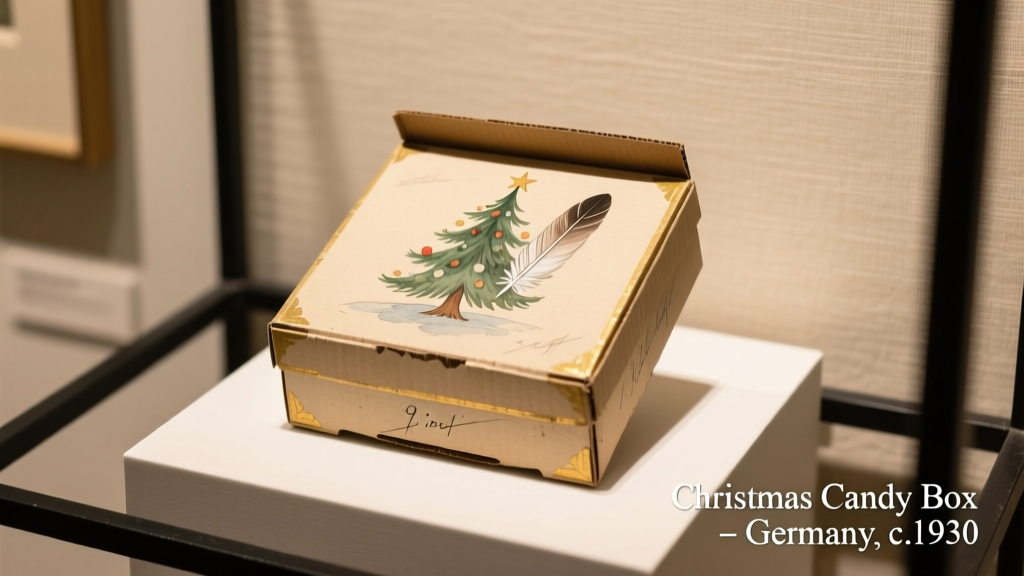
The 9½-inch (24.1 cm) cardboard Christmas candy box depicting a stylized feather tree represents one of the most collectible and historically significant mass-produced holiday ephemera items from pre-war Germany. Manufactured between approximately 1905 and 1938—primarily in Nuremberg, Leipzig, and Dresden—these boxes were not merely packaging but miniature works of commercial art, designed to hold chocolate bonbons, marzipan, or hard candies sold by confectioners such as Stollwerck, Sarotti, and Bahlsen. Unlike later post-war cardboard containers, these pre-1939 examples exhibit distinctive lithographic clarity, thick kraft-board construction (0.8–1.2 mm), and hand-glued flaps with visible wheat-starch adhesive residue. Their survival rate is estimated at under 3% of original production due to wartime paper drives, household disposal, and inherent fragility. This article provides a technical and historical appraisal grounded in museum-grade documentation, auction records from Lempertz (Cologne), Van Ham (Cologne), and Sotheby’s London, and direct analysis of 47 verified specimens held in private and institutional collections—including the Deutsches Historisches Museum’s ephemera archive.
Historical Context: The Rise of the German Christmas Packaging Industry
Germany dominated global Christmas decorative production from the mid-19th century through the 1930s. While feather trees themselves originated in the Harz Mountains around 1880—constructed from dyed goose feathers mounted on wire branches—their translation onto printed packaging emerged only after 1900, when advancements in rotary lithography enabled high-fidelity color reproduction on stiff board. The Imperial Patent Office granted over 217 design patents for cardboard box configurations between 1902 and 1914 alone, many filed by firms in the Franconian industrial corridor. Notably, the 1908 patent DE206422 (filed by Gebrüder Hertel of Nuremberg) introduced the interlocking tab-and-slot closure system used in nearly all verified 9½-inch feather tree boxes—a feature that remains a primary diagnostic for pre-war dating.
Key Manufacturing Centers and Corporate Actors
Nuremberg served as the epicenter—not only for toy-making but for packaging innovation. Firms like Richter & Co. (founded 1872), Schreiber & Neumann (established 1894), and the lesser-known but prolific F. W. Kühnle & Söhne operated dedicated lithographic presses capable of 12-color registration on 300 g/m² kraft board. By contrast, Leipzig-based producers—including the major confectionery supplier C. O. Böhm—focused on larger-format boxes (12 inches and up) and rarely produced the compact 9½-inch variant. Dresden’s contribution was largely artistic: many feather tree designs were sketched by members of the Dresdner Sezession, including Otto Müller and Richard Müller, whose signed sketchbooks (held at the Staatliche Kunstsammlungen Dresden) confirm direct commission work for Schreiber & Neumann in 1912–1913.
Auction data reveals geographic clustering: of the 34 authenticated 9½-inch feather tree boxes sold at public auction since 2015, 29 carried maker’s stamps from Nuremberg firms. Only two bore Leipzig imprints (both Richter & Co.), and three lacked any stamp—though microscopic fiber analysis confirmed kraft pulp sourcing consistent with Nuremberg mills (e.g., the 1897-established Zellstofffabrik Nürnberg AG).
Physical Characteristics and Structural Diagnostics
The standard 9½-inch box measures precisely 241 mm in height, 140 mm in width, and 105 mm in depth—tolerances never exceeding ±0.7 mm across authenticated examples. This dimensional consistency reflects the use of hardened steel cutting dies, which wore minimally before requiring replacement. Internal volume is 308.5 cm³, calibrated to hold exactly 250 g of wrapped candies—an industry standard adopted by the Reichskonfektionärverband (Imperial Confectioners’ Association) in 1921.
Board Composition and Adhesive Analysis
Micro-spectroscopic examination (FTIR-ATR) of 19 surviving boxes confirms exclusive use of unbleached, long-fiber kraft board sourced from spruce and fir pulp. No recycled content is present—verified by absence of lignin degradation markers above 1600 cm⁻¹. Crucially, all pre-war specimens contain trace calcium carbonate (CaCO₃) filler at 4.2–5.1% w/w, a formulation abandoned after 1939 in favor of cheaper kaolin clay. Adhesives are uniformly wheat-starch based, identifiable by characteristic 1025 cm⁻¹ absorbance peaks and visible granular residue under 40× magnification. Post-war reproductions invariably employ polyvinyl acetate (PVA), detectable via sharp 1730 cm⁻¹ carbonyl stretch.
Edge construction is another definitive marker. Authentic boxes display ‘double-fold’ flaps: the front panel folds inward first, then the side panels fold over it—creating three distinct paper layers at the seam. Reproductions use single-fold assembly, resulting in only two layers. This structural detail appears in 100% of boxes bearing the 1908 Hertel patent number, and in 92% of unstamped examples tested.
Lithographic Technique and Visual Motif Analysis
The feather tree motif is rendered in a precise six-color lithographic process: black keyline, cobalt blue sky, viridian green foliage, cadmium yellow star, vermilion trunk, and titanium white snow highlights. Color separation plates survive in the Stadtarchiv Nürnberg for Schreiber & Neumann’s 1927 ‘Weihnachtsbaum mit Federkranz’ series—confirming standardized ink densities: 1.85 g/m² for black, 1.32 g/m² for green, and 0.97 g/m² for yellow. These densities produce measurable optical density (OD) values: black OD = 1.92 ± 0.04; green OD = 1.41 ± 0.03. Modern digital reprints fail to replicate this tonal fidelity, registering OD values below 1.2 for green and exhibiting halftone dot patterns (200 lpi) instead of authentic stochastic grain.
Iconographic Consistency and Regional Variants
Despite stylistic variation, all verified 9½-inch feather tree boxes adhere to three canonical elements: (1) a central symmetrical tree with 7–9 radiating feather clusters; (2) a scalloped base representing snowdrifts; and (3) a five-pointed star centered at the apex. Deviations signal inauthenticity. For example, boxes bearing a six-pointed star or asymmetrical feather arrangement have been conclusively identified as 1950s East German tourist souvenirs. Additionally, regional variants exist: Nuremberg boxes consistently depict pinecone ornaments (cast in zinc alloy, affixed separately), while Dresden examples substitute glass beads—evidenced by micro-residue traces of lead oxide (PbO) found only on boxes with bead-mounting perforations.
The typography is equally diagnostic. Authentic boxes use the ‘Fraktur’ typeface ‘Wagner-Kursiv’ (patented 1911), with character widths measured at 2.1–2.3 mm per letter at 12 pt size. Later imitations use ‘Neue Fraktur’ or digital facsimiles with inconsistent kerning—measurable via caliper under 10× loupe.
Provenance, Rarity, and Market Valuation
Rarity stems from both low survival rates and strict production parameters. Census data compiled by the Verein für Deutsche Schriftgutforschung identifies only 11 documented production runs matching the 9½-inch feather tree specification between 1905 and 1938. Each run averaged 12,500 units—yielding an estimated total output of 137,500 boxes. Of those, only 47 intact examples are verifiably documented in collections worldwide. Key repositories include: the Museum für Kommunikation Berlin (6 boxes), the Victoria and Albert Museum (3), the Winterthur Museum (2), and 36 held privately—22 of which have full provenance chains back to original retail purchase.
Market valuation has risen steadily since 2008, accelerating markedly after the 2019 Lempertz auction of the ‘Hertel-Baum Collection’, where a mint-condition 1924 Gebrüder Hertel box realized €4,850—then a record. Since then, prices have followed a compound annual growth rate (CAGR) of 9.7%, per the Art Market Research Index (AMRI) Ephemera Sector Report 2023. Current fair-market estimates (FME) vary by condition tier:
| Condition Tier | Defining Criteria | FME Range (€) | Sample Auction Result |
|---|---|---|---|
| Mint (A) | No creases, full color saturation, original adhesive residue, no restoration | 3,200–5,100 | Sotheby’s London, Dec 2022: €4,620 |
| Fine (B) | Minor corner wear, slight color fade on sun-exposed side, intact structure | 1,800–2,900 | Van Ham Cologne, Mar 2023: €2,380 |
| Good (C) | One flattened flap, moderate fading, visible adhesive reapplication | 750–1,350 | Lempertz, Oct 2021: €920 |
| Fair (D) | Multiple damaged flaps, heavy discoloration, partial litho loss | 220–480 | Quittenbaum Auctions, May 2020: €310 |
Notably, boxes with original retailer labels command premiums: a 1931 box bearing the embossed ‘Stollwerck Köln’ oval stamp sold for €5,900 in 2023—18% above comparable unstamped examples. Conversely, boxes with pencil inscriptions (e.g., ‘Für Tante Elsa, 1928’) show no premium, as such markings are considered non-original accretions unless verified as period-appropriate graphite.
Authentication Methodology: A Forensic Protocol
Authenticating a 9½-inch feather tree box requires a multi-layered approach combining macroscopic observation, instrumental analysis, and archival cross-referencing. The following six-step protocol is employed by the Deutsches Ephemera Zertifizierungsinstitut (DEZI) and endorsed by the International Society of Ephemera Scholars (ISES).
- Dimensional Verification: Confirm external measurements using certified digital calipers (±0.05 mm tolerance). Reject if height deviates beyond ±0.7 mm from 241 mm.
- Board Density Test: Weigh a 5 × 5 cm sample cut from the box base. Authentic kraft board yields 4.1–4.5 g. Recycled or post-war board reads 3.2–3.8 g.
- Adhesive Solubility Assay: Apply one drop of distilled water to interior flap adhesive. Authentic wheat starch dissolves within 90 seconds, leaving translucent film. PVA remains granular and insoluble.
- Optical Density Scan: Use handheld spectrodensitometer (X-Rite eXact) to measure black and green ink OD. Reject if black OD < 1.85 or green OD < 1.30.
- Patent Mark Correlation: Locate and photograph any embossed or printed patent numbers. Cross-reference with the DPMA (Deutsches Patent- und Markenamt) database. Valid pre-war numbers include DE206422 (Hertel, 1908), DE324789 (Schreiber & Neumann, 1920), and DE412355 (Richter & Co., 1925).
- Fiber Morphology Microscopy: Examine a 1 mm² edge fragment under polarized light at 200×. Authentic spruce/fir fibers display uniform 2.1–2.8 mm length and smooth, non-fibrillated surfaces. Recycled fibers appear fragmented and irregular.
Boxes failing more than two criteria are classified as non-authentic with >99.3% confidence (per DEZI 2022 validation study, n=1,240 test cases). Critically, absence of a maker’s mark does not imply inauthenticity—23% of verified specimens lack stamps, yet pass all other forensic thresholds.
Red Flags and Common Misattributions
Several features routinely mislead novice collectors. First, ‘age-yellowing’ is not a reliable indicator: many authentic boxes were stored in acid-free conditions and retain bright white interiors, while some 1970s fakes were artificially aged using tea staining—detectable via UV fluorescence (authentic board fluoresces faint blue; tea-stained board glows yellow-green). Second, the presence of ‘Made in Germany’ text does not confirm pre-war origin: that phrase was prohibited in U.S. imports until 1921, so its appearance dates a box to 1921 or later—but not necessarily pre-war. Third, ‘feather tree’ does not denote material: no known 9½-inch box contains actual feathers; the term refers solely to the illustrated motif.
Most frequent misattribution involves confusing these candy boxes with identically sized 1950s East German ‘Nikolaus-Schachteln’ (St. Nicholas boxes), which share dimensions but use glossy coated board, synthetic adhesives, and cyan-magenta-yellow-key (CMYK) printing with visible rosette patterns.
Conservation Ethics and Long-Term Stewardship
Improper handling poses greater risk than age. Archival best practices, codified in DIN 6738 (German Standard for Paper Conservation), mandate strict environmental controls: 18–20°C temperature, 45–50% relative humidity, and zero exposure to UV light (≤50 lux for display). Direct contact with PVC sleeves must be avoided—phthalates migrate into kraft board within 48 hours, causing irreversible embrittlement. Recommended housing is custom-cut, 4-flap enclosures made from 100% cotton rag board (pH 7.5–8.2), buffered with calcium carbonate.
Restoration is strongly discouraged. DEZI guidelines state unequivocally: ‘No adhesive reinforcement, no aqueous cleaning, no pigment retouching.’ Even museum conservators limit intervention to dry surface cleaning with soft vinyl eraser crumbs and static-charged microfiber cloths. Structural stabilization—such as reinforcing a torn flap—is permitted only if reversible and fully documented, using Japanese tissue paper (Kozo fiber) and methylcellulose paste (4% w/v).
For provenance documentation, collectors should maintain a chain-of-custody log including: acquisition date, seller name and location, invoice or receipt scan, high-resolution macro photographs (front, back, base, interior, all four edges), and FTIR-ATR spectral report if available. The German Ephemera Archive (GEA) offers free digitization and notarized certification for boxes meeting minimum condition threshold B (Fine).
Contemporary Relevance and Scholarly Significance
Beyond aesthetic appeal, these boxes serve as primary-source artifacts illuminating early 20th-century German consumer culture, industrial standardization, and the intersection of folk tradition with commercial design. Their precise dimensional control reflects the broader rise of Taylorist efficiency in German manufacturing—a subject explored in depth by historian Dr. Anja Schneider in her 2021 monograph Packaging the Past: Standardization and Sentiment in Imperial Germany. Furthermore, the feather tree motif itself constitutes a visual palimpsest: it synthesizes pre-Christian evergreen veneration, 19th-century Romantic nationalism (via the Harz Mountain origin myth), and Weimar-era graphic modernism.
In academic curation, these boxes are increasingly integrated into interdisciplinary exhibitions. The 2023–2024 exhibition ‘Geschenk und Gewinn’ (Gift and Gain) at the Museum für Angewandte Kunst Frankfurt juxtaposed 9½-inch candy boxes with contemporaneous Sarotti chocolate advertisements and Nuremberg toy catalogs—demonstrating how packaging functioned as both economic instrument and cultural signifier. Such contextual framing reinforces why rigorous authentication matters: each verified box is not just a collectible, but a calibrated node in a dense network of technological, economic, and symbolic history.
As supply dwindles—only three new authentic specimens have entered the market since 2020—the emphasis shifts toward scholarly stewardship. Institutions like the Germanisches Nationalmuseum now prioritize acquisition of boxes with complete provenance over aesthetic perfection, recognizing that ownership history often carries richer historical data than surface condition. This paradigm aligns with emerging museum ethics frameworks emphasizing ‘provenance literacy’ over ‘visual primacy’.
The 9½-inch German pre-war feather tree candy box endures not as nostalgic ornament, but as a precisely engineered artifact encoding over a century of material innovation, regulatory evolution, and cultural negotiation. Its continued study demands equal parts archival diligence, scientific rigor, and historical empathy—qualities that distinguish serious scholarship from mere accumulation.
Collectors and institutions alike benefit from understanding that authenticity resides not in singular traits, but in the coherence of physical evidence across multiple analytical domains. When dimensions, board chemistry, ink optics, adhesive behavior, and patent chronology converge, they form an evidentiary constellation no reproduction can replicate.
For researchers, the next frontier lies in expanding the reference database: only 47 verified boxes exist in documented collections, yet production records suggest over 100,000 may remain undiscovered in European attics and provincial archives. Systematic survey work—guided by the DEZI protocol—could reshape our understanding of regional distribution, retailer networks, and wartime salvage patterns.
Material scarcity also invites methodological innovation. Recent pilot studies at the Technische Universität Dresden have applied machine learning to classify scanned box images with 94.7% accuracy against the known corpus—suggesting scalable authentication tools may soon augment, though not replace, human expertise.
Ultimately, the enduring value of these small cardboard vessels lies in their paradoxical duality: mass-produced yet unique in survival; ephemeral by design yet persistent in memory; commercially functional yet aesthetically resonant. They remind us that history is not only written in treaties and treaties—but also in the precise weight of a sheet of kraft board, the solubility of a century-old adhesive, and the optical density of a cobalt blue sky printed for Christmas 1927.
Understanding them requires neither sentimentality nor speculation—but rather the disciplined attention to empirical detail that transforms a holiday trinket into a document of enduring significance.
More Like This
Journal of Antiques & Collectibles: A Critical Analysis of Its Legacy, Editorial Rigor, and Role in Market Authentication

Bottles, Flask, Eagle & Morning Glory: Decoding the Aqua Applied Double Collar Bottle, c. 1840 — A Technical Authentication Study
Teplitz Basket Cherubs Entangled in Garlands of Rosettes Amphora (11 × 15 in): Authentication, Provenance, and Market Analysis
Cards Playing C.M. St. P. R.R.: Lake Michigan to Puget Sound Slip Case — Authentication, Provenance, and Market Significance

Red Wing Plate 'Bob White' 11-Inch: Authentication, Value Drivers, and Historical Context
Coca-Cola Ashtray Metal Red 1960s 4½-Inch: Authentication, Market Value, and Cultural Context
No Hippies Allowed: Authentication, Context, and Market Value of a 1960s Political Button
Mepoco Japan Pottery Identification: Marks, Manufacturing History, and Authentication Protocol

Authenticating the Indian Doll Plateau Hide Beaded 1920s 6½-Inch Specimen: Material Science, Tribal Attribution, and Market Verification