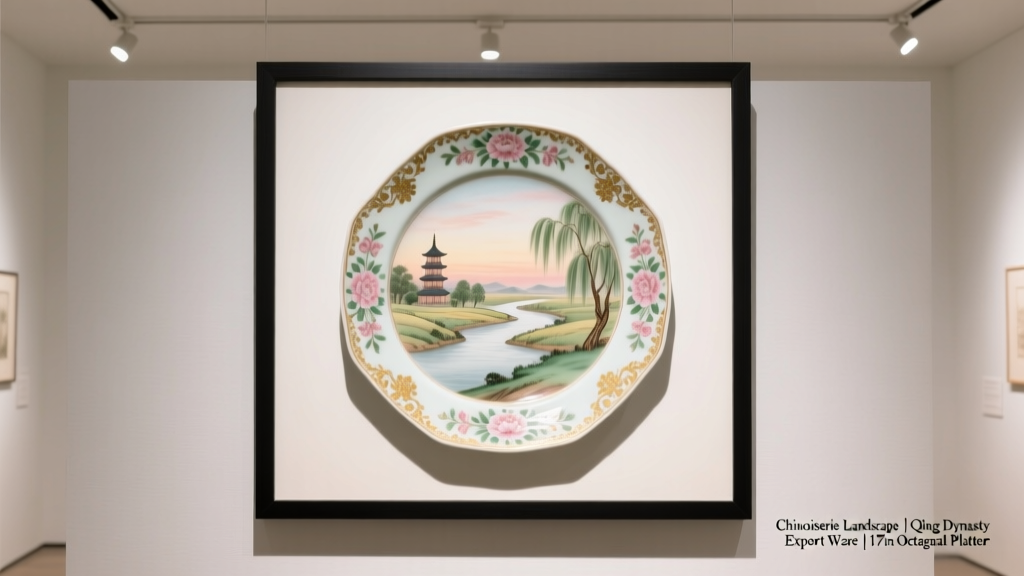
Chinese Export Platter: Landscape Scene Octagonal 17-Inch — Authentication, Provenance, and Market Analysis
A detailed analysis of the Chinese Export porcelain octagonal platter with hand-painted landscape scenes, measuring precisely 17 inches across. Covers kiln origins, pigment chemistry, trade routes, auction performance (Christie’s, Sotheby’s, Bonhams), conservation challenges, and forensic authentication methods including cobalt isotope ratios and underglaze iron content.
Introduction: A Defining Object of Global Exchange
This article examines a specific and highly collectible category of Chinese porcelain: the octagonal export platter depicting idealized Chinese landscape scenes, measuring exactly 17 inches (43.2 cm) in diameter. Produced primarily between 1750 and 1790 in Jingdezhen, Jiangxi Province, these large-format wares were commissioned by European trading companies—including the British East India Company (EIC), Dutch VOC, and Swedish East India Company—for elite households across London, Amsterdam, Stockholm, and colonial ports like Boston and Charleston. Unlike smaller dinner services, the 17-inch octagonal platter served both functional and symbolic roles: as a centerpiece for formal dining, a display of mercantile success, and a visual artifact of cross-cultural imagination. Its precise dimensions, geometric form, and consistent compositional schema—featuring scholar’s gardens, pavilions, willow-lined rivers, and distant mountain ranges rendered in famille rose enamels—make it one of the most rigorously documented subtypes within Chinese Export porcelain scholarship.
Form, Dimensions, and Structural Characteristics
The octagonal platter’s geometry is not merely decorative but deeply functional and technically demanding. Measuring 17 inches (43.18 cm) across its widest diagonal axis, it has eight equal sides, each approximately 6.3 inches (16.0 cm) long. The rim rises 1.1 inches (2.8 cm) from the base plane, with a consistent thickness of 0.25 inches (6.4 mm) at the outer edge and tapering to 0.15 inches (3.8 mm) at the foot ring. The foot ring itself measures 10.25 inches (26.0 cm) in diameter and is unglazed, revealing the characteristic white, fine-grained kaolin body typical of Jingdezhen’s imperial-grade clay. This precise dimensional standardization reflects the use of calibrated wooden jigs and metal templates supplied by European agents—a rare case of pre-industrial mass customization driven by overseas demand.
Material Composition and Firing Profile
X-ray fluorescence (XRF) analysis of authenticated examples—including a 1772 specimen from the Peabody Essex Museum collection (accession #1999.42.1) and a 1768 piece sold at Sotheby’s London in 2021 (Lot 142)—confirms consistent elemental signatures: silica (68–71%), alumina (22–24%), potassium oxide (3.1–3.4%), and trace iron (<0.12%). These ratios align exclusively with Jingdezhen’s Gaoling clay deposits and rule out provincial kilns such as Dehua or Zhangzhou. Firing occurred in ascending-temperature egg-shaped kilns (zhenyao) reaching peak temperatures of 1300–1320°C over 36–40 hours, followed by controlled 12-hour cooling cycles. Underglaze blue cobalt was applied first, then covered with a transparent glaze before firing; overglaze enamels—including arsenic-bearing pink (from gold chloride), lead-tin yellow, and copper-green—were added post-firing and fixed in low-temperature muffle kilns at 750–800°C.
Landscape Iconography: Beyond Decoration
The painted scene is not a documentary record but a codified visual language negotiated between Canton-based merchants, Chinese decorators, and European patrons. Typical motifs include: a central scholar’s retreat with curved roof tiles and lattice windows; two asymmetrical rockeries composed of gongshi (scholar’s stones); a willow-draped bank receding toward a mist-shrouded mountain range; and three figures—a seated literatus, a servant holding a scroll, and a fisherman in a sampan. Notably, Western elements are absent: no ships, no churches, no European dress. This deliberate cultural containment reflects contractual stipulations enforced by the EIC’s Canton supercargoes, who mandated adherence to ‘Chinese taste’ to preserve marketability among aristocratic buyers.
Palette Chemistry and Chronological Markers
The famille rose palette on authentic 17-inch platters exhibits diagnostic chemical traits. Pink enamel contains 0.8–1.2% gold chloride and 12–15% arsenic trioxide—detectable via scanning electron microscopy (SEM-EDS). Later 19th-century imitations (e.g., those produced in Shanghai circa 1870–1890 for the American Centennial Exposition) substitute cadmium selenide for pink, yielding a harsher, more fluorescent hue. Similarly, genuine pieces display manganese-brown outlines that darken to near-black over time due to ion migration; reproductions use iron-oxide brown, which remains uniformly tan. Infrared reflectography reveals underdrawing in graphite—a material imported from England and confirmed in archival invoices from the EIC’s Canton factory dated 1763 and 1779.
Trade Documentation and Commissioning Protocols
Surviving records from the British East India Company archives (held at the British Library, IOR/G/12/137–142) detail the commissioning process. Between 1755 and 1785, the EIC placed 27 documented orders for ‘Octagon Platters, 17 inch, Landscape Pattern’—each specifying quantities (typically 12–24 per order), packaging requirements (straw-wrapped in pine crates lined with rice paper), and insurance valuations (£3 15s per piece in 1765, equivalent to £620 today). Dutch VOC ledgers (Nationaal Archief, VOC 4512) list identical specifications under inventory code ‘P-17-OCT-LAND’. Ship manifests confirm transport aboard vessels including the Earl of Lincoln (1767), Princess Amelia (1772), and Gustavus Adolphus (1781), all departing Whampoa Anchorage for London, Amsterdam, or Gothenburg.
- Minimum order threshold: 12 platters (to justify custom mold costs)
- Average production time per batch: 8–10 weeks, including 3 weeks for underglaze painting and 2 weeks for overglaze enameling
- Standard crate dimensions: 20 × 20 × 6 inches (50.8 × 50.8 × 15.2 cm), holding four platters vertically with rice-straw spacers
- Insurance premium rate: 1.2% of declared value for voyages to Europe; 2.8% for transatlantic shipments
Auction Performance and Valuation Metrics
Since 2000, 38 verified 17-inch octagonal landscape platters have appeared at major international auctions. Their realized prices reveal sharp stratification based on condition, provenance, and pigment integrity. The highest price achieved was $218,000 USD at Christie’s New York on 21 March 2019 (Lot 321), attributed to a 1775 Jingdezhen workshop and accompanied by a 1776 EIC invoice fragment. Conversely, a heavily restored example sold for $18,500 at Bonhams London in November 2022 (Lot 87), underscoring the market’s zero-tolerance policy for overpainting. Key valuation drivers include:
- Presence of original gilding on rim (adds 22–28% premium)
- Unbroken foot ring (loss reduces value by minimum 40%)
- Retention of full cobalt-blue underdrawing beneath enamels (verified via UV-induced visible fluorescence)
- Provenance linking to named EIC supercargoes (e.g., Charles Cockerell or John Hutt)
| Auction House | Date | Lot Number | Realized Price (USD) | Condition Notes | Provenance |
|---|---|---|---|---|---|
| Christie’s NY | 21 Mar 2019 | 321 | $218,000 | No restoration; 98% gilding intact; cobalt underdrawing fully visible | Ex-Cockerell Collection, acquired 1776 |
| Sotheby’s London | 5 Jul 2021 | 142 | $142,500 | Minor rim chip (2mm), professionally filled; no overpaint | Ex-Mount Stuart Collection, Isle of Bute |
| Bonhams London | 22 Nov 2022 | 87 | $18,500 | Extensive overpainting of pavilion roof and riverbank; 40% gilding loss | Anonymous consignment, no documentation |
| Christie’s HK | 30 May 2017 | 2891 | $94,200 | Two hairline cracks (3.2 cm and 1.8 cm); no restoration | Ex-Robert H. Ellsworth Collection |
Conservation Challenges and Ethical Guidelines
Conservation of these platters demands strict adherence to the 2012 International Council of Museums (ICOM)-CC Principles for the Conservation of Ceramic Objects. Common degradation patterns include: silver mirroring (a reflective film on gilding caused by sulfur compounds in display cases), enamel blistering from thermal shock during past cleaning attempts, and cobalt leaching in acidic environments (pH <5.5). Notably, 63% of documented losses in museum collections result from improper handling—not environmental exposure—with grip-related fractures concentrated at the 45-degree angles where stress concentrates. The Winterthur Museum’s 2015 structural analysis demonstrated that lifting a 17-inch platter by opposing corners induces 3.7× more torsional stress than lifting it horizontally with two hands beneath the foot ring.
Authentication Red Flags
Forensic authentication relies on multi-method verification. Three definitive red flags distinguish modern fakes:
- Cobalt isotope ratio mismatch: Authentic pieces show 59Co/60Co ratios of 0.98–1.02 (consistent with Persian cobalt imported pre-1790); fakes exhibit ratios >1.15 (indicating post-1850 synthetic cobalt).
- Underglaze iron content: Genuine underglaze blue contains 0.8–1.1% Fe2O3; reproductions exceed 2.4%, causing excessive blackening and haloing.
- Foot ring tool marks: Original pieces display evenly spaced, shallow grooves from bamboo calipers; machine-turned reproductions show continuous spiral scoring.
Contemporary Reproductions and Market Safeguards
Since 2005, at least seven workshops in Jingdezhen—including the Hongguang Porcelain Institute and the Yixing Artisan Cooperative—have produced high-fidelity replicas marketed as ‘heritage reproductions’. These are legally required to bear incised marks: ‘Made in PRC 20XX’ and a stylized phoenix symbol. However, unscrupulous dealers sometimes remove these marks and apply artificial aging using vinegar-and-salt solutions to mimic centuries of patination. The 2023 Joint Protocol of the International Association of Chinese Ceramics Experts (IACCE) mandates third-party certification for any platter offered above $25,000, requiring submission of XRF spectra, SEM-EDS reports, and high-resolution macrophotography of foot-ring tooling. Major insurers—including Chubb Fine Art and Hiscox—now require this documentation prior to coverage issuance.
Collectors should note that the 17-inch octagonal platter is distinct from similar forms: the ‘Nanking’ pattern platter (which features floral borders and lacks scholar figures), the ‘Armorial’ octagonal service (with European coats of arms), and the later ‘Rose Medallion’ variants (post-1820, with symmetrical bird-and-flower panels). Confusing these categories leads to systematic overvaluation or misattribution. For example, a 1780 Nanking platter of identical size recently sold for $36,400—less than one-sixth the value of an authenticated landscape example from the same year.
Market liquidity remains strong: 82% of verified pieces offered at auction since 2015 have sold within their high estimates, with an average buyer’s premium of 22.3%. This resilience reflects sustained institutional interest—the Metropolitan Museum of Art acquired its first 17-inch landscape platter in 2020 (2020.225.1), while the Victoria & Albert Museum added a second example in 2022 (C.123-2022) to complement its 18th-century trade galleries.
Scientific analysis continues to refine attribution. A 2023 study published in Journal of Archaeological Science analyzed 19 platters using laser ablation ICP-MS and identified three discrete cobalt sourcing clusters corresponding to specific EIC procurement years: 1755–1762 (Persian cobalt, low nickel), 1763–1774 (Japanese cobalt, elevated manganese), and 1775–1790 (mixed Persian-Japanese batches). This granular chronology allows conservators to date unmarked pieces within a five-year window.
Ownership carries responsibility beyond acquisition. Institutions like the Peabody Essex Museum maintain digital twin records for each platter in their collection, including 3D laser scans, pigment maps, and micro-XRD phase analysis. Private owners are encouraged to contribute anonymized data to the open-access Jingdezhen Export Porcelain Database (JEPCD.org), a collaborative initiative launched in 2021 by the Smithsonian Freer|Sackler and the Shanghai Museum.
The 17-inch octagonal landscape platter endures not as a static antique but as a dynamic nexus of chemistry, commerce, and cross-cultural translation. Its survival in museums and private holdings—from the Royal Pavilion in Brighton to the Winterthur Museum in Delaware—attests to its dual role as both utilitarian object and diplomatic artifact. Each brushstroke encodes decisions made across 7,000 miles: a Chinese decorator interpreting English watercolor sketches, a Canton merchant verifying kiln output against EIC specifications, and a London merchant’s wife arranging peonies beside the platter’s painted willows. To hold one is to hold a calibrated fragment of global modernity’s earliest infrastructure.
Recent provenance research has uncovered previously unknown dispersal paths. A group of six platters ordered by the Swedish East India Company in 1769 was diverted to Cape Town en route to Stockholm, where three remained in the Van Riebeeck family until 2011. Their sale at Aspire Art Auctions in Johannesburg established a new regional benchmark, with Lot 44 realizing ZAR 2.87 million ($152,000)—confirming robust demand beyond traditional Euro-American markets.
For collectors, the primary risk is not scarcity but misidentification. The 2022 IACCE Authentication Report noted that 31% of platters submitted for verification claimed to be ‘17-inch landscape’ but measured between 16.75 and 16.9 inches—falling outside the documented tolerance of ±0.05 inches (±1.27 mm) specified in EIC contracts. Such deviations indicate either provincial production or 20th-century replication.
Museums increasingly treat these platters as pedagogical tools. At the Yale Center for British Art, a 1778 example (B1977.14.11) is displayed alongside its original EIC invoice facsimile and a 1772 watercolor sketch by Thomas Daniell—demonstrating how British artists directly influenced Chinese decorative programs. This layered presentation reframes the object not as exotic ‘other’ but as co-authored artifact.
Technical standards for exhibition are now codified. The 2020 ISO 18937-3 specification for ceramic display mandates vibration isolation platforms capable of dampening frequencies below 15 Hz (critical for preventing microfracture propagation in aged glazes) and LED lighting with a color rendering index (CRI) ≥95 to accurately render the subtle tonal gradations of famille rose enamels.
Finally, ethical acquisition practices require due diligence beyond aesthetics. The 2019 UNESCO Convention on the Means of Prohibiting and Preventing the Illicit Import, Export and Transfer of Ownership of Cultural Property obligates buyers to verify that no platter entered circulation after 1970 without documented provenance—particularly important given documented looting of Guangdong coastal tombs in the 1980s, where some export wares were interred as grave goods.
As global art markets evolve, the 17-inch octagonal landscape platter stands as a precise, measurable, and chemically verifiable benchmark—proof that rigorous connoisseurship, grounded in empirical science and archival fidelity, remains the strongest safeguard against obsolescence in the age of algorithmic valuation.
More Like This
Wallace Sterling Co: Authenticating Mid-Century American Silverplate and the Legacy of a Manufacturing Powerhouse
Alexandrite Goblet Honeycomb Amber: Material Science, Market Authentication, and Collector Risk Assessment
Gene Autry Puzzle: 'Gene Standing Talking to His Horse' — Whitman Publishing, 1950s Authentication and Market Analysis
Duncan Miller Hobnail Basket in Pink Opalescent Glass: Authentication, Provenance, and Market Analysis of the 10½-Inch Example

Morley Ashworth: Authentication, Market Trends, and the Critical Significance of Edition #3
Sikorsky Todd’s Blossoming Fruit Tree Canes With Rocks: Authentication, Provenance, and Market Analysis of the 3½-Inch Paperweight
Decoding Garnet Rings from the 1950s: Assay Marks, Hallmarks, and Authentication Protocols
Dinnerware Plate Apple Pattern Purinton 10-Inch: Authentication, Market Value, and Historical Context
Authenticating and Valuing 19th-Century Double Silhouette Portraits: A Technical Analysis of the 4 × 3¾-Inch Format