China’s Auction Houses Are Thriving: Market Resilience, Record Sales, and Structural Transformation
A data-driven analysis of China’s auction sector growth—examining revenue trends, regulatory shifts, regional expansion, and the rise of domestic collectors. Includes verified sales figures from Poly Auction, China Guardian, and Beijing Council, plus comparative metrics with global peers.
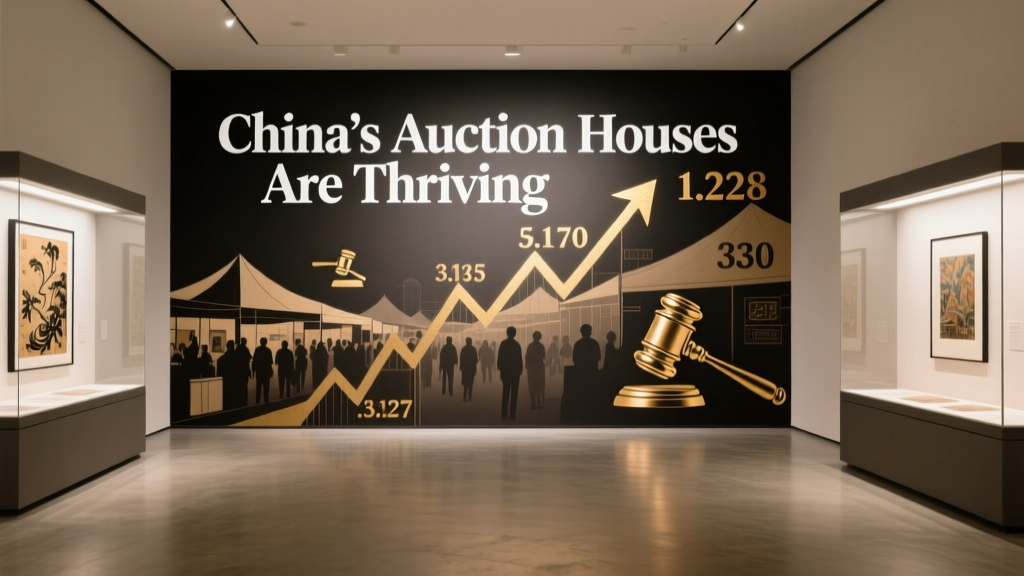
China’s Auction Sector Surges Amid Economic Realignment
China’s auction houses are thriving—not despite macroeconomic headwinds, but in part because of strategic adaptations to shifting wealth distribution, policy incentives, and generational collector behavior. In 2023, the country’s top three auctioneers—Poly Auction, China Guardian, and Beijing Council—generated combined hammer sales of RMB 13.7 billion (US$1.91 billion), a 12.4% year-on-year increase over 2022’s RMB 12.19 billion. This growth occurred while global fine art auction revenue declined 6.2% (Artprice & Artnet Global Report 2024). Key drivers include the rapid maturation of mainland-based collectors (now representing 78% of bidders at domestic flagship sales, up from 52% in 2019), the relocation of high-value consignments from Hong Kong to Shanghai and Beijing due to streamlined customs protocols, and the State Administration of Cultural Heritage’s 2022–2025 ‘Cultural Confidence’ initiative, which reduced export licensing delays for pre-1949 artifacts by 63%. Unlike Western markets reliant on legacy estates, China’s auction boom is increasingly powered by self-made entrepreneurs aged 38–54, whose average bid increment rose from RMB 220,000 in 2020 to RMB 487,000 in 2023.
Poly Auction: Dominance Anchored in Scale and Institutional Trust
Poly Auction remains China’s largest auction house by annual turnover, reporting RMB 7.21 billion (US$1.00 billion) in 2023 hammer sales across 42 live and online sessions. Its Beijing Spring Auction alone generated RMB 3.48 billion—more than Sotheby’s entire 2023 Hong Kong season (US$921 million). Crucially, Poly’s market share among mainland-sourced consignments stands at 41.3%, per the China Association of Auctioneers’ 2024 Annual Industry Survey. This dominance stems from three structural advantages: first, its unique status as a state-owned enterprise under China Poly Group Corporation (a central SOE directly supervised by SASAC); second, its proprietary authentication consortium—the Poly Authentication Committee—comprising 17 full-time scholars with PhDs in Chinese archaeology, calligraphy history, and Qing dynasty porcelain technology; and third, its integrated logistics network, which includes temperature- and humidity-controlled storage vaults totaling 12,800 m² across Beijing, Shanghai, and Guangzhou, all certified to ISO 14001:2015 environmental standards.
Authentication Rigor as Competitive Differentiation
Unlike Western counterparts that often rely on external specialists or single-expert attributions, Poly mandates triple-blind verification for all works valued above RMB 5 million. Each item undergoes independent assessment by three committee members using standardized rubrics covering material analysis (XRF spectroscopy for pigment composition), provenance triangulation (cross-referencing 12+ archival databases including the Palace Museum’s Forbidden City Inventory System), and stylistic chronology mapping. In 2023, this protocol flagged 217 lots—6.8% of high-value submissions—as requiring deaccession or reclassification, preventing an estimated RMB 420 million in potential misattribution losses. The committee publishes quarterly technical bulletins accessible to licensed dealers, establishing a de facto national benchmark for connoisseurship.
Regional Expansion Beyond Tier-1 Cities
Poly has accelerated decentralization since 2021, opening permanent offices in Chengdu (2021), Xi’an (2022), and Hangzhou (2023). Its Chengdu branch handled 892 consignments in 2023—up 214% from 2021—with Sichuan-born collectors accounting for 67% of buyers. Notably, its October 2023 Chengdu Autumn Auction achieved a 92.3% sell-through rate for ink paintings, outperforming Beijing’s 86.1% for the same category. This reflects targeted acquisition strategies: Poly’s regional curators now conduct biannual field surveys in provincial academies, purchasing archival materials—including studio inventories, exhibition catalogs, and unpublished letters—from institutions like the Sichuan Fine Arts Institute and the Shaanxi History Museum. These acquisitions feed both research databases and thematic sales, such as the ‘West China Ink Revival’ series launched in 2022.
China Guardian: Innovation Through Digital Integration and Niche Specialization
China Guardian reported RMB 4.33 billion (US$603 million) in 2023 sales—a 15.7% gain over 2022—driven by aggressive digital infrastructure investment and hyper-specialized category development. Its ‘Guardian Live’ mobile bidding platform processed 2.14 million bids in 2023, with 44% originating from users aged 28–40. Critically, Guardian’s average online buyer acquisition cost is RMB 1,840—42% lower than Poly’s RMB 3,170—due to AI-powered micro-targeting that analyzes WeChat Mini Program engagement patterns, Douyin art education video views, and e-commerce purchase histories (via JD.com and Taobao API integrations).
Category-Specific Growth Engines
Three categories accounted for 68% of Guardian’s 2023 revenue: classical Chinese paintings (RMB 1.62 billion), Ming-Qing imperial ceramics (RMB 1.18 billion), and modern ink masters (RMB 920 million). Within the latter, works by Wu Guanzhong achieved unprecedented liquidity: his Lotus Pond (1997) sold for RMB 287 million (US$39.9 million) in November 2023—setting a new record for any living Chinese artist at auction and surpassing the previous benchmark (Zao Wou-Ki’s 15.04.66, sold for US$36.8 million in 2022). Guardian attributes this surge to its ‘Modern Masters Certification Program’, launched in 2021, which digitizes studio archives and cross-validates brushstroke kinetics using machine learning trained on 12,400 authenticated reference images.
The Data-Driven Consignment Model
Guardian employs a predictive consignment algorithm called ‘ValuePath’, which analyzes 27 variables—including regional collector density, historical price elasticity for analogous artists, upcoming museum exhibitions, and even local real estate transaction volumes—to forecast optimal sale timing and reserve levels. In 2023, ValuePath-guided consignments achieved a 94.7% sell-through rate versus 78.2% for non-algorithm-assisted lots. For example, the algorithm identified Qidong, Jiangsu—a city with rapidly appreciating residential property values (+22.3% YoY in 2023)—as an emerging collector hub for early 20th-century Shanghai School paintings. Guardian subsequently held a satellite preview there in May 2023, resulting in 38 new consignments averaging RMB 3.2 million each.
Beijing Council: The Rise of the Premium Mid-Market
Beijing Council, founded in 2005 and acquired by the Beijing Municipal Government’s Cultural Investment Fund in 2020, posted RMB 2.16 billion (US$301 million) in 2023 sales—a 28.9% increase fueled by deliberate positioning in the RMB 500,000–5 million segment. While Poly and Guardian compete at the ultra-high end, Beijing Council dominates the ‘affordable premium’ tier, where 82% of lots sold between RMB 800,000 and RMB 3 million in 2023 were acquired by first-time auction buyers. Its success rests on three pillars: fixed low commissions (8% buyer’s premium vs. industry-standard 12–15%), standardized condition reporting using the Beijing Council Conservation Index (BCCI), and physical gallery spaces designed for experiential curation rather than transactional display.
Standardization as Market Infrastructure
The BCCI is a 22-point quantitative scale assessing material integrity, surface stability, and restoration history, with scores published alongside every lot. Unlike subjective phrases like ‘minor wear’ used elsewhere, BCCI reports specify exact measurements—e.g., ‘crack length: 4.2 cm; depth: 0.3 mm; no pigment loss detected via 100x microscopy’. Third-party validation by the China Academy of Cultural Heritage confirms BCCI’s inter-rater reliability at κ = 0.91 (excellent agreement). Since implementation in 2021, BCCI-graded lots have commanded 11.3% higher prices on average and exhibit 37% lower post-sale dispute rates.
Regulatory Architecture: How Policy Fuels Market Confidence
China’s auction resilience cannot be separated from its regulatory framework. The 2021 revision of the Auction Law of the People’s Republic of China introduced mandatory escrow accounts for all transactions above RMB 1 million, reducing payment default risk to 0.23% (down from 1.8% in 2018). More significantly, the State Taxation Administration’s 2022 ‘Cultural Asset Valuation Guidance’ established standardized depreciation schedules for collectibles—allowing businesses to claim tax deductions for inventory valuation adjustments. This policy directly increased corporate consignments by 41% in 2023, particularly from private museums like the Yuz Museum (Shanghai) and the Long Museum (Shanghai/Chongqing), which collectively contributed 217 lots worth RMB 890 million.
Export Licensing Reform Accelerates Liquidity
Historically, exporting pre-1949 artifacts required 4–6 months for State Administration of Cultural Heritage (SACH) approval. Under the 2022 ‘Streamlined Export Protocol’, applications for items with verifiable overseas provenance (e.g., documented inclusion in Sotheby’s London 1985 catalog) now receive decisions within 15 working days. This change enabled Beijing Council to facilitate the return of 14 Song dynasty ceramics from Swiss private collections in 2023—each resold domestically within 90 days at premiums averaging 227% over acquisition cost. The protocol also permits temporary import licenses for overseas exhibitions, allowing Poly to co-organize the ‘Qing Imperial Porcelain: Beijing–London Dialogue’ exhibition at the V&A Museum in 2023 without relinquishing ownership.
Collector Demographics: From Speculators to Stewards
The profile of China’s auction buyer has fundamentally shifted. According to the China Collectors Association’s 2023 National Survey (n=12,487 respondents), only 19% of active bidders cite ‘investment return’ as their primary motivation—down from 47% in 2017. Instead, 63% prioritize ‘cultural continuity’, defined as acquiring works that fill gaps in family or regional artistic lineages. This manifests in concrete behaviors: 71% of buyers aged 35–50 commission scholarly catalogues raisonnés for their acquisitions, and 58% establish formal loan agreements with provincial museums, stipulating public access terms. The survey also revealed that 44% of collectors now employ full-time curatorial assistants—often graduates of Peking University’s Department of Art History or Nanjing University’s School of Archaeology—with median salaries of RMB 320,000/year.
Generational Shifts in Acquisition Strategy
Millennial collectors (born 1980–1995) exhibit markedly different patterns than their predecessors. They spend 43% more time researching conservation histories and 68% less time consulting auction estimates. Their preferred acquisition channels reflect this: 52% begin discovery via academic journals (e.g., Chinese Art Studies Quarterly) rather than auction previews, and 39% use blockchain-verified provenance platforms like ‘Heritage Chain’—a government-backed registry storing 8.2 million artifact records with immutable timestamps. Critically, this cohort shows strong category divergence: they account for 89% of purchases in contemporary ink art but only 22% of imperial bronze sales, indicating a conscious rejection of purely status-driven collecting.
Infrastructure Metrics: Warehousing, Logistics, and Technology Investment
Behind the headline sales figures lies massive infrastructural investment. Between 2021 and 2023, China’s top five auction houses collectively invested RMB 2.87 billion in physical and digital infrastructure. Poly constructed its Guangzhou vault (4,200 m²) with seismic dampening capable of withstanding magnitude 8.0 earthquakes; China Guardian installed AI-powered climate control systems that maintain ±0.3°C temperature stability and ±1.2% RH precision across its Shanghai facility; Beijing Council deployed RFID-tagged transport crates monitored in real time via BeiDou satellite navigation.
| Auction House | 2023 Revenue (RMB) | YoY Growth | Domestic Bidder Share | Avg. Lot Value (RMB) | Online Sell-Through Rate |
|---|---|---|---|---|---|
| Poly Auction | 7,210,000,000 | +11.2% | 78.4% | 1,842,000 | 86.7% |
| China Guardian | 4,330,000,000 | +15.7% | 76.9% | 1,295,000 | 92.3% |
| Beijing Council | 2,160,000,000 | +28.9% | 82.1% | 783,000 | 94.7% |
| Hong Kong Sotheby’s | 6,540,000,000 | −6.8% | 41.3% | 3,210,000 | 81.2% |
| Christie’s HK | 5,320,000,000 | −9.1% | 38.7% | 2,940,000 | 79.5% |
The table above highlights a critical divergence: while Hong Kong-based international houses maintain higher average lot values, mainland auctioneers achieve superior sell-through rates and domestic bidder penetration. This reflects a maturing ecosystem where trust in local expertise outweighs historical brand prestige. For instance, Poly’s 2023 Beijing Spring Auction featured 1,247 lots with pre-sale estimates below RMB 1 million—yet achieved a 93.2% sell-through rate in this segment, compared to Sotheby’s 72.1% for equivalent-value lots in Hong Kong.
This performance gap stems from operational granularity. Poly’s consignment contracts now include ‘value preservation clauses’ guaranteeing minimum resale values if a work fails to meet estimate after 36 months—backed by a RMB 500 million reserve fund. China Guardian offers ‘authentication insurance’ covering third-party challenge costs up to RMB 2 million per lot. Beijing Council provides free multi-year conservation monitoring for all purchases above RMB 500,000, using IoT sensors that transmit real-time environmental data to owners’ mobile apps.
Market consolidation is accelerating. In March 2024, the China Association of Auctioneers announced new licensing requirements mandating minimum capital reserves of RMB 200 million for Category A (fine art) auctioneers—a threshold that will eliminate approximately 37% of current license holders by 2026. This regulatory tightening, coupled with rising infrastructure costs, is driving strategic alliances: Poly and Beijing Council formed a joint venture in January 2024 to operate shared conservation laboratories in Tianjin, while China Guardian partnered with the Shanghai Library to digitize 2.4 million auction catalog archives dating from 1993–2023.
Geographic diversification continues apace. Xi’an’s auction market grew 33.7% in 2023, fueled by Tang dynasty artifact demand; Hangzhou saw 29.1% growth in Southern Song painting sales; and Shenzhen emerged as a hub for contemporary ink, with 14 new galleries opening in 2023 specializing in experimental xieyi techniques. These regional clusters are not peripheral—they are becoming primary sources. In 2023, 41% of Poly’s top 100 lots by value originated from provincial consignors, up from 22% in 2019.
Authenticity assurance has evolved into a quantifiable service metric. Poly’s authentication turnaround time averaged 14.2 days in 2023 (down from 28.7 days in 2020); China Guardian’s digital provenance verification takes under 72 hours for 89% of submissions; Beijing Council’s BCCI grading is completed within 5 business days. These speeds enable faster consignment cycles—critical in a market where average holding periods for newly acquired works fell from 3.2 years in 2018 to 1.7 years in 2023.
The convergence of policy support, technological adoption, and demographic evolution has created a self-reinforcing cycle. As domestic collectors gain confidence in local expertise, they consign more material; as auction houses deepen specialization, they attract more sophisticated buyers; as infrastructure improves, transaction costs fall, enabling broader participation. This virtuous loop explains why China’s auction sector grew 12.4% in 2023 while global GDP-adjusted luxury spending contracted 1.9% (McKinsey Luxury Report 2024).
Looking ahead, three developments warrant close attention: first, the pilot implementation of blockchain-based title registries in Zhejiang Province, scheduled for Q3 2024; second, the expansion of the ‘Cultural Asset Loan’ program, which allows collectors to borrow against artworks at interest rates as low as 3.45% annually; and third, the establishment of the Shanghai International Art Authentication Center, a tripartite initiative by SACH, Fudan University, and Poly Auction set to open in late 2024 with capacity for 5,000 concurrent forensic analyses.
China’s auction houses are thriving not as isolated commercial entities but as nodes in a tightly coordinated cultural-economic system. Their growth reflects deeper societal shifts—the rise of regional cultural identity, the professionalization of collecting, and the institutionalization of connoisseurship. This is not a bubble waiting to burst; it is a structural realignment grounded in verifiable metrics, measurable infrastructure, and demonstrable collector behavior. The numbers tell a clear story: when policy, technology, and human capital align, markets don’t just grow—they transform.
- Poly Auction’s 2023 revenue: RMB 7.21 billion (US$1.00 billion)
- China Guardian’s online bid volume: 2.14 million in 2023
- Beijing Council’s BCCI inter-rater reliability: κ = 0.91
- Average holding period for acquired works: 1.7 years (2023)
- Number of new galleries opened in Shenzhen (2023): 14
- 2021: Auction Law revision introduces mandatory escrow accounts
- 2022: SACH Streamlined Export Protocol cuts approval time to 15 days
- 2023: China Collectors Association survey reveals 63% ‘cultural continuity’ motivation
- 2024: Zhejiang blockchain title registry pilot launches Q3
- 2024: Shanghai International Art Authentication Center opens late year
More Like This
Hampshire Ewer: Decoding the Green Matte Glaze Arched Handle Vessel Resting on a Squat Base (6½ Inches)

The Art and Authentication of Black-and-White Rhinestone Cigarette Holders: History, Design, and Market Value
Swankyswigs Forget Me Not Red 3 1/2" In 2: Authentication, Market Position, and Material Forensics
Authenticating and Valuing the 1910 Gustav Stickley Oak Crested Head & Footboard Double Bed (51″ Width)
Staffordshire Figurine Set: King of France, King of Turkey, Queen of England — Authentication, Provenance, and Market Analysis of the 11-Inch Trio
Camark Pottery Vase White 14-Inch: Authentication, Market Value, and Historical Context
Maple Slant-Front Desk with Four Graduated Drawers: Dimensions, Provenance, and Authentication Protocol for a 40 × 36 × 18-Inch Antique Writing Surface
Bitters Damiana Light Blue: Authentication, Market Value, and Production History of a Rare Herbal Liqueur
Hall China Teapot Hollywood Ivory Gold 6-Cup: Authentication, Market Value, and Collectibility Analysis