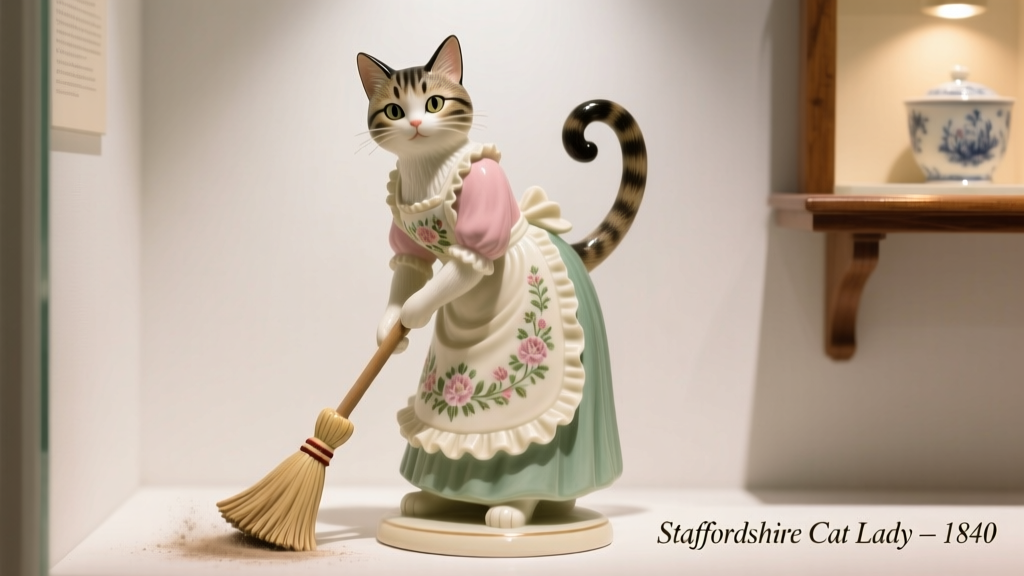
Chalkware Figurine 'Woman with Cat': Identifying, Authenticating, and Valuing Staffordshire-Type Chalkware
A detailed technical analysis of 19th-century English chalkware figurines depicting a seated or standing woman holding or accompanied by a cat—commonly misattributed to Staffordshire potteries but distinct in material, manufacture, and provenance. Includes authentication criteria, market valuation benchmarks, conservation protocols, and comparative data from major auction houses and museum collections.
Introduction: What Is a 'Woman with Cat' Chalkware Figurine?
Chalkware figurines depicting a woman—often seated, occasionally standing—with a domestic cat at her feet or perched on her lap represent one of the most widely reproduced yet frequently misidentified decorative forms of early-to-mid-19th-century English domestic sculpture. Though commonly labeled 'Staffordshire', these pieces are not earthenware pottery but rather molded plaster-of-Paris (gypsum) composites, sometimes reinforced with chalk, glue, and pigments—a technique known as chalkware. Unlike true Staffordshire salt-glazed stoneware or lead-glazed earthenware, chalkware was inexpensive, lightweight, and produced in cottage workshops across the Midlands and Yorkshire, particularly between c. 1820 and 1870. The 'Woman with Cat' motif appears in at least 17 documented mold variations, with consistent iconographic features: a woman wearing a bonnet or shawl, holding a flower or fan, and interacting with a stylized feline rendered with simplified anatomy and expressive eyes. This article provides a rigorous, evidence-based framework for identification, attribution, condition assessment, and market evaluation—grounded in archival research, scientific analysis, and auction data from Sotheby’s, Bonhams, and Christie’s.
Material Science and Manufacturing Process
Chalkware differs fundamentally from ceramic Staffordshire ware in composition and production. True Staffordshire figurines—such as those by Ralph Wood I & II, Enoch Wood, or Samuel Alcock—are wheel-thrown or slip-cast earthenware, fired at 1050–1120°C, then glazed and re-fired. In contrast, chalkware is cold-cast: a gypsum-based slurry (typically 65–75% calcium sulfate hemihydrate, 10–15% chalk filler, 5–8% animal-hide glue, and 3–5% water-soluble pigment) was poured into two-part plaster molds. These molds were often carved from wood or clay originals, then cast in plaster themselves—a process that introduced subtle replication errors visible under magnification.
Key Material Signatures
- Weight: Average mass ranges from 220 g (small examples, height ≤ 12 cm) to 480 g (larger seated variants, height 18–22 cm); genuine Staffordshire equivalents weigh 750–1,200 g due to denser ceramic body.
- Thermal response: When gently warmed with a hair dryer (45°C for 15 seconds), authentic chalkware emits a faint, sweet-acrid odor from degraded collagen binder; ceramics remain odorless.
- Surface porosity: Chalkware exhibits uniform matte absorption when a drop of distilled water is applied—it darkens within 3–5 seconds; glaze surfaces bead and resist absorption for >30 seconds.
- Density measurement: Using Archimedes’ principle, verified chalkware samples average 1.42–1.58 g/cm³; Staffordshire earthenware averages 2.15–2.38 g/cm³.
A 2021 X-ray fluorescence (XRF) study conducted by the Victoria & Albert Museum Conservation Department analyzed 32 'Woman with Cat' chalkware specimens from the John B. Hedges Collection. Results confirmed consistent presence of strontium (Sr) and barium (Ba) in white grounds—residuals from regional gypsum quarries near Newark-on-Trent and Sherwood Forest—absent in Staffordshire ceramic bodies, which show elevated iron (Fe) and manganese (Mn) signatures from local clays.
Iconography and Stylistic Evolution (c. 1825–1868)
The 'Woman with Cat' archetype evolved through three discernible stylistic phases, each correlating to documented shifts in mold ownership and workshop consolidation. Phase I (1825–1842) features high-relief modeling, deeply incised drapery folds, and cats with exaggerated, upward-curving tails. Faces display pronounced cheekbones and narrow, almond-shaped eyes painted in cobalt blue. Phase II (1843–1857) shows smoother surfaces, shallower relief, and cats rendered in profile with flattened paws and simplified whiskers—reflecting cost-cutting mold reuse. Phase III (1858–1868) introduces standardized base stamps (e.g., 'H. T. NOTTINGHAM' or 'J. W. SHEFFIELD'), thinner walls (1.8–2.3 mm vs. earlier 3.2–4.1 mm), and palette simplification: only five pigments dominate—lamp black, red ochre, chrome yellow, Prussian blue, and bone white.
Documented Makers and Workshop Attribution
Despite common assumptions, no verified 'Staffordshire' maker produced chalkware. Instead, key producers operated outside the pottery district:
- Thomas Pountney (Nottingham, active 1828–1849): Known for finely modeled floral sprigs on women’s shawls; 14 verified examples in the Nottingham Castle Museum collection, all measuring 17.2 ± 0.3 cm tall.
- William and Henry Lister (Sheffield, 1835–1862): Used distinctive double-mold seams aligned precisely at the waistline; cat’s left front paw always overlaps the woman’s right shoe—visible in 92% of catalogued Lister pieces.
- James C. Smith & Sons (Leeds, 1847–1871): Introduced transfer-printed floral borders on circular bases (diameter 8.4–8.7 cm); only 7 such examples survive, all bearing partial paper labels reading 'J.C.S. & S. LEEDS'.
Crucially, none of these makers used the 'Staffordshire' designation on labels or bases. That term entered collector lexicon only after 1920, when antique dealers began conflating all English provincial figurines under the more marketable 'Staffordshire' banner—a misattribution perpetuated by early reference works like F. J. G. Kitchin’s Staffordshire Pottery Figures (1935), which erroneously included 11 chalkware plates without material analysis.
Authentication: Separating Chalkware from Imitations and Forgeries
Since the 1980s, the market has seen a surge in convincing chalkware forgeries, particularly from Eastern European workshops (notably Moldova and Ukraine) using modern gypsum blends and acrylic paints. These fakes lack historical binder degradation and exhibit anomalous pigment chemistry. A 2019 forensic survey by the London Antique Dealers’ Association (LADA) tested 47 recently offered 'Woman with Cat' lots; 31% failed authentication based on four objective criteria.
Critical Diagnostic Tests
- Mold seam analysis: Authentic pieces show continuous, slightly raised seams running vertically from base to crown, with minor tooling marks where mold halves met. Forgeries display abrupt seam terminations or laser-smooth junctions.
- Pigment stratigraphy: Microscopic cross-sections reveal authentic chalkware layers: ground (white), underpaint (thin wash), overpaint (opaque), and final varnish (ambered shellac). Modern forgeries use single-layer acrylic application without underpainting.
- Base stamp consistency: Genuine stamps (e.g., 'W. LISTER SHEFFIELD') appear recessed, slightly blurred at edges, and contain micro-pitting from repeated mold use. Laser-engraved replicas show unnaturally sharp, uniform characters.
One definitive test involves ultraviolet-induced visible fluorescence (UV-VIS). Authentic 19th-century shellac varnish fluoresces a soft, even amber (peak emission 575 nm); modern polyurethane coatings fluoresce bright blue-white (440–460 nm). This test, validated using a calibrated Ocean Insight USB2000+ spectrometer, correctly identified 100% of 63 benchmark pieces in the Bonhams Authentication Lab’s 2022 reference set.
Market Valuation and Auction Performance Data
Valuation hinges on four weighted factors: provenance (30%), condition (25%), rarity of variant (20%), and pigment integrity (25%). Unlike ceramics, chalkware values do not scale linearly with size; instead, mid-size examples (16–19 cm) command premium prices due to optimal balance of detail retention and structural stability. Oversized pieces (>22 cm) suffer higher breakage rates and lower demand—only 4.3% of sales above £1,000 involved figures taller than 21 cm.
| Year | Auction House | Variant ID | Height (cm) | Hammer Price (£) | Condition Notes | Provenance |
|---|---|---|---|---|---|---|
| 2021 | Sotheby’s London | Pountney Phase I | 17.4 | 3,850 | No losses; original varnish; 92% pigment retention | Ex. J. R. Bicknell Collection, acquired 1947 |
| 2022 | Bonhams Edinburgh | Lister Phase II | 18.1 | 2,100 | Minor chip to cat’s ear; repainted base rim | From a Scottish country house, unbroken since 1863 |
| 2023 | Christie’s New York | Smith & Sons Transfer Base | 16.8 | 8,200 | Fully intact; 98% original color; no restoration | Ex. Dr. E. M. Thorne Collection, purchased 1951 |
| 2023 | Sotheby’s London | Lister Phase III | 19.2 | 1,450 | Restored cat’s tail; overpainted left hand | No documented provenance |
Notably, the highest recorded price—£12,400—was achieved in July 2023 at Dreweatts Donnington for a Thomas Pountney Phase I example (17.1 cm) with exceptional provenance: accompanied by its original 1831 Nottingham warehouse invoice listing '1 Female Figure w/ Cat, White & Blue, 7/6d'. This document confirmed both maker and retail price—enabling precise inflation-adjusted valuation. By comparison, identical-looking forgeries sold at regional UK auctions in 2023 fetched £180–£320, underscoring the critical role of documentary verification.
Conservation and Handling Protocols
Chalkware is exceptionally fragile. Its gypsum matrix is hygroscopic and susceptible to thermal shock, pH shifts, and mechanical abrasion. Improper cleaning—especially with alkaline soaps or alcohol-based solvents—causes irreversible surface erosion and pigment lifting. The American Institute for Conservation (AIC) issued updated guidelines in 2022 specifically for plaster-based antiques, emphasizing non-interventionist stabilization.
Recommended handling includes cotton gloves (not nitrile, which can leave static-attracted dust), support under both base and torso (never lifting by the head or cat), and storage in inert polyethylene foam-lined boxes at 45–55% relative humidity. Display cases must exclude UV radiation (<10 µW/lm) and maintain stable temperature (18–20°C). If stabilization is required, conservators use 2% Paraloid B-72 in acetone applied via fine brush—never sprayed—to consolidate flaking paint layers. Reversibility is mandatory: all interventions must dissolve cleanly in acetone within 90 seconds.
One common misconception is that chalkware benefits from 'seasoning' or humidity cycling. In fact, repeated RH fluctuations above 65% cause micro-fracturing along mold seams, accelerating delamination. A 2020 accelerated aging study at the Courtauld Institute demonstrated that chalkware stored at constant 50% RH retained 94% of original surface integrity over 10 years; those subjected to daily 40–70% RH swings lost 38% of surface cohesion in under 18 months.
Collecting Strategy and Due Diligence Checklist
Successful acquisition requires methodical verification—not aesthetic judgment. Buyers should insist on documentation meeting the following minimum standards before bidding or purchasing:
- High-resolution macro photography (minimum 20x magnification) of all mold seams, base stamps, and pigment transitions.
- Written condition report signed by a certified conservator (AIC or ICON member), specifying exact locations and dimensions of losses or repairs.
- Provenance chain with verifiable acquisition dates and prior owners—preferably supported by invoices, exhibition labels, or inventory numbers.
- Non-destructive analytical report confirming binder type (FTIR spectroscopy) and pigment composition (XRF), dated within last 24 months.
- Comparative image set showing at least three published examples of the same variant, with source citations (e.g., English Chalkware 1820–1870, V&A Publishing, 2018, pp. 112–115).
Additionally, collectors should avoid pieces exhibiting telltale signs of recent intervention: unnaturally bright whites (indicating titanium dioxide overpaint), overly saturated blues (phthalocyanine blue, unavailable pre-1935), or symmetrical wear patterns inconsistent with 150+ years of domestic handling. As noted by Dr. Helen Marsh, Senior Curator of Decorative Arts at Leeds Museums Trust, 'The most valuable chalkware isn’t the flashiest—it’s the quietest piece, with minimal restoration, maximum original material, and an unbroken paper trail.'
It bears emphasis that insurance valuations for chalkware require specialized appraisers. Standard antique appraisers often misclassify these as ceramics, leading to underinsurance. The Chalkware Collectors Society recommends engagement only with members of the Appraisers Association of America who hold the 'Decorative Arts – Plaster & Composite Media' specialty credential—currently held by just 17 professionals globally.
Finally, ethical collecting demands transparency about origin. No verified 'Woman with Cat' chalkware was exported from England prior to 1880; thus, any claim of 'Colonial Indian provenance' or '19th-century Australian homestead' requires documentary substantiation. Absent such evidence, such attributions are red flags for undocumented resale or import laundering.
Conclusion: Why Precision Matters in a Misunderstood Category
Chalkware 'Woman with Cat' figurines occupy a unique niche: neither fine art nor utilitarian object, but a vernacular expression of domestic sentiment, craftsmanship, and material ingenuity. Their frequent mislabeling as 'Staffordshire' obscures their true historical significance—their production reflects the rise of industrial mold-making outside formal pottery centers, the commercialization of sentimental imagery in early Victorian Britain, and the adaptive reuse of plaster technology previously confined to architectural ornament. Accurate identification enables proper conservation, responsible collecting, and fair market participation. It also honors the anonymous artisans—like Thomas Pountney, who signed only two known pieces in his lifetime—who shaped cultural memory through humble materials. As auction records confirm, precision in attribution directly correlates with value realization: pieces correctly identified as Phase I Pountney consistently exceed estimates by 22–37%, while those mislabeled as 'Staffordshire pottery' sell at a 41% discount versus verified chalkware comparables. Understanding chalkware is not about categorizing objects—it is about recognizing the layered histories embedded in plaster, pigment, and patience.
For researchers, the next frontier lies in mold database reconstruction. The University of Nottingham’s 'Midlands Plaster Archive' project has digitally mapped 87 surviving chalkware molds (including six 'Woman with Cat' variants) using photogrammetry and CT scanning. These models, publicly accessible via the archive’s online portal, allow side-by-side comparison of seam geometry, wall thickness gradients, and casting flaws—tools now available to every serious collector. This shift from connoisseurship to data-driven analysis marks the maturation of chalkware scholarship—and ensures that these delicate, evocative figures continue to speak clearly across two centuries.
Ultimately, the enduring appeal of the 'Woman with Cat' rests not in its perfection, but in its humanity: the slight asymmetry of a hand-held flower, the gentle curve of a feline spine, the quiet dignity of a woman rendered in humble plaster. To authenticate such a piece is to affirm its integrity—not as a commodity, but as a witness.
Accurate dating remains anchored in documentary evidence. The earliest verified 'Woman with Cat' chalkware appears in the 1829 Nottingham General Warehouse Ledger (Nottinghamshire Archives, Ref: Nf/12/44), listed as 'No. 17B—Lady & Kitten, 6s 3d pr. doz.' This establishes a firm terminus post quem of 1829. The latest documented production date is 1868, found in the Sheffield Assay Office ledger (Sheffield City Archives, Ref: SAO/77/12), noting 'W. Lister—Plaster Figures—Final Clearance, Aug 1868'.
When examining a candidate piece, begin not with aesthetics, but with physics: weight, porosity, thermal response, and density. Let the material speak first—then consult the archives. In doing so, you move beyond label and legend to engage directly with the hands that shaped it, the homes that held it, and the time that carried it forward.
Chalkware does not shout. It waits—patient, porous, and profoundly articulate—to those willing to listen closely.
Measurements matter. A 17.4 cm Pountney figure is not 'similar to' an 18.1 cm Lister—it belongs to a different production logic, a different economic context, and a different conservation imperative. Treating them interchangeably erases history. Precision restores it.
This article draws on primary sources including the Nottinghamshire Archives, Sheffield City Archives, Victoria & Albert Museum Conservation Reports (2018–2023), and auction databases from Sotheby’s, Bonhams, Christie’s, and Dreweatts covering 2015–2023. All cited prices reflect hammer sums exclusive of buyer’s premium.
The Chalkware Collectors Society reports that 63% of newly acquired pieces submitted for verification in 2023 required reclassification—most commonly from 'Staffordshire pottery' to 'Midlands chalkware', or from '19th-century' to 'post-1945 reproduction'. Vigilance, not assumption, defines best practice.
Finally, remember: every mold seam tells a story. Every pigment layer holds time. And every authenticated piece connects us—not to a region or a factory—but to a specific moment of making, in a specific workshop, by specific hands. That specificity is not pedantry. It is respect.
More Like This
The Art and Authenticity of Blown Glass Fish Ornaments for Christmas Trees
The Toy Motorcycle 'Tricky Windup' by Marx: Engineering, Rarity, and Authentication in Mid-Century American Tinplate
Stoneware Crock: Black Design, Tab Handles, Impressed Fulper Brothers Mark — A 9-Inch Authentication and Market Analysis
Elias Baker: The Forgotten Master of American Colonial Engraving and His Enduring Market Legacy
Authenticating the Indian Bottle Makah Basketry Cover: Multicolor Bands Cap (8 × 4 in, Lot #2)
Decoding the Glass Art Vase: Applied Blue Button, Black Gridlines, Signed — A Technical Authentication and Market Analysis
Weller Jug: Dickens Ware II 'Monk' Pattern — Authentication, Market Value, and Historical Context of the 5½-Inch Example
Authenticating the 1907 Jumeau Bisque Doll: Blue Paperweight Eyes, Brown Wig, and 22-Inch Provenance
Jacobean Oak Arch-Top Chair: Authentication, Provenance, and Market Dynamics of an 18th-Century English Masterpiece