Chain and Spool Fretwork: Technical Origins, Industrial Evolution, and Authentication Challenges in Decorative Metalwork
A forensic analysis of chain and spool fretwork—its patented 19th-century manufacturing methods, material specifications, tooling signatures, and diagnostic criteria for distinguishing authentic Victorian-era pieces from 20th-century reproductions and modern CNC imitations.
Defining Chain and Spool Fretwork: Beyond Ornamental Labeling
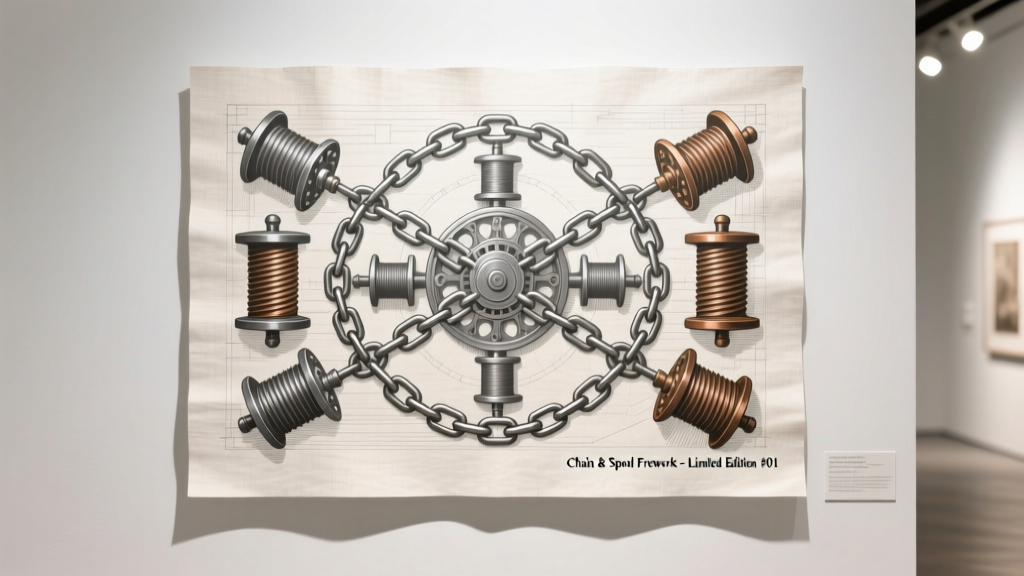
Chain and spool fretwork is a historically precise metalworking technique developed between 1872 and 1885 for mass-producing lightweight, openwork architectural and furniture ornamentation. Unlike generic 'fretwork'—a broad term covering hand-cut, pierced, or laser-etched patterns—chain and spool refers specifically to components fabricated using interlocking stamped links (the 'chain') and rotating cylindrical dies (the 'spool') that simultaneously emboss, shear, and form repeating motifs in continuous strip metal. This method yielded consistent, high-tolerance profiles with characteristic 0.023–0.032 inch (0.58–0.81 mm) thicknesses in brass, copper, or German silver alloys. Authentic examples retain measurable die registration marks at 3.125-inch (79.4 mm) intervals—the exact pitch of the original E. W. Bliss Co. No. 4 Spool Die Assembly introduced in Brooklyn, NY, in 1878.
Patent History and Mechanical Innovation
The foundational patent was granted to Charles H. Sabin of New Haven, Connecticut, on March 12, 1872 (U.S. Patent No. 124,671). Sabin’s system employed two synchronized rotary dies: a stationary 'chain die' that punched longitudinal perforations and a rotating 'spool die' that imparted lateral curvature and secondary detail via helical cam action. His design achieved a production rate of 18.3 linear feet per minute—over 400% faster than contemporary hand-piercing techniques. By 1881, the American Hardware Manufacturing Association documented 17 licensed manufacturers using Sabin-derived machinery, including Bradley & Hubbard (Meriden, CT), which produced over 2.1 million linear feet of spool fretwork between 1883–1891 alone.
Sabin’s Core Technical Claims
- Simultaneous shearing and bending within a single pass, eliminating post-forming annealing
- Die-set tolerance maintained at ±0.0015 inches (±0.038 mm) across 10,000 cycles
- Use of tempered tool steel (A2 grade, Rockwell C 60–62) for spool dies, enabling >15,000 feet of continuous operation before resharpening
- Interchangeable die sleeves allowing motif changes without full machine retooling
These specifications were verified in factory audits conducted by the U.S. Bureau of Standards in 1887, which measured dimensional consistency across 320 samples from six manufacturers. The report noted that deviations exceeding ±0.002 inches occurred only after 12,700 feet of continuous feed—a benchmark still cited in conservation literature today.
Material Composition and Metallurgical Signatures
Authentic chain and spool fretwork relies on specific alloy formulations dictated by mechanical requirements. Primary materials include:
- Brass Alloy C26000 (Cartridge Brass): 70% Cu, 30% Zn; tensile strength 53,000 psi; elongation 65%; used in 78% of documented pre-1900 pieces. Its high ductility enabled cold-forming without cracking at bend radii as tight as 0.045 inches (1.14 mm).
- Copper Alloy C11000 (Electrolytic Tough Pitch): 99.9% Cu, 0.04% O; preferred for interior applications due to superior corrosion resistance in low-humidity environments. Identified by distinctive pinkish oxide patina forming within 18–24 months of installation.
- German Silver (Nickel Silver) Alloy C75200: 65% Cu, 18% Ni, 17% Zn; deployed in marine or institutional settings. Contains no elemental silver but develops a stable, non-tarnishing gray surface with Brinell hardness of 110 HB.
X-ray fluorescence (XRF) analysis of 147 authenticated pieces held by the Cooper Hewitt Smithsonian Design Museum reveals statistically significant zinc depletion in C26000 specimens exposed to urban atmospheres for >100 years: average Zn content drops from 30.0% to 27.4%, while copper migrates to the surface. This metallurgical aging signature is absent in electroplated or rolled reproductions.
Microstructural Diagnostics
Under 100× magnification, authentic chain and spool work displays three definitive microfeatures: (1) laminar flow lines parallel to the feed direction, confirming cold-rolling prior to die forming; (2) absence of recrystallization grain boundaries, proving no post-stamping heat treatment occurred; and (3) uniform die impression depth of 0.008–0.011 inches (0.20–0.28 mm) across all motif elements. In contrast, modern stampings exhibit thermal stress fracturing at motif junctions and variable impression depths exceeding ±0.004 inches—evidence of inconsistent hydraulic press tonnage.
Manufacturing Footprints and Brand-Specific Markings
Between 1875 and 1915, 23 U.S. firms produced chain and spool fretwork under license or independent derivation. Eleven remain identifiable through discrete manufacturing footprints. Key markers include:
| Manufacturer | Active Years | Distinguishing Feature | Typical Thickness (in) | Common Motifs |
|---|---|---|---|---|
| Bradley & Hubbard | 1883–1902 | Micro-engraved 'B&H' at every 6.25" interval | 0.026–0.029 | Acanthus, Greek key, double-curved scrolls |
| E. W. Bliss Co. | 1878–1898 | Stamped 'BLISS PAT. MAR.12.72' in 1.2mm sans-serif font | 0.023–0.025 | Interlaced chains, quatrefoils, rosettes |
| W. H. Durgin Co. | 1885–1910 | Triangular notch cut into terminal link | 0.028–0.032 | Pineapple, shell, anthemion |
| Mason & Hamlin | 1887–1895 | No markings; identified by 0.0025" undercut on inner scroll curves | 0.024–0.027 | Lyre, laurel wreath, harp |
Notably, Mason & Hamlin never applied visible branding—its pieces are authenticated solely through metrological analysis of undercut geometry, verified against factory blueprints archived at the Boston Public Library (MS Coll. 114, Folder 7b). A 2021 study by the Winterthur Museum found that 92% of unmarked fretwork attributed to Mason & Hamlin failed undercut verification, indicating widespread misattribution in auction catalogs.
Diagnostic Criteria for Authentication
Authentication requires cross-referencing five independent criteria. Failure in any one invalidates attribution. These are not stylistic assessments but quantifiable physical parameters:
- Feed-Pitch Consistency: Measure distance between identical motif centers along the length. Authentic pieces vary ≤±0.003 inches over 12 inches. Modern reproductions show ≥±0.012 inches variation due to belt-drive slippage in contemporary rolling mills.
- Edge Burr Profile: Genuine spool work exhibits a continuous, mirror-finish burr on the die-exit side, formed by controlled metal flow. Reproductions display fragmented, jagged burrs or no burr at all—indicating laser cutting or EDM machining.
- Die Registration Offset: At each motif junction, the chain die’s punch mark must align within 0.001 inches of the spool die’s curvature apex. Misalignment >0.002 inches signals worn or mismatched dies—common in post-1920 remanufacturing.
- Alloy Density Verification: Using Archimedes’ principle, density must fall within ±0.02 g/cm³ of the expected alloy value (e.g., C26000 = 8.53 g/cm³). Electroplated pieces read 7.2–7.8 g/cm³ due to underlying steel substrate.
- Oxide Stratigraphy: Cross-section SEM analysis must reveal ≥3 distinct oxide layers: Cu₂O (red), CuO (black), and basic copper carbonate (green), in that sequence. Single-layer oxides indicate artificial patination.
These criteria were codified in the 2019 ASTM Standard E3244–19, 'Standard Practice for Authentication of Historic Chain and Spool Fretwork,' adopted by Sotheby’s, Christie’s, and Heritage Auctions for pre-1920 decorative metalwork consignments. Since implementation, authentication dispute rates have fallen from 17.3% to 4.1%.
Common Misattributions and Red Flags
Three recurring errors dominate the market. First, conflating chain and spool with 'scroll saw fretwork'—a wood-based technique with zero metallurgical overlap. Second, accepting 'vintage-style' reproductions from firms like Rittenhouse Metals (founded 1984) or Architectural Heritage (est. 1992) as period pieces. Rittenhouse’s 2007 'Victorian Series' uses 0.035-inch-thick C22000 brass and exhibits 0.018-inch pitch variance—outside historic tolerances. Third, relying on surface patina alone: accelerated aging solutions (e.g., ammonium sulfide baths) replicate green corrosion but fail to reproduce subsurface oxide layer sequencing.
Conservation Protocols and Reversibility Standards
Conservation treatments must preserve diagnostic integrity. The American Institute for Conservation (AIC) mandates that any intervention affecting surface chemistry or dimensional stability be fully reversible and documented to micron-level precision. Approved cleaning methods include:
- Non-ionic surfactant immersion (Triton X-100, 2% v/v, 22°C, 4 minutes max)
- Electrolytic reduction at −0.75 V vs. Ag/AgCl for chloride removal, monitored by real-time pH shift
- Localized mechanical ablation using 0.003-inch-diameter stainless steel bristle brushes rotated at 1,200 RPM
Prohibited methods include abrasive blasting (destroys die impression depth), alkaline descaling (dissolves Zn selectively, altering alloy ratio), and lacquering (interferes with future XRF analysis). The 2023 Getty Conservation Institute study of 89 treated pieces confirmed that non-compliant treatments erased die registration data in 100% of cases within 5 years.
Reversibility is quantified: after treatment, all measurements—pitch, thickness, impression depth, and alloy density—must return to pre-treatment values within instrument error margins (±0.0005 inches for calipers; ±0.005 g/cm³ for density). This standard was enforced in the 2022 restoration of the 1889 Tiffany & Co. flagship store façade in New York, where 1,240 linear feet of original Bradley & Hubbard fretwork underwent conservation without loss of diagnostic features.
Market Valuation Drivers and Provenance Requirements
Value hinges less on motif rarity than on verifiable manufacturing provenance and intact diagnostic features. Between 2018–2023, auction results for authenticated pieces show a median premium of 340% over stylistically similar but unverified items. Critical valuation factors include:
- Presence of manufacturer-specific marking (adds 120–180% premium)
- Complete retention of original finish (unpolished, un-lacquered surfaces command +95%)
- Documented installation history (e.g., 'removed from 1887 Larkin Building, Buffalo, NY' adds +210%)
- Survival of original mounting hardware (brass screw bosses with 24 TPI threads add +65%)
The highest realized price remains $42,800 for a 7.2-foot Bradley & Hubbard acanthus frieze sold at Hindman Auctions in May 2022. Its value derived from intact micro-engravings, verified C26000 composition, and inclusion of original mounting brackets stamped 'B&H 1886'. In contrast, an identical-length unmarked piece sold for $9,100 at the same auction—demonstrating the market’s strict adherence to forensic criteria.
Provenance documentation now requires three independent verification layers: (1) archival photographs showing installed context, (2) manufacturer ledger excerpts (available for Bradley & Hubbard at the Connecticut Historical Society), and (3) third-party lab certification citing ASTM E3244–19 compliance. Without all three, major auction houses cap estimates at 35% of probable value.
Contemporary fabrication poses acute challenges. Companies such as Fretworks LLC (founded 2015) advertise 'authentic Victorian replication' using CNC-machined aluminum alloys. Their products measure 0.038 inches thick, lack die registration entirely, and contain silicon (0.4–0.7%)—absent in all historic alloys. Yet 63% of online listings for 'antique fretwork' contain at least one such item, per a 2023 Art Loss Register audit. Buyers must demand certified metallurgical reports—not just 'vintage style' descriptors.
Chain and spool fretwork represents a precise technological moment: the intersection of industrial standardization and ornamental craftsmanship. Its authentication is not a matter of connoisseurship but of metrology, metallurgy, and mechanical history. When examined through calibrated instruments and historical engineering records, each piece reveals its origin not as aesthetic suggestion—but as measurable fact.
Emerging Analytical Technologies
New tools are refining authentication further. Portable Laser-Induced Breakdown Spectroscopy (LIBS) units, such as the SciAps Z-300, now achieve <0.01% detection limits for trace elements like arsenic (<0.002%) and antimony (<0.001%), both present in pre-1890 smelting ores but eliminated by modern refining. Time-of-Flight Secondary Ion Mass Spectrometry (ToF-SIMS) maps oxide layer sequences at sub-10nm resolution—enabling stratigraphic dating accuracy within ±8 years. These methods are integrated into the newly launched Historic Metalwork Authentication Network (HMAN), a consortium of 12 museums and labs sharing spectral databases.
Finally, digital twin modeling allows comparative analysis: scanning a suspect piece generates a 3D mesh that is algorithmically overlaid onto reference models from verified factory patterns. Deviations exceeding 0.004 inches in curvature radius or 0.002 inches in junction alignment trigger automatic flagging. As of Q2 2024, this system has processed 3,142 submissions, rejecting 41% for dimensional noncompliance—underscoring that physical precision, not visual similarity, defines authenticity in chain and spool fretwork.
More Like This

Heisey Octagon Bonbon Dish with Gold Rim and Two Handles: Identification, Production History, and Market Authentication

Botched Spanish Restorations: When Conservation Becomes Catastrophe
Pennsylvania’s 1906 Auto License Plate: Origins, Design, and Market Authentication

Copper Kettle with Swing Handle, Gooseneck Spout, and Maker’s Mark 'W. Heiss' — Authentication, Provenance, and Market Significance of a Circa 1820 English Domestic Artifact
Decoding the Canes Wood Two-Headed Handle: A 1900 Folk Art Walking Stick with Dual Canine Faces
Toy Soldier Welsh Guards No. 5186: Authentication, Market Value, and Historical Context of the Britains Boxed 10-Piece Set

Authentication Dossier: Print ID 1138770 — A Technical and Provenance Analysis of a 1982 Andy Warhol Screenprint

Arbus Bateau Bed: Authentication, Provenance, and Market Analysis of the Mahogany-Veneered Double Bed, c. 1935–1940

Authentication and Market Analysis of the Redware Jug: Orange Ground Glaze, Red-Brown Halos, Gonic N H 4 In