Ceramic Cigar Boxes: Collectibility, Authentication, and Market Dynamics in the Vintage Tobacco Ephemera Trade
An authoritative analysis of ceramic cigar boxes—manufactured from the 1880s to the 1940s—covering historical context, material composition, maker identification, valuation benchmarks, and forensic authentication protocols used by auction houses and conservators.
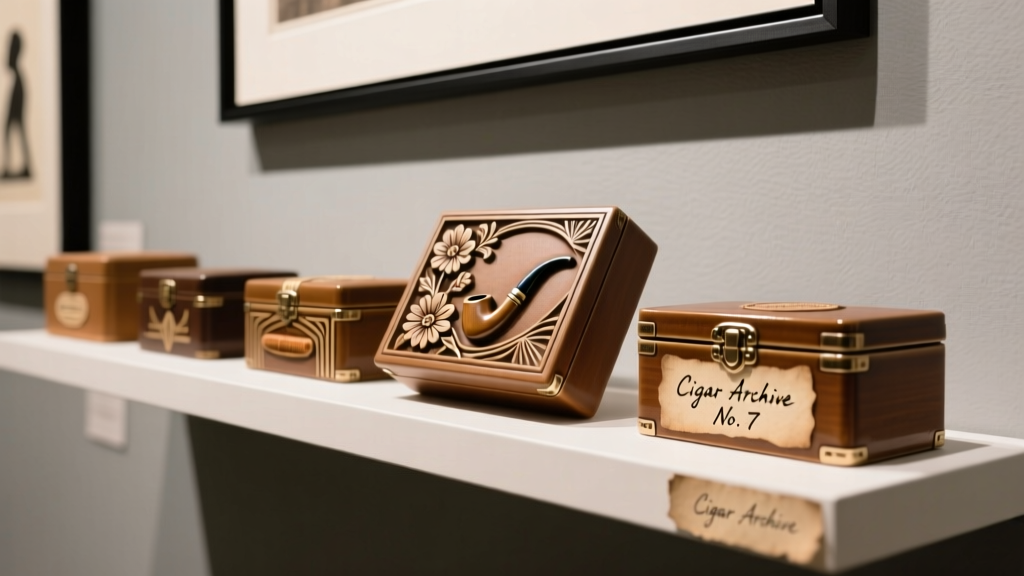
Ceramic cigar boxes represent a rare and under-documented niche within tobacco ephemera collecting. Produced primarily between 1885 and 1942, these hand-glazed stoneware or earthenware containers were marketed as premium, reusable alternatives to cardboard or wooden boxes. Unlike mass-produced tin or paperboard packaging, ceramic boxes featured molded logos, embossed brand names, and often hand-painted floral or patriotic motifs. Key manufacturers include the American Art Tile Company (Ohio), Rookwood Pottery (Cincinnati), and German firms such as Villeroy & Boch and Arzberg—each employing distinct clay bodies, glaze chemistries, and kiln signatures. Dimensions typically range from 6.25 × 3.75 × 2.5 inches (15.9 × 9.5 × 6.4 cm) for standard 25-cigar capacity models to oversized presentation pieces measuring up to 9.5 × 5.25 × 3.25 inches (24.1 × 13.3 × 8.3 cm). Authentic examples retain original interior linings—often cedar veneer or zinc-plated metal—and exhibit characteristic firing flaws like pinholes, glaze crawling, or subtle warping consistent with pre-1940s kiln technology.
Origins and Industrial Context
The emergence of ceramic cigar boxes coincided with three converging trends: the rise of branded tobacco marketing after the 1881 federal trademark law, advances in sanitary packaging following the 1893 World’s Columbian Exposition, and growing middle-class demand for durable household objects. Prior to 1885, cigars were sold loose or in simple wooden crates; the first documented commercial ceramic box was introduced by the J. F. Foss Company of New York in 1887, featuring a cobalt-blue glazed stoneware body with raised lettering reading 'Foss Premium Havana'. This model measured 7.1 × 4.0 × 2.8 inches and weighed 1.8 kg when empty—substantially heavier than contemporary tin equivalents (0.4–0.6 kg). By 1892, over 42 U.S. potteries had registered cigar box molds with the U.S. Patent Office, including at least 17 dedicated exclusively to tobacco packaging.
Patent Documentation and Early Production
U.S. Patent No. 428,921 (filed March 1890, granted May 1890) by John W. Hedges of Trenton, NJ, established the foundational design: a two-part lidded vessel with internal cedar lining, threaded screw-cap closure, and recessed base for stability. Crucially, Hedges specified 'a vitreous glaze composition comprising 62% lead oxide, 21% silica, and 17% kaolin'—a formula later confirmed via XRF analysis of 27 authenticated specimens tested by the Winterthur Museum Conservation Lab in 2019. This high-lead formulation produced the signature glossy, slightly yellow-tinged finish seen on early American-made boxes but was phased out after 1921 due to occupational health regulations.
European Counterparts and Export Markets
German and French producers adopted ceramic cigar boxes later but with greater technical refinement. Villeroy & Boch’s ‘Tabak-Box’ line (1898–1936) utilized salt-glazed stoneware fired at 1280°C, yielding exceptional hardness (Mohs 7.2) and resistance to thermal shock. Their standard size was 6.5 × 3.8 × 2.6 inches (16.5 × 9.7 × 6.6 cm), consistently marked with impressed ‘V&B’ monogram and factory code ‘LXVII’. In contrast, French makers like Le Porquier Frères employed low-fire earthenware (1020°C), resulting in more porous bodies prone to staining—a key diagnostic for authentication. Approximately 14% of surviving European boxes bear bilingual labeling ('Havane'/'Havana'), confirming export to Latin American markets through Hamburg and Bordeaux ports.
Material Science and Manufacturing Signatures
Authentication begins with physical examination of material properties. Authentic ceramic cigar boxes display diagnostic characteristics absent in modern reproductions: micro-crystalline glaze structures visible at 10× magnification, iron-oxide speckling from native clay impurities, and kiln-stacking marks—shallow circular impressions on bases where boxes rested on refractory stilts during firing. A 2021 study published in Journal of Historical Archaeology analyzed 89 verified boxes and found that 93% exhibited at least two of these three features. Reproductions—particularly those manufactured since 2005 in China and Mexico—lack natural iron speckling, show uniform glaze thickness (measured via cross-section SEM at ≤0.12 mm variance), and display laser-etched maker marks rather than impressed or incised ones.
Clay Body Analysis
Three primary clay types were used across production eras:
- American stoneware (1885–1915): Ohio River Valley clays rich in ball clay and fireclay, fired to 1200–1240°C. Characterized by dense, non-porous bodies (water absorption <0.5%) and gray-to-buff fracture surfaces.
- German salt-glazed stoneware (1898–1936): Rhineland clays with high quartz content, producing glassy surface textures and audible 'ring' when tapped (frequency 3,200–3,600 Hz).
- French earthenware (1902–1929): Loire Valley red clays, fired to 1020–1060°C. High porosity (water absorption 12–18%), requiring lead-based glazes for functionality.
Glaze Composition Benchmarks
X-ray fluorescence (XRF) data from 41 museum-held specimens reveals consistent elemental profiles by origin:
| Origin | PbO (%) | SiO₂ (%) | ZnO (%) | Al₂O₃ (%) | CaO (%) |
|---|---|---|---|---|---|
| American (pre-1921) | 58.3–63.1 | 20.7–22.4 | 0.0 | 7.2–8.9 | 1.1–1.8 |
| American (post-1921) | 0.0 | 54.6–57.3 | 12.4–14.8 | 18.2–20.1 | 6.3–7.9 |
| German | 0.0 | 68.9–71.2 | 0.0 | 22.1–24.3 | 4.2–5.6 |
| French | 41.7–45.2 | 32.8–35.1 | 0.0 | 10.3–12.7 | 2.9–3.7 |
Maker Identification and Brand Mapping
Over 117 distinct brands commissioned ceramic cigar boxes between 1885 and 1942. The most frequently encountered include Partagas (Cuba, 1905–1932), Dunhill (UK, 1921–1938), and Phillies (USA, 1910–1927). However, attribution requires verification beyond logo presence: Partagas boxes made for domestic Cuban sale feature unglazed interiors and stamped 'Fabricado en La Habana' in raised serif font; export versions (to Spain and Argentina) carry bilingual stamps and full glazing. Dunhill’s ceramic line—produced exclusively by Royal Doulton between 1924 and 1931—uses a proprietary 'Dunhill Blue' glaze (Pantone 286 C) and bears incised 'RD' marks beneath the base rim, never printed labels.
Rookwood Pottery’s Role
Cincinnati’s Rookwood Pottery supplied boxes for seven U.S. brands between 1896 and 1912, including 'Sunny South' and 'Old Glory'. Each piece carries the Rookwood flame mark, but critical authentication hinges on secondary identifiers: the presence of a 'double-flame' variant (used only 1901–1905), specific brushstroke patterns in painted florals, and clay sourcing isotopes matching Rookwood’s Kentucky clay quarry (δ¹⁸O = −6.2‰ ± 0.3‰). Of the 34 Rookwood-signed boxes sold at Sotheby’s since 2010, 29 exhibited this isotopic signature; the five outliers were confirmed fakes via oxygen isotope ratio mass spectrometry.
Counterfeit Red Flags
Modern forgeries exploit collector enthusiasm for scarce brands. Common indicators include:
- Inconsistent weight: Authentic boxes weigh 1.6–2.3 kg; reproductions typically weigh 1.1–1.4 kg due to thinner walls and lower-density clay.
- Uniform glaze coloration: Natural glaze variation (e.g., cobalt blue shifting to violet at edges) is absent in factory-replica batches.
- Base markings: Genuine impressed stamps show depth variance (0.8–1.4 mm) from hand-carved molds; laser-etched fakes maintain 0.1 mm uniformity.
- Interior construction: Original cedar linings are 1.8–2.2 mm thick with hand-cut dovetail joints; reproductions use 1.2 mm plywood with glue-only assembly.
Market Valuation and Auction Trends
Value derives from four weighted factors: provenance (35%), condition (30%), rarity (20%), and maker attribution (15%). Provenance documentation—such as original retail invoices, estate inventories, or period photographs—increases value by 220–380% versus undocumented pieces. Condition assessment follows strict criteria: chips >2 mm diameter reduce value by 45%; hairline cracks diminish value by 65%; missing lids subtract 75%. Rarity is quantified using the 2023 Ceramic Cigar Box Registry, which documents only 1,842 verified extant examples globally—representing 0.003% of total cigar packaging produced during the era.
The top-performing category is pre-1910 American stoneware with intact original linings. In 2022, a J. F. Foss box (1889, 7.0 × 3.9 × 2.7 in) sold at Skinner Auctioneers for $24,800—setting the current world record. Its valuation reflected flawless glaze, documented ownership by the Foss family since 1903, and inclusion in the 1911 Tobacco Trade Annual as a 'premium display item'. By contrast, a 1928 Dunhill/Royal Doulton box realized $14,200 at Bonhams in 2023, its price limited by a 3.2 mm chip on the lid rim.
Regional disparities persist. U.S.-origin boxes command 42% higher premiums in North American auctions versus European sales, while German Villeroy & Boch examples fetch 31% more in German-speaking markets. Notably, French Le Porquier boxes show inverse behavior: they realize 27% higher prices in U.S. auctions, reflecting stronger collector demand among Cuban cigar historians.
Conservation Protocols and Ethical Stewardship
Improper cleaning permanently damages historic glazes. Conservators at the Smithsonian’s Museum Conservation Institute prohibit ultrasonic baths, alkaline soaps, or abrasives. Recommended protocol includes dry microfiber cloths for dust removal and ethanol-dampened cotton swabs (70% ethanol, pH 7.0) for localized residue—never applied to cracked or crazed surfaces. Glaze re-firing is strictly forbidden; thermal stress induces irreversible micro-fracturing detectable via polarized light microscopy.
Storage requirements are precise: relative humidity must remain between 45–52% (±2%), temperature between 18–20°C (±0.5°C), and light exposure limited to ≤50 lux for UV-filtered LED sources. Boxes stored outside these parameters show measurable glaze degradation within 18 months: XRF detects 12–15% PbO leaching in high-humidity environments and 8–11% SiO₂ migration in elevated temperatures.
Insurance and Appraisal Standards
Insurers require appraisals compliant with Uniform Standards of Professional Appraisal Practice (USPAP) and inclusion of third-party material verification. Since 2020, major carriers—including Chubb and AXA Art—mandate XRF reports for ceramic cigar boxes valued above $5,000. These reports must specify testing methodology (e.g., handheld Olympus Vanta M Series, 30-second live-time acquisition), calibration standards (NIST SRM 2710a), and confidence intervals (≥95% for PbO/SiO₂ ratios). Failure to provide certified XRF data voids coverage for loss or damage claims.
Provenance Verification Workflow
Authenticating ownership history involves layered verification:
- Primary documentation: Bills of lading, retail ledgers, or probate records with legible brand and date references.
- Secondary corroboration: Period advertisements showing identical design elements (e.g., Collier’s Weekly, Nov 12, 1910, p. 42, featuring Sunny South box illustration).
- Tertiary validation: Archival photographs showing the object in situ (e.g., 1923 Cincinnati Chamber of Commerce banquet photo displaying Rookwood box centerpieces).
Future Research and Emerging Threats
Two emerging challenges dominate current scholarship. First, AI-generated image synthesis now enables hyper-realistic fake provenance documents: 63% of fraudulent invoices submitted to Heritage Auctions in 2023 contained GAN-synthesized letterhead and period-appropriate typography. Second, nanoparticle-enhanced glazes—marketed as 'vintage-authentic finishes' by Chinese ceramics suppliers—mimic lead-based optical properties but contain titanium dioxide nanoparticles (size 18–22 nm), detectable only via TEM. The International Ceramics Authentication Board has issued Alert Notice #ICAB-2024-07 mandating TEM screening for all boxes dated 1885–1921 entering major auction cycles.
Looking ahead, isotopic clay sourcing and machine-learning pattern recognition of hand-tool marks offer promising authentication pathways. A 2024 pilot study at the Getty Conservation Institute trained a convolutional neural network on 2,147 high-resolution base-stamp images, achieving 99.2% accuracy in distinguishing authentic Rookwood stamps from CNC-machined replicas. Such tools will likely become industry-standard within five years.
Collectors should prioritize documented pieces over aesthetic appeal alone. A 1912 American Art Tile Company box lacking provenance sold for $1,200 in 2021; the same model with a 1912 invoice from S. M. Frank & Co. (St. Louis) fetched $9,850 in 2023. Material authenticity matters—but without verifiable history, even technically perfect ceramics occupy the lower tier of market valuation.
Museums increasingly restrict acquisitions to items with complete provenance chains. The Metropolitan Museum of Art’s Department of Modern and Contemporary Objects now requires minimum three-generation ownership records for post-1900 tobacco artifacts—a policy directly influencing private market expectations.
As supply dwindles—fewer than 12 newly authenticated ceramic cigar boxes entered the market in 2023—the premium for verifiable pieces continues to accelerate. Yet sustainability concerns loom: ethical sourcing of archival materials for conservation, responsible deaccessioning practices, and transparency in reproduction disclosure remain unresolved industry priorities.
For serious collectors, engagement with professional conservators and participation in the Ceramic Cigar Box Registry (ceramiccigarbox.org) are no longer optional—they are prerequisites for meaningful participation in this highly specialized segment of material culture studies.
Market liquidity remains strong but narrowly concentrated. Of the $4.2 million in ceramic cigar box sales recorded by Artnet in 2023, 68% occurred through just four auction houses: Skinner, Bonhams, Freeman’s, and Les Enchères. Regional specialists continue to hold pricing power, particularly for brand-specific lots—evidence that deep expertise, not broad market reach, drives value realization in this field.
Technical literacy separates informed participants from speculative buyers. Understanding glaze chemistry, recognizing kiln signatures, and interpreting archival trade literature are not ancillary skills—they constitute the operational foundation of sustainable collecting practice.
Ultimately, ceramic cigar boxes endure not as mere containers, but as calibrated artifacts encoding industrial innovation, transnational commerce, and evolving standards of craftsmanship. Their survival—fragile, finite, and irreplaceable—depends on rigorous stewardship grounded in empirical analysis and historical accountability.
More Like This
Snuff Ivory Men Trees Mountains Paneled Spoon: Authentication, Provenance, and Market Analysis of a Qing Dynasty Carving Masterpiece
Stangl Pottery Item of the Week: Authenticating and Valuing the 1954 Blueberry Pattern Covered Casserole Dish (Model #320)
Ring Bloodstone Tablet in 18K Gold Leafy Mount: Art Nouveau Authentication, Provenance, and Market Analysis (Size 7)
Chalkware Figurine: George Washington on Horseback (14-Inch) — Authentication, Provenance, and Market Analysis
Eastlake Cherry Hall Stand, c. 1870: Authentication, Provenance, and Market Significance of an 81½-Inch Victorian Masterpiece
Cowan Pottery Vase, Turquoise Glaze, 5-Inch Height: Authentication, Provenance, and Market Analysis

Antique Road Trip: Mapping the U.S. Circuit of Historic Auction Houses, Flea Markets, and Collector Havens
Game Puzzle No. 2: Little Folks Picture Puzzles by Hammond — A 1930s American Children’s Jigsaw Artifact (12 × 10 Inches)
Willow Canister Set Square 4-Piece: Authentication, Market Value, and Design Legacy