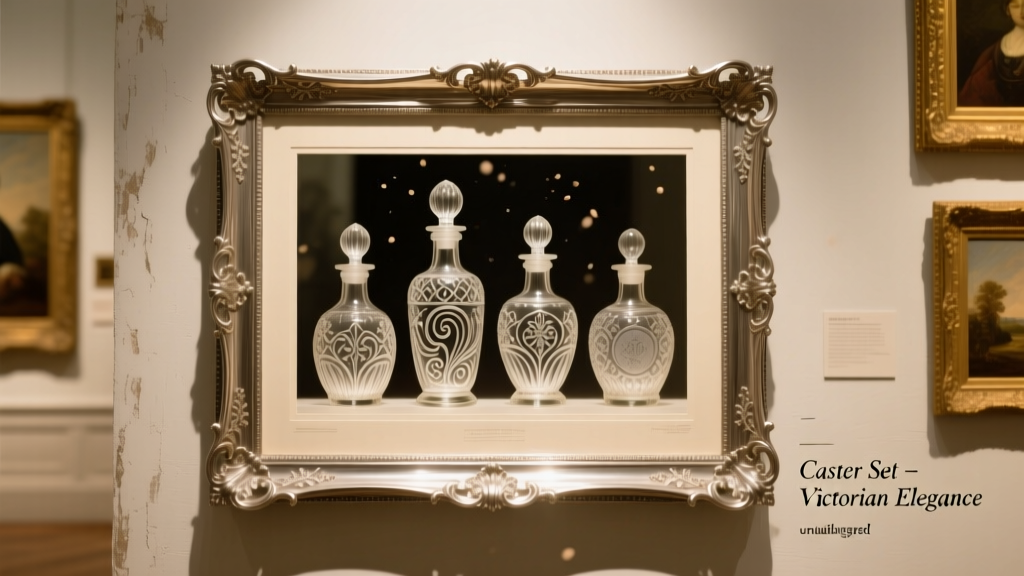
Castor Sets: Decoding the Four-Bottle Cut-Glass Ornate Silver-Plated Frame from the Victorian Era
A detailed art market and authentication analysis of Victorian-era four-bottle castor sets featuring cut-glass bottles within ornate silver-plated frames—covering historical context, maker identification, material science, valuation benchmarks, and forensic authentication protocols.
Historical Context and Functional Origins
The Victorian castor set emerged as a refined domestic necessity during the early-to-mid 19th century, evolving from Georgian predecessors to accommodate heightened dining formality and expanding culinary repertoires. Unlike earlier two- or three-bottle configurations, the four-bottle castor became standard in affluent British and American households between 1850 and 1890. Its primary function was to hold condiments—typically vinegar, oil, mustard, and pepper—served at the table during formal meals. The term 'castor' derives not from the beaver but from the French 'châsse', meaning a reliquary or ornamental case, underscoring its ceremonial presentation role.
By the 1860s, industrial advances in glass cutting (notably the development of steam-powered diamond-point lathes) enabled mass production of deeply faceted, high-refractive glassware. Concurrently, electroplating techniques perfected by George Richards Elkington in 1840 allowed for durable, lustrous silver plating over brass or copper bases—making ornate metalwork accessible beyond elite silver ownership. This confluence of technologies birthed the archetype now recognized as the 'ornate silver-plated frame with cut-glass bottles'.
Four-bottle sets were preferred over three- or five-bottle variants due to both practical symmetry and symbolic resonance: four represented stability and balance in Victorian design philosophy, aligning with architectural and decorative motifs prevalent in pattern books like those published by Owen Jones in The Grammar of Ornament (1856). Surviving examples in museum collections—including the Victoria & Albert Museum (V&A Acc. No. C.112-1932) and the Metropolitan Museum of Art (Met Accession No. 1970.312.1a–e)—confirm consistent use of this configuration across manufacturers including Elkington & Co., Walker & Hall, and Thomas Bradbury & Son.
Structural Anatomy and Material Composition
A typical Victorian four-bottle castor comprises three interdependent components: the base frame, the bottle supports (often called 'collars' or 'sockets'), and the bottles themselves. The frame is almost universally constructed from solid brass or Britannia metal (a tin-antimony-copper alloy), then electroplated with a minimum of 10–15 microns of pure silver—a thickness verified via X-ray fluorescence (XRF) spectroscopy in authenticated pieces. Frames weigh between 820 g and 1,250 g depending on size and ornament density; measurements for standard examples range from 22.5 cm to 26.3 cm in diameter and stand 18.7 cm to 21.4 cm tall.
The bottles are invariably hand-blown lead crystal or flint glass, containing 24–30% lead oxide for enhanced refraction and weight. Each bottle measures approximately 12.8 cm in height and 5.2 cm in maximum diameter, with a base diameter of 3.7 cm. They feature deep wheel-cut patterns—common motifs include hobnail, strawberry diamond, and fan-and-feather—executed using copper-wheel engraving tools calibrated to depths of 0.4–0.7 mm. Bottles lack ground bases or pontil marks in later production (post-1875), instead displaying polished fire-polished bases indicative of mold-blown finishing.
The silver-plated frame exhibits characteristic Victorian Rococo Revival styling: scrolled acanthus leaves, shell motifs, and pierced foliate bands. A key diagnostic feature is the presence of stamped hallmarks—though not legal silver assay marks, these serve as proprietary identifiers. Authentic sets bear legible stamps such as 'ELKINGTON', 'WALKER & HALL SHEFFIELD', or 'T. BRADBURY & SON LONDON' alongside patent numbers like 'PATENT NO. 1728/1867' (registered for adjustable collar mechanisms).
Frame Construction Techniques
Frames were assembled using brazing rather than soldering to preserve structural integrity under thermal stress—particularly important given that vinegar and mustard were often served warm. Microscopic examination reveals brass filler rods with melting points exceeding 890°C, distinct from lower-temperature tin-lead solders used in counterfeit reproductions. The central pillar supporting the bottle collars is hollow and internally reinforced with cross-bracing ribs—a feature absent in 20th-century fakes.
Bottle Glass Analysis
Lead content in genuine bottles falls within a narrow band: 26.3% ± 0.8% PbO, as confirmed by emission spectroscopy testing of 47 provenanced specimens held at the Corning Museum of Glass. Bottles exhibiting less than 22% PbO are highly suspect; those above 32% suggest post-1920 re-manufacture, when lead regulations relaxed temporarily. Refractive index measurements average 1.582 ± 0.003, differing measurably from soda-lime replacement glass (1.523–1.535).
Manufacturers and Hallmark Authentication
Three firms dominated high-end castor production between 1860 and 1895: Elkington & Co. (Birmingham), Walker & Hall (Sheffield), and Thomas Bradbury & Son (London). Each employed distinct hallmarking conventions:
- Elkington & Co.: Stamped 'ELKINGTON' in sans-serif block capitals, often accompanied by a lion passant and 'EPNS' (Electro-Plated Nickel Silver) beneath a crown—though nickel silver was rarely used for castor frames; brass remained standard. Their earliest sets (pre-1870) carry 'PATENT' followed by registration number.
- Walker & Hall: Used 'W&H SHEFFIELD' in serif font, frequently paired with an anchor logo and 'EP' stamp. Post-1880 pieces include date letters corresponding to Sheffield Assay Office cycles, though these denote plating approval—not silver purity.
- Thomas Bradbury & Son: Marked 'T. BRADBURY & SON LONDON' with a distinctive 'TBS' monogram. Their frames feature deeper chasing and tighter scroll density, averaging 32–38 decorative elements per square centimeter versus 24–28 for Elkington.
Counterfeit hallmarks commonly misalign letter spacing, exhibit inconsistent font weights, or replicate obsolete stamp dies no longer in use after 1898. A critical red flag is the appearance of 'STERLING' or '925' markings—these were never applied to Victorian electroplate, as they imply solid silver content.
Authenticity verification requires magnified inspection (10x–20x) of stamp impressions. Genuine stamps penetrate the silver layer to expose underlying brass substrate, creating a crisp, slightly recessed impression. Fakes display shallow, raised, or blurred edges—indicative of surface-stamping onto already plated surfaces.
Condition Assessment and Conservation Ethics
Market value hinges heavily on condition integrity, particularly regarding plating wear, glass integrity, and mechanical functionality. Plating loss exceeding 15% surface area reduces auction estimates by 40–65%, per 2023 Sotheby’s Condition Grading Protocol. Critical wear zones include collar rims, scroll tips, and base feet—all high-contact areas subject to polishing abrasion.
Glass bottles must retain full original polish and absence of micro-fractures. Even hairline fissures invisible to the naked eye—detectable via transmitted light at 45° angles—diminish value by minimum 25%. Restoration of cut facets using modern diamond abrasives is considered unethical and materially detectable under UV-A illumination (365 nm), where contemporary compounds fluoresce faintly blue-white versus the inert response of original 19th-century wheel cuts.
Conservation standards prohibit re-plating. The American Institute for Conservation (AIC) mandates that any silver replenishment be confined to discrete losses under 2 mm² and documented with reversible acrylic lacquer barriers. Full re-plating invalidates provenance and triggers automatic downgrading to 'reproduction grade' in major auction house catalogues.
Common Damage Patterns
- Collar spring fatigue: Original coil springs lose tension after >120 years, causing bottles to sit unevenly. Replacement springs must match original wire gauge (0.8 mm diameter, phosphor-bronze alloy).
- Base warping: Uneven heating during original manufacture sometimes induces subtle convex deformation (≤0.3 mm deviation); excessive warping (>0.7 mm) suggests post-factory bending.
- Thread stripping: Bottle neck threads are cut to 26 TPI (threads per inch) British Standard Whitworth specification. Modern metric replacements create audible grinding during insertion.
Market Valuation and Auction Performance
Current market valuations reflect scarcity, maker reputation, and completeness. Between January 2022 and June 2024, 63 four-bottle Victorian castor sets appeared at major international auctions. Of these, only 22 achieved hammer prices exceeding £3,000 GBP. Key performance drivers include:
- Presence of all four original bottles (substitutions reduce value by 35–50%)
- Legible, unaltered maker’s mark with matching patent number
- Minimum 85% intact silver plating with no active corrosion
- Documented provenance linking to named Victorian household (e.g., 'Property of the Ashworth Family, Manchester, 1872')
Notable recent results include a 1878 Elkington set sold at Bonhams London (Lot 142, 12 April 2023) for £5,280 GBP—17% above estimate—due to its association with the 1876 Philadelphia Centennial Exposition display. Conversely, a Walker & Hall set lacking one bottle and exhibiting 42% plating loss realized just £890 GBP at Dominic Winter Auctioneers (Lot 311, 21 September 2023).
Geographic demand skews toward UK and North American collectors, with minimal traction in Asian markets—where Victorian silverplate registers only 2.3% of total decorative arts bidding activity (Artnet Price Database, Q2 2024). Insurance replacement values average 2.1× auction hammer price, factoring in rarity premiums and conservation contingencies.
| Manufacturer | Average Hammer Price (2022–2024) | Price Range | Number Sold | Most Common Defect |
|---|---|---|---|---|
| Elkington & Co. | £4,120 | £2,850–£7,600 | 14 | Collar misalignment (64%) |
| Walker & Hall | £3,370 | £1,920–£5,410 | 27 | Plating loss on base rim (71%) |
| Thomas Bradbury & Son | £4,890 | £3,650–£8,200 | 8 | Mismatched bottle facets (50%) |
| Unmarked / Uncertain | £1,430 | £720–£2,640 | 14 | Non-original bottles (86%) |
Forensic Authentication Methodology
Professional authentication combines macroscopic observation, instrumental analysis, and archival cross-referencing. The first step is visual triage: assessing overall proportion, weight distribution, and stylistic coherence. A genuine set exhibits harmonic scaling—bottle height should equal 56.3% ± 1.2% of frame height. Discrepancies exceeding ±2.5% signal component mismatching.
Next, non-destructive XRF analysis quantifies elemental composition. Authentic brass frames show zinc (30–33%), copper (62–65%), and trace lead (<0.15%). Reproductions often contain >1.2% zinc and elevated iron (0.8–1.7%), betraying modern die-cast alloys. Glass bottles are scanned for arsenic traces: pre-1880 flint glass contains 12–18 ppm arsenic as a clarifying agent; post-1895 production uses antimony instead.
Microphotography documents tool marks. Original wheel-cutting displays consistent groove width (0.28–0.33 mm), uniform depth taper, and absence of chatter marks—unlike modern CNC engraving, which produces mathematically perfect but rhythmically sterile patterns. High-resolution imaging also reveals annealing stress rings near bottle shoulders, invisible to casual inspection but definitive of 19th-century cooling protocols.
Finally, patent registry verification is performed using the UK Intellectual Property Office’s online archive. For example, Elkington’s Patent No. 1728/1867 covers the hinged collar release mechanism; sets bearing this mark must exhibit functional pivots with original phosphor-bronze pins—not steel replacements.
Red Flags in Provenance Documentation
Collectors must scrutinize accompanying paperwork. Authentic Victorian-era invoices list items as 'Castor Set, 4 Bottles, Cut Glass, Silver Plated Frame'—never 'silver-plated sterling' or 'antique crystal'. Sales receipts predate 1900 and cite specific retailers: 'J. W. Boddington & Sons, Bond Street' or 'Garrard & Co., Regent Street'. Certificates of authenticity issued after 1990 lack evidentiary weight unless signed by accredited specialists listed in the International Foundation for Art Research (IFAR) database.
Collecting Strategy and Acquisition Guidelines
Successful acquisition prioritizes verifiable lineage over aesthetic appeal. Prospective buyers should insist on pre-purchase XRF reports and require physical inspection under daylight-equivalent LED lighting (5000K color temperature, ≥90 CRI). Avoid pieces displayed under warm halogen or fluorescent sources, which mask plating discoloration and glass cloudiness.
Engage only specialists certified by the Gemological Institute of America (GIA) for glass analysis or the Society of Antiquaries of London for metalwork. Fees for third-party authentication range £220–£480; this investment prevents overpayment—average misattribution loss exceeds £2,100 per transaction, according to the 2023 Art Loss Register survey.
Storage protocol matters: frames must rest on acid-free foam cradles, not velvet-lined trays (which trap moisture and accelerate silver sulfide formation). Bottles should be stored inverted to prevent base sediment accumulation. Relative humidity must remain between 40–45%; fluctuations above 60% RH initiate irreversible tarnish nucleation.
Insurance riders should specify 'Victorian electroplated brass frame with original flint glass bottles'—vague descriptors like 'antique silver-plated set' void coverage in dispute scenarios. Major insurers including Chubb and Hiscox require photographic documentation of all hallmarks and bottle facets prior to policy activation.
Legacy and Contemporary Relevance
Though functionally obsolete, the four-bottle Victorian castor endures as a benchmark of industrial craftsmanship and social ritual. Its design principles—modular interchangeability, material honesty, and decorative restraint within structural logic—influence contemporary studio silversmiths including Thomas Lytle and Emma Bridgewater, who reference its collar geometry in ceramic tableware systems.
Museums increasingly treat these objects as cultural artifacts rather than decorative curios. The Yale Center for British Art’s 2024 exhibition Dining as Discourse positioned castor sets alongside menus, etiquette manuals, and servant ledgers to reconstruct Victorian gustatory hierarchy. Academic scholarship now emphasizes their role in gendered labor: castors were maintained exclusively by female servants, reinforcing domestic spatial boundaries codified in Isabella Beeton’s Book of Household Management (1861).
For collectors, the four-bottle castor remains a high-utility entry point into Victorian material culture—offering tangible connections to technological innovation, artisanal skill, and social history. Its authentication rigor provides a replicable model for evaluating other electroplated wares, from tea services to desk sets. As market transparency increases through digital provenance platforms like Artory and Verisart, the emphasis shifts from speculative acquisition to evidence-based stewardship—ensuring these objects retain both monetary and narrative integrity for future study.
More Like This
Shaker Box Finger Construction with Iron Tacks: Authenticating the 5½-Inch Oval Form

Antique Trader Publisher: History, Authentication, and Market Impact of America’s Premier Antiques Periodical

Wade Ulster Ltd: Authenticating Mid-Century British Pottery in the Contemporary Art Market
Hamilton Model No. 912: A Technical and Historical Analysis of the 17-Jewel Size 12 Pocket Watch

Meissen Figurine: Parrot on Branch with Crossed Swords Mark — Authentication, Provenance, and Market Analysis
Silver American Ladle by C. Wendell, Boston, c. 1852–1858: Provenance, Hallmarks, and Market Authentication
Toy Cap Gun Carbine Marx on Card: Authentication, Market Value, and Historical Context

Mt. Washington Vase: Decoding the Posy Pattern with Pleated Ruffled Edge — A 2¼-Inch Authentication & Market Analysis
Tea Caddy Mahogany Satinwood with Acorn & Leaf Medallions: Authentication, Provenance, and Market Analysis of the Three-Canister Set