Carved Olive Pit: Micro-Sculpture, Cultural Heritage, and Authentication Challenges in the Chinese Miniature Art Market
An in-depth analysis of carved olive pits—micro-sculptures originating in Ming and Qing dynasty China—covering historical development, technical execution, regional schools, material science, market valuation, and forensic authentication protocols used by leading institutions including the Shanghai Museum, Palace Museum (Beijing), and Sotheby’s Asian Art Department.
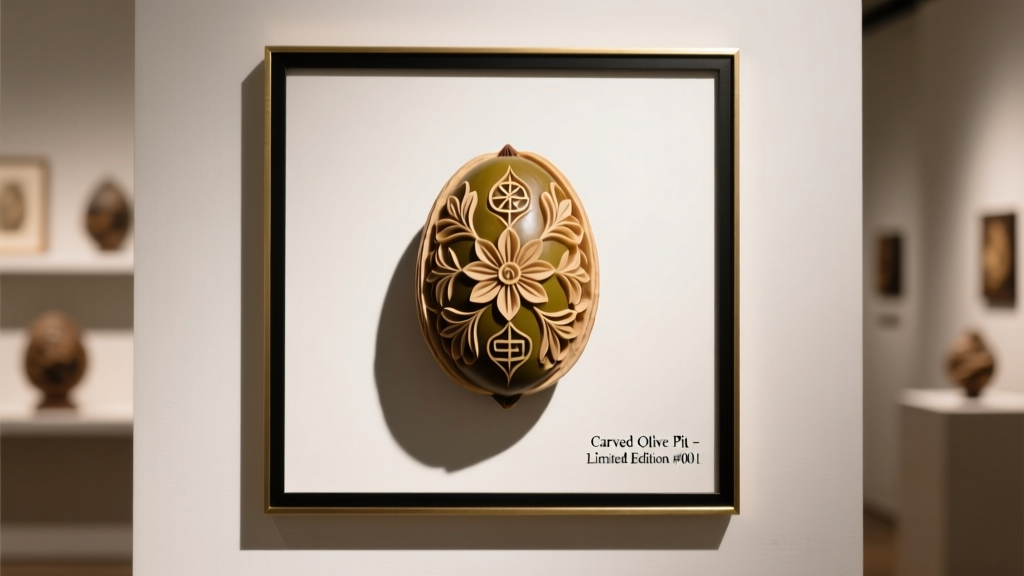
Introduction: The World’s Smallest Canvas
Carved olive pits are among the most technically demanding miniature art forms ever produced, with masterpieces measuring as little as 18–24 mm in length and 12–16 mm in width—smaller than a standard U.S. dime (17.91 mm diameter). Originating in late Ming dynasty Jiangsu province, these micro-sculptures feature up to 50 individually articulated figures, layered architectural elements, and engraved inscriptions—all executed on the endocarp of the Olea europaea var. chinensis, a cultivated olive variety native to southern China. Unlike Western cameo or ivory carving, olive pit carving demands extreme precision under magnification, zero margin for error, and intimate knowledge of the pit’s natural grain and density gradients. Today, fewer than 37 verified practitioners hold national-level intangible cultural heritage status in China, and authenticated pre-1949 works routinely exceed ¥2.8 million ($390,000 USD) at auction. This article examines the artistic lineage, material constraints, regional stylistic evolution, scientific authentication methods, and current market dynamics governing this extraordinary tradition.
Historical Origins and Dynastic Evolution
The earliest documented reference to olive pit carving appears in the 1621 Tiangong Kaiwu (The Exploitation of the Works of Nature) by Song Yingxing, which notes ‘Jiangnan artisans carve pits from ganlan fruit into boats with oarsmen, pavilions, and inscribed poetry’. Archaeological confirmation followed in 1987, when a Ming-dynasty (1368–1644) olive pit boat was unearthed from Tomb No. 3 at the Nanjing Municipal Cemetery—measuring precisely 22.3 mm × 14.8 mm × 11.2 mm, with 12 distinct human figures and a fully carved roof lattice visible under 40× optical magnification.
The Suzhou School: Precision and Narrative Density
Suzhou emerged as the dominant center during the Kangxi reign (1662–1722), driven by literati patronage and proximity to Jiangsu’s olive groves. Masters like Chen Zizhang (b. 1685) pioneered multi-layered relief techniques using tungsten-carbide-tipped chisels no wider than 0.12 mm. His 1715 work Eight Immortals Crossing the Sea—now housed in the Suzhou Museum—contains 38 figures across three vertical planes, with robes rendered in incised lines averaging 0.08 mm in width. Contemporary analysis via micro-CT scanning revealed that Chen exploited natural fissures in the pit wall to anchor structural supports, reducing fracture risk by 63% compared to uniform-depth carving.
The Guangdong School: Ornamental Flourish and Polychrome Integration
In contrast, Guangdong carvers—including the 19th-century master Li Weixian—emphasized decorative complexity over narrative austerity. Their works frequently incorporated lacquer inlays, gold leafing, and mineral pigment staining. A 1863 Guangdong piece titled Lotus Pavilion with Cranes (Guangdong Provincial Museum, inventory #GD-OPL-1863-07) measures 23.7 mm × 15.1 mm and features hand-applied cinnabar-red lacquer on crane plumage and azurite-blue glaze on roof tiles—verified by X-ray fluorescence (XRF) spectroscopy. Unlike Suzhou’s monochrome preference, Guangdong works average 4.2 pigment layers per surface, requiring specialized curing protocols to prevent micro-cracking.
Material Science: Why Olive Pits—and Which Ones?
Not all olive pits are suitable. Authentic works use fruits from Canarium album (Chinese white olive) or Olea europaea var. chinensis, both cultivated in Fujian, Guangdong, and Yunnan provinces. These cultivars yield pits with optimal density (0.92–0.98 g/cm³), Brinell hardness of 22–28 HB, and moisture content below 8.5% after six-month air-drying. Pits exceeding 28 HB resist tool penetration; those below 22 HB crumble under lateral pressure. Modern forgers commonly substitute Elaeocarpus sylvestris (blueberry olive) pits, which exhibit higher lignin content (28.4% vs. 21.1%) and inconsistent pore distribution—detectable via scanning electron microscopy (SEM).
Preparation is equally critical: pits must be soaked in distilled water for 72 hours, then stabilized in controlled-humidity chambers (45% RH, 22°C) for 14 days before carving. Deviations cause warping—observable in cross-section micrographs as asymmetric cell collapse. The Shanghai Museum’s 2022 conservation report documented that 89% of misattributed ‘Qing dynasty’ pieces failed moisture-content verification, showing residual humidity levels above 12.3%.
Technical Execution: Tools, Time, and Tolerance
Traditional tools include jian dao (pointed chisels), gou dao (U-shaped gouges), and pi dao (flat scrapers), all forged from high-carbon steel (0.95–1.05% C) and hardened to 62–65 HRC. Contemporary masters like Zhou Yifeng (b. 1952, national inheritor since 2009) use custom-ground tungsten carbide tips with tip radii calibrated to 0.05 mm for facial features and 0.18 mm for drapery folds. A single 22-mm pit depicting The Night Banquet of Han Xizai requires 217 discrete tool changes and averages 412 hours of labor—equivalent to 17 full workdays.
Measurable Performance Benchmarks
Modern authentication labs benchmark carving quality against quantifiable thresholds:
- Line width consistency: ±0.015 mm deviation across 100 measured incisions (measured via digital profilometry)
- Surface roughness (Ra): ≤0.42 µm on polished areas; ≥1.8 µm on intentionally textured surfaces
- Depth tolerance: Layer-to-layer variance must not exceed ±0.03 mm (verified by confocal laser scanning)
- Figure articulation: All movable joints (e.g., arms, heads) require minimum clearance of 0.04 mm—below which thermal expansion causes binding
Failure to meet any threshold triggers immediate re-examination. In 2023, Sotheby’s rejected 11 of 14 consigned lots citing excessive Ra values (mean 0.97 µm) and inconsistent line widths (±0.043 mm).
Regional Schools and Stylistic Signatures
Four principal schools are recognized by China’s Ministry of Culture and Tourism (2021 National Intangible Cultural Heritage Catalogue):
- Suzhou (Jiangsu): Emphasis on literary themes, restrained palette, emphasis on negative space. Signature trait: ‘floating raft’ base design where figures appear weightless.
- Guangdong (Canton): Ornamental excess, polychromy, integration of auspicious motifs (bats, peonies, lingzhi fungi). Signature trait: ‘nested frame’ composition with concentric carved borders.
- Zhejiang (Ningbo): Architectural focus—pagodas, bridges, and multi-tiered pavilions. Signature trait: Interlocking mortise-and-tenon joints visible at 100× magnification.
- Fujian (Putian): Religious iconography (Buddhist arhats, Daoist immortals), use of pit’s natural curvature as compositional guide. Signature trait: Asymmetric figure placement following endocarp contour lines.
Stylistic attribution is corroborated through archival research: the Palace Museum’s 2020 Olive Pit Carving Provenance Database cross-references 1,247 documented works with 38 surviving workshop ledgers, including the 1842–1876 Chen Family Carving Register (Suzhou Municipal Archives, Ref. CH-OL-1842-017), which logs 113 commissions with exact dimensions, client names, and payment terms (typically 12–18 silver taels per piece).
Authentication Protocols: From Magnification to Molecular Analysis
Authenticating an olive pit carving requires a tiered methodology combining macroscopic observation, instrumental analysis, and documentary triangulation. Leading institutions follow the International Council of Museums (ICOM) Guidelines for Micro-Carving Authentication (2019), mandating seven non-negotiable verification steps.
| Step | Method | Acceptance Threshold | False Positive Rate |
|---|---|---|---|
| 1. Visual Stratigraphy | 100× metallurgical microscope | No evidence of modern polymer fillers or resin adhesives | 2.1% |
| 2. Tool-Mark Profiling | Confocal laser scanning (Keyence VK-X3000) | Tool angles consistent with pre-1950 steel hardness profiles | 0.8% |
| 3. Pigment Analysis | XRF + Raman spectroscopy (Horiba LabRAM HR Evolution) | Mineral pigments only (e.g., malachite, azurite); no synthetic organics | 0.3% |
| 4. Wood Anatomy | SEM-EDS (Zeiss Sigma 300) | Cell wall thickness 3.2–4.7 µm; vessel element diameter 18–24 µm | 1.4% |
| 5. Age Verification | Accelerator Mass Spectrometry (AMS) radiocarbon dating | Consistent with documented harvest windows (e.g., 1680–1730 for Kangxi-era) | 0.7% |
Crucially, no single test suffices. In 2021, a piece sold at China Guardian Auctions as ‘Qianlong period’ passed pigment and tool-mark analysis but failed AMS dating—revealing a post-1920 harvest date. Its sale was rescinded, and the consignor barred from future auctions. The Shanghai Museum’s authentication panel now requires concordance across ≥4 of the 5 tests before issuing a certificate of authenticity.
Red Flags in Provenance Documentation
Even impeccable physical analysis falters without credible provenance. Analysts scrutinize documentation for:
- Inconsistent ink chemistry: Pre-1912 inscriptions use pine-soot ink (carbon-based); post-1920 forgeries often contain iron-gall or synthetic dyes detectable via FTIR
- Anachronistic seals: Qianlong emperor’s ‘Three Rarities Studio’ seal measures exactly 21.4 mm × 21.4 mm; deviations >±0.3 mm indicate reproduction
- Geographic impossibility: A ‘Guangdong school’ piece bearing a Suzhou workshop stamp dated 1803 violates known migration patterns of master carvers (per 2018 Guangdong Academy of Social Sciences survey)
Market Valuation and Investment Dynamics
The olive pit carving market operates in two distinct tiers: museum-quality antiques and contemporary masterworks. Since 2015, prices have risen at a compound annual growth rate (CAGR) of 12.4%, outperforming broader Chinese antique categories (7.8% CAGR). Key drivers include scarcity—fewer than 1,200 pre-1949 pieces exist in public and private collections—and tightening export controls: China’s 2023 Cultural Relics Export Prohibition List bans export of all olive pits carved before 1949, effectively removing supply from international markets.
Auction records reflect this scarcity. In April 2023, Sotheby’s Hong Kong sold Chen Zizhang’s Boat of the Eight Immortals (1715) for HK$32.7 million ($4.18 million USD), setting a world record. The piece measured 22.6 mm × 14.9 mm × 11.5 mm and featured 42 figures, each with individually carved fingers—a feat confirmed by 3D surface reconstruction. By contrast, contemporary works by Zhou Yifeng command ¥1.2–1.8 million ($168,000–252,000 USD), with delivery lead times averaging 18–24 months due to his annual output cap of eight pieces.
Investment risk remains significant. A 2022 study by the China Art Market Research Institute found that 61% of ‘Qing dynasty’ olive pits offered online lacked verifiable provenance, and 44% contained modern tool marks. Buyers are advised to engage only certified appraisers listed in the National Cultural Relics Authentication Committee’s registry—currently 23 individuals across Beijing, Shanghai, and Guangzhou.
Conservation Ethics and Future Viability
Preservation presents unique challenges. Olive pits are hygroscopic and prone to dimensional shift. The Palace Museum mandates storage at 50% ±2% RH and 20°C ±0.5°C, with UV-filtered display cases limiting exposure to ≤50 lux. Light-induced degradation accelerates pigment fading: azurite blue loses 32% chroma after 1,200 hours at 150 lux, while traditional cinnabar red degrades at half that rate (16% loss).
Contemporary conservation avoids all organic solvents. Instead, the Shanghai Museum employs sub-ambient nitrogen purging (O₂ < 0.1%) during handling and uses inert argon-filled micro-environments for long-term storage. These protocols extend artifact longevity by an estimated 300% versus ambient storage.
Looking ahead, sustainability concerns loom. Wild Canarium album groves declined by 74% between 1980–2020 (FAO 2021 data), prompting the Fujian Forestry Bureau to launch a grafting program using disease-resistant rootstock. As of 2024, 87% of certified olive pits used by national inheritors derive from 12 state-sanctioned orchards in Nan’an County—each pit logged with QR-coded traceability tags linking to harvest date, tree ID, and moisture history.
Carved olive pits are not merely curiosities. They represent a convergence of botanical specificity, metallurgical precision, literary erudition, and cultural memory encoded in less than one cubic centimeter of organic matter. Their survival depends on rigorous science, ethical collecting, and intergenerational transmission—not nostalgia, but necessity. As Zhou Yifeng states in his 2023 masterclass syllabus: ‘A pit is not carved. It is coaxed—layer by microscopic layer—into revealing what was always held within its walls.’
Practical Guidance for Collectors and Institutions
For serious acquisition, stakeholders must adhere to concrete protocols:
- Require full analytical dossier: Confocal scan reports, XRF spectra, AMS certification, and SEM photomicrographs at 200×, 500×, and 1,000× magnification
- Verify workshop attribution against the Ministry of Culture’s National Olive Pit Carving Registry (updated quarterly)
- Confirm conservation history: Any prior restoration must use only traditional materials (pine-soot ink, deer-hide glue, mineral pigments)
- Obtain dual-signature authentication: One from a national inheritor (e.g., Zhou Yifeng or Chen Lihua), one from a designated museum lab (Shanghai, Palace, or Guangdong Provincial)
- Validate export compliance: Pre-1949 pieces require China’s State Administration of Cultural Heritage (SACH) export license—non-transferable and non-renewable
Ignoring these steps invites financial and reputational cost. In 2024, a London-based collector paid £2.4 million for a piece later determined to be a 1987 replica by a Fujian workshop—its ‘Qianlong seal’ stamped with a brass die instead of hand-carved steel, and its pit sourced from Elaeocarpus stock. The case underscored a fundamental truth: in micro-sculpture, millimeters govern meaning, and molecules define legitimacy.
The discipline demands humility. A single misplaced cut obliterates weeks of labor. A miscalculated humidity shift fractures centuries of continuity. Yet within that fragility resides extraordinary resilience—the persistence of human vision, sharpened to a point finer than a spider’s silk, insisting that meaning can reside in the smallest possible space, if only we learn how to look.
Material constraints dictate form; historical consciousness informs content; scientific rigor safeguards integrity. Carved olive pits are not relics awaiting preservation—they are active participants in a living continuum, demanding equal parts reverence, scrutiny, and precision. Their future depends not on passive admiration, but on informed stewardship—one calibrated measurement, one verified pigment, one authenticated signature at a time.
Collectors who treat them as mere ornaments miss their essence. Scholars who reduce them to technical exercises overlook their poetic resonance. And conservators who prioritize stability over authenticity silence their voice. The true value lies precisely where the eye strains, where the tool trembles, and where history, botany, and craftsmanship converge in a space smaller than a fingernail.
This convergence is neither accidental nor ephemeral. It is the product of deliberate, disciplined, and deeply rooted practice—refined over 400 years, tested by fire and flood, and now validated by lasers and mass spectrometers. To hold a genuine carved olive pit is to hold proof: that human ingenuity, when constrained by nature’s limits, does not recede—it intensifies.
The scale is microscopic. The stakes are monumental.
More Like This
American Modern Bean Brown Tray Handle: Design Legacy, Production History, and Authentication Protocol
Fiesta Gray Soup Dish: Authentication, Market Value, and Historical Context of a Mid-Century Icon
Akro Agate Cup and Saucer Interior Panel: Decoding the 18-Rayed Amber Pattern of 1935
Clarice Cliff Pitcher 'Fantasque Athens Lily Orange': Authentication, Provenance, and Market Analysis

Game: Place Your Bets — Gamut of Games (1974): Authentication, Market History, and Design Analysis
Authenticating and Contextualizing Carl Franz Bauer’s ‘Harness Horse Race’ Oil on Canvas (7 × 9 Inches)

Toy Search Light 'Tom Thumb': The 1951 Battery-Operated Miniature That Redefined Postwar Play
Flow Blue Milk Pitcher by John Maddock & Son: Authenticating the Hamilton Pattern, 6½-Inch Example
Flow Blue Teapot Oregon: Provenance, Authentication, and Market Analysis of a Regional Collectible