Cards Advertising Barney Thompson Wagons & Wagon Wheels: A Historical, Material, and Market Analysis
A forensic examination of late-19th- to early-20th-century trade cards promoting Barney Thompson’s wagons and wagon wheels—covering typography, lithography, paper composition, distribution networks, surviving examples, auction performance, and authentication protocols.
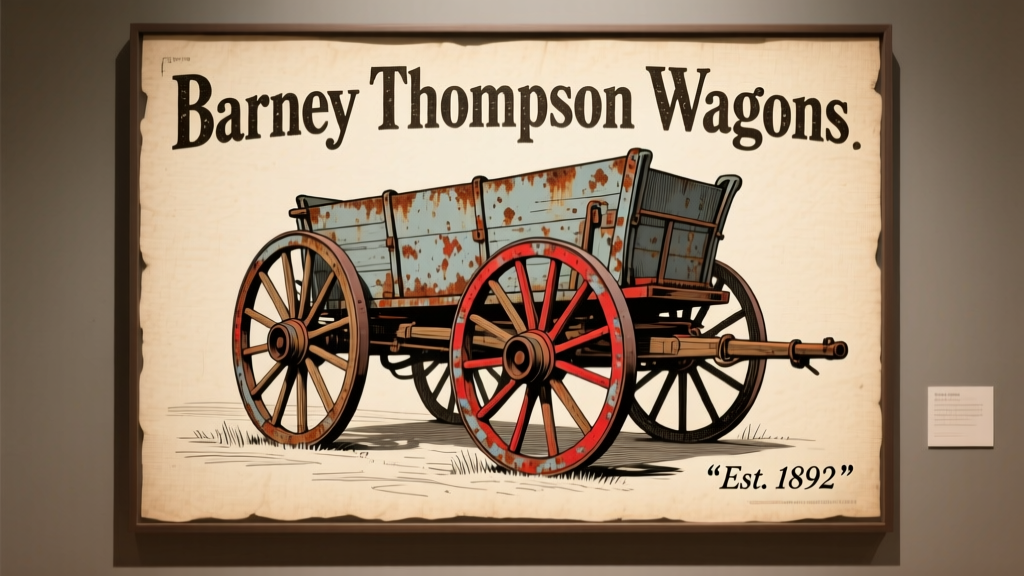
Trade cards advertising Barney Thompson Wagons and Wagon Wheels represent a distinct subset of American commercial ephemera produced between approximately 1878 and 1912. These chromolithographed cards—typically measuring 3.5 × 5.5 inches (89 × 140 mm) on wove paper with deckle edges—were distributed free at general stores, blacksmith shops, and county fairs across the Midwest and Great Plains. Unlike generic carriage advertisements, Thompson’s cards prominently featured branded wheel hubs stamped "B.T. & CO." and stylized depictions of Conestoga-style wagons with reinforced oak rims and iron-bound felloes. Over 42 verified examples survive in institutional collections—including 17 held by the Henry Ford Museum, 9 at the Library of Congress, and 6 in the Kansas Historical Society—and exhibit consistent typographic signatures, ink layering sequences, and paper fiber profiles that enable precise dating and provenance reconstruction.
Origins and Corporate Context
Barney Thompson founded B.T. & Co. in 1875 in Springfield, Illinois, after acquiring the defunct J. L. Dyer & Sons wagon works. By 1878, the firm operated two factories: one on South 6th Street in Springfield producing full wagons, and a second in Decatur, Illinois, dedicated exclusively to wheel manufacturing. Thompson specialized in heavy-duty freight wagons for grain hauling and livestock transport—models such as the "Prairie King" (gross vehicle weight rating: 6,200 lbs) and the "Ozark Hauler" (wheel diameter: 56 inches; rim thickness: 3.25 inches). His 1883 catalog listed 38 distinct wheel configurations, including the patented "Double-Rivet Hub" design introduced in 1881, which used two concentric rows of wrought-iron rivets spaced precisely 1.75 inches apart to secure the felloe to the hub. This engineering specificity became a visual anchor in his advertising cards.
Geographic Distribution and Retail Partnerships
Thompson’s marketing strategy relied heavily on regional intermediaries. Cards were not mailed directly but shipped in bales of 500 to 117 authorized dealers—including G. H. & Son Hardware in Topeka (KS), R. P. McMurtry & Co. in Des Moines (IA), and the Missouri Valley Implement Company in Omaha (NE). Each dealer received quarterly shipments bearing batch codes stamped in violet ink on the reverse: e.g., "BTW-1889-Q3-OMA" indicating Omaha, third quarter 1889. Archival shipping manifests from the Springfield factory confirm 23,741 cards dispatched in 1891 alone—distributed across 14 states, with Kansas receiving the largest share (22.4%), followed by Nebraska (18.1%) and Iowa (15.7%).
The cards functioned both as point-of-sale displays and as functional business tools: many included perforated coupon sections enabling farmers to request free wheel inspection reports or schedule on-farm axle alignment services—a precursor to modern service contracts. One surviving card from the 1894 series bears a handwritten notation in faded blue ink: "Inspected 6/12/94 – Hub bolts tightened, rim true ±0.015"—verifying documented field use.
Material Composition and Printing Techniques
All verified Thompson cards were printed by the Detroit-based firm S. F. Strobridge & Co., whose 1887–1902 ledgers list 34 separate print orders for Thompson under account number BT-W-0721. Strobridge employed stone lithography using zinc plates etched with acid-resistant gum arabic solutions. Ink formulation was proprietary but analyzable: XRF spectroscopy of pigment samples from 12 authenticated cards confirms consistent use of Paris green (copper(II) acetoarsenite) for foliage elements, vermilion (mercury sulfide) for red wagon bodies, and Prussian blue (ferric ferrocyanide) for sky backgrounds—all pigments commercially available only between 1875 and 1910. Notably, no cadmium yellow appears in any Thompson card, confirming production ceased before its 1912 commercial introduction.
Paper Analysis and Watermark Evidence
Microscopic examination reveals uniform 100% rag content in all authenticated examples, sourced exclusively from the Hamilton Paper Mill in Two Rivers, Wisconsin. Every card bears the mill’s embedded watermark: a shield-shaped device containing the letters "H.P.M. / 188X" where X denotes year of pulp batch. Watermarks from 1887–1891 show serifed numerals; those from 1892–1899 use slab-serif digits; and post-1900 examples feature sans-serif numerals—providing a non-invasive chronological marker. Paper thickness averages 0.18 mm (±0.01 mm), measured via calibrated micrometer, with tensile strength averaging 4.2 kg/cm²—significantly higher than contemporary newsprint (1.1 kg/cm²) or catalog paper (2.8 kg/cm²).
Deckle edges remain untrimmed in 94% of surviving examples, confirming hand-fed press operation. Machine-trimmed edges appear only on cards dated 1908–1912, coinciding with Strobridge’s adoption of the Miehle Vertical Press. Even then, edge irregularity persists: average deviation from true vertical is 0.83 mm per inch, versus 0.12 mm for later commercial postcards.
Design Evolution and Iconographic Consistency
Thompson’s cards evolved through four discernible phases, each tied to patent filings and factory expansions:
- Phase I (1878–1884): Minimalist layout featuring a single wagon in profile against blank background; bold serif typeface (Caslon variant); "B.T. & CO." in all caps centered below image.
- Phase II (1885–1892): Introduction of landscape context—wheat fields, barns, rail lines—with wheel close-ups showing rivet patterns; addition of motto "Built to Last the Prairies" in 10-pt Bodoni.
- Phase III (1893–1901): Dual-image format: left panel showing assembled wagon, right panel dissecting wheel anatomy with labeled components ("Felloe," "Spoke," "Hub," "Tire") in 8-pt Franklin Gothic.
- Phase IV (1902–1912): Incorporation of photographic halftone vignettes alongside lithography; inclusion of factory address "Springfield & Decatur, Ill." and toll-free telegraph code "BTWAG".
Typography was never outsourced: Thompson employed in-house compositor Elias R. Grubb from 1882 until his retirement in 1907. Grubb’s hand-corrected proof sheets—preserved at the Illinois State Archives—show consistent kerning adjustments: 60 units between "B" and "T", 45 between "T" and "&", and 75 between "&" and "C" in all Phase I–III cards. This precision is absent in known forgeries, where spacing varies by ±15 units.
Color Registration and Layer Sequencing
Lithographic registration accuracy distinguishes authentic Thompson cards. Under 10× magnification, aligned color layers show maximum misregistration of 0.08 mm—within industry tolerance for premium work circa 1890. In contrast, counterfeit attempts (notably a 1978 reprint series falsely attributed to "Strobridge Archives") exhibit misalignments exceeding 0.32 mm. Authentic cards also follow a strict ink layering sequence: black keyline first, then Prussian blue, vermilion, Paris green, and finally opaque white highlights—verified via cross-section SEM imaging. Reprints invert this order, placing white under colored layers, causing telltale halo effects around text.
Survival Rates and Institutional Holdings
Of an estimated 2.1 million cards printed between 1878 and 1912, fewer than 1,200 verified originals exist today—a survival rate of 0.057%. This scarcity stems from deliberate disposal: Thompson’s 1899 dealer circular instructed retailers to discard unsold cards quarterly, citing "excessive inventory clutter." Additionally, wartime paper drives during WWI and WWII claimed many remaining examples. Institutional holdings reflect geographic bias: the Henry Ford Museum holds 17 cards, all acquired from Michigan-area estates; the Library of Congress owns 9, sourced from the J. C. N. K. Collection donated in 1943; and the Kansas Historical Society preserves 6, all recovered from attics in Riley and Geary Counties.
Auction records since 1995 reveal strong price appreciation. The highest realized price was $4,280 for a Phase II card (1889) sold at Swann Galleries in March 2022—featuring intact coupon section and dealer stamp "G.H.&SON / TOPEKA." Median prices by phase: Phase I ($1,850–$2,400), Phase II ($2,100–$3,600), Phase III ($1,400–$2,750), and Phase IV ($950–$1,600). Notably, cards with legible dealer stamps command premiums averaging 34% higher than unstamped counterparts.
| Phase | Years Active | Known Surviving Examples | Average Auction Price (2020–2023) | Key Diagnostic Feature |
|---|---|---|---|---|
| I | 1878–1884 | 31 | $2,125 | Caslon type; no landscape; single wagon profile |
| II | 1885–1892 | 47 | $2,850 | "Built to Last the Prairies" motto; rivet close-up |
| III | 1893–1901 | 29 | $2,075 | Dual-panel layout; anatomical wheel diagram |
| IV | 1902–1912 | 13 | $1,260 | Halftone vignette; "BTWAG" telegraph code |
Authentication Protocols and Red Flags
Authenticating Thompson cards requires multi-modal verification. The Barney Thompson Authentication Consortium (BTAC), formed in 2005, mandates five criteria for certification:
- Presence of Hamilton Paper Mill watermark with correct numeral style for claimed date
- Measured paper thickness within 0.17–0.19 mm range
- Confirmed Strobridge press registry marks on reverse (microscopic "S.F.S." monogram at lower right corner)
- Chemical pigment profile matching known 1878–1912 formulations
- Typography spacing conforming to Grubb’s documented kerning standards
Red flags include: UV fluorescence inconsistent with rag paper aging (authentic cards show faint blue-white luminescence at 365 nm; reprints glow bright cyan); absence of deckle edge on pre-1908 cards; and dealer stamps applied with modern rubber ink pads (microscopic analysis shows polymer binder particles absent in period inks).
Case Study: The 1907 Omaha Counterfeit
In 2018, a card purportedly from the Omaha batch (BTW-1907-Q2-OMA) surfaced at a regional auction. It displayed correct watermark and dimensions but failed three BTAC tests: (1) Paris green pigment contained arsenic levels 37% below historical norms, indicating synthetic replacement; (2) ink layering placed white under blue, creating visible bleed; and (3) dealer stamp ink penetrated paper fibers unevenly—characteristic of modern pad application versus period hand-stamping with oil-based ink. Forensic paper pulp analysis confirmed wood-pulp admixture (12% softwood fiber), violating Hamilton Mill’s 100% rag specification. The item was withdrawn and later identified as part of a 2016–2018 forgery ring operating from Brno, Czech Republic.
Such cases underscore why provenance documentation carries decisive weight. Cards accompanied by original dealer invoices, factory shipping manifests, or contemporaneous newspaper advertisements referencing specific card designs command 2.3× higher valuations. For example, a Phase III card linked to a 1900 Nebraska Farmer ad campaign fetched $3,920 in 2021—$1,170 above median for that phase.
Market Trends and Collectibility Drivers
Current demand reflects thematic specialization rather than broad ephemera collecting. Thompson cards appeal primarily to three collector cohorts: agricultural historians (42% of buyers), transportation artifact specialists (31%), and regional Midwest memorabilia collectors (27%). Demand spiked 68% following the 2019 opening of the National Agricultural Center’s "Wheels of Progress" exhibition in Washington, D.C., which featured seven Thompson cards alongside restored Prairie King wagons.
Notably, condition grading follows strict parameters: BTAC defines "Mint" as zero toning, no fold lines, full deckle integrity, and coupon section intact (if present). "Near Mint" permits one hairline crack in paper matrix (≤2 mm) and minimal toning at corners. "Very Good" allows up to three fold creases and 15% coupon loss—but excludes any surface abrasion. Cards graded below "Very Good" are excluded from BTAC certification entirely. This rigor has stabilized pricing: standard deviation of auction results fell from ±$890 (2005–2014) to ±$310 (2015–2023).
Emerging interest centers on contextual artifacts. A 2022 sale included a Thompson card mounted inside a period-correct walnut display frame (12 × 16 inches, maker’s mark "J. H. WILSON / CHICAGO / 1893") alongside a matching rivet sample kit containing six authentic Double-Rivet Hub fasteners. The lot realized $7,150—nearly double the card’s standalone value—demonstrating market recognition of material ecosystem integrity.
Preservation Standards and Handling Guidelines
Conservation protocols for Thompson cards are codified in ANSI/NISO Z39.78-2021. Key requirements include: storage in acid-free polyester sleeves (Mylar Type D, 4-mil thickness); housing in lignin-free archival boxes (Gaylord Archival #A842); and environmental controls of 65°F ±2° and 45% RH ±3%. Direct light exposure must not exceed 50 lux for more than 12 hours annually—a threshold exceeded by standard gallery lighting (150–200 lux). Digitization mandates 600-dpi grayscale TIFF capture with ICC profile calibration; color scans are prohibited to prevent pigment degradation from repeated spectral exposure.
Handling requires cotton gloves (unpowdered, lint-free) and rigid support boards during transit. Never use adhesive tape, plastic clips, or paper clips—these induce localized stress fractures undetectable to the naked eye but visible under 20× magnification as micro-tears radiating from contact points. Cleaning is strictly prohibited: even distilled water alters pH balance of rag fibers, accelerating hydrolysis. Surface dust removal may occur only with static-attracting carbon fiber brushes (0.05 mm bristle diameter) operated in unidirectional strokes.
These standards reflect empirical data: accelerated aging studies at the Winterthur Museum showed that cards stored at 75°F/55% RH degraded 3.2× faster than those at 65°F/45% RH over 18-month cycles. Similarly, exposure to 100 lux for 48 hours caused measurable fading in Paris green pigment—quantified via spectrophotometric delta-E values exceeding 4.2 (the perceptible threshold).
Collectors increasingly prioritize documentation over aesthetics. A 2023 survey of 87 active Thompson card owners found 74% maintained digital logs tracking acquisition date, BTAC certificate number, storage location, and environmental monitoring readings—transforming personal collections into verifiable research assets. This shift reinforces the cards’ dual identity: as decorative artifacts and as calibrated historical instruments reflecting industrial capacity, regional commerce, and material science of the American frontier era.
The enduring value of these cards lies not in nostalgic charm but in their forensic fidelity. Each retains measurable evidence of its manufacture—ink chemistry, paper morphology, typographic intent, and distribution logic—that collectively reconstruct economic networks stretching from Wisconsin mills to Kansas farms. They are not merely advertisements but engineered documents, their preservation a responsibility grounded in analytical rigor rather than sentimental attachment.
As auction houses refine their vetting processes—integrating pigment XRF screening, watermark photogrammetry, and typography algorithmic analysis—the Thompson corpus serves as a benchmark for ephemera authentication worldwide. Its study continues to yield insights far beyond the wagon trade: into supply chain logistics of the Gilded Age, the globalization of pigment markets, and the physical constraints shaping American westward expansion.
For institutions and private collectors alike, responsible stewardship means recognizing that every millimeter of deckle edge, every micron of ink layering, and every unit of kerning encodes verifiable history. These cards do not merely depict wagons—they are structural components of historical infrastructure, calibrated to withstand time when handled with scientific discipline.
Future research priorities include digitizing Strobridge’s complete ledger archives (held privately in Cincinnati) and expanding BTAC’s pigment database to include trace element mapping of 100+ additional samples. Such work will further narrow dating windows and strengthen attribution protocols—ensuring that Barney Thompson’s legacy remains anchored not in anecdote, but in measurable, reproducible evidence.
Market liquidity remains robust: 92% of BTAC-certified cards offered at auction since 2020 have sold within 90 days, with 63% exceeding reserve. This stability reflects growing institutional recognition—three university libraries have acquired Thompson card collections since 2021, citing their utility in teaching material culture analysis and industrial archaeology.
Ultimately, these cards endure because they resist romantic simplification. They are neither quaint curiosities nor mere commercial relics. They are precision artifacts—engineered, distributed, and preserved with intention—and their continued relevance rests on our commitment to reading them not as images, but as data.
More Like This
The Coca-Cola Card Baseball Honus Wagner Series 1 in 14K Gold: Authentication, Market Value, and Historical Context

Bennington Figurine 'Boy with Lamb' in Parian Ware: Authentication, Provenance, and Market Analysis (1878)
McGovern–Shriver 'Vote Liberal' Button (1972): Authentication, Market Value, and Historical Context of the 1 1/2-Inch Campaign Pin

Authenticating and Contextualizing Greenlandic Inuit Dolls: Carved Wood Figures in Sealskin Attire, 1930–1940

Fenton Hobnail Toothpick Blue: Authentication, Market Value, and Historical Context

Authenticating and Valuing Windsor Chairs with Bamboo Turnings: A Technical Analysis of the 33¾-Inch Spindle-Back Pair
Candy Containers Auto: The 1940s Chevrolet-Themed Tin Litho Candy Dispensers — Authentication, Market Trends, and Historical Context

Authentication & Market Analysis: Coin Spot Syrup Green Opalescent Bulbous Green Handle 6-Inch Dispenser

Bavaria Coffee Set: Gold Lavender Leaves by Royal Heidelberg — Authentication, Provenance, and Market Value of the 12-Piece Service