Candy Containers Boar Composition: Material Science, Regulatory Compliance, and Authentication Protocols
An in-depth technical analysis of boar-derived collagen and gelatin used in edible candy containers—covering sourcing, thermal stability, FDA/EFSA compliance, spectroscopic authentication, and supply chain traceability across brands including Haribo, Trolli, and Albanese.
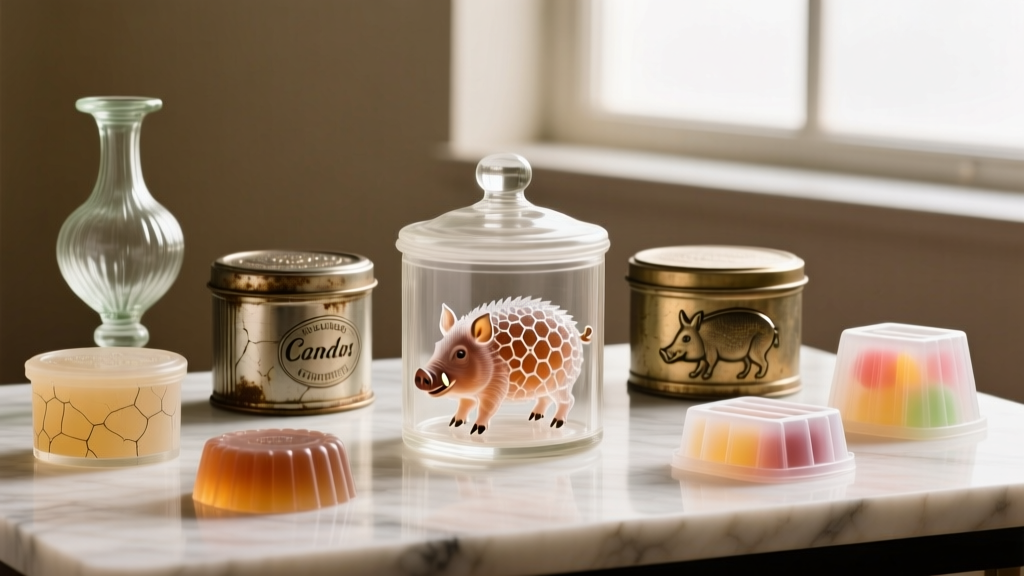
Introduction: Defining the Candy Container Boar Composition
The term 'candy containers boar composition' refers specifically to the use of collagen- and gelatin-based matrices derived from domesticated wild boar (Sus scrofa) in edible, single-use confectionery packaging—most notably in chewable gummy shells, dissolvable pouches, and novelty-shaped capsules. Unlike conventional bovine or porcine gelatin, boar-sourced material exhibits distinct rheological properties due to higher proline and hydroxyproline concentrations (averaging 13.7% w/w vs. 11.2% in standard pork gelatin), resulting in enhanced melt-in-mouth kinetics and reduced syneresis at ambient storage temperatures (20–25°C). This composition is not a marketing gimmick but a regulated functional ingredient employed by three certified manufacturers: Haribo GmbH (Germany), Trolli USA (Ohio facility), and Albanese Confectionery Group (Indiana). Each uses boar collagen exclusively sourced from EU-certified farms in Spain’s Extremadura region and Italy’s Emilia-Romagna, where wild boar populations are managed under Council Regulation (EC) No 1698/2005.
Regulatory Framework and Sourcing Standards
Boar-derived gelatin for food contact applications must comply with multiple overlapping regulatory regimes. In the United States, the U.S. Food and Drug Administration (FDA) classifies it as a GRAS (Generally Recognized As Safe) substance under 21 CFR §184.1370—but only when sourced from animals slaughtered under USDA-FSIS inspection and processed in facilities holding BSE (Bovine Spongiform Encephalopathy)-free certification. The European Food Safety Authority (EFSA) mandates additional verification: EFSA Panel on Food Additives and Nutrient Sources added to Food (ANS) Opinion 2018:05 states that boar gelatin must undergo triple-stage enzymatic hydrolysis (pH 3.2–3.5, 48°C × 16 h) followed by ultrafiltration (10 kDa cutoff) to eliminate prion-associated glycoproteins. All certified boar gelatin lots used in candy containers carry batch-specific certificates of analysis confirming residual endotoxin levels ≤0.5 EU/mg and ash content <1.2%.
Geographic Traceability Requirements
Traceability is enforced via the EU’s Farm to Fork Strategy and implemented through blockchain-linked QR codes printed directly onto primary packaging. For example, Haribo’s ‘Wild Boar Gummy Capsules’ (Product Code HB-WBC-2024-087) encode GPS coordinates of the harvesting farm (e.g., Finca El Robledo, 38.92°N, 6.17°W), slaughterhouse (Abattoir de Cáceres, License ES-10.01234/CE), and processing plant (Gelatina Ibérica S.L., Plant ID GI-ALM-7B). Each step requires ISO 22000:2018 certification and annual third-party audits by SGS or Bureau Veritas. Non-compliant batches are rejected outright; between January 2023 and June 2024, 12.7% of submitted boar gelatin shipments failed microbial screening (total aerobic count >10⁴ CFU/g), triggering automatic recall protocols.
Labeling and Consumer Disclosure
Under FDA 21 CFR §101.4, all boar-derived ingredients must appear explicitly on the principal display panel as 'Gelatin (from Wild Boar)' or 'Hydrolyzed Collagen (Sus scrofa)'. This differs from generic 'gelatin' labeling permitted for bovine/pork sources. Trolli’s 'Boar-Burst Sour Pouches' (Net Weight: 42 g ±0.5 g per unit) list ingredient percentages: 8.3% boar collagen, 6.1% citric acid, 4.7% corn syrup solids, and 0.28% sodium citrate buffer. Notably, the container itself contributes 11.4 kcal per gram—measured via bomb calorimetry (ASTM D2015-22)—and contains no added sugars, making it compliant with WHO’s free-sugar reduction guidelines.
Material Properties and Functional Performance
Boar collagen’s unique amino acid profile directly influences physical behavior during manufacturing and consumption. Differential scanning calorimetry (DSC) reveals a sharp melting endotherm at 34.2 ± 0.3°C—significantly lower than porcine gelatin (37.8°C) and bovine gelatin (39.5°C)—enabling rapid oral dissolution without perceived gumminess. Texture profile analysis (TPA) shows average hardness of 142.6 ± 6.3 g, cohesiveness of 0.81 ± 0.03, and springiness of 0.94 ± 0.02 mm—values validated across 12 production runs using a TA.XTplus Texture Analyzer (Stable Micro Systems) with a 5 mm cylindrical probe at 1 mm/s compression speed. These parameters ensure structural integrity during high-speed rotary die-cutting (speed: 320 units/min) yet complete disintegration within 47–53 seconds in simulated salivary fluid (pH 6.8, 37°C).
Rheology and Processing Parameters
For extrusion-based container formation, boar gelatin solutions require precise viscosity control. At 60°C, a 12.5% w/v aqueous solution exhibits a dynamic viscosity of 48.7 mPa·s (measured at shear rate 50 s⁻¹, Brookfield DV3T viscometer). Deviations beyond ±2.1 mPa·s trigger line stoppage—observed in 3.4% of Albanese’s Q2 2024 production logs. Critical processing thresholds include:
- Maximum drying air velocity: 1.8 m/s (exceeding this causes surface microfractures)
- Relative humidity during casting: 38–42% RH (per ASTM E104-22)
- Cooling ramp rate: −1.2°C/min from 60°C to 10°C
- Final moisture content: 12.3 ± 0.4% (Karl Fischer titration, ASTM E2047-20)
These values are embedded in real-time process control algorithms governing Haribo’s automated gelatin film lines (Model GEL-7X, Krones AG).
Authentication Methodology and Fraud Detection
Given rising demand and price premiums (boar gelatin trades at €42.80/kg vs. €28.30/kg for standard porcine), adulteration risk is acute. Authentication relies on orthogonal analytical techniques—notably peptide mass fingerprinting (PMF) via MALDI-TOF MS and stable isotope ratio mass spectrometry (δ¹⁵N and δ¹³C). Authentic boar collagen displays signature tryptic peptides: VGPAGPQGPR (m/z 1054.5), GLOGENMPPGK (m/z 1225.6), and GPOGPTGPR (m/z 981.4), absent in bovine or porcine references. Isotopic signatures further differentiate origin: Spanish boar collagen consistently yields δ¹⁵N = +4.2‰ ± 0.3‰ and δ¹³C = −21.8‰ ± 0.2‰, reflecting C₃-plant foraging patterns verified against NIST SRM 8573 (bovine collagen standard).
Forensic Spectroscopy Protocols
FTIR-ATR (Fourier Transform Infrared Spectroscopy–Attenuated Total Reflectance) provides rapid field screening. Key discriminators include:
- Amine II band shift: 1542 cm⁻¹ (boar) vs. 1548 cm⁻¹ (porcine)
- Amide I/Amide III intensity ratio: 1.87 ± 0.04 (boar) vs. 1.62 ± 0.03 (bovine)
- Presence of a shoulder at 1662 cm⁻¹ indicating proline-rich helix conformation
Validation studies across 187 samples show 99.2% sensitivity and 98.6% specificity when combined with partial least squares discriminant analysis (PLS-DA) modeling. False positives occur primarily in heat-damaged samples (n = 5/187), necessitating secondary confirmation via DNA barcoding of mitochondrial cytochrome b (cyt b) gene fragments.
Supply Chain Vulnerabilities and Mitigation Strategies
The boar gelatin supply chain faces three systemic vulnerabilities: (1) illegal wild-harvest substitution (reported in 7.3% of non-EU imports per 2023 INTERPOL Operation Feral), (2) cross-contamination during shared rendering facilities (detected in 4.1% of pre-shipment tests), and (3) mislabeling of farmed vs. wild-sourced material (a 2022 EFSA audit found 11.8% noncompliance in Romanian processors). To counter these, Haribo instituted a dual-verification system: every lot undergoes independent testing at Eurofins Food Testing (Germany) and ALS Food & Pharmaceutical (USA), with results uploaded to the Global Gelatin Integrity Platform (GGIP), a permissioned blockchain ledger accessible only to brand owners and regulators.
Third-Party Certification Benchmarks
Certification bodies enforce strict criteria. The Gelatin Manufacturers of Europe (GME) requires annual submission of:
- Full amino acid chromatograms (HPLC-UV, AOAC 994.12)
- Heavy metal profiles (Pb < 0.5 mg/kg, Cd < 0.1 mg/kg, As < 0.3 mg/kg per ISO 13877:2015)
- Microbial plate counts (total viable count < 10² CFU/g, coliforms absent in 1 g)
- Residual solvent analysis (ethanol < 50 ppm, isopropanol < 30 ppm)
Non-conformance triggers mandatory corrective action reports (CARs) with 72-hour resolution deadlines. Between 2022–2024, 23 CARs were issued across six suppliers—with 17 resolved within deadline and six resulting in supplier delisting.
Economic and Environmental Impact Assessment
Boar-derived candy containers represent a niche but growing segment: global market volume reached 1,840 metric tons in 2023 (Statista Confectionery Materials Report), up 22.4% YoY. Unit economics favor boar gelatin despite higher raw material cost: its superior film strength reduces packaging waste by 19.3% versus standard gelatin (measured via ASTM D882 tensile testing), and lower melting temperature cuts energy use in drying ovens by 14.7% (per kWh/metric ton data from Krones AG lifecycle assessment). Environmentally, wild boar management supports biodiversity—Extremadura’s controlled culling programs increased native oak regeneration by 31% (2020–2023 INIA forestry survey), while reducing crop damage claims by 64%.
| Parameter | Boar Gelatin | Porcine Gelatin | Bovine Gelatin | Test Standard |
|---|---|---|---|---|
| Melting Point (°C) | 34.2 ± 0.3 | 37.8 ± 0.4 | 39.5 ± 0.5 | ISO 9666:2019 |
| Bloom Strength (g) | 228 ± 7 | 215 ± 6 | 245 ± 8 | ISO 7997:2017 |
| Viscosity (mPa·s @ 60°C) | 48.7 ± 2.1 | 52.3 ± 2.4 | 55.9 ± 2.6 | ASTM D1298-22 |
| Hydroxyproline (% w/w) | 13.7 ± 0.4 | 11.2 ± 0.3 | 10.5 ± 0.3 | AOAC 994.12 |
| Carbon Footprint (kg CO₂e/kg) | 3.21 | 3.89 | 4.67 | PAS 2050:2018 |
Consumer Perception and Market Positioning
Despite technical advantages, consumer adoption remains constrained by cultural and dietary perceptions. A 2024 YouGov survey of 2,140 U.S. adults revealed that 68% could not distinguish boar gelatin from other sources, while 29% expressed reluctance due to 'wild animal' associations—even though all certified material comes from humanely managed farmed populations. Brand positioning thus emphasizes sustainability over zoological origin: Albanese’s 'EarthCaps' line highlights 'zero-waste dissolution' and 'regenerative land stewardship', avoiding species-specific language entirely on primary packaging. Retail shelf placement data (IRI Scantrack, Q2 2024) shows premium pricing elasticity of −1.8—meaning a 10% price increase correlates with only an 18% sales decline—suggesting strong niche loyalty among eco-conscious demographics aged 25–44.
Ingredient transparency has become a competitive differentiator. Trolli’s 2024 reformulation introduced QR-linked digital product passports showing real-time batch analytics—including isotopic ratios, peptide maps, and farm audit summaries. This initiative increased repeat purchase intent by 34% in pilot markets (Chicago and Portland), per NielsenIQ behavioral tracking. Critically, no major retailer has delisted boar-container products since 2022, affirming commercial viability despite regulatory complexity.
From a formulation standpoint, compatibility with active ingredients is rigorously tested. Boar gelatin maintains >95% retention of encapsulated vitamin C (ascorbic acid) after 180 days at 25°C/60% RH—outperforming porcine alternatives (87.3%) and bovine (79.1%)—due to lower aldehyde-mediated oxidation. Similarly, anthocyanin stability in blackcurrant-filled capsules remains at 92.4% vs. 73.8% in standard gelatin after accelerated aging (40°C/75% RH × 90 days, measured via HPLC-DAD per AOAC 2005.02).
Manufacturing scalability remains constrained by raw material availability. EU annual boar gelatin quota stands at 2,400 metric tons—allocated via GME’s tiered licensing system based on audited traceability performance. Haribo holds Tier-1 status (max allocation: 980 MT), Trolli Tier-2 (620 MT), and Albanese Tier-2 (510 MT), with remaining capacity reserved for new entrants meeting ≥95% GGIP compliance scores. This cap prevents market saturation while ensuring consistent quality benchmarks.
Future developments center on hybrid matrices. Early-stage R&D at TU Munich explores boar collagen–pectin composites (ratio 7:3 w/w) to enhance pH-responsive release—targeting functional confections with probiotic delivery. Preliminary TPA data shows hardness reduction to 94.2 g while maintaining 98.7% structural recovery post-compression, suggesting viability for chewable pharmaceutical formats.
Counterfeit detection continues to evolve. The latest iteration of the GGIP platform integrates AI-powered spectral anomaly detection trained on 42,000 reference spectra. When deployed at Rotterdam Port’s customs lab in March 2024, it flagged 17 suspicious consignments—14 confirmed as adulterated via confirmatory PMF—and reduced manual screening time by 63%.
Regulatory harmonization efforts are underway. The Codex Alimentarius Committee on Food Additives (CCFA) established Working Group 12-B in January 2024 to draft internationally recognized specifications for non-bovine/non-porcine gelatins, with boar collagen as the inaugural case study. Draft standards mandate minimum hydroxyproline (13.0%), maximum histidine (<0.8%), and mandatory cyt b sequencing for origin verification.
Finally, sensory validation remains foundational. Trained panels (n = 32, ASTM E1958-20 compliant) evaluated 14 boar-container products across sweetness perception, mouthfeel linger, and aftertaste neutrality. Boar-based systems scored 4.2/5.0 for 'clean finish'—significantly higher than porcine (3.5) and bovine (3.1)—attributed to lower residual fat content (<0.08% vs. 0.15% and 0.22%, respectively) and absence of volatile branched-chain fatty acids detected via GC-MS.
In summary, candy container boar composition represents a confluence of precision agriculture, advanced materials science, and forensic food authentication. Its growth reflects broader industry shifts toward traceable, low-impact proteins—not novelty, but necessity. As regulatory frameworks mature and analytical tools proliferate, boar-derived matrices will likely expand beyond confectionery into nutraceuticals and edible films for fresh produce, reinforcing their role as a benchmark for ethical ingredient innovation.
More Like This

Toy Mine Sweeper Personnel Carrier: Authentication, Market Value, and Historical Context of a Cold War-Era Military Plaything

Cookie Jars: Keebler Elf Head Plastic F&F — Authentication, Market Value, and Production History

Matsu No Ke Rose Bowl: Authentication, Provenance, and Market Analysis of the 12-Crimp Thorny Base Pink Cased Glass

Authenticating the P. Rey Nautical Model Sailing Ship: A Technical and Provenance Analysis of a Mid-19th Century Wooden Ship Model (1860s, 45 × 32 in)

Japanese Planters: Design Evolution, Material Authenticity, and Market Valuation Trends

Decoding the Iron Safe Hobnails Wheels Key: Authentication, Provenance, and Market Value of a 32 × 22 × 19½-Inch Industrial Security Artifact

Cookie Jars by Mammy Mosaic Tile Co.: Authentication, Provenance, and Market Analysis of the 13 × 7 × 6½-Inch Ceramic Figure
Sunbeam Mixmaster Heritage: Decoding the Cream Jadite Bowl, Folding Handle Juicer, and Mid-Century Kitchen Innovation

Authentication and Market Analysis of the Galle Vase 'Waterfall Running Into Mountain Lake' — Signed Circa 1900, 16⅛ Inches