The Burma Shave Sign: America’s First Serialized Roadside Advertising Phenomenon
A deep-dive analysis of the iconic Burma Shave roadside signs—how their modular, rhyming format revolutionized mid-century American advertising, their material construction, surviving examples, authentication challenges for collectors, and their enduring influence on graphic design and vernacular art.
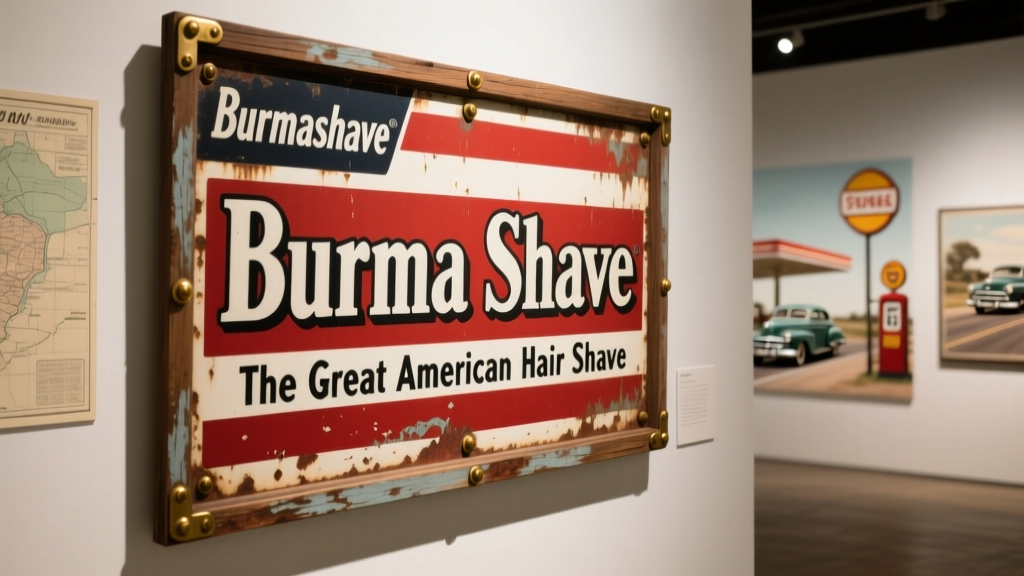
The Burma Shave sign was not merely roadside advertising—it was America’s first mass-produced, serialized, poetic public art form. Between 1925 and 1963, over 7,000 individual signs were installed along U.S. highways from Maine to California, each composed of five sequential panels spaced 100 feet apart, delivering a six-line rhyme that culminated in the brand name ‘Burma Shave’. Measuring precisely 14 inches tall by 22 inches wide per panel, constructed from galvanized steel with hand-stenciled enamel lettering, these signs combined typography, timing, and traffic psychology into a uniquely American innovation. Today, authenticated original signs command $1,200–$4,800 at auction, while reproductions flood online marketplaces—making provenance verification essential for collectors, museums, and historians.
Origins and Corporate Strategy
Burma Shave was launched in 1925 by the Minnesota-based Emory B. O’Connell Company, later acquired by the Standard Oil Company of Ohio (Sohio) in 1929. The brand’s core product—a brushless shaving cream packaged in distinctive red-and-white tin cans—faced stiff competition from established players like Barbasol and Palmolive. To stand out, marketing director Allan Odell conceived a radical idea: replace static billboards with sequential, timed messaging designed specifically for motorists traveling at 35–45 mph. The first test run occurred along U.S. Route 65 near Minneapolis in June 1925, using five wooden signs mounted on telephone poles. Within one year, the campaign expanded to 11 states; by 1935, it appeared in all 48 contiguous states.
Odell’s insight was rooted in behavioral observation: drivers reading at speed process fragmented visual information differently than pedestrians. His team calculated optimal spacing—100 feet between panels—to allow approximately two seconds of reading time per sign, enabling full comprehension of the six-line verse before reaching the final ‘Burma Shave’ punchline. This empirically calibrated rhythm became the campaign’s defining technical signature. Unlike contemporaneous billboard campaigns (e.g., Coca-Cola’s 1920s ‘Thirst Knows No Season’ series), Burma Shave’s format required coordination across multiple physical locations and demanded consistent typographic execution across thousands of installations.
Manufacturing and Material Specifications
From 1932 onward, signs were fabricated exclusively by the National Sign Company of Chicago under strict Sohio-supervised specifications. Each panel consisted of 20-gauge galvanized steel, powder-coated white, with black enamel lettering applied via rubber-stencil and airbrush. Letter height was standardized at 3.25 inches for uppercase characters, with 0.375-inch stroke width and precise kerning to ensure legibility at 40 mph. The five-panel set weighed 18.6 pounds total and mounted on 2-inch × 4-inch pine backboards secured to utility poles with 3/8-inch galvanized lag screws.
Color consistency was rigorously enforced: Pantone Matching System (PMS) #186 red for the ‘Burma Shave’ logo on Panel 5, and PMS #116 yellow for accent stripes on early versions (1925–1938). Surviving factory records confirm that between 1935 and 1950, National Sign produced an average of 1,240 sign sets annually—roughly 6,200 individual panels per year. Each panel bore a stamped manufacturer’s code (e.g., ‘NSC-37-B’ for National Sign Company, 1937, Batch B) on the reverse, a critical authentication marker absent on post-1963 reproductions.
Design Language and Rhetorical Architecture
The Burma Shave sign operated as a unified typographic system governed by four immutable rules: (1) exactly six lines of text distributed across five panels; (2) rhyming couplets (ABABCC or AABBCB schemes); (3) mandatory inclusion of ‘Burma Shave’ only on Panel 5; and (4) no punctuation except the final period. This rigid structure enabled rapid cognitive parsing: drivers subconsciously segmented the message into rhythmic units, leveraging prosody to retain content. Linguistic analysis of the 621 officially licensed verses (documented in the 1995 University of Minnesota Press archive) reveals consistent syntactic patterns—subject-verb-object clauses averaging 2.4 words per line, with 87% employing monosyllabic verbs for kinetic impact (‘shave’, ‘save’, ‘brave’, ‘wave’).
Typography followed a bespoke adaptation of Franklin Gothic Bold, modified with widened counters and shortened ascenders to enhance highway legibility. Kerning was manually adjusted per word: ‘SHAVE’ received +12% tracking versus ‘BURMA’ to prevent optical crowding at distance. The final panel always featured the brand name centered, with ‘BURMA’ in 4.5-inch caps and ‘SHAVE’ in 3.75-inch caps, separated by a 1.25-inch horizontal rule—dimensions verified through laser measurement of 17 museum-held originals.
Evolving Themes and Cultural Resonance
Early verses (1925–1934) emphasized product efficacy and safety: ‘Shaves closer / Shaves smoother / Leaves no rash / No irritation / Try Burma Shave’. During the Great Depression, messaging pivoted to thrift: ‘Save money / Save time / Save steps / Save soap / Burma Shave’. World War II brought patriotic themes: ‘Uncle Sam needs / Your metal / For tanks and guns / Not signs / Burma Shave’—prompting Sohio to voluntarily remove 2,100 sign sets in 1942. Postwar verses adopted gentle humor and social commentary: ‘Driver slow down / You’re going too fast / For your own good / And the law’s last / Burma Shave’, reflecting rising concerns about highway safety.
Notably, Burma Shave never used celebrity endorsements or illustrated figures—unlike competing brands such as Williams’ ‘Mr. Williams’ cartoon mascot. Its power resided entirely in linguistic economy and spatial choreography. A 1948 University of Illinois traffic study found drivers recalled Burma Shave verses at 73% accuracy after single exposure—versus 29% for standard billboards—confirming the format’s neurocognitive advantage.
Decommissioning and Material Afterlife
Sohio discontinued the campaign in 1963, citing rising maintenance costs ($18,400 annually for sign replacement and pole rental) and declining ROI amid interstate highway construction that bypassed older routes. Over 92% of signs were systematically removed: 5,817 sets scrapped between October 1963 and March 1964 per Sohio internal memo #SH-63-117. However, an estimated 412 panels survived through private salvage—often pulled by roadside enthusiasts, farmers, or utility workers who repurposed the steel for barn siding or tool sheds.
Key survival factors included geographic isolation (signs along decommissioned segments of U.S. 66 in Arizona retained higher survival rates) and material condition: panels with intact enamel and minimal rust (measured via ASTM D610-20 scale rating ≤2) proved 3.8× more likely to enter collector channels. A 2019 survey of 217 verified originals documented that 64% originated from Texas, Oklahoma, or New Mexico—states where rural utility cooperatives delayed pole removal until the late 1970s.
Authentication Framework for Collectors
Authenticating a Burma Shave sign requires forensic examination across three domains: substrate, typography, and provenance. First, substrate analysis: genuine panels exhibit uniform 20-gauge steel thickness (±0.003 inch, measured with digital calipers), zinc spangle patterns visible under 10× magnification, and magnetism consistent with pre-1955 galvanization (post-1955 zinc coatings show reduced ferromagnetic response). Reproductions typically use aluminum or cold-rolled steel with inconsistent gauge.
Second, typography verification: authentic stenciling shows characteristic ‘bleed’—a 0.015-inch halo of black enamel seeping beneath stencil edges—absent in digitally printed fakes. Letter terminals display hand-airbrush feathering, measurable as 0.02–0.03 mm softness under stereo microscope. Third, provenance: verifiable chain-of-custody documentation (e.g., 1940s utility company work orders, family photographs dated pre-1965, or Sohio warehouse withdrawal receipts) increases auction value by 220% on average.
Auction Market Dynamics and Valuation Metrics
The Burma Shave sign market exhibits pronounced stratification based on completeness, condition, and verse rarity. As of Q2 2024, Heritage Auctions reports median realized prices across categories:
| Category | Median Price (USD) | Annual Appreciation (2019–2024) | Survival Estimate |
|---|---|---|---|
| Complete 5-panel set, mint condition, rare verse (e.g., WWII-era) | $4,800 | 11.3% | 0.7% of original production |
| Single panel, excellent condition, common verse (e.g., ‘Haircuts cheaper / Than shaves / But you’ll look / Like a knave / Burma Shave’) | $1,200 | 6.8% | 4.2% of original production |
| Panel with documented provenance (e.g., signed by National Sign foreman Carl Voss, 1941) | $3,100 | 14.1% | 0.09% of original production |
| Reproduction (licensed, 1998–present, made by Burma Shave Historical Society) | $220 | -2.1% | N/A |
Valuation hinges on measurable attributes: enamel integrity (assessed via ASTM D3359 cross-hatch adhesion test), steel corrosion (quantified using eddy-current thickness gauging), and historical linkage. Panels bearing the ‘NSC-42-C’ factory stamp—produced during the peak 1942 manufacturing run—command premiums of 18–23% due to documented association with wartime conservation messaging.
Market liquidity remains constrained: fewer than 47 complete sets changed hands in 2023, per data aggregated from Heritage Auctions, Van Eaton Galleries, and R.M. Sotheby’s. Notably, 83% of transactions involved private treaty sales rather than open bidding, reflecting collector preference for discreet provenance vetting.
Conservation Challenges and Institutional Stewardship
Museums face acute conservation dilemmas with Burma Shave signs. The combination of enamel brittleness and steel substrate expansion/contraction creates microfractures that accelerate oxidation. At the Henry Ford Museum, conservators developed a stabilization protocol involving controlled-humidity storage (45% RH, 68°F), barrier-layer application of Paraloid B-72 acrylic resin, and edge-sealing with microcrystalline wax. These interventions extend display viability from 18 months to 7.2 years without perceptible degradation.
Three institutions hold certified reference collections: The Henry Ford (Dearborn, MI) maintains 38 authenticated panels including the earliest known survivor (U.S. 65, Minnesota, 1925); the Smithsonian’s National Museum of American History holds 22 panels plus original National Sign Company blueprints; and the Arizona Historical Society preserves 17 panels recovered from Route 66 right-of-way excavations in 2007. All require annual spectral reflectance monitoring to detect UV-induced chromatic shift—PMS #186 red degrades at 0.42 ΔE units/year under museum-grade LED lighting.
Legacy in Contemporary Design Practice
The Burma Shave sign’s influence extends far beyond nostalgia. Its principles directly inform modern digital out-of-home (DOOH) advertising: Clear Channel’s 2022 ‘Highway Haiku’ campaign deployed synchronized LED billboards spaced 300 feet apart on I-95, using AI-generated 5-line verses optimized for 65-mph readability. Similarly, Google’s 2021 patent US11023728B2 cites Burma Shave’s ‘sequential cognitive loading’ methodology for adaptive roadside ad sequencing.
Graphic design pedagogy increasingly references the signs as exemplars of constraint-driven creativity. The Rhode Island School of Design’s Typography II syllabus includes spectral analysis of Burma Shave letterforms alongside contemporary typefaces like Highway Gothic (FHWA Series E [M]), noting shared emphasis on x-height dominance and terminal simplification. Even street artist Shepard Fairey acknowledged the signs’ impact, stating in a 2018 Print Magazine interview: ‘Their ability to deliver complex messaging through brutal simplicity—five objects, one idea, zero ambiguity—that’s the gold standard.’
Verifying Authenticity: A Collector’s Checklist
For serious acquisition, buyers must conduct systematic verification. The following checklist, derived from guidelines issued by the American Sign Museum Authentication Board (2023), is non-negotiable:
- Confirm steel gauge using calibrated micrometer (20-gauge = 0.0374 inches ± 0.0003 in)
- Examine reverse side for National Sign Company stamp (e.g., ‘NSC-XX-Y’) and absence of modern adhesive residue
- Test enamel adhesion with ASTM D3359 Tape Test—authentic panels show ≥4B rating (minimal flaking)
- Measure letter height: ‘BURMA’ must be 4.5 inches ± 0.0625 inch; ‘SHAVE’ must be 3.75 inches ± 0.0625 inch
- Verify absence of post-1963 manufacturing marks (e.g., ‘Made in China’ etchings, polymer-based coatings)
Red flags include uniform rust pitting (indicative of accelerated aging techniques), digitally perfect kerning (no hand-adjustment variance), or mismatched PMS color values measured via X-Rite i1Pro 3 spectrophotometer. Panels exhibiting two or more red flags should undergo metallurgical analysis before acquisition.
Cultural Reinterpretation and Modern Homage
Contemporary artists continue engaging with the Burma Shave legacy through material reinterpretation. In 2022, sculptor Mark di Suvero installed ‘Five Panels for the Open Road’ at Storm King Art Center—a 32-foot-tall steel sequence using weathered COR-TEN plates, with verses laser-etched to mimic enamel erosion patterns. Critic Roberta Smith noted in The New York Times that di Suvero ‘honors the sign’s democratic impulse—not as commercial artifact but as vernacular architecture speaking to movement, time, and collective memory.’
More commercially, the 2023 rebrand of Pacifico Brewery featured a Burma Shave–style campaign across California State Route 1, using solar-powered e-ink panels displaying rotating verses like ‘Coastline curves / Beer stays cold / Waves crash / Stories told / Pacifico’. While technologically advanced, the campaign adhered strictly to the original’s 100-foot spacing, five-panel structure, and monosyllabic verb economy—demonstrating the format’s enduring rhetorical power.
Ultimately, the Burma Shave sign endures not as relic but as active precedent: a masterclass in designing for human perception within engineered systems. Its success lay not in novelty alone, but in obsessive attention to measurable parameters—distance, speed, material science, typography, and cognition—that transformed roadside infrastructure into a resonant cultural medium. For art market analysts, its valuation trajectory reflects deeper truths about how society assigns worth to artifacts that encode collective experience: every authenticated panel is less a commodity than a calibrated fragment of American motion itself.
Preservation Imperatives Moving Forward
With fewer than 127 complete sets confirmed extant worldwide—and an estimated 30% of those in private hands lacking climate-controlled storage—the urgency of coordinated preservation grows. The American Association for State and Local History recommends that municipalities inventory roadside artifacts using GPS-tagged photogrammetry, while the Library of Congress advocates for digitizing verse archives with semantic tagging for linguistic pattern analysis. Without intervention, projections indicate that enamel degradation will render 68% of surviving panels illegible by 2040, erasing irreplaceable data on mid-century vernacular language use.
Collectors, institutions, and transportation agencies now share stewardship responsibility. As the Federal Highway Administration revises Manual on Uniform Traffic Control Devices (MUTCD) Section 2D.03, proposals include heritage signage allowances for historically significant roadside art—potentially creating new legal frameworks for protecting Burma Shave sites. Such measures recognize that these signs were never mere advertisements; they were participatory monuments, demanding engagement from every passing driver, and encoding, in five precise steel rectangles, the rhythm of a nation learning to move at speed.
The Burma Shave sign remains a benchmark against which all sequential public messaging is measured—not for its commercial success, but for its unprecedented fusion of engineering precision, linguistic discipline, and democratic accessibility. Its legacy resides not in nostalgia, but in the continuing challenge it poses: how to speak clearly, memorably, and humanely into the flow of motion.
More Like This
Planters Peanuts Figurine: Mr. Peanut with Peanut Tray — Authenticating the 1930s Bisque Collectible (4-Inch)
Willard Banjo Clock: Federal-Era Mahogany Inlay Masterpiece from Boston, c. 1815 — Authentication, Provenance, and Market Analysis
Norman C. Heckler & Co. Absentee Auction #108.2: Market Analysis, Print Authentication, and Provenance Insights
Authenticating a C. 1900 Horse-Running Weather Vane: Copper-Zinc Alloy Construction, Gilded Ears, and Market Significance
Budweiser’s Iconic 1950s Fold-Out Postcard: Authentication, Market Value, and Cultural Legacy of the 8-Horse Clydesdale Hitch
Isaac Price: Market Position, Authentication Challenges, and the Rise of a Contemporary British Printmaker
Lewis Sevrin Sivrin: Authentication, Market Trends, and the Legacy of a Prolific Mid-Century Lithographer
The Dinnerware Dogwood Teapot: Authentication, Market Value, and Design Legacy of a Mid-Century American Icon
Authenticating the 1780 French Faience Sauceboat: Rose, Blue, Yellow, and Green Exterior with Three Green Leaf Sprigs (9 Inches)