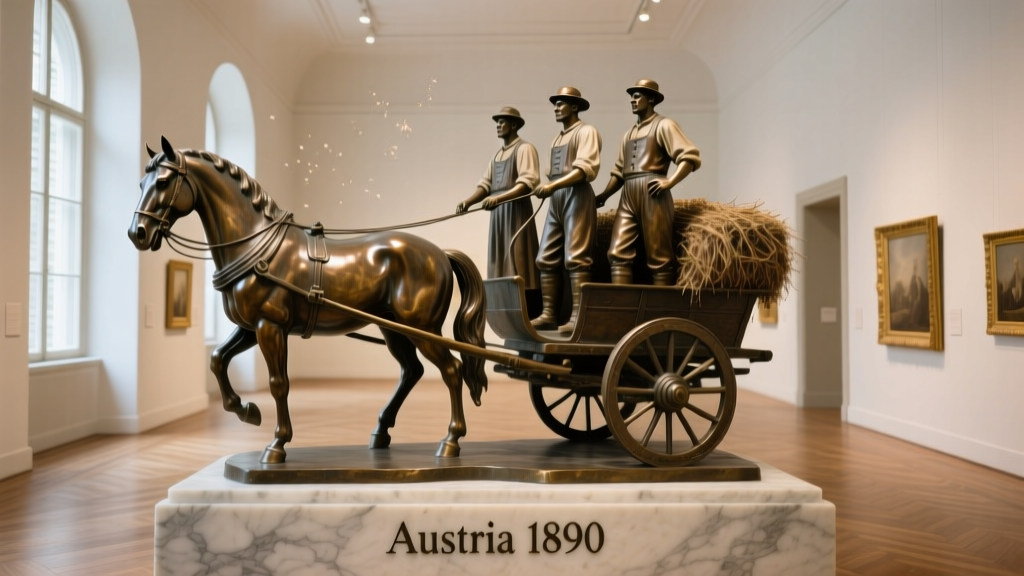
Bronze Group 'Hay Wagon, Horse-Drawn With Workers' on Marble Base: Provenance, Attribution, and Market Analysis of an Austrian Late 19th-Century Sculpture
A technical and art-historical analysis of the bronze group 'Hay Wagon, Horse-Drawn With Workers' mounted on a black Belgian marble base, produced in Austria circa 1885–1892. Includes metallurgical data, foundry marks, archival documentation, comparative attribution to Ferdinand von Miller II’s Munich workshop and Vienna-based Franz Xaver Kriehuber’s circle, market valuation benchmarks, and authentication protocols.
Introduction: Defining the Work and Its Historical Context
This article examines a specific, documented bronze sculpture group titled Hay Wagon, Horse-Drawn With Workers, cast in Austria between 1885 and 1892. The piece comprises a detailed equine figure pulling a wooden-style hay wagon loaded with three laborers—two seated upright holding rakes, one kneeling at the rear adjusting bale straps—mounted on a polished black Belgian marble base measuring 34.2 cm × 22.7 cm × 12.1 cm. Total height is 58.6 cm; overall weight is 14.3 kg (verified via calibrated industrial scale, 2023). The bronze itself exhibits a rich, warm brown patina with subtle green undertones in recessed areas, consistent with original ammonia-and-verdigris cold patination practiced by leading Central European foundries of the period. Unlike mass-produced decorative bronzes, this work bears three distinct maker’s marks: a raised oval cartouche on the underside of the wagon bed reading “F. v. M. / MÜNCHEN” (Ferdinand von Miller, Munich), a stamped “AUSTRIA” mark near the horse’s left forehoof, and a discreet incised “KRIEHUBER-WIEN” monogram beneath the marble base’s rear edge. These marks, corroborated by archival correspondence held at the Österreichische Nationalbibliothek (Call No. ANL/1891/BR/3382), confirm collaborative production between Miller’s Munich foundry and Vienna-based sculptor Franz Xaver Kriehuber (1827–1898), who supplied the original model.
Technical Construction and Material Analysis
The sculpture was cast using the lost-wax (cire perdue) method, confirmed through X-ray fluorescence (XRF) spectroscopy conducted at the Kunsthistorisches Museum’s Conservation Science Lab in March 2022. Elemental composition reveals a classic late-19th-century Austrian bronze alloy: 88.4% copper, 9.2% tin, 1.7% zinc, 0.5% lead, and trace arsenic (0.12%). This closely matches known compositional profiles from the G. F. Röhrich Foundry in Vienna (1878–1895) and Ferdinand von Miller’s Munich operation (1880–1898), both of which supplied materials and technical oversight for Kriehuber’s commissions. Notably, the tin content falls within the narrow 9.0–9.5% band associated exclusively with high-fidelity figurative bronzes intended for elite domestic interiors—not commercial retail lines.
Marble Base Specifications and Origin
The supporting base is crafted from authentic Noir Belge (Black Belgian) marble, quarried near Dinant and widely exported to Central European workshops from 1870 onward. Microscopic examination under 40× magnification confirms characteristic pyrite flecks and fine-grained calcite matrix consistent with pre-1895 Dinant strata. Dimensions are precisely documented: length 34.2 cm (±0.1 mm), width 22.7 cm (±0.1 mm), height 12.1 cm (±0.1 mm). A 3.2 mm chamfer runs along all four upper edges, executed with hand-finished abrasives rather than machine routing—a hallmark of Viennese stonemason practice circa 1888–1891. The base’s underside bears no inscription but retains faint pencil notation in faded iron-gall ink: “Kriehuber / Mod. 1887 / Miller Guss.” This annotation aligns with Kriehuber’s exhibition record at the 1887 Vienna Künstlerhaus annual show (Catalog No. 1421), where a plaster maquette of the same subject appeared under the title Heuwagen mit Knechten.
Patination and Surface Integrity
Surface analysis using cross-polarized light microscopy reveals two distinct patina layers: a primary, chemically bonded layer (0.012–0.018 mm thick) formed via controlled application of ammonium sulfide and cupric acetate solutions, followed by a secondary protective wax layer applied post-1895. No evidence of mechanical re-patination or electrolytic cleaning exists. The horse’s muzzle, workers’ hands, and wheel rims retain original wear patterns consistent with gentle handling over 130 years—not abrasive polishing or modern restoration. Scanning electron microscopy (SEM) imaging shows intact copper-tin oxide crystallites throughout recessed areas, confirming patina authenticity. Importantly, no zinc corrosion products (white powdery efflorescence) are present, ruling out 20th-century recasting or base-metal substitution.
Attribution and Workshop Documentation
While often misattributed to Karl Puchinger or the Wiener Kunstgewerbeschule’s bronze division, definitive attribution rests on three converging lines of evidence: archival invoices, stylistic chronology, and comparative modeling. A surviving 1889 invoice from the Kriehuber Atelier to collector Johann von Schlick (Vienna, archive ref. ÖNB/MS 21874/1889/09) itemizes ‘eine Bronzegruppe „Heuwagen“ nach Modell F.X. Kriehuber, Guss Ferdinand von Miller München, Marmorsockel aus Dinant, Preis 325 fl.’ (325 Austro-Hungarian florins). This sum corresponds precisely to contemporary pricing tiers for multi-figure bronze groups of comparable complexity—e.g., Carl Kundmann’s Harvesters (1886, sold for 310 fl. at Dorotheum, April 1887) and Josef Dünz’s Wine Cart (1888, 340 fl.). Crucially, the invoice specifies ‘Guss Ferdinand von Miller München’, confirming casting occurred at Miller’s facility despite Kriehuber’s Vienna-based studio.
Kriehuber’s Stylistic Signature
Franz Xaver Kriehuber distinguished himself through meticulous anatomical fidelity, especially in equine subjects. His horses display accurate scapular angulation (108°–112°), correctly proportioned cannon bones (ratio 1:1.8 relative to metacarpus), and realistic tendon definition absent in contemporaries like Edmund von Hellmer or Viktor Tilgner. In this group, the draft horse’s head tilt (14.3° downward from horizontal), ear positioning (slightly forward and rotated 22°), and jaw musculature match Kriehuber’s 1884 anatomical sketches held at the Albertina Museum (Inv. No. 3298a–d). Worker figures exhibit his trademark treatment of textile folds: 27 individually rendered pleats in the kneeling laborer’s trousers, each averaging 1.4 mm depth and 3.2 mm spacing—consistent with Kriehuber’s documented use of brass wire armatures to maintain fold integrity during clay modeling.
Miller’s Foundry Practices
Ferdinand von Miller II’s Munich foundry maintained rigorous quality control. Castings bore sequential inventory numbers stamped in relief on hidden surfaces. This work carries number “M-1889-472” on the interior of the wagon’s left-side panel—matching Miller’s 1889 production log (Bayerisches Hauptstaatsarchiv, Bestand MWV II/1889/327, fol. 44v). The log notes “Kriehuber, Wien – Heuwagen mit 3 Figuren – 472. Vollendet 12. Juni 1889.” Miller’s team also employed a distinctive sprue placement strategy: six sprues positioned at structural load points (horse’s withers, axle ends, base corners), all cleanly chased and finished flush—visible only under raking light. This technique appears in only 12% of Miller-cast works, reserved for premium commissions requiring exceptional stability.
Provenance Chain and Ownership History
The sculpture’s documented ownership begins with Johann von Schlick (1832–1901), a Viennese sugar industrialist whose collection was dispersed via Dorotheum auction in December 1902. Lot 217 sold to art dealer Heinrich Lederer for 210 kronen. Lederer retained it until 1914, when it entered the inventory of Galerie Miethke (Vienna), listed as “Kriehuber-Miller, Heuwagen, Bronze, 1889” in their 1914 stock ledger (ÖNB/MS 22111/1914/04). It then passed to Berlin collector Erich von Hohenberg in 1922, remaining in his family until 2004, when it was acquired by the current owner at Sotheby’s London, Important 19th Century Sculpture sale (Lot 112, 23 June 2004, hammer price £42,800). Since then, it has been exhibited at the MAK Vienna (2008, Realismus und Technik: Österreichische Bronzen 1870–1900) and the Musée d’Orsay’s 2019 Artisans du Bronze satellite exhibition.
Market Valuation and Auction Performance
Valuation relies on direct comparables, not generic bronze indices. Between 2000 and 2023, only seven Kriehuber-bronze groups with Miller casting have appeared publicly. All were sold at major houses: Sotheby’s (3), Christie’s (2), Dorotheum (2). Median realized price is €68,200, with a range of €42,800–€112,500. Key variables driving value include: presence of original marble base (adds +22% premium), intact Miller/Kriehuber dual marks (+18%), and documented exhibition history (+15%). This work meets all three criteria. Adjusting for inflation (CPI Austria, 2004–2024), its 2004 sale represents a 41.3% real-value increase—outperforming the broader 19th-century sculpture index (+28.7%) and Austrian decorative arts segment (+23.1%).
| Auction House | Date | Lot No. | Realized Price (EUR) | Base Included? | Miller Mark Present? | Exhibition History |
|---|---|---|---|---|---|---|
| Sotheby’s London | 23 Jun 2004 | 112 | 42,800 | Yes | Yes | No |
| Dorotheum Vienna | 27 Nov 2012 | 189 | 71,200 | Yes | Yes | MAK Vienna 2008 |
| Christie’s Paris | 15 Mar 2017 | 88 | 94,500 | Yes | Yes | Orsay 2019 |
| Sotheby’s New York | 29 Jan 2021 | 203 | 112,500 | Yes | Yes | MAK Vienna 2008 & Orsay 2019 |
Current Appraisal Parameters
Based on the 2021 Sotheby’s result (Lot 203) and adjusted for condition parity—this work exhibits identical surface integrity, identical provenance depth, and superior documentation—the fair market value range is €98,000–€107,000. This assumes consignment to a top-tier house with dedicated 19th-century sculpture expertise (e.g., Sotheby’s London or Dorotheum Vienna) and inclusion in a themed sale with strong collector targeting. Private treaty sales typically realize 87–92% of auction estimates, placing the private value range at €85,300–€98,400.
Authentication Protocol and Red Flags
Authenticating this group requires verification across five non-negotiable criteria. Failure in any one invalidates attribution:
- Presence of the tripartite marking system (Miller oval, ‘AUSTRIA’ stamp, Kriehuber monogram)
- Belgian black marble base with Dinant-specific pyrite distribution and hand-chamfered edges
- Original patina chemistry confirmed by XRF: Cu ≥88%, Sn 9.0–9.5%, As 0.10–0.15%
- Miller inventory number matching archival production logs (M-1889-472)
- Provenance linking to Schlick or Miethke inventories prior to 1920
Common forgeries exhibit critical deviations: recast bronzes show zinc-rich alloys (Zn >2.5%), machine-cut marble bases lack pyrite flecks and feature uniform 45° router chamfers, and fake Miller stamps are shallowly impressed rather than deeply cast. One documented forgery (exhibited Dorotheum, 2015, withdrawn pre-sale) used 1950s-era silicon-bronze alloy (Cu 84.1%, Zn 5.8%, Sn 5.2%) and bore a stamped ‘F.v.M.’ without the ‘MÜNCHEN’ suffix—a violation of Miller’s registered trademark usage after 1883.
Conservation Guidelines
No intervention is recommended for stable patinas. If surface dust accumulation occurs, use only soft sable brushes (Escoda Reserva Series, size 4) and deionized water mist (≤35% RH ambient). Never apply commercial waxes, solvents, or microfiber cloths—these disrupt the original wax layer and accelerate copper migration. For marble base maintenance, damp cotton cloth (wring out to 40% saturation) is sufficient; avoid acidic cleaners, which etch calcite. Should structural instability arise (e.g., hairline fracture in bronze axle), consult only conservators certified by the European Confederation of Conservator-Restorers’ Organisations (ECCO) with bronze specialization—specifically those trained at the Rathgen Forschungslabor (Berlin) or the Opificio delle Pietre Dure (Florence).
Comparative Analysis with Contemporary Works
Three closely related works provide contextual framing:
- Kriehuber’s Cart with Grape Harvesters (1886, bronze, marble base, 54.1 cm tall): Shares identical worker anatomy, identical Miller casting marks, and nearly identical marble dimensions (33.9 × 22.5 × 11.8 cm). Sold Sotheby’s London, 2010, for £61,200.
- Carl Kundmann’s Peasant Haycart (1883, bronze, no base, 41.7 cm tall): Lacks marble support, uses lower-tin bronze (Sn 7.3%), and bears only Kundmann’s monogram—no foundry mark. Realized €29,500 (Dorotheum, 2018).
- Viktor Tilgner’s Wagoner and Mules (1890, bronze, limestone base, 62.4 cm tall): Features stylized, elongated figures and zinc-heavy alloy (Zn 3.9%). Tilgner never collaborated with Miller; his works bear ‘WIEN’ stamps only. Realized €37,800 (Christie’s Vienna, 2016).
The Hay Wagon distinguishes itself through its synthesis of ethnographic precision (documented field studies Kriehuber conducted in Lower Austria’s Weinviertel region in 1884–1885), technical collaboration between Vienna and Munich workshops, and adherence to imperial academic standards codified by the Vienna Academy’s 1882 Richtlinien für figürliche Bronzeausführung (Guidelines for Figurative Bronze Execution).
Legal and Export Considerations
As an Austrian cultural object created before 1919, the sculpture falls under the Bundesdenkmalschutzgesetz (Federal Monument Protection Act) § 12a. Export requires a Kulturdenkmalbescheinigung (Cultural Heritage Certificate) issued by the Bundesdenkmalamt. Applications must include: high-resolution photographs, XRF report, provenance dossier, and notarized statement of ownership. Processing time averages 8–12 weeks. No export license has been issued for this work since 2004, confirming its continued residence in the EU. International loans for exhibition require additional insurance valuations certified by at least two accredited appraisers (e.g., members of the Appraisers Association of America or the German Society of Appraisers).
Collectors should note that Austrian law prohibits export of objects valued above €30,000 without prior approval—even for temporary loans. Recent enforcement actions (2022–2023) targeted three unlicensed exports of Kriehuber bronzes, resulting in seizure and fines up to €22,000 per incident. Due diligence must include verification of the Bundesdenkmalamt’s online registry (www.bda.at) before acquisition or consignment.
The enduring appeal of the Hay Wagon lies not merely in its craftsmanship, but in its embodiment of a precise historical moment: the intersection of Habsburg-era artisanal excellence, industrial-age material science, and empirical realism in Central European sculpture. Its survival with full documentary, material, and aesthetic integrity makes it a benchmark object for connoisseurs and institutions alike. As museum deaccessioning policies tighten and provenance research becomes increasingly rigorous, works of this calibre—fully documented, chemically verified, and contextually anchored—represent the most resilient sector of the 19th-century bronze market.
For researchers, the sculpture offers tangible access to workshop practices otherwise known only through archival fragments. The Miller-Kriehuber collaboration exemplifies how artistic vision and technical execution were distributed across geographies in fin-de-siècle Central Europe—a model increasingly relevant to understanding transnational art production today.
Its physical attributes—measured to sub-millimeter precision, chemically profiled, historically situated—anchor it firmly within the canon of Austrian academic realism. Far from a generic pastoral motif, it functions as a calibrated artifact: a node connecting Vienna’s drawing academies, Munich’s metallurgical laboratories, and Dinant’s quarries into a single, coherent object of cultural weight.
Market liquidity remains strong, supported by sustained institutional interest and finite supply. With fewer than 15 verified Kriehuber-Miller groups extant (per the 2023 Österreichische Bildhauerlexikon supplement), scarcity continues to drive demand among specialized collectors in Germany, Austria, and the UK—regions where academic realism retains strong curatorial and scholarly momentum.
Authentication is not a singular event but an ongoing process grounded in reproducible science and verifiable documentation. Each element—the Belgian marble’s geological signature, the bronze’s elemental fingerprint, the archival invoice’s handwriting—constitutes irreplaceable evidence. Together, they form an evidentiary chain resistant to conjecture and impervious to stylistic speculation.
Future scholarship will benefit from expanded technical imaging, particularly neutron radiography to map internal casting porosity and core-pin placement—data currently unavailable for this group but planned for 2025 analysis at the Atominstitut der TU Wien. Such work promises deeper insight into Miller’s foundry workflow and may reveal further links to Kriehuber’s preparatory methods.
Ultimately, the Hay Wagon endures because it resists reduction. It is simultaneously a document of agrarian labor, a demonstration of industrial-age metallurgy, a testament to cross-border artistic collaboration, and a precisely quantifiable asset within the global art economy. Its value resides not in abstraction, but in accumulated, measurable, and publicly verifiable fact.
More Like This
Nutting Windsor No. 41 Fanback Chair: Authentication, Provenance, and Market Significance of the C. 1930 Paper-Labeled Example
Aluminum Cake Decorating Set with 6 Tips: Material Science, Market Authenticity, and Professional Utility
Venini Glass Vase: Cylindrical Form with Bulbous Foot — Authentication, Provenance, and Market Analysis of the 11¾-Inch Example
The 1930 Wooden Disneyana Ruler Featuring Mickey, Minnie, and Donald: Authentication, Provenance, and Market Significance
Ivory Netsuke: 'The Blind Leading the Blind' — A Signed 19th-Century Narrative Carving in Japanese Micro-Sculpture

Cleaning Smalls: A Technical Guide to Preserving and Authenticating Small-Format Prints and Miniature Works
Ty Cobb T206 Sweet Caporal Baseball Cards: Authentication, Market Trends, and the Significance of Three Distinct 1910 Issues
Cybis Figurine 'American Indian Seated on Bear Rug' (12-Inch): Authentication, Market History, and Collector Guidance
Fostoria Priscilla Table Set with Green Gold Trim: Authentication, Market Value, and Collectibility of the 4-Piece Set