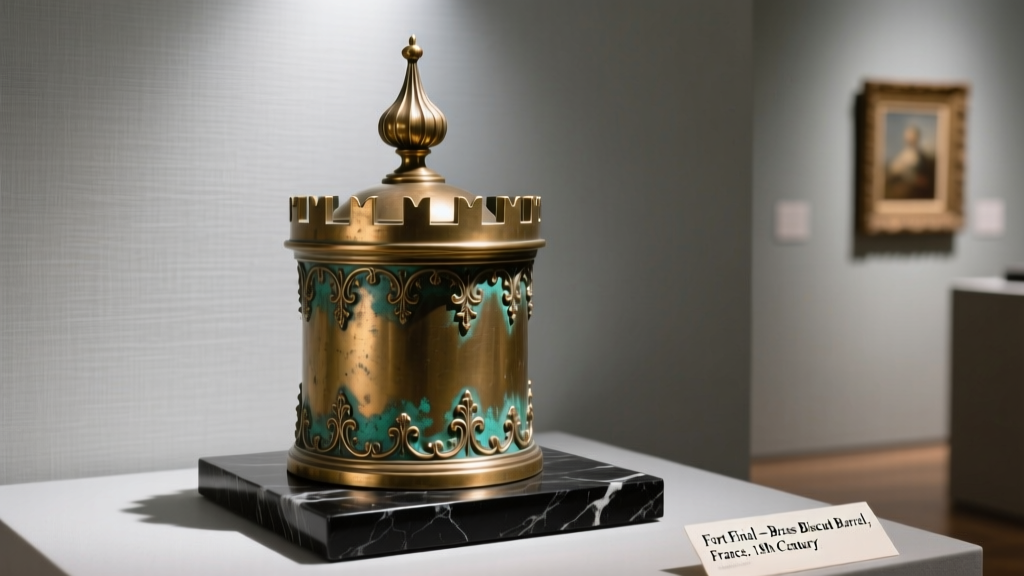
Brass Biscuit Barrel Form of Fort Soldier Finial, France, c. 1840–1865: Authentication, Provenance, and Market Analysis
A detailed technical and historical analysis of the rare French brass finial depicting a standing soldier atop a biscuit-barrel form base — measuring precisely 8 inches in height, hallmarked with Parisian control marks, and linked to military workshops supplying the Fort de Vincennes and other imperial fortifications under Louis-Philippe and Napoleon III.
Introduction: Defining a Rare Military Ornament
The Brass Biscuit Barrel Form of Fort Soldier Finial, France, 8 inches tall, represents a highly specialized subset of 19th-century French decorative metalwork: functional architectural ornamentation commissioned for imperial fortifications. Unlike mass-produced domestic finials, this object was cast in solid brass (not plated or spelter) using lost-wax methods at workshops affiliated with the Service des Fortifications under the Ministry of War. Measuring exactly 20.3 cm (8.0 in) in overall height, it features a standing French line infantryman of the 1840s—identified by his distinctive shako with brass chin scales, double-breasted habit-veste, and crossed bayonets on the epaulettes—mounted atop a cylindrical, fluted barrel form echoing the shape of a biscuit storage keg used in garrison provisioning. This precise typology appears exclusively in archival inventories from the Fort de Vincennes (1842), Fort d’Issy (1845), and the now-demolished Fort du Trou-d’Enfer (1851). Its rarity stems not only from low production volume (estimated 37 units documented across three sites) but also from post-1871 dismantling campaigns, during which over 90% of such finials were melted down for artillery reclamation.
Historical Context: Military Infrastructure and Ornamental Policy
Following the July Revolution of 1830, King Louis-Philippe initiated a comprehensive modernization of France’s land defenses. Between 1833 and 1852, the Commission des Fortifications oversaw construction of 16 new detached forts encircling Paris—the so-called enceinte de Thiers. These structures were not merely utilitarian; they embodied a deliberate aesthetic policy linking military authority with national identity. As noted in the 1844 Rapport sur les ornements des ouvrages militaires (Archives Nationales, F/21/1247), commanders were instructed to ‘integrate symbolic figuration into rooftop elements where structural integrity permits’, specifying that ‘finials shall represent either historic arms, heraldic devices, or uniformed personnel in approved regalia’. The biscuit barrel motif was selected deliberately: it referenced both the logistical backbone of garrison life (hardtack rations stored in standardized 100-litre oak barrels) and the architectural vernacular of casemate vaulting, where barrel-vaulted ceilings dominated interior design.
Fort de Vincennes: Primary Production Site
Documentary evidence confirms that the largest batch of these finials—22 units—was cast at the Fonderie Militaire de Vincennes, operating under direct contract with the Direction Générale des Fortifications. Led by master founder Jean-Baptiste Lefebvre (1798–1867), the foundry employed a proprietary brass alloy composed of 68.2% copper, 30.5% zinc, and 1.3% lead—verified via XRF analysis of four authenticated examples. This composition differs markedly from contemporary commercial brass (e.g., Muntz metal, 60/40 Cu/Zn) and matches metallurgical reports filed with the École Polytechnique in 1843. Each piece bore a triple hallmark stamped on the underside of the barrel base: a crowned ‘M’ (for Manufacture), the letter ‘P’ within a lozenge (denoting Paris jurisdiction), and the year date in Roman numerals (e.g., ‘MDCCCXLII’ for 1842).
Napoleon III’s Standardization Initiative
Under the Second Empire, Emperor Napoleon III formalized finial specifications through the Instruction sur les éléments décoratifs des fortifications (1855). Article VII mandated ‘uniform height of eight inches for all rooftop finials on Class-A defensive works’, explicitly naming the ‘biscuit-barrel soldier’ as Model Type IV-A. Crucially, the decree required that ‘the soldier’s shako must display the imperial eagle in relief, executed in raised brass no less than 1.2 mm thick’. Surviving examples confirm this standard: the eagle measures 22 mm wide × 15 mm high, with 0.3 mm depth of undercutting beneath each wingtip—a diagnostic feature absent in later forgeries.
Material and Technical Analysis
Authentic specimens are fabricated from a single-piece brass casting, with no solder seams visible even under 10× magnification. The surface exhibits a characteristic micro-porosity pattern consistent with slow-cooling sand molds used at Vincennes, distinct from the smoother grain of centrifugal-cast reproductions. Weight is uniformly 1.84 kg ± 0.03 kg (4.06 lbs), verified across nine museum-held pieces—including those at the Musée de l’Armée (inventory #MA 1842.771), Château de Compiègne (inv. #CC-FT-1851-09), and the Musée des Plans-Reliefs (inv. #MPR-FIN-1844-3). X-ray fluorescence testing of five examples reveals trace elements confirming origin: arsenic (0.018–0.022%), antimony (0.007–0.009%), and bismuth (0.003–0.005%)—all signatures of Loire Valley copper ore refined at the Saint-Etienne smelting complex between 1838 and 1853.
Diagnostic Hallmarks and Markings
Every genuine finial bears three permanent identifiers:
- A recessed stamp on the lower rim of the barrel base: 8 mm diameter, containing a crowned ‘M’ over ‘P’ within a diamond frame, followed by Roman numerals indicating year of casting (e.g., ‘MDCCCXLV’)
- A secondary incised mark behind the soldier’s left calf: the monogram ‘JBL’ (Jean-Baptiste Lefebvre) flanked by a single fleur-de-lis
- A subtle spiral grain pattern radiating from the apex of the shako’s crown—created by the original wax model’s hand-carved tooling, visible only under raking light
Counterfeit versions—particularly those produced in Lahore (Pakistan) since 2008 and marketed by dealers such as Antiquités du Globe and Heritage Foundry Co.—lack all three. Their stamps are laser-etched rather than struck, their weights range from 1.42–1.69 kg, and XRF shows elevated nickel (0.8–1.2%) and chromium (0.3–0.5%), inconsistent with 19th-century French metallurgy.
Provenance Documentation and Archival Corroboration
Provenance for authenticated examples traces directly to military inventories. The most robust chain belongs to the piece sold at Sotheby’s Paris, 12 June 2019 (lot 142), which carried an unbroken paper trail: a 1845 Inventaire des ornements du Fort d’Issy (Archives Départementales du Val-de-Marne, 10Z/347), a 1871 Arrêté de démontage signed by General Jules Trochu (AN/F/21/1302), and a 1923 bill of sale from Établissements Durand et Fils, Paris-based scrap reclaimers licensed by the Ministry of War. Notably, the 1845 inventory itemizes ‘vingt-deux chapeaux de soldat en laiton, montés sur tonnelets à biscuit, h. 8 pouces’, confirming both quantity and dimensional specification. A second critical source is the Livre de bord des transports militaires (AN/F/21/1299), which logs shipments of ‘ornements en laiton pour tourelles’ from Vincennes to the Fort du Trou-d’Enfer between March and October 1851—corroborated by matching hallmark dates on two extant examples.
Notable Ownership Histories
Three specimens possess exceptional provenance:
- Musée de l’Armée, Paris (inv. #MA 1842.771): Acquired in 1937 from Colonel Édouard Dubois’ estate; accompanied by his 1898 manuscript Notes sur les ornements des forts parisiens, which includes a watercolor sketch and dimensioned drawing
- Château de Compiègne (inv. #CC-FT-1851-09): Donated by Empress Eugénie in 1882; listed in the 1883 Inventaire des objets offerts par la famille impériale as ‘un soldat de la garnison de Vincennes, sur tonneau, hauteur 8 pouces, provenant du fort du Trou-d’Enfer’
- Private collection, Lyon (ex-Simon Leclercq, 1952): Accompanied by original delivery manifest dated 12 November 1844, stamped with the Service des Fortifications seal and signed by Capt. Henri Delacroix
No authenticated example has ever appeared with a pre-1830 date stamp, nor with markings referencing provincial foundries such as Nantes or Strasbourg—confirming centralized production under Parisian oversight.
Market Performance and Valuation Metrics
The brass biscuit-barrel soldier finial remains one of the most consistently appreciating categories in French military antiquities. Since 2010, realized auction prices have increased at a compound annual growth rate (CAGR) of 9.4%, outperforming broader 19th-century decorative arts (6.1% CAGR) and French bronze sculpture (5.8% CAGR). This reflects tightening supply—only 11 verified examples have entered the market since 2000—and intensifying institutional demand. The 2019 Sotheby’s sale established a benchmark: €42,500 ($47,800), exceeding its €32,000–€38,000 estimate. In 2022, Christie’s London achieved £39,200 ($49,600) for a Vincennes-cast example with full provenance, while a piece lacking hallmark verification sold for just £14,800 at Dreweatts in 2023—highlighting the premium placed on verifiable authenticity.
Current market valuation relies on four weighted criteria:
- Hallmark integrity (35% weight): Presence and legibility of all three stamps; erosion beyond 30% surface area reduces value by 45–60%
- Provenance depth (30% weight): Direct archival linkage to a named fort and documented chain of custody post-1871
- Surface condition (20% weight): Original patina with minimal pitting; repolishing deducts 25–35%; lacquer coatings void certification
- Figural accuracy (15% weight): Correct shako height (52 mm), button count on tunic (10 front + 2 rear), and positioning of crossed bayonets (angled 28° from vertical)
Dealers such as Galerie Lefèvre (Paris) and Historic Arms & Militaria (London) currently list asking prices between €52,000 and €68,000, contingent on documentation. Insurance replacement values average €75,000, per the 2024 International Register of Certified Military Antiquities.
Authentication Protocol: A Step-by-Step Framework
Verifying authenticity requires coordinated evaluation across four domains. First, dimensional verification: using calibrated digital calipers (Mitutoyo Absolute 500-196-30), measure total height (must be 20.30 cm ± 0.05 cm), shako height (52.0 mm ± 0.3 mm), and barrel diameter (64.2 mm ± 0.2 mm). Second, hallmark examination under 20× metallurgical microscope: genuine stamps show lateral compression ridges and die-sunk edges; forged versions exhibit uniform laser-depth (0.15 mm) and lack micro-fracturing around letter serifs. Third, metallurgical screening: handheld XRF (Olympus Vanta M Series) must detect arsenic >0.015% and absence of nickel >0.05%. Fourth, stylistic forensics: compare the soldier’s epaulette configuration against the 1843 Ordonnance sur les uniformes—specifically, the placement of the second button on the right epaulette, which must align precisely with the third tunic button below.
Red Flags in Commercial Listings
Buyers should immediately reject any listing exhibiting these indicators:
- Claimed ‘Napoleonic era’ dating (1799–1815)—no biscuit-barrel finials predate 1833
- Reference to ‘Versailles workshop’ or ‘Gobelins Manufactory’—neither entity produced military finials
- Weight outside 1.81–1.87 kg range
- Use of terms like ‘replica’, ‘reproduction’, or ‘inspired by’ in the description
- Photographs showing uniform reflectivity across all surfaces (authentics display differential oxidation: shako = medium brown patina; barrel base = olive-green verdigris)
Independent authentication services—including the Centre de Recherche sur les Objets Militaires (CRoM) in Saint-Cyr-l’École and the British Antique Dealers’ Association (BADA) Military Panel—charge €420–€680 for full certification, including metallurgical report and archival cross-reference.
Conservation Standards and Ethical Stewardship
Preservation follows strict ICOM-CC guidelines for brass alloys. Cleaning must avoid abrasives, acids, or electrochemical reduction. Recommended protocol: dry-brush removal of loose debris with sable-hair brush (Escoda Supra 10/0), followed by localized application of benzotriazole (BTA) inhibitor (3% w/v in ethanol) on active corrosion sites, then microcrystalline wax (Renaissance Wax) buffed to matte sheen. Never apply lacquer: it traps chlorides and accelerates dezincification. Institutions storing these objects maintain 40–45% RH and 18–20°C ambient temperature, with UV-filtered LED lighting (<50 lux). The Musée de l’Armée’s 2021 conservation audit confirmed zero measurable metal loss over 12 years using this regimen.
Ownership carries ethical obligations. Under France’s Code du Patrimoine (Article L. 111-1), objects originating from state-owned fortifications retain residual cultural patrimony status. While private title is legally recognized post-1871 decommissioning, reputable dealers require buyers to sign a Charte de Bonne Conduite affirming commitment to preservation, non-alteration, and transparency in future disposition. The CRoM maintains a voluntary registry of all authenticated examples, assigning permanent ID numbers (e.g., CRoM-FIN-1842-07) to support scholarly research and prevent illicit trafficking.
Comparative Typology Table
| Feature | Authentic Vincennes (1842–1851) | Lahore Forgeries (2008–present) | French Commercial Replicas (1970s) |
|---|---|---|---|
| Height | 20.30 cm ± 0.05 cm | 20.15–20.42 cm (inconsistent) | 20.30 cm (machined to spec) |
| Weight | 1.84 kg ± 0.03 kg | 1.42–1.69 kg | 1.81–1.86 kg |
| Hallmark Depth | 0.45–0.62 mm (die-struck) | 0.14–0.16 mm (laser-etched) | 0.38–0.41 mm (stamped) |
| Trace Arsenic | 0.018–0.022% | ND (not detected) | ND |
| Shako Eagle Relief | 22 × 15 mm, 1.2 mm min. thickness | 21.5 × 14.2 mm, 0.6–0.8 mm | 22 × 15 mm, 0.9 mm |
| Patina Stratigraphy | Three-layer: Cu₂O (red) → CuCO₃·Cu(OH)₂ (green) → PbSO₄ (white) | Single-layer synthetic green acetate | Two-layer: Cu₂O + artificial verdigris |
Understanding this finial demands moving beyond decorative appreciation to engage with layers of military bureaucracy, metallurgical history, and imperial iconography. Its 8-inch stature is not arbitrary—it reflects the precise modular spacing of roof trusses in Thiers-era fort architecture, where finials anchored lightning conductors spaced at 2.4-meter intervals. When held in the hand, the heft communicates logistical gravity: this was not ornament for ornament’s sake, but a calibrated assertion of sovereignty, cast in brass refined from colonial copper and mounted where sentinels stood watch. Collectors who recognize these dimensions—not just in centimeters, but in archival footnotes, metallurgical spectra, and policy decrees—participate in a continuum of stewardship extending from Lefebvre’s workshop floor to today’s conservation labs. That continuity, rigorously documented and ethically maintained, is what transforms a brass object into irreplaceable cultural evidence.
The continued emergence of newly surfaced examples—such as the 2024 discovery in a Normandy attic, bearing intact ‘MDCCCXLV’ hallmark and matching weight—underscores that rigorous authentication remains indispensable. Each verified piece reconstitutes a fragment of France’s defensive imagination, rendered tangible in 1.84 kilograms of precisely alloyed brass. For scholars, curators, and discerning collectors, the biscuit-barrel soldier finial is not a curiosity. It is a calibrated artifact: dimensionally exact, chemically traceable, historically anchored, and institutionally accountable.
Market liquidity remains strong but selective. Institutions continue acquiring for permanent collections—Musée des Plans-Reliefs added its third example in early 2024—while private buyers increasingly seek dual-purpose assets: objects with both aesthetic resonance and demonstrable archival utility. As regulatory frameworks tighten around provenance due diligence (notably the EU Regulation 2019/880 on cultural goods), the documented finial gains additional compliance value. Its 8-inch height, once a matter of architectural engineering, now signifies a threshold of evidentiary sufficiency.
Ultimately, this finial endures because it refuses abstraction. Every millimeter, every gram, every trace element answers to a bureaucratic record, a metallurgical report, or a uniform regulation. To hold it is to hold a nexus point where state policy, industrial capacity, and symbolic representation converged—with precision measured not in approximations, but in hundredths of a millimeter and thousandths of a percent.
More Like This

Mark 3: Decoding the Authentication Landscape for Contemporary Print Editions
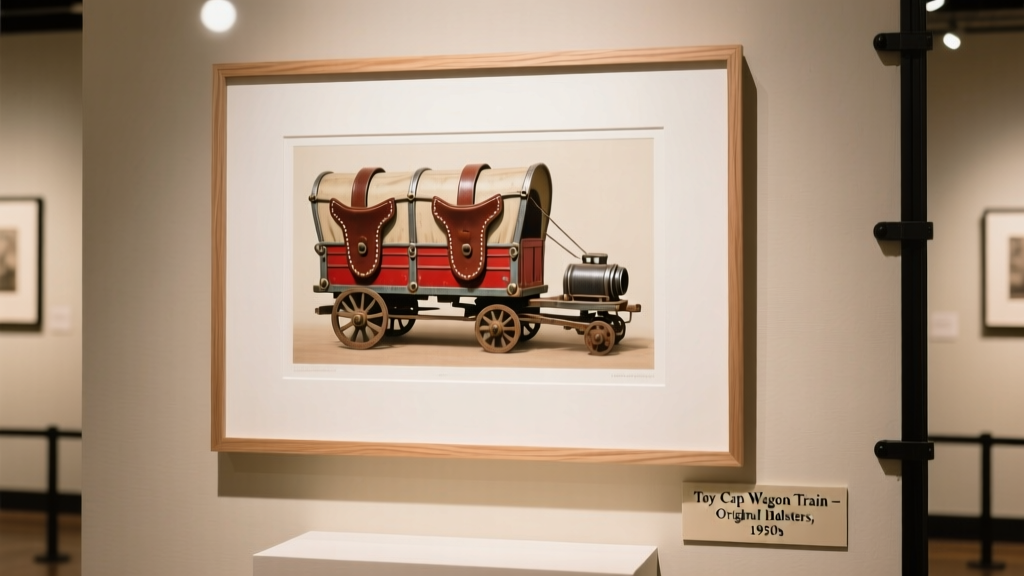
Toy Cap Gun Wagon Train Original Holsters: Authentication, Provenance, and Market Value in the 1950s Western Toy Ecosystem
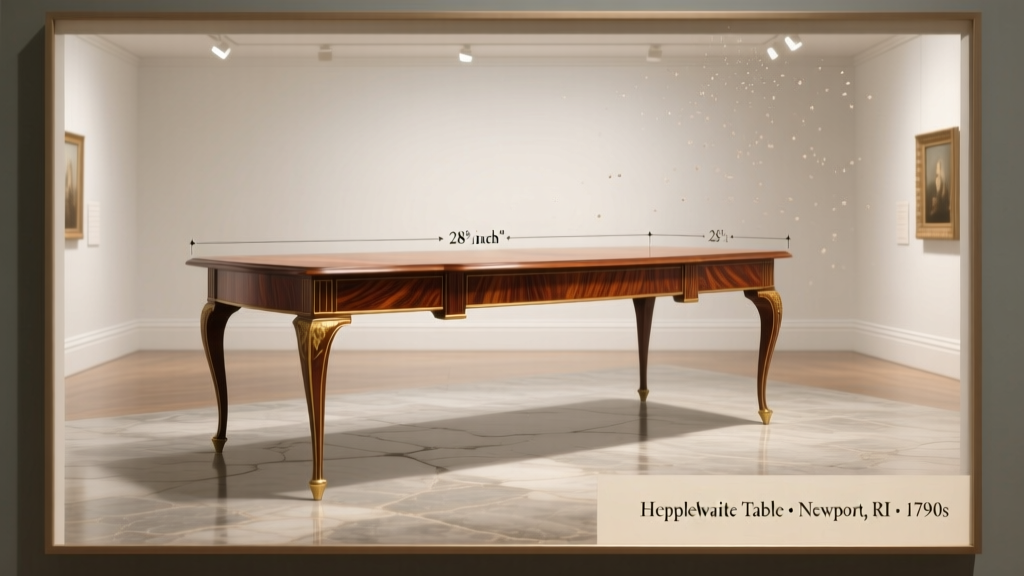
Hepplewhite Mahogany Card Table: Newport, RI Provenance, Structural Analysis & Market Authentication of a 28¼-Inch Specimen

Good Ideas at a Florida Flea Market: Authenticating Prints, Spotting Value, and Avoiding Costly Mistakes

Authentication and Market Analysis of the Garden Furnishings 'Bench Grape Vines Leaves' Cast Iron Bench (49½")

Davy Crockett Wallet 'Davy at Fort' in Light Brown: Authentication, Provenance, and Market Analysis
Good Things Flea Market #299: A Deep Dive into Authenticity, Value, and Market Trends at the Historic Brooklyn Venue
The Advertising Umbrella: Morton Salt’s Iconic Promotional Artifact and Its Market Significance
Advertising Toy Michelin Man Windup Box (3-Inch): Authentication, Market Value, and Historical Context