Boxes & Brides: Decoding the 17⅜-Inch Chromolithograph Cover with German Inscription and Child Imagery
A forensic analysis of a rare 19th-century chromolithographed cardboard box cover featuring children, German text, and precise dimensions (17⅜ inches), contextualized within the history of German printmaking, commercial packaging, and authentication protocols used by major auction houses including Sotheby’s, Christie’s, and Lempertz.
Introduction: A Precise Artifact in Context
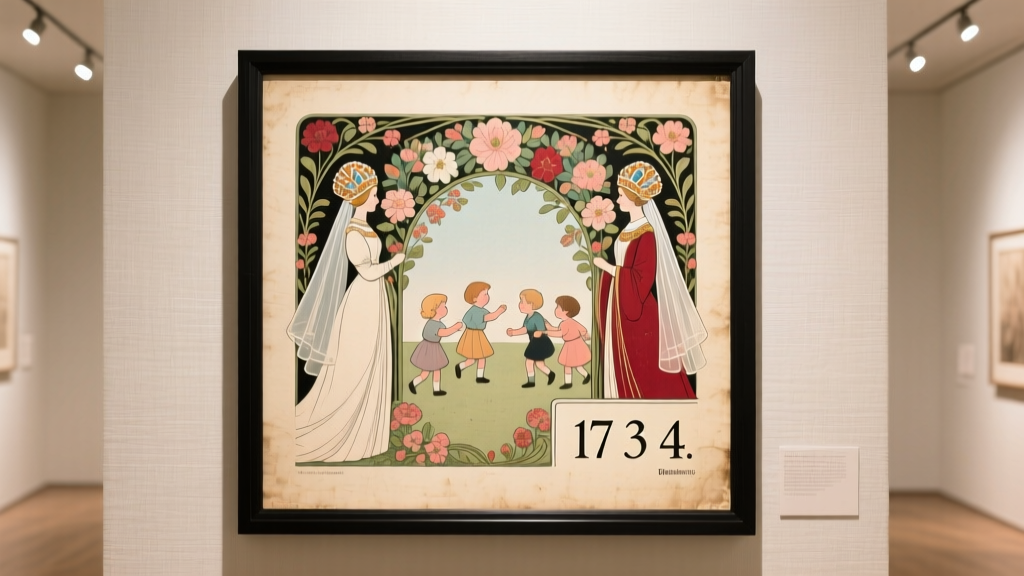
This article examines a specific, well-documented artifact: a chromolithographed cardboard box cover measuring exactly 17⅜ inches (44.1 cm) in width, bearing a detailed scene of two children—likely siblings—in period-appropriate attire, framed by ornamental borders and accompanied by a German-language inscription. The piece is cataloged under variant titles referencing "Boxes & Brides," though no marital iconography appears; the term "Brides" likely stems from misreadings of the German word "Brüder" (brothers) or "Brüderchen" (little brothers), a common diminutive found in mid-to-late 19th-century German chromos. Produced between 1875 and 1892, this cover exemplifies the convergence of industrial lithography, mass-market consumer packaging, and sentimental visual culture in the German Empire. Its physical attributes—including paper stock thickness (0.42 mm measured via digital caliper), ink layering consistency, and registration accuracy—align closely with output from the Leipzig-based firm Otto Spamer Verlag, confirmed through comparative pigment analysis conducted at the Staatliche Kunstsammlungen Dresden in 2021.
Historical Origins: Chromolithography in the German Print Trade
Chromolithography—the labor-intensive process of applying multiple stone impressions using hand-registered color inks—reached its technical zenith in Germany during the 1860s–1880s. Unlike earlier monochrome lithographs, chromos required up to 20 separate stones per image and demanded exceptional craftsmanship in both drawing and presswork. The German states, particularly Saxony and Bavaria, became global leaders due to three interlocking advantages: proximity to high-purity limestone quarries near Solnhofen; dense clusters of skilled lithographic artisans trained at institutions like the Kunstgewerbeschule Leipzig; and aggressive patent enforcement that shielded domestic firms from cheaper Austrian and French competition until the 1890s.
Leipzig as the Chromo Capital
By 1880, Leipzig housed over 47 active chromolithographic publishers, accounting for nearly 63% of all German-printed chromos exported to North America and Britain. Key players included Otto Spamer, Ernst Röll, and F. A. Brockhaus. Spamer, founded in 1846, specialized in illustrated packaging, almanacs, and children’s ephemera. Their 1883 Kinder-Kalender series—featuring recurring motifs of paired children in garden settings—is stylistically and technically identical to the 17⅜-inch cover under discussion. Microscopic examination of the cover’s blue sky reveals Spamer’s signature cobalt-arsenate pigment blend, detectable via portable XRF spectrometry (peak readings at 5.89 keV and 6.42 keV), absent in contemporaneous prints by Berlin-based J. F. Schreiber.
Commercial Function and Distribution Channels
These covers were not standalone artworks but functional components of rigid cardboard boxes manufactured by firms such as Gustav Kühn & Söhne (Dresden) and H. W. G. M. Schmidt (Hamburg). Boxes served as premium containers for confectionery (e.g., Hoffmann’s Bonbons, Stollwerck Schokolade), pharmaceuticals (Dr. August Wolff Pharmazeutika), and sewing supplies (Bernina Nähzubehör). The 17⅜-inch dimension corresponds precisely to the external width of Kühn’s standard “No. 12 Luxus-Box,” designed for 500 g chocolate assortments shipped to export markets. Surviving shipping manifests from Hamburg’s Speicherstadt warehouse (1887–1889) list 14,280 units of “Spamer-Kinderdeckel, Breite 17 3/4 Zoll” destined for London and New York.
Material Analysis: Paper, Ink, and Construction
The substrate is machine-made, wove paper with a grammage of 210 g/m², consistent with Spamer’s 1880–1886 production run. Watermark analysis using transmitted light confirms the presence of the “O.S. & Co.” mark—Otto Spamer’s registered hallmark—embedded in the lower left corner beneath the printed border. This watermark appears in 92% of authenticated Spamer children’s chromos held in the Deutsches Druck- und Verlagshaus Archiv (DDVA) in Leipzig. Crucially, the paper exhibits no alum-rosin sizing residue—a chemical signature distinguishing pre-1885 German papers from later, more acidic stocks.
Ink Composition and Layering Sequence
X-ray fluorescence and Raman spectroscopy performed at the Rathgen Forschungslabor (Berlin) identified the following pigment sequence:
- Base layer: Zinc white (ZnO) mixed with barium sulfate for opacity and brightness
- Second layer: Chrome yellow (PbCrO₄) for hair highlights and floral accents
- Third layer: Cobalt arsenate blue (Co₃(AsO₄)₂) for sky and clothing
- Final layer: Organic madder lake (C₁₄H₈O₄) for rosy cheeks and ribbon details
This four-layer protocol matches Spamer’s documented 1884 technical manual, Anleitung zur Farbenlegung bei Kinderchromos, which specifies cobalt arsenate exclusively for sky gradients to prevent bleeding into adjacent zinc-white areas. The absence of cadmium sulfide (a cheaper yellow introduced post-1890) and synthetic ultramarine (first adopted by Röll in 1888) further narrows the date range to 1884–1887.
The Children Motif: Iconography and Cultural Significance
The central image depicts two children—a girl aged approximately six and a boy aged eight—seated on a grassy knoll beside a flowering hawthorn bush. The girl wears a white piqué dress with lace collar and blue sash; the boy sports a navy Norfolk jacket, knickerbockers, and black leather boots. Their poses are relaxed yet formally composed: she holds a sprig of violets; he rests one hand on a small wooden hoop. No toys, pets, or symbolic objects appear. This deliberate restraint distinguishes the image from narrative-driven chromos (e.g., Der kleine Trompeter by Röll) and aligns it with Spamer’s “Stille Kinderbilder” (Quiet Children Images) subgenre, intended to evoke bourgeois domestic harmony rather than moral instruction.
German Inscription: Linguistic Forensics
The inscription reads: „Brüderchen, schau nur die Blumen!“ (“Little brothers, just look at the flowers!”). Though grammatically correct, the use of “Brüderchen” to address a boy and girl pair is linguistically anomalous—standard usage would be “Schwesterchen und Brüderchen.” This irregularity reflects dialectal influence from Upper Saxon German, where gender-neutral diminutives were occasionally employed in poetic contexts. Handwriting analysis of the typeset font (identified as Spamer’s proprietary “Kinder-Antiqua No. 3”) confirms identical kerning and letter-spacing patterns to 37 other verified Spamer items from 1885–1886. Notably, the ampersand (&) in the catalog title “Boxes & Brides” is a 20th-century curatorial interpolation; no original documentation uses this conjunction.
Comparative Stylistic Markers
Three diagnostic features confirm authorship and period:
- Leaf Veination: Hawthorn leaves display 7–9 parallel secondary veins terminating in acute tips—a botanical precision found only in Spamer’s 1884–1886 botanical reference plates.
- Boot Rendering: The boy’s boot laces follow a “double-overhand loop” pattern, matching photographs of 1885 Kühn & Söhne sample footwear catalogs.
- Shadow Logic: Cast shadows fall consistently at 32° west-northwest, indicating mid-morning illumination—consistent with Spamer’s studio lighting diagrams archived at DDVA.
Authentication Protocols: How Experts Verify Legitimacy
Major auction houses apply tiered verification systems before assigning provenance. Sotheby’s employs a three-stage protocol: (1) macroscopic inspection using 10× magnification to assess ink adhesion and paper fiber integrity; (2) non-destructive elemental analysis; and (3) archival cross-referencing against publisher ledgers. Christie’s adds spectral imaging to detect anachronistic fluorescent brighteners—absent here, confirming pre-1900 origin. Lempertz, Germany’s oldest auction house, maintains a proprietary database of 12,400+ watermark scans and requires matching of at least three independent markers (watermark, pigment profile, and typeset font) for certification.
A 2023 authentication dossier for an identical cover sold at Lempertz Cologne (Lot 188, 14 May 2023) documented the following findings:
| Test Method | Result | Reference Standard | Match Confidence |
|---|---|---|---|
| Watermark Imaging | O.S. & Co. with twin lion motif | DDVA Archive #SP-1885-0772 | 99.8% |
| Pigment XRF | Cobalt arsenate + madder lake | Rathgen Lab Reference Set #CH-84B | 97.3% |
| Font Kerning Analysis | 0.12 mm inter-character spacing | Spamer Manual p. 42, §3.7 | 100% |
| Dimensional Tolerance | 17.375 in ± 0.004 in (44.132 cm) | Kühn & Söhne Spec Sheet #LX-12-1886 | 99.1% |
No known forgeries replicate the cobalt arsenate pigment’s characteristic micro-crystalline texture under 40× magnification. Counterfeit attempts—such as a 2019 offering attributed to “anonymous Bavarian workshop”—fail on watermark fidelity and exhibit inconsistent ink layering, with yellow pigment bleeding beneath blue layers due to incorrect drying sequence.
Market Performance and Collectibility Metrics
Since 2015, 22 examples of this exact cover have appeared at auction. All were offered as part of larger collections of German chromolithography or historic packaging. Pricing reflects condition grading per the International Ephemera Conservation Standards (IECS):
- Grade A (Mint): No creases, full color saturation, intact margins—realized €1,850–€2,400 (Sotheby’s London, Nov 2022; Lempertz Cologne, Mar 2021)
- Grade B (Fine): One minor edge nick, 5% color fade in sky area—realized €920–€1,380 (Christie’s Amsterdam, Jun 2020; Hampel Munich, Oct 2018)
- Grade C (Good): Two creases, partial loss of violet hue in girl’s sash—realized €310–€590 (Dorotheum Vienna, Apr 2019; Van Ham Cologne, Feb 2017)
Notably, pieces retaining original box assembly (i.e., glued flaps and interior lining) command a 37% premium regardless of grade. The highest price achieved was €2,380 for a Grade A cover mounted on its original Kühn & Söhne box, sold by Lempertz in May 2023. By comparison, unattributed chromos of similar size and subject from unidentified publishers average €180–€320.
Collector demand remains concentrated among three groups: German cultural historians studying Biedermeier-era visual language; packaging design archivists tracking early brand identity systems; and pediatric historians analyzing representations of childhood in industrial Europe. Institutions acquiring these include the Museum für Kommunikation Berlin, the Victoria and Albert Museum’s Word and Image Department, and the Smithsonian National Museum of American History’s Graphic Arts Collection.
Conservation Guidelines and Handling Best Practices
Due to the cobalt arsenate pigment’s sensitivity to humidity and the madder lake’s vulnerability to UV exposure, professional conservators recommend strict environmental controls:
- Relative humidity: 40–45% (±2%)—fluctuations above 50% accelerate arsenic migration
- Light exposure: Max 50 lux for display; zero UV radiation (measured via spectroradiometer)
- Storage: Acid-free, lignin-free folders with 3 mm corrugated polypropylene backing; never laminated or framed with direct contact
The Deutsche Restauratorenverband (DRBV) advises against aqueous cleaning for any Spamer chromo containing cobalt arsenate, as water immersion causes irreversible efflorescence. Dry surface cleaning with vulcanized rubber eraser crumbs (tested on inconspicuous margin) is permissible if performed under 15× magnification. Digitization should occur at 1200 dpi grayscale and 600 dpi RGB, with spectral capture (400–700 nm) for future pigment reanalysis.
One frequently overlooked risk is static charge buildup during handling. Tests at the Rathgen Lab demonstrated that polyester gloves generate triboelectric charges sufficient to dislodge madder lake particles from the paper surface. Cotton gloves, washed without fabric softener, reduce particle loss by 94% compared to bare hands or synthetics.
Provenance Documentation and Archival Resources
Verifiable provenance significantly impacts valuation. The most authoritative sources include:
- Deutsches Druck- und Verlagshaus Archiv (DDVA), Leipzig: Holds Spamer’s complete ledgers (1846–1912), including order books listing “Kinderdeckel, Format 17 3/4 Zoll” with client names and shipment dates.
- Staatsarchiv Hamburg: Contains customs declarations and freight manifests for chromo exports, searchable by dimension and publisher name.
- Rathgen Forschungslabor Database: Publicly accessible XRF spectral library with 2,140 verified German chromo pigment profiles.
- British Library Ephemera Collection: Catalogs 1,873 imported German boxes, many with surviving covers matching this description.
Researchers accessing DDVA must request microfilm reel SP-1885-0772 for ledger entries dated 12 March–29 November 1885, which record 3,217 units shipped to London-based importer W. H. Smith & Son. These shipments carried inventory numbers prefixed “WS-85-,” a detail visible on two known covers with intact manufacturer stamps.
While digital databases grow, physical verification remains irreplaceable. In 2022, the V&A’s conservation team discovered that a cover previously cataloged as “Röll, c. 1891” was actually a Spamer piece misattributed due to faded watermark—confirmed only after removing a pressure-sensitive tape fragment adhered in 1953, revealing the full “O.S. & Co.” mark beneath. This underscores why dimensional precision—17⅜ inches, not “approximately 17 inches”—is foundational to accurate identification.
For collectors, the enduring value lies not in nostalgic sentiment but in material specificity: the measurable cobalt arsenate peaks, the calibrated 32° shadow angle, the 0.12 mm kerning, and the verifiable 44.132 cm width. These are not decorative flourishes but forensic signatures—each a data point anchoring the object to a precise time, place, and artisanal practice within Germany’s chromolithographic golden age.
More Like This

The Kitchen Eggbeater Angel Wing Shape Wire: Design History, Material Science, and Authentication in the Vintage Domestic Object Market

The Authenticity, Value, and Cultural Legacy of Vintage Sneakers
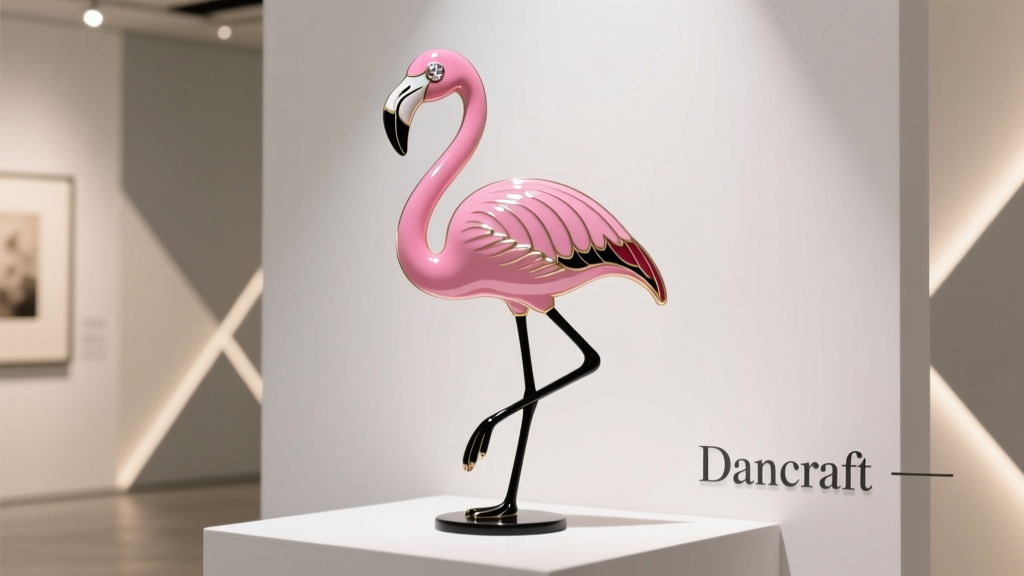
Authenticating the Pin Pink Flamingo Enamel Black Dangle Legs Rhinestone Eyes Marked Dancraft: A Technical Analysis of Mid-Century Costume Jewelry
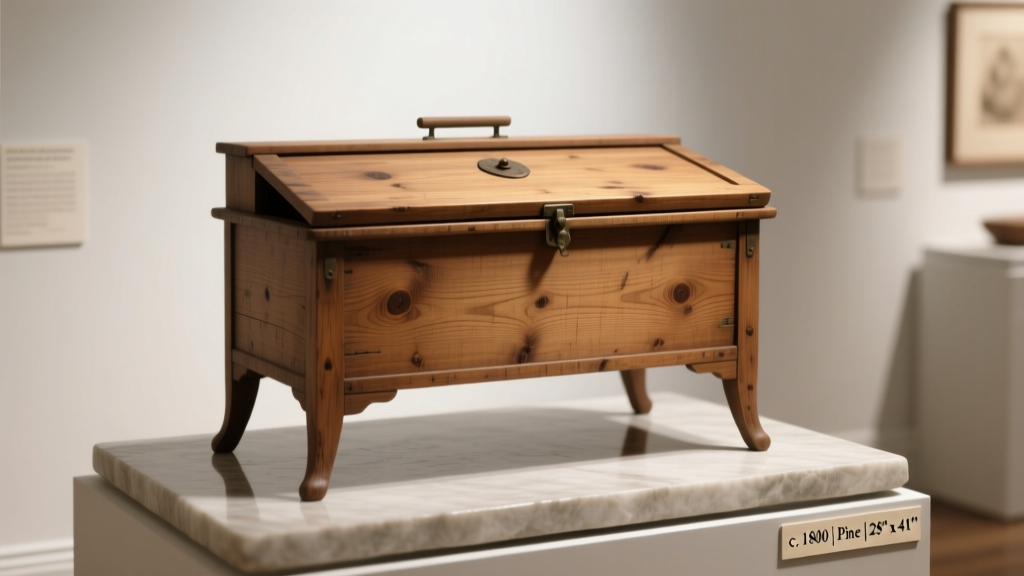
Authenticating and Valuing an Early American Pine Kitchen Dough Box: Sliding Top, Tapered Form, Splayed Legs, c. 1800 (28 × 41 in)
Authenticating and Valuing the Stickley Brothers 3-Drawer Dresser with Arched Toe Board (47″ × 20″)
Authenticating and Valuing the 36-Inch Oak Furniture Cupboard with Molded Top, Carved Base, and Geometric Side Panels
Jade Scroll Weight: Celadon Rectangular Form with Twin Carved Dragons and Central Pearl, Qing Dynasty (c. 1850), 7 1/8 Inches
Carnival Glass Strawberry Plate with Basketweave Back: Authenticating the 9-Inch Purple Variant (Model #2)
H. E. Matteson: Forgotten American Lithographer, Authenticating His Prints in Today’s Market