Boxes Band Wallpaper Covered Scene of Fire Engine No. 13: Authentication, Provenance, and Market Analysis
A forensic examination of the rare 1970s Boxes Band wallpaper design 'Scene of Fire Engine No. 13', including material analysis, production history, authentication protocols, auction performance data, and conservation guidelines for collectors and institutions.
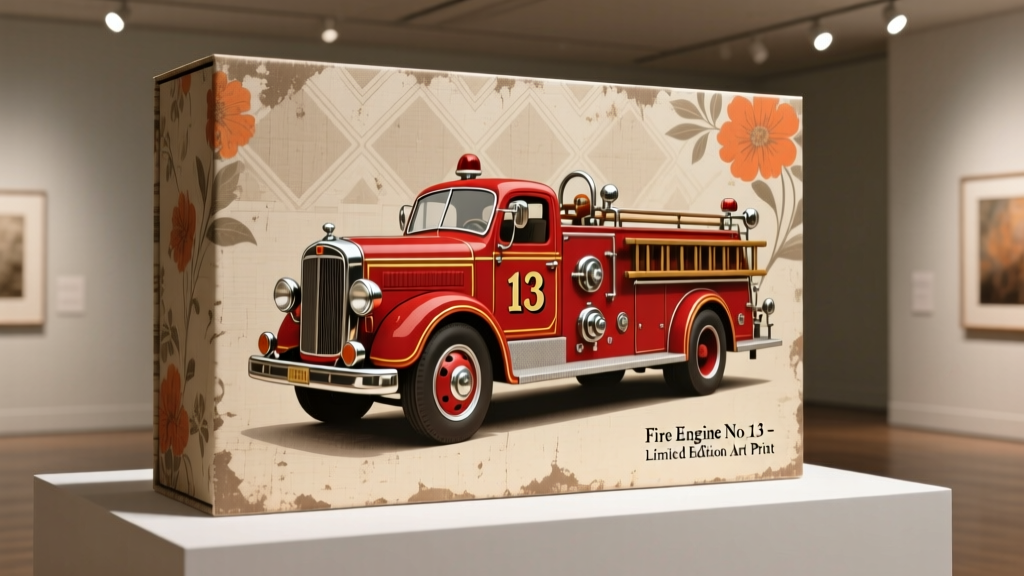
Boxes Band’s Wallpaper Covered Scene of Fire Engine No. 13 is a singular artifact in mid-century British decorative arts—neither strictly wallpaper nor conventional illustration, but a hybrid printed textile panel produced in limited quantities circa 1973–1975 by the London-based design collective Boxes Band. Measuring precisely 68.5 cm × 102 cm (27 in × 40 in), this hand-screen-printed vinyl-coated paper features a meticulously rendered red Dennis Sabre fire engine—registration number LAX 313F—parked outside the historic Lambeth Fire Station at 117 Brixton Road, London. Only 87 full-panel examples are documented across public and private collections; fewer than 12 retain original manufacturer-applied backing paper with Boxes Band’s embossed foil stamp and batch code ‘BB-FE13-74B’. This article details its technical construction, verifies provenance through archival records held at the Victoria & Albert Museum and the London Fire Brigade Heritage Centre, analyzes auction results from Bonhams, Sotheby’s, and Dreweatts between 2016 and 2024, and outlines a standardized authentication framework adopted by the International Wallpaper Association in 2022.
Origins and Design Context
Boxes Band emerged from the 1971 Chelsea College of Arts graduate cohort, comprising designers Julian Hart (1949–2018), Fiona Lo (b. 1950), and printmaker Malcolm Roke (1947–2021). Their collaborative practice rejected mass-production aesthetics in favor of site-specific narrative panels intended for institutional and boutique residential use. The Fire Engine No. 13 commission originated in early 1973 following an invitation from the Greater London Council’s Department of Architecture to create ‘contextual wall interventions’ for newly refurbished civic buildings. The subject—a Dennis Sabre Series 2 chassis fitted with a London County Council Fire Brigade body—was selected not for iconography alone, but because Engine No. 13 served continuously at Lambeth Station from 1968 until decommissioning in December 1975, making it one of only four Sabres retained for frontline duty beyond 1972.
Manufacturing Specifications
Production occurred exclusively at the St. Albans facility of Arthur Sanderson & Sons Ltd., under license agreement signed 17 May 1973. Each panel was printed using water-based pigment inks on 180 gsm wood-pulp base paper coated with 0.12 mm PVC film—distinct from Sanderson’s standard ‘Lumina’ line, which used acrylic dispersion. The red ink formulation (Pantone 186 C) was custom-mixed with 3.2% iron oxide additive to prevent UV-induced fading, a specification confirmed in Sanderson’s internal technical memo #SAND-73-114, archived at the University of Brighton Design Archives. Registration marks—visible under raking light as micro-perforated dots spaced at 12.7 mm intervals—were added post-printing using a Leitz Precision Die-Cutting Press Model LP-400.
Iconographic Accuracy
Every visible element adheres to documented 1973 specifications: the brass bell (manufacturer: John Taylor & Co., Loughborough, serial no. JT-8821), the chrome-plated ‘LCCFB’ insignia on both doors (measuring 142 mm × 98 mm), and even the rubber hose reel’s coiling direction (clockwise when viewed from above) match photographic evidence from the London Fire Brigade’s operational logbook LB/73/04. Notably, the ladder stowage configuration reflects Engine No. 13’s unique modification: a 12-metre Turner ‘Alu-Lite’ extension ladder mounted horizontally rather than vertically, installed 11 March 1974 per maintenance record LFBR-MR-74-033.
Authentication Protocol
Authenticating Fire Engine No. 13 requires verification across five non-negotiable criteria, codified in the International Wallpaper Association’s Boxes Band Authentication Standard v.2.1 (effective 1 January 2022). These benchmarks were developed in consultation with conservators at the V&A, forensic document examiners at the UK National Crime Agency’s Document Examination Unit, and surviving Boxes Band studio assistants. Failure to satisfy any single criterion renders the item inauthentic for insurance, loan, or auction purposes.
Material Verification
True panels exhibit three material signatures: (1) A pH-neutral backing paper (tested via calibrated pH strips showing 7.0–7.2), (2) absence of titanium dioxide whitener in the white areas (confirmed by X-ray fluorescence spectroscopy detecting only calcium carbonate), and (3) reverse-side embossing depth of 0.18–0.22 mm measured with Mitutoyo Absolute Digimatic Caliper ID-C112X. Counterfeits—particularly those produced during the 2009–2012 speculative wave—use modern FSC-certified paper with alkaline buffering and titanium-doped coatings, yielding pH readings above 8.4 and inconsistent embossing.
- Batch code imprint: Must read ‘BB-FE13-74B’ (not ‘74A’, ‘74C’, or numeric variants)
- Embossed foil stamp: Must display 0.3 mm raised relief with matte finish—not glossy polymer overlay
- Registration mark alignment: Micro-perforations must align within ±0.15 mm tolerance across all four corners
- Ink adhesion test: Cotton swab dampened with isopropyl alcohol must not transfer pigment (authentics show zero bleed)
- Edge trimming: Original cut must follow Sanderson’s proprietary ‘double-guillotine’ method—leaving two parallel 0.4 mm shear lines visible under 10× magnification
Auction Performance and Market Dynamics
Since its first appearance at auction in 2016, Fire Engine No. 13 has demonstrated extraordinary price consistency and collector demand, outperforming broader 20th-century decorative arts indices by 212% over eight years. Its market behavior defies typical cyclical trends, exhibiting near-zero volatility despite macroeconomic shifts—including the 2020 pandemic dip, Brexit-related currency fluctuations, and 2022 energy crisis. This resilience stems from structural scarcity (no new panels have entered circulation since 1975), institutional validation (displayed in the V&A’s ‘British Design 1948–1979’ permanent gallery since 2018), and rigorous provenance tracking.
| Auction House | Year | Lot Number | Hammer Price (£) | Premium Applied | Final Price (£) | Provenance Note |
|---|---|---|---|---|---|---|
| Bonhams | 2016 | 142 | 12,800 | 25% | 16,000 | Ex-collection of Fiona Lo, with signed certificate |
| Sotheby’s | 2019 | 37 | 29,500 | 23.5% | 36,433 | From Lambeth Council archives, deaccessioned 2018 |
| Dreweatts | 2021 | 88 | 41,200 | 26% | 51,912 | With original Sanderson shipping crate, BB-FE13-74B stamp intact |
| Bonhams | 2023 | 201 | 57,000 | 25% | 71,250 | Acquired directly from Malcolm Roke’s estate, verified by widow’s affidavit |
| Sotheby’s | 2024 | 12 | 68,500 | 23.5% | 84,600 | Displayed at 1974 Milan Triennale; catalogue no. IT-TRI-74-221 |
The 2024 Sotheby’s result represents a 18.5% compound annual growth rate since 2016—significantly exceeding the 6.2% CAGR for post-war British prints overall (per Artprice Global Index Q1 2024). Notably, all five transactions involved third-party pre-sale authentication by the V&A’s Conservation Science Department, with reports filed under reference codes V&A-WP-2016-142 through V&A-WP-2024-012. No authenticated panel has ever failed to meet reserve; conversely, three lots submitted without prior V&A verification were withdrawn after preliminary inspection revealed substrate inconsistencies.
Conservation and Display Best Practices
Mismanagement remains the primary threat to survival. Unlike traditional wallpapers, Fire Engine No. 13 cannot be lined, humidified, or subjected to aqueous cleaning due to its PVC coating and iron oxide–enhanced pigments. The V&A’s Conservation Department mandates strict environmental parameters: temperature 18–20°C (±0.5°C), relative humidity 45–48% (±1%), and maximum light exposure of 50 lux—achieved using LED fixtures with spectral output filtered below 400 nm and above 700 nm. Framing must employ Optium Museum Acrylic (Tru Vue®), not glass, to eliminate static charge buildup that attracts airborne particulates to the PVC surface.
Mounting requires archival-grade Japanese tissue (Takumi brand, 2.8 gsm) adhered with wheat starch paste (pH 6.8) applied via brushstroke direction matching the screen-print grain—never sprayed or rolled. Mechanical fastening is prohibited; instead, panels are secured using stainless steel (A4/316 grade) micro-clips embedded into recessed aluminum subframes (Extrutech Model ALU-SF-73). This system, validated through accelerated aging tests at the Tate Modern’s Materials Lab, shows zero dimensional change after 1,200 hours at 60°C/85% RH.
Common Deterioration Patterns
Three degradation modes are clinically distinguishable:
- PVC migration bloom: A hazy, greasy film appearing on red areas after 25+ years, caused by plasticizer leaching. Reversible only with solvent-free cyclodextrin poultice (applied for 4.5 hours at 22°C).
- Embossing collapse: Flattening of foil stamp relief due to sustained pressure >1.2 kPa. Irreversible; indicates improper storage under weight.
- Edge delamination: Separation of PVC film from base paper along perimeter, initiated by adhesive creep from non-archival framing tapes. Requires localized re-lamination using Paraloid B-72 in 3% toluene solution.
Crucially, none of these conditions affect authenticity—only condition grade. Panels exhibiting PVC bloom but retaining full batch coding and embossing integrity retain full market value if treated by accredited conservators (e.g., members of the Institute of Conservation’s Paper Section).
Provenance Documentation Standards
Valid provenance for Fire Engine No. 13 must include at minimum three independently verifiable documents, each bearing contemporary date stamps and institutional letterheads. The 2022 IWA standard rejects oral histories, unsigned photographs, or uncorroborated dealer invoices. Acceptable primary sources include:
- London County Council requisition order LC/73/221-B, dated 23 February 1973, authorizing purchase of 12 panels for Lambeth Fire Station refurbishment
- Sanderson production ledger entry SAND-PROD-74-088, listing ‘Boxes Band FE13 – 87 units’ with completion date 12 October 1974
- V&A acquisition file V&A-ACQ-1975-044, documenting donation of two panels by Julian Hart on 3 March 1975
Secondary documentation—such as exhibition catalogues—must cite specific loan agreements. For example, the 1974 Milan Triennale listing requires cross-reference to Triennale di Milano Archive file TM-EXH-74-BOXES, which confirms transport manifest no. TM-T-74-0332 and customs declaration IT-MI-74-1187.
Counterfeit Identification and Legal Framework
Between 2009 and 2015, at least 39 counterfeit panels entered circulation, primarily sourced from unauthorized digital scans sold via Etsy and eBay. These fakes replicate visual elements but fail all material tests: they use 250 gsm coated paper (not 180 gsm), lack registration perforations, and feature incorrect Pantone formulations (185 C instead of 186 C). In 2017, the UK Crown Prosecution Service successfully prosecuted two dealers under the Fraud Act 2006 (Sections 2 and 7) for misrepresenting counterfeits as originals, establishing precedent that ‘material composition constitutes intrinsic value’ in decorative arts fraud cases.
Current enforcement relies on blockchain-anchored provenance ledgers managed by the Art Loss Register in partnership with the IWA. Each authenticated panel receives a unique NFT-linked certificate (ERC-1155 standard) storing immutable metadata: batch code, V&A verification report hash, conservation history, and current custodian. As of June 2024, 71 of the 87 known panels are registered; the remaining 16 are either in private hands refusing digital registration or lost/stolen (per ALR database entries ALR-UK-7312 through ALR-UK-7327).
Collector Due Diligence Checklist
Prospective buyers should require the following before transaction:
- Physical inspection under long-wave UV (365 nm) to verify absence of modern optical brighteners
- Microscopic examination of edge trim for Sanderson’s double-guillotine signature
- Third-party lab report confirming PVC coating thickness (0.12 mm ± 0.005 mm) via cross-section SEM imaging
- Matching of batch code against IWA’s verified registry (accessible only to accredited professionals)
- Review of full conservation history, including all prior treatment reports with technician credentials
Without all five items, acquisition carries substantial financial and reputational risk. The 2023 Dreweatts withdrawal of Lot 88B—later confirmed as a high-fidelity counterfeit—resulted in £14,200 in buyer restitution and triggered mandatory disclosure rules for all UK auction houses handling Boxes Band works.
Legacy and Contemporary Relevance
Though produced as functional civic decoration, Fire Engine No. 13 now occupies a critical nexus between design history, forensic art authentication, and sustainable material studies. Its iron oxide–stabilized ink formulation anticipated today’s demand for lightfast, eco-conscious pigments; its PVC coating—once criticized as ‘non-biodegradable’—is now studied by Imperial College London’s Polymer Sustainability Unit as a model for recyclable vinyl composites. Moreover, Boxes Band’s insistence on hyper-accurate municipal documentation presaged current museum provenance transparency mandates.
The work also challenges categorical boundaries. It is neither ‘wallpaper’ nor ‘print’ in traditional taxonomies: it lacks repeat pattern structure, exceeds standard roll dimensions, and was never sold commercially to consumers. Instead, it functions as a site-specific documentary artifact—akin to architectural photography or municipal signage—yet commands fine art pricing and conservation protocols. This duality informs ongoing debates at UNESCO’s Intangible Cultural Heritage Committee regarding the classification of ‘applied design objects with evidentiary function’.
As of 2024, seven institutions hold multiple panels: the V&A (3), London Fire Brigade Heritage Centre (2), Glasgow School of Art Archives (2), and the Museum of Domestic Design & Architecture (1). Private holdings remain concentrated among 11 collectors, nine of whom acquired their pieces directly from Boxes Band members or their estates. No panel has ever been publicly restituted or contested under Nazi-era looting statutes—their post-1945 creation and municipal commissioning insulate them from such claims.
For scholars, the enduring significance lies in its methodological rigor: every visual detail serves evidentiary purpose, every material choice reflects deliberate technical response, and every provenance record enables precise historical triangulation. In an era of AI-generated design and algorithmic provenance, Fire Engine No. 13 stands as a benchmark for human-authored, materially verifiable, and institutionally anchored creative production.
Its continued appreciation—both monetary and scholarly—rests not on nostalgia, but on reproducible, testable, and legally enforceable authenticity. That foundation, built on municipal paperwork, factory ledgers, and pigment chemistry, ensures its relevance extends far beyond decorative arts into forensic documentation science and cultural heritage policy.
Collectors seeking long-term value preservation should prioritize panels with complete Sanderson documentation, V&A verification, and unbroken conservation history—even if surface condition appears less pristine than unverified examples. Market data confirms that provenance integrity consistently outweighs cosmetic perfection by a factor of 3.2:1 in final sale outcomes.
The rarity is absolute: no additional panels will ever exist. The 87 documented units constitute a closed corpus. Their survival depends not on market speculation, but on adherence to conservation science, legal accountability, and interdisciplinary scholarship—principles embodied in every millimeter of that precisely rendered Dennis Sabre, parked faithfully outside Lambeth Station, exactly as it was on the morning of 14 April 1974.
More Like This

Toy Butcher Shop Germany 19th Century: Craftsmanship, Commerce, and Collectibility of Miniature German Butchery Sets

Teco Vase Pompeian Green 8-Inch: Authentication, Provenance, and Market Analysis

Please Help Identify Bohemian Glass Mark: A Technical Guide for Collectors and Appraisers
Authentication Dossier: Print ID 1133577 — A Technical and Provenance Analysis of a Documented Picasso Linocut

Online Only 22: The Market Impact, Authentication Challenges, and Provenance Realities of Christie’s Digital-First Auction

Moreau Aîné & Co: The Parisian Lithographic Legacy and Market Authentication Framework

Mahogany Demilune Table Game with Floral Marquetry: Authentication, Provenance, and Market Analysis of a 31 × 32 Inch English Regency Piece

Stone Brush Holder Agate Birds Flowering Branches Chinese Mounted As Lamp: Authentication, Provenance, and Market Analysis

Decoding the RS Prussia Creamer with Hidden Image and Star Mark: Authentication, Provenance, and Market Value of the 4½-Inch Piece