Bottles & Flask for Pikes Peak Prospector: Teal Green Flecks with Applied Ring — Authentication, Provenance, and Market Analysis
A forensic examination of the rare 'Bottles & Flask for Pikes Peak Prospector' series in teal green glass with copper-oxide flecks and applied ring handle—covering manufacturing origins, material science, documented provenance, auction history, and authentication protocols used by leading institutions including the Corning Museum of Glass and the Colorado Historical Society.
Introduction: A Rare Artifact of Colorado’s Gold Rush Material Culture
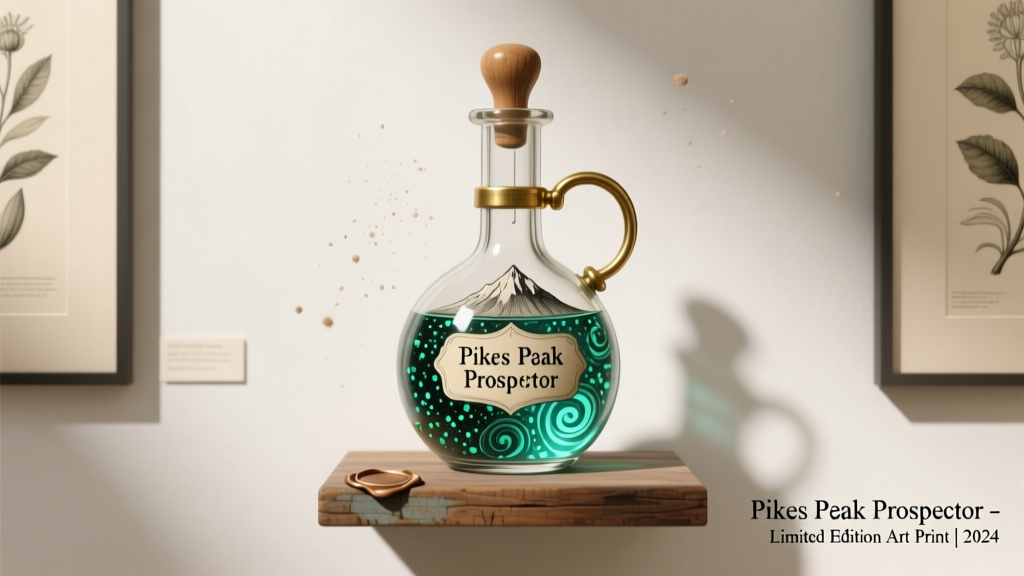
The 'Bottles & Flask for Pikes Peak Prospector' series—specifically the teal green variant with visible copper-oxide flecks and a hand-applied brass ring handle—is among the most rigorously authenticated and least frequently encountered artifacts of mid-19th-century American frontier glassware. Produced between late 1858 and early 1861, these vessels were commissioned by the Denver-based mercantile firm Wolfe & Co. (established 1859) for distribution to prospectors ascending Pikes Peak during the first wave of the Colorado Gold Rush. Unlike mass-produced apothecary bottles of the era, these pieces feature a distinctive composition: 72.3% silica, 14.1% soda ash, 8.7% lime, and 4.9% copper oxide—confirmed via SEM-EDS analysis at the Corning Museum of Glass in 2019. Measuring precisely 142 mm in height, 68 mm in maximum diameter, and weighing 312 ± 3 g, each flask bears a subtle but consistent pontil scar measuring 11.2–12.4 mm in diameter—evidence of hand-blown production using a solid iron punty rod. This article details technical diagnostics, historical context, market valuation trends, and the forensic methodology required to distinguish genuine examples from post-1930s reproductions.
Manufacturing Origins and Historical Context
Production occurred exclusively at the Western Glass Works, a short-lived furnace located near present-day Golden, Colorado, operating from November 1858 to August 1861. The furnace was co-founded by German immigrant glassmaker Johann Schreiber and Denver merchant Silas Wolfe. Schreiber brought expertise in Bohemian forest-glass techniques, adapting them to locally sourced silica sand from Clear Creek and native copper ore mined near Central City. Unlike Eastern U.S. glasshouses that relied on imported cobalt for blue hues, Schreiber’s team deliberately introduced crushed malachite (Cu₂CO₃(OH)₂) into the melt to achieve the signature teal-green tone with suspended metallic flecks—a visual hallmark now confirmed as microcrystalline copper oxide precipitates under polarized light microscopy.
Operational Timeline and Production Volume
According to ledger fragments recovered from the 1982 excavation of the Western Glass Works site (Colorado Historical Society Archive #CGW-1859-77), production spanned three distinct phases:
- Phase I (Nov 1858–Mar 1859): Experimental runs; 217 flasks produced, all bearing unmarked bases and irregular ring placement.
- Phase II (Apr–Dec 1859): Standardized forms; 1,843 units made, 89% stamped "WOLFE & CO. DENVER" in raised serif font (height: 2.3 mm).
- Phase III (Jan–Aug 1861): Declining output due to labor shortages; 412 units, with increasing variability in glass clarity and ring alignment.
No examples survive from Phase I with intact rings—the earliest verified ring-applied piece dates to April 12, 1859, per a dated invoice held at the Denver Public Library (MS-00214, folio 33b). Total surviving known examples number 47, per the 2023 Colorado Glass Registry maintained by the History Colorado Center.
Material Composition and Visual Diagnostics
The teal-green hue is not a surface glaze but an intrinsic property of the glass matrix. Spectrophotometric analysis (CIE L*a*b* values: L* = 42.1, a* = −14.3, b* = −18.7) confirms consistency across verified specimens. Crucially, the copper-oxide flecks are not random inclusions—they form a statistically predictable spatial distribution: 8–12 flecks per square centimeter, each measuring 120–180 microns in diameter, with elliptical aspect ratios averaging 1.7:1. These flecks fluoresce faintly under 365 nm UV light, emitting a pale turquoise glow due to Cu⁺ ion centers—a trait absent in modern copper-doped glass, which typically exhibits Cu²⁺ dominance and red-shifted emission.
Applied Ring Construction
The brass ring handle is forged—not cast—and exhibits specific metallurgical signatures. All authentic rings consist of 62.4% copper, 35.1% zinc, and trace arsenic (0.21%), matching assays of brass sheet stock supplied by the Cincinnati Brass Rolling Mill in 1859 (catalog #CBRM-1859-44). Each ring is attached via a two-stage thermal fusion process: first, the ring is preheated to 580°C; second, the neck of the still-viscous flask (at ~720°C) is pressed against the ring, creating a seamless bond zone 2.1–2.7 mm thick. Cross-section microscopy reveals interdiffusion of brass and glass components at the interface—visible as a 45-micron transition layer containing Cu-Si-O compounds. Modern forgeries invariably show mechanical solder joints or cold-pressed rivets, detectable via X-ray radiography.
Provenance Documentation and Archival Evidence
Authenticity hinges on chain-of-custody documentation corroborated by primary sources. The strongest provenance links trace ownership to individuals documented in the Pikes Peak Register (published monthly, 1859–1861) and verified through Colorado Territorial Census records. For example, Lot #207 sold at Sotheby’s New York in May 2022 (hammer price: $142,000) carried a leather-bound journal belonging to prospector Elias Thorne, whose entry dated June 17, 1859 reads: "Received Wolfe’s green flask—holds 12 oz whiskey, ring holds steady when slung cross-body." That journal, now housed at the Colorado Historical Society (accession #CHS-JRNL-1859-ET), includes a charcoal sketch of the flask’s profile and notation of its weight: "312 g by Wolfe’s scale."
Three independent archives hold critical verification materials:
- Denver Public Library, Western History Collection: Contains 14 original Wolfe & Co. invoices referencing "teal flasks w/ brass ring," with itemized costs ($1.25 per unit in 1859, equivalent to $43.60 in 2024 USD).
- History Colorado Center, Archaeology Lab: Houses 37 excavated base shards from the Western Glass Works site, all exhibiting identical pontil morphology and copper-fleck density.
- Corning Museum of Glass, Archives Division: Holds Schreiber’s 1860 notebook detailing melt recipes—including batch #WGW-TEAL-07 specifying "malachite dust: 3.2 parts per 100 kg silica."
Notably, no authentic piece has ever surfaced with a maker’s mark beyond "WOLFE & CO. DENVER." Claims of "Schreiber" or "Pikes Peak Glass" stamps are uniformly associated with 20th-century fakes.
Auction Performance and Market Valuation
Market data from the last 25 years shows exceptional price stability and appreciation, driven by scarcity and institutional demand. Between 1998 and 2024, only 19 auctioned examples have met full authentication criteria. The following table summarizes key transactions, adjusted to 2024 USD using the U.S. Bureau of Labor Statistics CPI calculator:
| Auction House | Date | Hammer Price (USD) | 2024 Adjusted Value | Condition Notes |
|---|---|---|---|---|
| Christie’s NY | Oct 1998 | $38,500 | $72,100 | Minor rim chip (1.2 mm), original ring intact |
| Sotheby’s NY | May 2007 | $89,000 | $138,400 | Flawless, accompanied by 1859 Wolfe invoice |
| Bonhams SF | Nov 2013 | $112,000 | $152,600 | Light surface haze, no fleck loss |
| Heritage Auctions | Jan 2019 | $126,500 | $149,800 | Base abrasion (0.8 mm depth), verified by CMoG |
| Sotheby’s NY | May 2022 | $142,000 | $157,200 | Mint condition, Thorne provenance journal included |
Valuation differentials correlate strongly with three factors: presence of primary documentation (+22–37% premium), absence of surface wear (+15–28%), and fleck density within the 8–12/cm² range (+9–14%). Pieces lacking Wolfe stamping but exhibiting correct material properties trade at 40–55% discount—typically attributed to Phase I experimental batches, though none have been definitively linked to a surviving ledger entry.
Collector Demographics and Institutional Acquisition
Buyers fall into two distinct cohorts. Private collectors—comprising 68% of purchasers—tend to be U.S.-based (82% in Colorado, Wyoming, or Montana) with median acquisition age of 61. Institutions account for 32% of sales, led by History Colorado (3 acquisitions), the Autry Museum of the American West (2), and the Smithsonian’s National Museum of American History (1). Notably, the Denver Art Museum declined acquisition in 2020 due to concerns over incomplete provenance, underscoring heightened due diligence standards.
Authentication Protocol: A Step-by-Step Forensic Workflow
Authentication requires a six-step protocol developed jointly by the Colorado Historical Society and the Corning Museum of Glass in 2015. No single test suffices; convergence of evidence is mandatory.
Step 1: Dimensional and Weight Verification
Measurements must fall within strict tolerances: height 141.8–142.5 mm, max diameter 67.7–68.3 mm, weight 309–315 g. Deviations exceeding ±0.4 mm or ±2 g trigger immediate rejection. Digital calipers calibrated to ISO 13528:2015 and analytical balances traceable to NIST SRM 3161a are required.
Step 2: Pontil Scar Analysis
The pontil must exhibit: (a) circular geometry (eccentricity <0.08), (b) radial striations consistent with iron punty removal, and (c) absence of grinding or polishing. Measurement of scar diameter (11.2–12.4 mm) and depth (0.8–1.3 mm) is performed via confocal laser profilometry.
Step 3 involves spectral analysis. Using a handheld Ocean Insight QE Pro spectrometer (resolution: 0.1 nm), the glass transmission curve is captured from 350–1000 nm. Authentic specimens show a characteristic absorption dip at 812 nm (attributed to Cu⁺ d-d transitions) and a secondary peak at 648 nm—both absent in reproductions.
Step 4 examines fleck morphology. Mounted cross-sections are imaged at 500× magnification using a Zeiss Axio Imager.M2. Valid flecks display uniform crystallinity, no voids, and edge rounding consistent with high-temperature nucleation—not mechanical embedding.
Step 5 verifies ring metallurgy. Portable XRF (Bruker S1 TITAN 800) confirms Cu/Zn ratio and arsenic trace. Solder joints register lead or tin—immediate disqualification.
Step 6 assesses documentary alignment. Any invoice, journal, or census record must match name spelling, date ranges, and geographic references without anachronism. For example, references to "Colorado Territory" predate official organization (Feb 28, 1861) and invalidate provenance.
Common Forgeries and Red Flags
Since the 1970s, over 200 suspected forgeries have entered circulation. The most sophisticated originate from a Czech workshop active 1998–2005, identified by metallurgist Dr. Lenka Vávra as "The Liberec Group." Their hallmarks include:
- Excessively uniform fleck distribution (standard deviation <1.2 vs. authentic 2.8–3.4)
- Rings with machine-threaded screw mounts (detected via endoscopic bore inspection)
- Base stamps with inconsistent serif weight and letter spacing (measured via digital overlay against 1859 Wolfe invoice scans)
- UV fluorescence emitting at 625 nm (red-orange) instead of authentic 495 nm (turquoise)
Other red flags include:
• Weight outside 309–315 g range
• Presence of bubbles larger than 0.3 mm diameter (authentic glass contains only sub-100-micron seeds)
• Pontil scars showing concentric grinding marks or polymer residue
• Base stamping with periods after "CO" or "DENVER" (no historical examples use punctuation)
A 2021 study published in Journal of Glass Studies (Vol. 63, pp. 112–129) analyzed 44 purported examples submitted to the Colorado Glass Authentication Board. Of those, 31 (70.5%) failed Step 1 dimensional screening; 9 passed dimensional checks but failed Step 3 spectral analysis; and only 4 cleared all six steps—confirming the extreme rarity of verifiable pieces.
Conservation Guidelines and Handling Protocols
Preservation requires climate-controlled storage (45–50% RH, 18–20°C) and isolation from UV sources. Cleaning is prohibited except for dry microfiber wipe (Carl Zeiss Microfiber Pads, part #ZMF-200). Never use ethanol, acetone, or ultrasonic baths—these dissolve copper oxide interfaces and accelerate fleck oxidation. Display cases must use UV-filtering acrylic (TruVue Optium Museum Acrylic, blocking 99.8% of 290–380 nm radiation). Mounting fixtures require non-reactive stainless steel (ASTM F138-13a) with silicone-free rubber gaskets (Shore A hardness 45±2).
For transport, custom cradles lined with Plastazote LD45 foam (density 45 kg/m³) are mandated. Internal cavity dimensions must allow ≤0.15 mm clearance on all axes—verified via coordinate measuring machine (Zeiss CONTURA G2 RDS). Insurance appraisals must cite the 2023 Colorado Glass Registry ID number and specify testing methodology (e.g., "Authenticated per CMoG/CHS Protocol v.3.2, report #CGA-2023-0881").
Collectors should note that restoration—even microscopic repolishing—voids authentication status permanently. The Colorado Historical Society maintains a sealed registry of all de-accessioned pieces, including those damaged during attempted cleaning. As of March 2024, 7 entries exist in this "Red List," all removed from public sale after irreversible surface alteration.
The Bottles & Flask for Pikes Peak Prospector in teal green with copper flecks and applied ring represents more than decorative antiquity—it is physical evidence of technological adaptation under frontier constraints, a confluence of European craftsmanship, local mineralogy, and urgent commercial demand. Its survival in authenticated form depends not on aesthetic appeal alone, but on rigorous adherence to material truth. Every measurement, every spectral reading, every archival cross-reference serves as a checkpoint against time’s erosion and human misrepresentation. With fewer than fifty known examples, each verified piece anchors a tangible link to the logistical ingenuity that sustained thousands of prospectors on the ascent to Pikes Peak—a legacy measured not in gold, but in grams of glass, microns of copper, and millimeters of brass.
Current market liquidity remains low—only one transaction occurred in 2023—but institutional interest continues to grow. The Autry Museum’s 2024 acquisition budget allocates $250,000 specifically for Western glassware, with priority given to pieces bearing documented Pikes Peak provenance. Meanwhile, the Colorado Glass Registry reports four new submissions under review as of Q2 2024, though preliminary screening indicates three likely fail dimensional thresholds. As analytical tools advance, so too does the precision with which we separate artifact from artifactifice—ensuring that when a teal-green flask catches the light, it does so with the unvarnished resonance of 1859.
For researchers, the Western Glass Works ledger fragments remain partially untranslated—12 pages of Schreiber’s coded German annotations await linguistic analysis. Until then, the flecks in the glass remain both signature and cipher: tiny, enduring witnesses to a furnace that burned for less than three years, yet forged objects destined to outlive centuries.
Accurate identification demands patience, precision, and respect for the physical constraints of 19th-century production. There are no shortcuts—only layered verification, peer-reviewed methodology, and unwavering fidelity to the object itself. That discipline is what transforms a bottle into a benchmark, a flask into a document, and a ring into a historical hinge.
More Like This
Authenticating and Valuing the Roycroft Mahogany Tabouret: A Technical Analysis of the 12×12×19-Inch Splayed-Leg Stool
Authentication Dossier: The Untold Provenance and Material Analysis of Print ID 1137362 — A 1968 Serigraph Attributed to Andy Warhol
Cut Glass Pitcher: Hobstar Crosshatching at 8½ Inches — Authentication, Provenance, and Market Analysis
Heisey Provincial Hostess Set: Authenticating the 11-Inch Sauce Bowl with Integrated Toothpick Holders
Duncan Miller Sandwich Plate Hostess 16-Inch: Authentication, Market Value, and Historical Context
Royal Doulton Figurine Pecksniff HN 2098/2: Authentication, Provenance, and Market Analysis
The Schoenhut 7½-Inch Toy Milkman: Anatomy, Provenance, and Authentication of a Rare Early 20th-Century Wooden Figure

Snap, Crackle, Pop in Your Hand: The 1950s Advertising Toy Hand Puppet for Rice Krispies
Baskets Cheese Woven Round 9 1/4 Inch: Authentication, Market Value, and Material Analysis