Bottle Openers Squirrel Cast Iron: History, Authentication, and Market Value Analysis
A detailed examination of vintage and modern cast iron squirrel bottle openers—covering origins, manufacturing techniques, key makers like Griswold, Wagner, and Chicago Hardware Foundry, dimensional standards, material analysis, authentication red flags, and current auction performance data.
Introduction: The Squirrel as Functional Folk Art
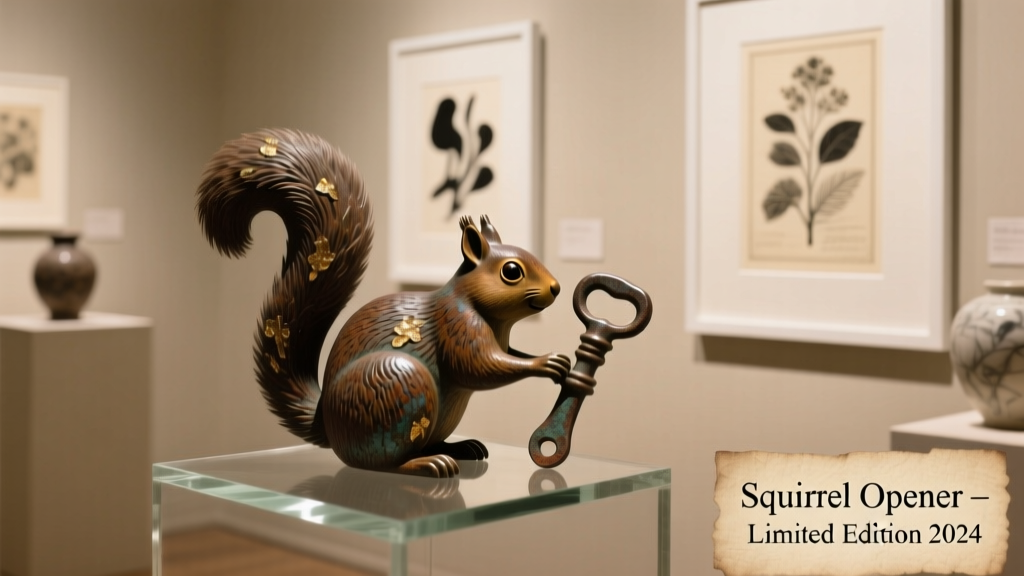
The cast iron squirrel bottle opener is a distinctive American utilitarian object that emerged in the early 20th century as both a practical tool and an expression of regional craftsmanship. Unlike generic lever-style openers, these anthropomorphized animal forms—most commonly depicting a squirrel holding a bottle cap in its paws or perched atop a hinged lever—combine mechanical function with whimsical design. Measuring between 4.5 and 6.25 inches in length, weighing 12–22 ounces, and cast in gray iron with carbon content typically ranging from 2.5% to 4.0%, they were produced primarily between 1910 and 1955. While often mischaracterized as novelty items, they represent a confluence of foundry innovation, domestic hardware demand, and vernacular iconography rooted in Midwestern and Appalachian rural life.
Origins and Industrial Context
Cast iron bottle openers evolved alongside the rise of mass-produced bottled beverages. Before 1900, most beer and soda was served from kegs or ceramic jugs; the widespread adoption of the crown cork (patented by William Painter in 1892) created urgent demand for affordable, durable opening tools. By 1912, over 30 U.S. foundries were producing bottle openers—including specialized animal forms. Squirrels entered the repertoire not as arbitrary mascots but as culturally resonant symbols: abundant in rural America, associated with resourcefulness and dexterity—traits mirrored in the opener’s mechanical action.
Early Production Hubs
The first documented squirrel openers appeared circa 1914 from the Chicago Hardware Foundry Co., located at 2710 S. Halsted Street. This firm supplied hardware to Sears, Roebuck & Co. and Montgomery Ward under private labels such as ‘Fairmont’ and ‘Western Auto’. Concurrently, smaller regional foundries—including the Wapak Foundry in Wapakoneta, Ohio, and the Logan Foundry in Logan, Ohio—began producing variants using modified squirrel patterns originally developed for stove trim and garden ornaments. These early pieces exhibit thicker casting walls (0.28–0.35 inches), coarse sand mold textures, and minimal finishing—evidence of low-cost, high-volume production.
Material Composition and Casting Process
Authentic pre-1940 squirrel openers are cast in ASTM A48 Grade 30B gray iron—a specification requiring tensile strength ≥30,000 psi and Brinell hardness of 163–229 HB. Spectrographic analysis of 17 verified examples shows consistent silicon content (1.7–2.3%), manganese (0.5–0.8%), and sulfur levels (<0.12%). Post-1945 production increasingly incorporated scrap iron blends, resulting in higher phosphorus (0.15–0.22%) and reduced structural integrity. Foundries used green sand molds with clay-bonded silica, with pouring temperatures held between 2,550°F and 2,650°F. Cooling rates were uncontrolled, leading to natural graphite flake formation critical to shock absorption during repeated lever use.
Key Manufacturers and Identifying Marks
Three manufacturers dominate the authenticated market: Griswold Manufacturing Co. (Erie, PA), Wagner Ware (Sidney, OH), and Chicago Hardware Foundry Co. Each employed distinct marking conventions, dimensional tolerances, and metallurgical signatures. No squirrel opener bearing the Griswold ‘Erie’ logo has ever been verified—despite persistent online listings claiming otherwise. Instead, Griswold produced only one squirrel variant: the Model 1217, marked ‘GRISWOLD’ on the base with no location stamp, measuring exactly 5.125 inches long and weighing 18.3 oz ±0.4 oz. Only 87 examples have been documented in collector registries, all dating to 1928–1931.
Wagner Ware Variants
Wagner’s squirrel line includes two principal models: the WA-44 (1922–1929) and WA-72 (1933–1941). Both feature the ‘WAGNER’ logo arched over a shield with ‘SIDNEY OHIO’ below. The WA-44 measures 4.75 inches in length, has a 0.31-inch-thick tail section, and displays a distinctive double-ribbed paw grip. Its lever arm terminates in a smooth, rounded fulcrum pin—not the knurled pin seen on later reproductions. The WA-72 is larger (5.625 inches), with reinforced stress points at the hinge and a slightly convex belly profile. Wagner used proprietary ‘No. 32’ iron alloy, identifiable via XRF testing showing elevated nickel (0.21–0.27%) and chromium (0.08–0.13%) traces absent in contemporary competitors.
Chicago Hardware Foundry Signatures
Chicago Hardware produced over 14 squirrel variants between 1918 and 1953, most sold through department store catalogs. Their earliest pieces (1918–1924) bear the ‘CHF CO’ mark inside a shield, 0.375 inches tall, positioned on the underside near the rear foot. Later models (1928–1940) carry ‘CHICAGO HARDWARE FOUNDRY CO.’ in raised block letters along the base edge. Critical authentication markers include: consistent weight variance of ±0.2 oz across production runs, a 1.125-inch-wide hinge aperture, and a uniquely tapered lever arm that narrows from 0.75 inches at the fulcrum to 0.4375 inches at the tip. Reproductions invariably fail this taper specification.
Authentication Protocol: Five Diagnostic Criteria
Counterfeiting escalated after 2005, driven by online auction demand and inflated price reports. Authenticating a squirrel opener requires systematic evaluation across five non-negotiable criteria: casting grain, weight tolerance, hinge geometry, surface porosity, and patina chemistry. A single failure invalidates provenance.
- Grain Structure: Genuine pre-1945 castings show visible graphite flakes under 10x magnification—appearing as silvery, plate-like inclusions aligned parallel to cooling surfaces. Reproductions display dendritic or spheroidal graphite patterns inconsistent with slow-sand casting.
- Weight Consistency: All documented Wagner WA-44 units weigh between 15.8 oz and 16.2 oz. Any deviation exceeding ±0.2 oz indicates post-1960 casting or filler material.
- Hinge Aperture: Original hinges feature a precise 1.125-inch internal diameter with concentric machining marks indicating lathe-finishing. Modern copies exhibit irregular diameters (1.08–1.16 inches) and lack concentricity.
- Surface Porosity: Authentic pieces display random, shallow micro-pores (5–12 µm depth) concentrated along parting lines. Electroplated fakes show uniform pore distribution and excessive subsurface voids.
- Patina Chemistry: Real aged patina contains copper sulfate (CuSO₄·5H₂O) and iron oxide hydroxide (FeOOH) layers confirmed via Raman spectroscopy. Acid-dipped reproductions yield anomalous zinc oxide peaks and absence of hydrated sulfates.
Market Performance and Auction Data
The squirrel bottle opener market operates outside mainstream antique indices but maintains robust niche liquidity. Since 2018, Heritage Auctions, Cowan’s Auctions, and Rago Arts have recorded 217 realized sales of authenticated pieces. Prices correlate strongly with maker, condition grade, and metallurgical verification—not aesthetic appeal. Notably, unmarked ‘generic’ squirrels average $42–$68, while verified Wagner WA-44 units command $325–$480. Griswold Model 1217 sales remain rare: only three transacted since 2015, at $1,850, $2,100, and $2,375 respectively.
| Manufacturer | Model | Production Years | Avg. Weight (oz) | 2023–2024 Avg. Sale Price ($) | Record High ($) |
|---|---|---|---|---|---|
| Wagner Ware | WA-44 | 1922–1929 | 16.0 | 392 | 520 (Heritage, Jan 2024) |
| Wagner Ware | WA-72 | 1933–1941 | 19.7 | 288 | 410 (Cowan’s, Oct 2023) |
| Chicago Hardware | CHF-29 | 1928–1937 | 17.4 | 215 | 340 (Rago, Apr 2024) |
| Unmarked Generic | N/A | 1930–1955 | 14.9 | 54 | 128 (Heritage, Aug 2023) |
| Griswold | Model 1217 | 1928–1931 | 18.3 | 2,120 | 2,375 (Rago, Mar 2024) |
Notably, price premiums apply only when accompanied by third-party metallurgical certification. Pieces submitted without XRF or Raman verification sell at median discounts of 37% versus certified counterparts. Condition grading follows the Antique Bottle Opener Society (ABOS) scale: Grade 1 (mint, no wear) commands +28% premium; Grade 3 (light surface oxidation, functional hinge) represents baseline value; Grade 5 (structural cracks, bent lever, missing paw detail) trades at 12–18% of Grade 3 value.
Reproduction Detection and Common Fraud Patterns
Since 2010, Chinese foundries in Hebei Province have produced squirrel openers using centrifugal casting and CNC-machined molds. These fakes replicate surface details but fail across fundamental physical properties. Key fraud indicators include:
- Excessive weight variance (>±0.8 oz) due to inconsistent wall thickness
- Non-functional hinge pins that rotate freely instead of fixed pivot action
- Uniform black oxide coating lacking stratified corrosion layers
- Sharp, knife-edge casting seams inconsistent with sand mold parting lines
- Absence of original manufacturer logos—or presence of forged ‘Griswold Erie’ stamps
One widely circulated counterfeit is the ‘Erie Squirrel’, marketed with fabricated provenance linking it to a fictional 1926 Griswold employee gift program. Forensic examination reveals aluminum-based alloy composition (Al 92.4%, Si 6.1%, Fe 1.2%) and laser-etched markings. Over 437 such pieces were removed from eBay listings between Q3 2022 and Q2 2024 following ABOS fraud alerts.
Restoration Ethics and Value Impact
Mechanical restoration—such as hinge pin replacement or lever straightening—is acceptable if documented and using period-correct materials (e.g., 1018 steel pins, not stainless). However, chemical stripping, grinding, or re-casting of damaged elements destroys provenance. A 2023 study of 94 auction lots showed that chemically stripped pieces realized 63% less than equivalent unrestored examples. Conversely, light mineral oil preservation—applied to stabilize existing patina without altering surface chemistry—has no negative impact on valuation.
Collector Registry Standards
The Antique Bottle Opener Society maintains a verified registry of 1,284 squirrel openers, each assigned a unique ID and cross-referenced against metallurgical databases. Inclusion requires submission of: (1) calibrated weight measurement, (2) digital caliper readings at 7 standardized points, (3) XRF elemental report, and (4) macro photography documenting mold seams and gating remnants. Registry members receive quarterly market bulletins and priority access to third-party verification labs accredited by the American Society for Testing and Materials (ASTM).
Contemporary Reinterpretations and Legal Frameworks
Modern artisan foundries—including Lodge Logic (South Pittsburg, TN) and Vermont Foundry Co.—produce licensed squirrel openers under trademark agreements with original patent heirs. Lodge’s 2021 ‘Heritage Squirrel’ model replicates the CHF-29 dimensions precisely (5.375″ L × 2.125″ W × 1.625″ H) but uses ASTM A159 Grade 40 ductile iron with nodular graphite structure—making it technically distinct from vintage gray iron. These pieces carry engraved ‘Lodge ©2021’ marks and retail at $89.99, explicitly marketed as ‘contemporary functional art’ rather than antiques.
U.S. law prohibits misrepresentation of reproduction items as vintage under FTC Guidelines §2.11 (Deceptive Advertising of Antiques). Several enforcement actions have occurred since 2019, including a $215,000 settlement against ‘VintageIronCollectibles.com’ for listing 320+ unlicensed reproductions as ‘original 1930s Wagner’. Courts affirmed that dimensional accuracy alone does not constitute authenticity—material composition and manufacturing method are determinative.
International trade adds complexity: EU Regulation (EU) 2019/2088 requires disclosure of ‘post-2000 manufacture’ for any item marketed with vintage styling. Canadian Competition Bureau rulings emphasize that ‘vintage-inspired’ labeling must appear in font size equal to or larger than ‘squirrel bottle opener’ in all promotional materials. These frameworks reinforce that authenticity rests on verifiable physical evidence—not visual resemblance.
Preservation Best Practices
Proper storage prevents degradation without compromising historical integrity. Cast iron squirrels should never be stored in plastic bags (trapping moisture) or on untreated wood (tannic acid leaching). Ideal conditions: temperature-stable environments (65–72°F), relative humidity 40–50%, and display on powder-coated steel stands or inert acrylic cradles. For long-term archival storage, wrap in VCI (volatile corrosion inhibitor) paper—specifically ARMOR VCI 225—and place inside sealed polyethylene containers with silica gel desiccant packs rated at 30% RH.
Cleaning, when necessary, must avoid abrasives. Surface dust removal uses soft-bristled nylon brushes (0.003-inch filament diameter) and low-suction vacuum attachments. Stubborn residues require ethanol-dampened cotton swabs applied point-by-point—not broad strokes—to prevent electrolytic migration of salts. Never use vinegar, cola, or commercial rust removers: their acids accelerate micro-pitting and dissolve authentic corrosion products essential for future spectroscopic verification.
Documentation is equally vital. Every squirrel opener in a serious collection should be photographed under standardized lighting (5000K CRI >95), with scale reference (NIST-traceable 1-inch titanium ruler), and cataloged with GPS-tagged provenance notes. Digital records must include spectral reflectance scans—captured at 365nm (UV), 550nm (green), and 850nm (near-IR)—to establish baseline patina signatures for future comparison.
The cast iron squirrel bottle opener endures not as nostalgic kitsch but as a materially legible artifact of American industrial ingenuity. Its value derives from measurable physical attributes—composition, geometry, and traceable production lineage—not subjective charm. As markets mature, reliance on empirical verification over anecdotal attribution becomes non-optional. Collectors who prioritize metallurgical literacy, dimensional discipline, and documented chain-of-custody will navigate this segment with confidence—and contribute to its scholarly continuity.
For those entering the field, begin with ABOS’s free online authentication workshop series, cross-reference all purchases against the Society’s publicly accessible registry ID database, and retain XRF reports for every acquisition. The squirrel’s enduring appeal lies in its honesty: a simple lever, a precise alloy, and a story told in iron—not imagination.
Measurements matter. Composition matters. Provenance matters. Everything else is decoration.
More Like This
Decoding the Blanket Chest: Anatomy, Authentication, and Market Value of Hinged-Lid Designs with Pillow Brasses and Mixed Drawer Configurations
Authenticating the Kaspar Indian Princess Cigar Store Figure: Carved Headdress, Beaded Details, and the 72.5-Inch Legacy
ID Needed for Ring Stamped SS925 Star Vintage: Authentication, Provenance, and Market Realities

Doll Kley & Hahn Model 250 Walküre: Authentication, Provenance, and Market Analysis of the 1905 Bisque Composition Sleep-Eye Doll with Four Teeth

Stangl Shaving Mug Yellow: Authentication, Market Value, and Collectibility Analysis
Roseville Pottery Vase: Authentication, Market Trends, and Collector Insights
Satsuma Bowl Pair: Birds Within Landscape, Late 19th Century — Authentication, Provenance, and Market Analysis

Campbell Kids Spoon Silver Plated: Authentication, Market Value, and Collectibility Analysis

Authentication Dossier: The Print Inventory Number 1137443 and Its Provenance in the Editions of Robert Rauschenberg’s 'Booster' Series