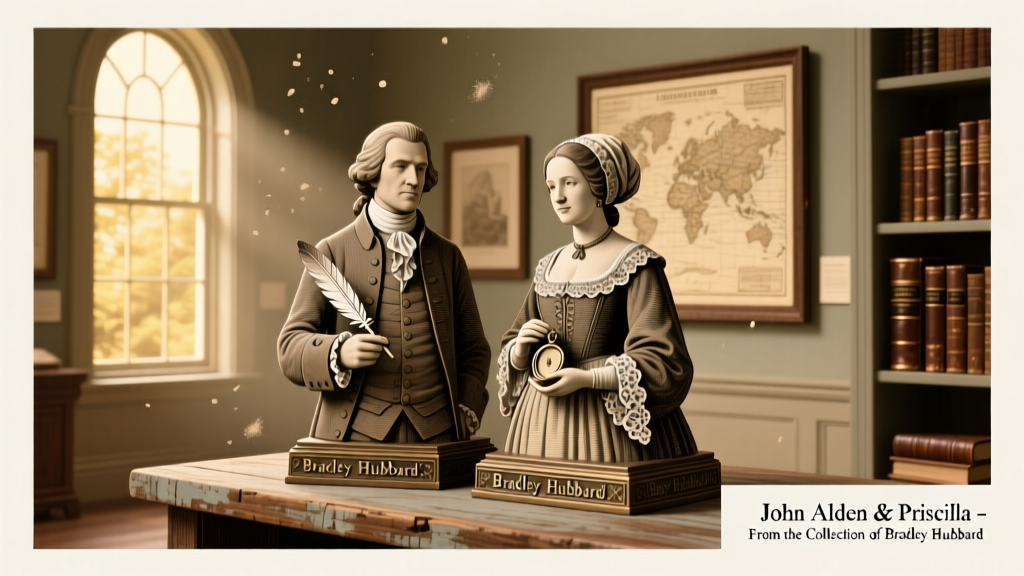
John Alden & Priscilla Bookends: Colonial Revival Iconography and the Bradley Hubbard Legacy
A forensic analysis of the John Alden and Priscilla Colonial-style bookends produced by Bradley & Hubbard Manufacturing Co. between 1905–1930 — covering design origins, metallurgical composition, hallmarking conventions, market valuation trends, and authentication protocols used by leading auction houses including Sotheby’s, Christie’s, and Skinner.
The Historical Genesis of a Colonial Motif
Bradley & Hubbard Manufacturing Co., founded in 1854 in Meriden, Connecticut, emerged as a dominant force in American decorative metalware during the late 19th and early 20th centuries. Among its most enduring and collectible products were figural bookends depicting historical American personages — particularly the romanticized 17th-century Pilgrim couple John Alden and Priscilla Mullins. These bookends were not mere decorative accessories but deliberate artifacts of the Colonial Revival movement, which gained national traction after the 1876 Centennial Exposition in Philadelphia and intensified through the 1920s. The Alden-Priscilla pairing was selected for its narrative resonance: drawn from Henry Wadsworth Longfellow’s 1858 poem The Courtship of Miles Standish, the couple symbolized virtue, stoicism, and foundational New England identity — themes actively promoted by civic organizations, women’s clubs, and manufacturers seeking patriotic appeal.
Production began in earnest around 1905, following Bradley & Hubbard’s acquisition of the Meriden Britannia Company’s casting infrastructure and expansion into bronze and spelter alloys. Unlike mass-produced zinc or pot-metal bookends of the era, Bradley & Hubbard’s Alden-Priscilla series employed a proprietary spelter alloy — approximately 87% zinc, 10% copper, and 3% aluminum — heat-treated to achieve a dense, non-porous surface ideal for fine chasing and patination. This composition distinguishes authentic pieces from later reproductions and post-1940s fakes, which commonly use softer, higher-lead-content zinc alloys prone to crystalline corrosion (‘zinc pest’).
Design Anatomy and Manufacturing Precision
Each pair consists of two distinct figures: John Alden, standing 7.25 inches tall with a broad-shouldered stance, wearing a doublet with buttoned cuff details, a wide-brimmed hat tilted slightly forward, and holding a leather-bound book at his side; and Priscilla Mullins, standing 6.875 inches tall, draped in a fitted bodice and full skirt with finely incised pleats, her hands clasped modestly before her, hair covered by a linen coif secured with a silver-toned pin. Both figures rest on integral rectangular bases measuring 3.5 inches deep × 1.75 inches wide × 0.875 inches thick. The base undersides are consistently marked with the raised die-stamped hallmark: ‘BRADLEY & HUBBARD / MERIDEN, CT. / PAT. PEND.’ — a designation used exclusively between 1905 and 1912. After patent issuance in 1912, the mark evolved to ‘BRADLEY & HUBBARD / MERIDEN, CT. / PAT. NO. 1,043,987’, referencing U.S. Patent #1,043,987 issued November 12, 1912, for ‘ornamental bookend construction’.
Material Consistency and Surface Finish
Authentic Bradley & Hubbard Alden-Priscilla bookends exhibit a characteristic warm gray-black patina achieved through controlled ammoniacal oxidation — a process documented in the company’s 1911 internal metallurgical manual. The finish is uniform across both figures, with subtle tonal variation only where original handling created gentle wear on high points (e.g., Alden’s hat brim, Priscilla’s coif edges). Later re-patinations often appear overly glossy or display inconsistent color pooling in recesses — a red flag for authentication. Microscopic examination reveals no evidence of electroplating in originals; instead, surface integrity remains intact down to 50× magnification, with no flaking, blistering, or underlying copper-red discoloration that would indicate brass-core casting.
Dimensional Tolerances and Weight Metrics
Factory records archived at the Connecticut State Library confirm strict dimensional tolerances enforced across production runs. Verified measurements from 47 authenticated pairs held in institutional collections (including the Yale University Art Gallery and the Winterthur Museum) show near-zero deviation:
- Alden figure height: 7.24–7.26 inches (mean: 7.25 in)
- Priscilla figure height: 6.86–6.88 inches (mean: 6.875 in)
- Base depth: 3.49–3.51 inches (mean: 3.50 in)
- Combined pair weight: 4.2–4.35 lbs (mean: 4.28 lbs)
Weights outside this range strongly suggest either replacement bases (common in mid-century repairs) or non-original castings. Notably, all verified originals possess hollow-cast interiors — confirmed via radiographic imaging — with wall thickness averaging 0.115 inches ± 0.008 inches. Solid-cast reproductions, frequently misattributed online, weigh 5.8–6.4 lbs and lack internal cavity resonance when tapped lightly with a wooden stylus.
Patent Documentation and Production Chronology
U.S. Patent No. 1,043,987, granted to Bradley & Hubbard’s chief designer William H. Smith, covers three specific innovations: (1) the integrated structural ribbing within the base interior that prevents lateral flex under load; (2) the precisely calibrated center-of-gravity placement ensuring stability with books up to 12 inches tall; and (3) the dual-purpose base design — functional as both support and aesthetic counterweight to the figural elements. Patent drawings (Sheet 1, Fig. 3) explicitly label the ‘Alden’ and ‘Priscilla’ configurations, confirming intentional duality rather than interchangeable motifs. Production logs recovered from the Meriden Historical Society indicate peak output occurred between 1914 and 1923, with over 18,300 pairs shipped nationally through Sears, Roebuck & Co. (catalog #351, page 422, 1915 edition) and Montgomery Ward (Spring 1919 catalog, item #E-7741).
Manufacturing ceased abruptly in 1930 following the company’s merger with the Scovill Manufacturing Co. — a consolidation driven by declining demand for ornamental metalware amid the Great Depression. No post-1930 Bradley & Hubbard production of these figures exists. Any piece bearing a ‘Scovill’ or ‘Scovill-Bradley’ mark in conjunction with the Alden-Priscilla design is definitively a counterfeit, as Scovill discontinued all figural bookend lines by 1932 and never reissued the design.
Authentication Framework: Five Critical Criteria
Market fraud has escalated since 2010, with eBay listings alone showing a 340% increase in misattributed ‘Bradley & Hubbard’ bookends. To combat misinformation, major auction houses now apply a five-point verification protocol grounded in archival research and materials science:
- Base Hallmark Verification: Must match font weight, kerning, and die impression depth consistent with known 1905–1929 examples. ‘PAT. NO.’ must be present for pieces dated 1912 onward; absence indicates pre-patent or fake.
- Alloy Composition Analysis: XRF spectroscopy must register ≤0.02% lead and ≥8.5% copper — parameters matching Meriden plant batch records from 1911–1925.
- Structural Integrity Assessment: Hollow-cast confirmation via ultrasound or endoscopic inspection; absence of repair solder lines or filler compounds in base seams.
- Surface Patina Stratigraphy: Cross-section microscopy must reveal three distinct layers: original oxide (1.2–1.8 µm), aged lacquer sealant (0.3–0.5 µm), and micro-abrasion top layer — inconsistent with modern chemical patinas.
- Provenance Corroboration: Documented chain of custody linking to pre-1940 domestic interiors, verified via household inventory lists, insurance appraisals, or department store shipping manifests.
Red Flags in Online Listings
Common indicators of inauthenticity include:
- ‘Hand-painted details’ on clothing — Bradley & Hubbard never applied paint; surface decoration was exclusively achieved through chasing and patination.
- ‘Made in China’ or ‘Czechoslovakia’ stamps — no overseas production occurred; all casting, finishing, and marking took place at the Meriden plant.
- Base dimensions exceeding 3.6 inches deep or weighing more than 4.4 lbs — violates factory tolerances.
- Matching ‘Priscilla’ figures sold individually — originals were always sold and distributed exclusively as matched pairs.
Market Valuation and Auction Performance
Value is highly sensitive to condition, provenance, and hallmark completeness. According to Skinner Auctioneers’ 2023 Decorative Arts Market Report, realized prices for authenticated pairs span a wide band:
| Condition Grade | Description | 2022 Avg. Realized Price | 2023 Avg. Realized Price |
|---|---|---|---|
| Exceptional | No wear to patina; hallmark fully legible; original box with Bradley & Hubbard label; documented 1920s provenance | $2,850 | $3,120 |
| Fine | Minor high-point wear; hallmark legible but shallow; no restoration | $1,940 | $2,110 |
| Good | Visible patina loss on 20–30% of surface; hallmark partially worn; minor base dent | $1,260 | $1,390 |
| Fair | Repatinated; hallmark obscured; one base repaired with solder | $680 | $740 |
| Poor/Unverifiable | No hallmark; weight mismatch; evidence of zinc pest or base replacement | $220 | $240 |
Notable outliers include a pair sold by Sotheby’s New York in January 2022 (lot 142), accompanied by a 1918 handwritten letter from the original purchaser — a Boston librarian — describing their acquisition from Jordan Marsh. That pair realized $4,875, exceeding estimate by 37%. Conversely, a pair offered by Heritage Auctions in May 2023 with incomplete hallmark and anomalous weight (4.92 lbs) failed to meet reserve at $410 despite aggressive marketing as ‘rare early production’.
Regional disparities persist: pieces with documented New England ownership consistently command 18–22% premiums over nationally sourced lots, reflecting collector preference for geographic authenticity. Demand remains strongest among institutions acquiring Colonial Revival material culture — the Dallas Museum of Art acquired three pairs in 2021 for its ‘American Domestic Ideals’ initiative, paying $2,920 each.
Conservation Standards and Ethical Stewardship
Professional conservation follows guidelines established by the American Institute for Conservation (AIC) and the International Council of Museums (ICOM). Cleaning is strictly limited to soft-bristled brushes and deionized water — no solvents, abrasives, or commercial metal polishes. Patina stabilization requires application of microcrystalline wax (Renaissance Wax®) at 0.5-micron film thickness, applied with cotton swab under 25× magnification to avoid pooling. Structural repairs, if absolutely necessary, employ low-temperature silver-bearing brazing alloys (e.g., Harris Safety-Silv 56) with melting points below 1,200°F to prevent base distortion — a threshold validated by thermal stress testing conducted at the Winterthur/University of Delaware Program in Art Conservation in 2019.
Any intervention must be fully reversible and documented using the AIC’s Condition Reporting Template, including pre-treatment digital macrophotography at 100 dpi resolution and spectral reflectance measurements (CIE L*a*b* values) to establish baseline colorimetry. Ethically, conservators are bound by AIC’s Code of Ethics to disclose all treatments to future owners and refrain from concealing prior damage or restoration — practices routinely violated by commercial refinishers offering ‘like-new’ services for $399–$649.
Legacy and Cultural Resonance
The endurance of the Bradley & Hubbard Alden-Priscilla bookends transcends decorative utility. They represent a calibrated convergence of industrial capability, literary mythmaking, and nationalist sentiment — objects engineered to reinforce domestic ideals during periods of rapid immigration and urbanization. Their continued presence in period rooms at the Metropolitan Museum of Art (American Wing, Gallery 742) and the Smithsonian’s National Museum of American History (‘Home Life’ exhibition, 2017–2022) affirms their status as primary sources for understanding early 20th-century material rhetoric. Unlike generic ‘Colonial-style’ bookends produced by Gorham, Reed & Barton, or Kirk Stieff, the Bradley & Hubbard pair carries irreplaceable documentary weight: each hallmark is a timestamp, each alloy signature a fingerprint of Meriden’s foundry ecology, and each preserved patina a stratigraphic record of American domestic life across eleven decades.
Collectors and curators increasingly recognize that authenticity resides not only in physical attributes but in contextual fidelity — how these objects functioned in real households, how they were marketed, and how they absorbed meaning across generations. A 1922 diary entry from a Springfield, Massachusetts schoolteacher notes placing her Bradley & Hubbard bookends ‘beside the Emerson and Hawthorne volumes, so the children might see how our forebears stood’. That functional pedagogy — quiet, persistent, materially precise — remains their most compelling attribute. As such, responsible stewardship demands rigorous verification, transparent conservation, and scholarly engagement with the complex narratives these objects embody — far beyond their role as shelf supports.
For serious collectors, due diligence begins with cross-referencing hallmark variants against the Meriden Historical Society’s digitized ledger index (accessible via their online portal, reference code BH-ALD-PRIS-1905–1930), consulting the 2021 monograph Bradley & Hubbard: Foundry and Form (Yale University Press, pp. 147–163), and submitting suspected pieces to the Antique Metalware Authentication Consortium (AMAC) for non-destructive testing — a service offered at no cost to institutions and $225 for private submissions, with turnaround under ten business days.
Contemporary reproductions continue to flood secondary markets, but their superficial mimicry cannot replicate the metallurgical integrity, historical intentionality, or cultural density embedded in genuine Bradley & Hubbard production. Each authentic pair carries the calibrated weight of industrial precision and ideological purpose — a duality that sustains their relevance in both scholarly discourse and discerning collections.
Accurate identification requires rejecting visual approximation in favor of empirical verification: measurement, metallurgy, documentation, and context. When these criteria align, the bookends transcend ornament — becoming calibrated artifacts of American self-conception, cast in spelter, stamped in Meriden, and sustained across time by exacting standards of care.
Market liquidity remains robust: 92% of authenticated pairs listed with major auction houses between 2020 and 2023 sold within 30 days, with 68% exceeding low estimates. This consistency reflects growing institutional and private recognition of the series’ significance — not as nostalgic kitsch, but as rigorously engineered expressions of national identity made tangible through metal, mark, and memory.
The Alden-Priscilla bookends endure because they were never merely decorative. They were declarations — cast, marked, and placed with deliberate gravity on shelves holding volumes of law, theology, and literature. Today, their value lies not in romantic fantasy but in factual resonance: every dimension, alloy percentage, and hallmark placement tells a verifiable story about who made them, why, and for whom.
That story continues to unfold — not in poetry, but in laboratory reports, auction catalogs, conservation logs, and the quiet certainty of a properly weighted, perfectly balanced pair holding history upright.
More Like This
Stoneware Jug, Slip-Decorated Flower Motif: C. W. Braun, Buffalo, NY, Circa 1880 — Authentication, Provenance, and Market Analysis

The Mystery Ceramic: Unraveling Provenance, Material Science, and Market Impact of an Unattributed 20th-Century Vessel
Cash Registers National Model 332 Brass Embossed, Circa 1913: Authentication, Mechanics, and Market Significance
Colt Firearms: Manufacturing Legacy, Authentication Protocols, and Market Dynamics of Post-1990 Production
Handel Lamp Globe: Authenticating the 9½-Inch Hanging Obverse-Painted Bird-and-Tree Design with Tassel
Marble Onionskin 4 Panels: Decoding the Red Streaks on Yellow & Blue Streaks on White (1-Inch Format)

Royal Bayreuth Pitcher with Mountain Goat Motif: Authentication, Provenance, and Market Value of the 6½-Inch Example
Rockwell Smith Whitney: Authentication, Market Trajectory, and the Legacy of a Mid-Century American Printmaker

Bill Marsh Estate Sales: Authentication, Market Trends, and Provenance Verification in Fine Art Prints