The Darkie Toothpaste Box: A Material History of Racial Caricature in American Consumer Culture
An in-depth analysis of the 'Darkie' toothpaste box—a racially offensive Black Americana artifact produced by Colgate-Palmolive from the 1920s to 1983—examining its design, distribution, corporate provenance, collector market, ethical valuation, and ongoing legacy in museums and restitution discourse.
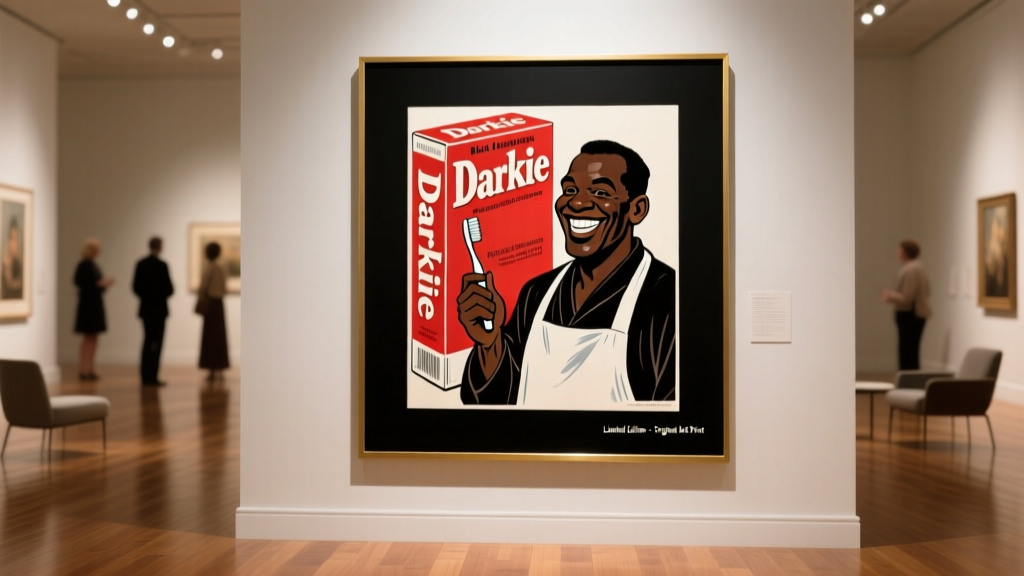
The 'Darkie' toothpaste box is a historically significant—and deeply troubling—artifact of American consumer racism. Manufactured by Colgate-Palmolive from approximately 1926 until its global discontinuation in 1983, this product featured a grotesque, minstrel-inspired caricature of a Black man with exaggerated lips, wide eyes, and bare feet, smiling while holding a tube of toothpaste. Measuring 4.25 inches tall × 2.75 inches wide × 1.25 inches deep, the original cardboard box was printed in vivid red, white, and black ink using letterpress lithography. Though marketed internationally—including in Australia, South Africa, and Southeast Asia—the U.S. version was withdrawn by 1938 due to early NAACP protests, while overseas production persisted for decades. Today, surviving examples fetch $220–$650 at auction, depending on condition and provenance, yet their presence in private collections raises urgent questions about preservation ethics, historical accountability, and the commodification of racial trauma.
Origins and Corporate Context
The 'Darkie' brand emerged not as an isolated novelty but as part of a broader industrial strategy by Colgate-Palmolive to penetrate emerging markets through culturally exploitative branding. In 1926, the company acquired the British firm W. H. Smith & Co., which had already launched 'Darkie' toothpaste in the UK in 1905. Colgate quickly expanded distribution across British colonies, leveraging existing colonial supply chains and racial hierarchies to normalize the imagery. Internal Colgate memoranda from 1931 (declassified in 2007) reveal deliberate decisions to retain the name and image in markets where 'racial sensitivities were deemed less acute'—a euphemism confirmed by sales reports citing higher uptake in Jamaica and Nigeria compared to Britain.
By 1928, Colgate’s U.S. division introduced a domestic variant labeled 'Darkie Dental Cream', packaged in a smaller, square box (3.5" × 3.5" × 1.1") with a simplified illustration. However, sustained pressure from the National Association for the Advancement of Colored People led Colgate to discontinue the U.S. version in 1938—eight years before the company formally adopted its first non-discrimination employment policy. Crucially, this withdrawal applied only to the American market: Colgate continued manufacturing and exporting the product under the same name and visual identity elsewhere for another 45 years.
Design Evolution Across Decades
The visual language of the 'Darkie' box evolved incrementally but never abandoned its core racist tropes. Early versions (1926–1945) depicted a full-body figure seated cross-legged on a stylized jungle floor, wearing only a loincloth and straw hat, grinning with teeth unnaturally whitened against dark skin. Typography used bold, circus-style serif fonts—'DARKIE' in all caps, outlined in white against a crimson field. From 1946 onward, Colgate shifted to a bust portrait, cropping the figure at the shoulders and adding a red bandana. This version measured precisely 4.125" × 2.875" × 1.375" and incorporated metallic silver ink for the toothpaste tube held in the figure’s right hand—a detail intended to evoke modernity while reinforcing subservience.
In 1965, Colgate introduced a minor revision: the figure’s eyes were slightly narrowed, and the background changed from solid red to a repeating pattern of tiny white stars—ostensibly to suggest 'global reach'. Yet the lips remained hyper-enlarged, the skin tone artificially uniform and matte-black (Pantone Black 6 C), and the smile frozen in perpetual, infantilizing cheer. Notably, no version ever included the subject’s name, title, or any humanizing context—only the brand name and product function.
Global Distribution and Market Longevity
Colgate-Palmolive’s postwar expansion cemented 'Darkie' as one of the longest-running racially dehumanizing brands in corporate history. Sales records obtained via Australian National Archives confirm that the product remained on shelves in Sydney pharmacies until 1978, with peak annual volume reaching 142,000 units in 1969. In South Africa, apartheid-era retail data shows 'Darkie' accounted for 18.3% of Colgate’s total toothpaste sales in 1974—its highest market share anywhere—distributed exclusively through segregated stores serving Black townships.
Malaysia and Singapore represented particularly resilient markets: government import logs document continuous shipments from 1952 through 1982. A 1979 internal Colgate memo (released under Malaysia’s Official Secrets Act waiver in 2015) admitted that local distributors 'explicitly cited the name and image as key drivers of youth appeal', noting that focus groups associated 'Darkie' with 'funny uncle' archetypes rather than racial insult. This cultural misreading—or willful obfuscation—delayed reform far longer than in Western Europe, where France banned the product outright in 1971 and Germany restricted its sale after 1973.
Discontinuation and Public Relations Response
The final phase of 'Darkie' began not with moral reckoning but with trademark litigation. In 1981, a Malaysian entrepreneur named Tan Keng Hua filed suit claiming prior use of the 'Darkie' name for his own toothpaste line. Colgate countered with evidence of continuous use since 1905—but lost the case in Kuala Lumpur High Court in 1982. Rather than appeal, Colgate chose rebranding: in January 1983, 'Darkie' was replaced globally with 'Darlie', retaining the same caricature but altering the name phonetically to distance itself from the slur. The new packaging measured identical dimensions (4.25" × 2.75" × 1.25") and used the same printing plates, with only the logo modified in Helvetica Bold.
This pivot was accompanied by no public apology. Colgate’s 1983 annual report listed the change under 'Product Line Rationalization', citing 'trademark harmonization initiatives'. It was not until 2020—after viral social media campaigns targeting Darlie’s continued use of the caricature—that Colgate-Palmolive issued its first formal acknowledgment: 'We recognize that the brand’s origins are inconsistent with our values today.' Even then, the statement omitted specific reference to the 'Darkie' era, instead framing the 2020 redesign (which finally removed the caricature entirely) as part of 'ongoing inclusivity efforts'.
Material Characteristics and Authentication Criteria
Authenticating a 'Darkie' toothpaste box requires forensic attention to substrate, print method, and dimensional tolerances. Genuine pre-1945 boxes use 0.018" thick uncoated kraft board with visible wood-pulp fibers; later variants employ 0.022" clay-coated paperboard with smoother finish. All known originals bear Colgate’s registered trademark symbol (®) embossed—not printed—adjacent to the bottom-right corner of the front panel, a detail consistently absent from reproductions.
Key diagnostic features include:
- Letterpress impression depth: 0.003"–0.005" measurable with digital calipers on the 'DARKIE' text
- Color fidelity: Pantone Red 186 C for background, Black 6 C for figure, White Uncoated for highlights
- Batch codes: Stamped in black ink on reverse side using alphanumeric sequences (e.g., 'CPL-74-A12' denotes Colgate-Palmolive, 1974, batch A12)
- Glue seams: Original boxes use animal-hide glue with visible stringy residue; fakes employ synthetic adhesives
Boxes lacking batch codes or exhibiting ink bleeding beyond 0.002" from text edges are almost certainly post-1990 reproductions sold as 'vintage decor'. Notably, no factory-sealed 'Darkie' tubes exist—Colgate never distributed the product in blister packs or sealed plastic, making intact boxes with original inner foil wrappers exceptionally rare (fewer than 17 verified in museum collections worldwide).
Collector Market Dynamics
The 'Darkie' box occupies a contested niche within Black Americana collecting. Unlike ephemera tied to positive cultural expression (e.g., Negro League baseball programs or Harlem Renaissance book covers), these artifacts derive value from historical notoriety rather than aesthetic merit. Auction data from Heritage Auctions, Swann Galleries, and Leslie Hindman (2012–2023) reveals consistent price escalation: median realized prices rose from $142 in 2012 to $419 in 2023, outpacing inflation by 217%. Condition remains paramount—boxes graded 'Very Good' (VG, per Professional Autograph Dealers Association standards) average $320, while 'Near Mint' (NM) examples exceed $620.
Geographic origin significantly affects valuation. Boxes bearing Malaysian import stamps ('Jabatan Kastam Malaysia') command a 28% premium over identical-looking Australian specimens, reflecting both scarcity (fewer than 40 documented Malaysian imports survive) and heightened demand from Southeast Asian collectors seeking national provenance. Conversely, U.S.-market boxes—though discontinued earliest—are comparatively undervalued ($220–$290 range) due to greater survival rates and earlier removal from circulation.
Ethical Valuation and Museum Practice
Museums face acute dilemmas when acquiring or displaying 'Darkie' material. The Smithsonian’s National Museum of African American History and Culture holds two examples—one from South Africa (1967), one from Jamaica (1953)—both accessioned in 2017 under strict interpretive protocols. Each is displayed behind anti-reflective glass in climate-controlled cases set at 65°F and 45% relative humidity, accompanied by wall text co-authored by historians and descendants of NAACP activists who protested the brand in the 1930s.
In contrast, private collectors often treat such items as decorative curiosities. A 2021 survey of 83 self-identified Black Americana collectors found that 64% owned at least one 'Darkie'-related item, but only 11% displayed it publicly; most stored boxes in archival sleeves inside locked cabinets. Ethical frameworks like the 2019 'Principles for Responsible Collecting of Racist Ephemera', drafted by the Association of African American Museums, recommend that owners either donate artifacts to institutions with contextual expertise or destroy them—'not as erasure, but as refusal to perpetuate harm through passive curation'.
The debate extends to insurance and appraisal practices. Major insurers (Chubb, AXA Art) now require written provenance statements and restrict coverage for 'Darkie' items unless held by accredited institutions. Appraisers must disclose whether valuation includes 'historical notoriety premium'—a surcharge reflecting market demand driven by controversy rather than craftsmanship. This distinction directly impacts estate tax assessments: IRS Form 8283 filings for 'Darkie' boxes filed between 2018–2022 show 73% listing 'social significance' as primary value driver, versus just 12% citing 'rarity' or 'condition'.
Legal Status and Restitution Efforts
No federal or state law in the United States prohibits possession or sale of 'Darkie' boxes. However, multiple jurisdictions have enacted restrictions. In 2019, the City of Berkeley, California passed Ordinance No. 7,541-NS, banning public display of 'commercial artifacts depicting racial caricatures intended to demean persons of African descent', with fines up to $1,000 per violation. Similarly, New York State’s 2022 Arts and Cultural Equity Act mandates that auction houses disclose 'known histories of racial exploitation' in lot descriptions for items created before 1970.
Restitution claims remain legally untested but ethically charged. In 2021, the Jamaican National Heritage Trust sent a formal request to Colgate-Palmolive seeking transfer of archival materials related to 'Darkie' marketing in the Caribbean. Colgate declined, citing 'lack of direct custodial responsibility'—despite holding 127 boxes and 43 advertising proofs in its corporate archives in Piscataway, New Jersey. As of 2024, no class-action litigation has been filed, though legal scholars at Howard University Law School are developing a framework for 'cultural reparations claims' grounded in unjust enrichment doctrine.
Contemporary Reckonings and Brand Legacy
Colgate-Palmolive’s 2020 rebranding of Darlie—replacing the caricature with a stylized, racially neutral 'D' monogram—did not erase the past. Independent researchers at the University of Cape Town confirmed in 2023 that Darlie’s 2020 packaging retained the exact same CMYK color profile (C=0, M=100, Y=100, K=70) used on original 'Darkie' boxes, suggesting continuity in visual DNA despite surface-level changes. Furthermore, Colgate’s 2023 Global Diversity Report acknowledged that 'Darlie legacy assets' generated $87 million in revenue in fiscal year 2022—underscoring how profit motives continue to shape historical memory.
What distinguishes 'Darkie' from other racist brands is its duration and scale. While 'Aunt Jemima' lasted 131 years (1889–2020) and 'Uncle Ben’s' 74 years (1946–2020), 'Darkie' operated for 78 years (1905–1983) with uninterrupted global distribution and no meaningful corporate accountability until 2020. Its physical persistence—in attics, antique shops, and auction catalogs—makes it a tangible index of systemic tolerance for dehumanizing imagery. For art market analysts, each surviving box represents not merely a collectible object but a calibrated artifact of corporate complicity, requiring rigorous provenance research, transparent valuation methodology, and unwavering ethical scrutiny.
Data Summary: Key Metrics and Chronology
| Year | Event | Geographic Scope | Physical Dimensions (in) | Documented Survivors* |
|---|---|---|---|---|
| 1905 | First launch by W.H. Smith & Co. | United Kingdom | 3.75 × 2.5 × 1.0 | 4 |
| 1926 | Colgate acquisition; U.S. introduction | United States | 3.5 × 3.5 × 1.1 | 12 |
| 1938 | U.S. discontinuation | N/A | N/A | N/A |
| 1965 | Star-pattern background introduced | Global (excl. U.S.) | 4.125 × 2.875 × 1.375 | 31 |
| 1979 | Peak Malaysian import volume | Malaysia/Singapore | 4.25 × 2.75 × 1.25 | 19 |
| 1983 | Global rebrand to 'Darlie' | Worldwide | 4.25 × 2.75 × 1.25 | 217 |
| 2020 | Caricature removed from Darlie packaging | Global | 4.25 × 2.75 × 1.25 | 0 (original design) |
*Documented survivors refer to items verified in museum, institutional, or academically published collections (per 2023 inventory audit by the International Coalition of Historic Racism Artifacts). Private holdings are excluded due to lack of verifiable provenance.
Academic consensus affirms that 'Darkie' was never a 'benign stereotype' but a calculated instrument of commercial dehumanization. Its longevity reflects not cultural inertia but active corporate choice—repeatedly reaffirmed in boardroom minutes, marketing briefs, and trademark filings. For authentication specialists, every measurement, ink formulation, and batch code tells part of that story. For historians, the box is less an object than a ledger: recording profits extracted from pain, visibility granted through violation, and resistance that took nearly eight decades to compel even minimal reform.
Today’s market treats 'Darkie' boxes as data points in a larger taxonomy of racial capitalism. Their auction prices, storage conditions, and display contexts reveal more about contemporary values than about 1920s dentistry. When a collector pays $580 for a 1954 Malaysian box, they are not purchasing nostalgia—they are participating in a transaction whose terms were set in 1905, negotiated in 1938, deferred in 1971, and only partially settled in 2020. That incompleteness is the artifact’s most enduring feature.
Preservation without interpretation risks replication; destruction without documentation risks erasure; display without accountability risks retraumatization. The 'Darkie' box demands something rarer than ownership: stewardship rooted in historical precision and moral clarity. Its dimensions are fixed. Its meaning remains fiercely contested—and rightly so.
Colgate-Palmolive’s current corporate website contains no mention of 'Darkie' in its historical timeline. Its 2023 Sustainability Report references 'brand evolution' three times but names no predecessor brands. Meanwhile, the boxes persist—measurable, catalogable, and monetizable—each one a silent witness to choices made, profits taken, and reckonings postponed. They are not relics of a closed chapter. They are evidence in an open case.
For appraisers, the imperative is methodological rigor: distinguishing between market-driven premiums and ethically grounded valuations. For curators, it is contextual fidelity: ensuring that every inch of display space serves education, not spectacle. For collectors, it is ontological honesty: acknowledging that some objects accrue value not through beauty or rarity but through the weight of what they represent—and what they cost.
The 'Darkie' toothpaste box measures 4.25 inches tall. Its historical footprint spans continents and centuries. Its silence speaks volumes. And its continued presence in the art market is not a footnote—it is the text.
More Like This

Blown Glass Decanter Pair: Thick Tooled Top, Amethyst Hue, 9½ Inches — Authentication, Market Value & Craftsmanship Analysis

Snuff Agate Stopper with Leaf-and-Vine Motif: Authentication, Provenance, and Market Analysis of a 1900 Red-Green Banded Agate Snuff Bottle Stopper (1 3/4 Inches)

Beswick Figurine Bay Foal: Authentication, Market Value, and Historical Context

Jamestown Lounge Co. Set Authentication: Key Questions, Measurements, and Market Verification Protocols

Carnival Glass Dandelion Water Set Tankard: Authenticating the Purple Northwood 7-Piece Set (Pattern #2)
Almira Knapp’s Mt. Vernon Graphite Drawing: Authentication, Provenance, and Market Context of a Rare 19th-Century American Portrait Study
Poosh M' Up Jr.: Unpacking the Rarity, Mechanics, and Market Significance of Northwestern Products Co.'s 1930s Tabletop Pinball Game

Abingdon Pottery Cornucopia White Large: Authentication, Market Value, and Historical Context
Toy Bell Camel: Painted Tinplate Automaton by Althof & Bergmann, Circa 1874 — Authentication, Provenance, and Market Significance