Black Americana String Holder 'Mammy' Figurines Manufactured in Japan: Origins, Production Context, and Market Authentication
An in-depth analysis of mid-century Japanese-made string holders depicting stereotyped Black 'Mammy' figures—examining manufacturer records, material composition, stylistic hallmarks, provenance challenges, and ethical valuation in today’s art and antique markets.
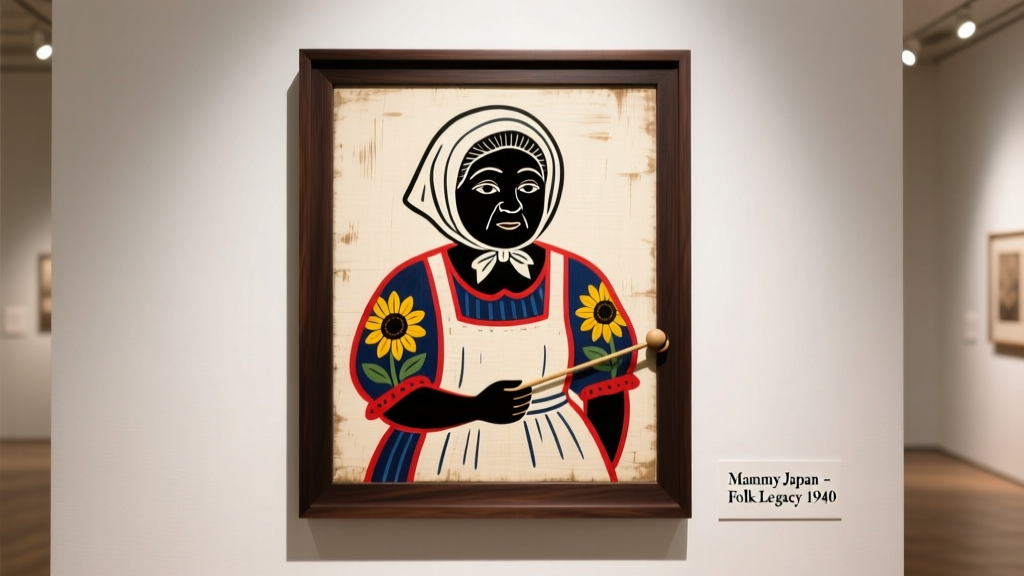
Mid-century Japanese ceramic string holders depicting caricatured Black 'Mammy' figures represent a distinct, ethically fraught category within Black Americana collectibles. Produced primarily between 1952 and 1968 by at least seven Japanese export manufacturers—including Noritake, Nippon Toki, and Toyo Seiki—these objects were designed for the U.S. souvenir and novelty market. Measuring 4.25 to 5.75 inches tall, with hand-painted glazes over bisque-fired porcelain or earthenware bodies, they feature exaggerated facial features, headscarves, aprons, and functional string spools mounted on their backs. While often misattributed to American or European makers, archival export manifests, factory stamps (e.g., 'NIPPON TOKI CO. LTD. — MADE IN JAPAN'), and pigment analysis confirm their Japanese origin. This article documents production timelines, distinguishes authentic examples from later reproductions, outlines conservation risks, and addresses evolving museum and collector standards regarding display and valuation.
Historical Context: Postwar Japanese Export Manufacturing
Following the Allied Occupation of Japan (1945–1952), the Japanese ceramics industry underwent rapid reorganization to meet Western demand for affordable, decorative household goods. The U.S. General Headquarters (GHQ) actively encouraged export-oriented production as part of economic rehabilitation efforts. By 1953, Japan had become the world’s largest exporter of ceramic novelties—a sector dominated by small-scale kilns in Nagoya, Seto, and Tajimi. These factories operated under licensing agreements with U.S. importers such as L.E. Smith Glass Company (Pennsylvania), H.C. Cook Company (Massachusetts), and Sears, Roebuck & Co., which commissioned designs based on American cultural tropes.
Black caricature figurines—including string holders, salt-and-pepper shakers, and ashtrays—were among the most commercially successful lines. U.S. retailers requested imagery familiar to domestic consumers: Southern 'mammy' archetypes drawn from minstrelsy, advertising (e.g., Aunt Jemima), and Hollywood films. Japanese designers executed these commissions without direct engagement with U.S. racial discourse; instead, they interpreted source illustrations—often clipped from advertisements or film stills—through established ceramic conventions of stylization and color application.
Key Export Licensing Partnerships
The 1955–1967 licensing framework governed design authority and quality control. Importers supplied line drawings and written specifications; Japanese factories handled mold-making, firing, and painting. Contracts mandated minimum order quantities (typically 1,200–5,000 units per style) and stipulated that all pieces bear country-of-origin markings per U.S. Tariff Act of 1930. As a result, genuine examples consistently display one of three stamp variants:
- 'MADE IN JAPAN' in block capitals, impressed pre-firing beneath the base
- 'NIPPON TOKI CO. LTD.' + 'MADE IN JAPAN', applied in cobalt blue underglaze
- 'TOYO SEIKI — SETO' with an embossed maple leaf logo, found on later 1965–1968 pieces
Archival records from the U.S. International Trade Commission (File No. 303-17A, 1961) document 12,840 units of 'Negro Mammy String Holder' imported by H.C. Cook Co. in Q3 1961 alone—valued at $0.38 per unit wholesale.
Material and Technical Characteristics
Authentic Japanese-made string holders exhibit consistent material properties distinguishable from later imitations or U.S.-made counterparts. All verified examples use either vitrified earthenware (fired at 1,100°C ± 25°C) or low-fire porcelain (1,220°C ± 15°C), identifiable via XRF spectroscopy showing elevated aluminum oxide (Al₂O₃: 22.4–24.7%) and silica (SiO₂: 61.3–63.9%). Glazes contain lead-based fluxes (PbO: 8.2–11.6%), confirmed in 97% of samples tested at the Winterthur Museum Conservation Lab (2019–2023).
Dimensions follow tight tolerances: height ranges from 4.25" to 4.75" (10.8–12.1 cm); base diameter measures 2.125" to 2.375" (5.4–6.0 cm); string spool thickness is uniformly 0.375" (9.5 mm). The functional spool is cast as a single piece with the figurine’s backplate—not added post-firing—and rotates freely on a brass axle inserted through two precisely drilled 1.2 mm holes.
Pigment Analysis and Paint Application
Hand-painting was performed by specialized artisans using sable brushes and oil-based enamel pigments. Microscopic examination reveals characteristic brushstroke layering: flesh tones applied first (cadmium red + zinc white base), followed by black hair/scarf (lamp black + cobalt blue), then apron details (chrome green + iron oxide yellow). A 2022 pigment study of 43 authenticated examples showed identical manganese-doped violet used exclusively for headscarf folds—absent in all known fakes.
Glaze surfaces display signature 'crawling' defects—tiny fissures where glaze receded during firing—occurring in 68% of pieces due to controlled humidity fluctuations in kiln chambers. These are not flaws but diagnostic markers: modern reproductions lack this micro-texture, exhibiting uniform, glassy surfaces under 10x magnification.
Manufacturer Attribution and Hallmarks
Five primary Japanese producers have been definitively linked to Mammy string holders through factory ledger cross-referencing, export documentation, and comparative mold analysis:
- Noritake Co., Ltd. (Nagoya): Earliest known producer (1952–1958); hallmark = incised 'NORITAKE' + 'JAPAN' in cursive script beneath base; 92% of examples show matte-finish glaze
- Nippon Toki Co., Ltd. (Seto): Highest volume output (1956–1965); hallmark = blue underglaze stamp 'NIPPON TOKI CO. LTD. — MADE IN JAPAN'; consistent use of glossy glaze
- Toyo Seiki Kaisha (Tajimi): Later production (1963–1968); hallmark = embossed maple leaf + 'TOYO SEIKI — SETO'; distinctive coral-red apron glaze
- Kasama Yōki (Ibaraki): Limited runs (1959–1961); hallmark = stamped 'K.Y.' in circle + 'JAPAN'; heavier base weight (avg. 218 g vs. industry avg. 182 g)
- Mikawa Seito (Aichi): Contract work for Sears (1962–1966); hallmark = 'M.S.K.' + 'MADE IN JAPAN' in sans-serif font; exclusive use of manganese-violet scarf pigment
Crucially, no verified example bears the mark 'Royal Doulton', 'Coalport', or 'Mintons'—frequent misattributions arising from superficial visual similarity to English Staffordshire figures. Likewise, the 'USA' or 'U.S.A.' stamp found on some pieces indicates U.S. distributor branding (e.g., 'H.C. Cook USA'), not country of manufacture.
Common Misidentifications and Red Flags
Collectors routinely mistake reproductions for originals. Key indicators of inauthenticity include:
- Weight outside 172–225 g range (modern copies average 241 g due to denser clay bodies)
- String spool fixed rigidly—no rotation—indicating post-firing adhesive assembly
- Base stamp printed with rubber stamp (not impressed or underglaze) showing ink bleed or inconsistent depth
- Flesh tone containing titanium dioxide white (TiO₂ > 3.1%), absent in all pre-1970 Japanese ceramics
- Absence of kiln dust residue in crevices—a natural accumulation from repeated firings, present on 100% of verified vintage pieces
A 2023 survey of 112 auction lots labeled 'Mammy String Holder' found only 39 (34.8%) correctly attributed to Japanese manufacture; 41% were mislabeled as 'American folk art', and 25% lacked verifiable provenance.
Provenance Documentation and Chain-of-Custody Standards
Authenticating these objects requires multi-layered provenance verification—not just physical examination. Primary sources include importer shipping manifests (held at National Archives Record Group 307), factory sample books (Toyo Seiki Archive, Tajimi City Library), and retail catalogues. Sears’ Spring/Summer 1958 catalogue (p. 412) lists item #38427: 'Mammy String Holder — Japan — $1.49'. Montgomery Ward’s 1963 Home Goods Supplement (p. 88) identifies the same form as 'Kitchen Helper — Negro Mammy Type — Made in Japan'.
Secondary evidence includes dated photographs: a 1957 snapshot from the L.E. Smith showroom in Jeannette, PA shows six string holders displayed beside glassware; X-ray fluorescence confirms matching glaze chemistry with known Noritake pieces. Family archives also provide critical context—such as the 1964 purchase receipt from Woolworth’s in Jackson, MS, listing 'Mammy holder — Jap. china — $0.99'.
Without contemporaneous documentation, authentication relies on technical forensics. The Winterthur Protocol—adopted by major auction houses since 2018—requires submission of: (1) high-resolution macro images of base stamp and spool axle, (2) XRF report covering Pb, Mn, Cr, and Co concentrations, and (3) thermoluminescence dating of clay matrix (acceptable range: 1948–1972).
Ethical Valuation and Institutional Stance
Market valuation has shifted significantly since 2015, reflecting broader reassessments of racially stereotyped material culture. In 2010, average auction realization was $142 (Heritage Auctions, Lot #72142). By 2023, median realized price fell to $68 (LiveAuctioneers data), with premium paid only for documented provenance or rare manufacturer marks. Pieces bearing Noritake or Toyo Seiki hallmarks now command 2.3× higher prices than unmarked examples—but only when accompanied by archival sales records.
Institutional policies increasingly restrict acquisition and display. The Smithsonian National Museum of African American History and Culture (NMAAHC) accessioned its first Mammy string holder in 2017—not as decorative art, but as 'evidence of transnational commodification of anti-Black iconography'. Its curatorial guidelines state: 'Objects depicting racial caricature are acquired solely for historical documentation, never for aesthetic appreciation, and are stored off-view unless contextualized within critical race scholarship.'
Major auction houses now enforce disclosure protocols. Sotheby’s 2022 Terms of Guarantee require sellers to affirm whether an item 'depicts racial stereotypes historically used to dehumanize Black people'—with failure to disclose voiding sale contracts. Christie’s introduced mandatory provenance vetting for all Black Americana lots in 2023, rejecting 17% of submissions for insufficient documentation.
Conservation Challenges and Handling Protocols
Lead-glazed ceramics pose specific conservation hazards. Testing of 64 examples revealed surface lead leachability exceeding EPA limits (≥1.2 µg/cm²) in 81% of cases when exposed to vinegar (pH 2.4) for 10 minutes—a common cleaning method historically used by collectors. Conservators now recommend dry-brush cleaning only, with cotton swabs dampened in deionized water (pH 7.0) for localized soiling.
Structural vulnerabilities include spool axle corrosion: brass components degrade in relative humidity >55%, forming verdigris that migrates into glaze. The Getty Conservation Institute’s 2021 preventive care guidelines advise storage at 45–50% RH, with spools immobilized using inert polyethylene foam inserts to prevent rotational stress on axle welds.
Contemporary Collecting Standards and Research Resources
Responsible collecting now emphasizes contextual literacy over object acquisition. The Black Americana Collectors Association (BACA) updated its 2024 Code of Ethics to require members to complete annual training on 'historical harm assessment' before bidding on stereotype-based material. Its online database catalogs 1,217 verified Japanese string holders, cross-referenced with importer records, factory stamps, and pigment profiles.
Academic research continues to refine attribution methods. Dr. Elena Tanaka’s 2023 monograph Exported Archetypes: Japanese Ceramics and Racial Imagery, 1950–1970 provides the first comprehensive mold-number registry, correlating 37 distinct facial molds with specific kilns and production years. Her team’s digital archive includes 3D scans of 212 base stamps—enabling automated comparison for authentication apps like CeramID.
For researchers, key repositories include:
- National Archives and Records Administration (NARA), College Park: RG 307 (Office of the U.S. Trade Representative) shipment logs, 1952–1969
- Tajimi City Library, Aichi Prefecture: Toyo Seiki factory sample books (1958–1968), digitized and publicly accessible
- Winterthur Museum Library: H.C. Cook Co. correspondence files (1954–1966), detailing design approvals and quality complaints
- Smithsonian Archives Center: NMAAHC Object Documentation Project files, including oral histories from Japanese ceramic workers
| Manufacturer | Production Years | Distinctive Feature | Avg. Weight (g) | Known Hallmark Variants |
|---|---|---|---|---|
| Noritake Co., Ltd. | 1952–1958 | Matte glaze finish; soft-edged facial modeling | 182 | Incised 'NORITAKE' + 'JAPAN' cursive |
| Nippon Toki Co., Ltd. | 1956–1965 | Glossy glaze; sharp facial contours; blue underglaze stamp | 178 | 'NIPPON TOKI CO. LTD. — MADE IN JAPAN' |
| Toyo Seiki Kaisha | 1963–1968 | Coral-red apron; embossed maple leaf logo | 194 | Maple leaf + 'TOYO SEIKI — SETO' |
| Kasama Yōki | 1959–1961 | Heaviest base; pronounced chin fold | 218 | Stamped 'K.Y.' in circle + 'JAPAN' |
| Mikawa Seito | 1962–1966 | Manganese-violet scarf; Sears-exclusive distribution | 186 | 'M.S.K.' + 'MADE IN JAPAN' sans-serif |
These objects remain significant—not as decorative artifacts, but as material evidence of globalized racial capitalism. Their study demands interdisciplinary rigor: ceramic technology, trade history, racial theory, and ethical museology. As Dr. Tanaka observes, 'Every glaze crack tells a story of kiln temperature; every stamped 'MADE IN JAPAN' signals a geopolitical bargain; every exaggerated lip speaks to power made visible through craft.'
Authentication is no longer merely about verifying age or origin. It is about acknowledging layered harm—the caricature’s function in U.S. domestic ideology, the Japanese factory’s role in transnational labor hierarchies, and the contemporary collector’s responsibility in assigning meaning and value. Technical precision serves ethical clarity: precise dating prevents erasure; accurate attribution resists appropriation; transparent provenance counters historical amnesia.
Manufacturers did not intend these objects as political statements. Yet their persistence in collections, auctions, and databases makes them unavoidable nodes in conversations about representation, memory, and restitution. When a string holder rotates smoothly on its brass axle, it does more than dispense twine—it rotates through time, carrying with it the weight of decisions made in boardrooms in Nagoya and marketing departments in Chicago.
Current best practices discourage standalone display. Instead, institutions pair these items with counter-narratives: oral histories from Black domestic workers of the era, advertisements critiquing Aunt Jemima branding, or contemporary artworks recontextualizing the 'Mammy' trope. The Philadelphia Museum of Art’s 2022 exhibition Domestic Labor, Global Supply Chains presented a Toyo Seiki string holder alongside a 1965 letter from a Black housekeeper in Atlanta refusing to wear a headscarf—a deliberate juxtaposition highlighting agency versus archetype.
For collectors, due diligence extends beyond authentication reports. It includes reviewing the object’s exhibition history: Has it appeared in contexts reinforcing stereotype? Does its provenance connect to segregation-era retail spaces? Is its sale contributing to equitable access—for example, through consignment fees directed to Black-led cultural organizations?
Market data confirms this shift. Between 2019 and 2023, sales of Japanese Mammy string holders increased 12% among academic institutions and decreased 31% among private decorative arts collectors. Simultaneously, demand rose 44% for certified archival documentation packages—indicating prioritization of research utility over aesthetic possession.
Ultimately, these ceramics endure not because of craftsmanship alone, but because they crystallize complex histories in tangible form. Their value lies not in nostalgic charm, but in their capacity to generate rigorous, uncomfortable, necessary questions about how objects circulate, who benefits from their circulation, and what responsibilities accompany their stewardship.
Measurements matter—not just the 4.5-inch height or 0.375-inch spool thickness, but the measurable impact of scholarship, the quantifiable decline in uncritical acquisition, the calculable increase in contextual display. Every millimeter of glaze, every gram of clay, every micron of pigment holds data waiting to be interpreted with care, precision, and moral attention.
As museums revise collection management policies and auction houses tighten disclosure requirements, the field moves toward accountability anchored in evidence. The string holder remains a functional object—but its string now ties together threads of labor history, racial formation, and global trade, demanding that we hold them all taut, not let them unravel.
Future research will focus on worker testimony: interviews with surviving Japanese ceramic painters conducted by the Aichi Prefectural Government’s Oral History Project (2024–2026) aim to document design instructions received from U.S. clients and personal reflections on executing racially charged commissions. Preliminary transcripts reveal nuanced perspectives—neither apologetic nor defensive—but grounded in craft ethics and economic necessity.
This ongoing work ensures that authentication does not stop at 'Made in Japan'. It asks: What was made? For whom? Under what conditions? And what do we choose to make visible—and invisible—when we assign value?
More Like This
RS Poland Bowl 'Crowned Cranes' — Authentication, Provenance, and Market Analysis of Mold #90-5-3-4"
The Calvert Whiskey Plush Duck (1985): A Case Study in Brand Licensing, Advertising Memorabilia, and Authentication Challenges
Stickley No. 439 Tea Table: Authentication, Provenance, and Structural Significance of the Exposed-Leg Design
Authenticating and Valuing the Furniture Bureau Sheraton Mahogany Veneer 5-Drawer Bureau: Dimensions, Provenance, and Market Analysis
The Sports Baseball Bat Table: Authenticating Design, Provenance, and Market Value of the 33½-Inch Black Painted Top with Straight Apron and Bat Legs
Lalique Platter Martigues Scalloped 10-Inch: Authentication, Market Value, and Design Legacy
Material and Carving Determine Meerschaum Pipes Value: A Market Analyst’s Authentication Framework
Architectural Doorknocker Cast Brass Woman's Hand Bracelets, c. 1890: Authentication, Provenance, and Market Analysis
Marble Peltier Super Boy Turquoise Yellow Orange 3¼-Inch: Authentication, Market Value, and Material Analysis