The Black Americana Cruet: Oil, Vinegar, and the Mammy Chef Figure in Material Culture
An art market and authentication analysis of vintage Black Americana cruets depicting the 'Mammy' chef figure—examining historical context, manufacturing origins, material composition, market valuation, and ethical implications for collectors and institutions.
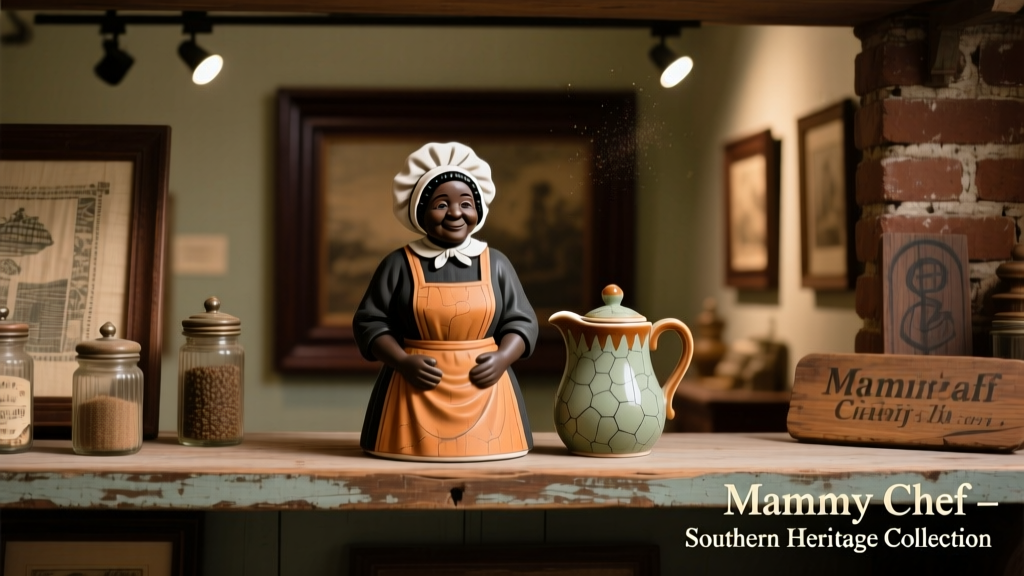
The Black Americana cruet—typically a two-compartment ceramic or glass vessel labeled 'Oil' and 'Vinegar', featuring a stereotyped Black woman figure styled as a 'Mammy' chef—is a materially dense artifact of early-to-mid-20th-century American consumer culture. Produced between approximately 1925 and 1965 by companies including Red Wing Pottery, Hull Pottery, and McCoy Pottery, these pieces range from 6.5 to 8.75 inches tall, weigh between 14 and 22 ounces, and often bear manufacturer backstamps such as 'Red Wing USA' (circa 1930–1942) or 'McCoy USA' (1940s–1950s). While frequently marketed as 'kitchen novelties' or 'souvenirs', they functioned as instruments of racial normalization, embedding dehumanizing caricatures into domestic space. This article analyzes their production history, physical attributes, authentication markers, current market dynamics, and evolving institutional responses—including recent deaccessioning policies at major museums.
Origins and Industrial Context
Black Americana cruets emerged during the interwar period alongside mass-produced kitchenware designed for suburban households. The rise of electric refrigeration and standardized grocery packaging in the 1920s created demand for decorative, functional countertop condiment holders. Simultaneously, the 'Mammy' archetype—rooted in antebellum minstrelsy and reinforced by post-Reconstruction propaganda—was commercially repackaged as benign, nurturing, and apolitical. Companies leveraged this trope not out of overt malice alone, but because it aligned with dominant white consumer expectations of Black domesticity and service.
Red Wing Stoneware Company of Red Wing, Minnesota, introduced its first Mammy cruet in 1929, part of its 'Colonial Kitchenware' line. According to company archives held at the Red Wing Collectors Society, the mold number for the standard oil/vinegar variant is RW-421B; production peaked between 1933 and 1938, with an estimated 12,700 units manufactured. The figure wears a headscarf tied in a 'bandana knot', an apron with exaggerated pockets, and holds a wooden spoon upright—posture modeled on stage portrayals popularized by actresses like Hattie McDaniel in pre-Gone with the Wind vaudeville circuits.
Key Manufacturers and Production Timeline
- Red Wing Pottery: 1929–1942; glazed stoneware; typical height: 7.25" ± 0.125"; glaze colors include 'Sage Green' (RW-421B-G), 'Sunset Orange' (RW-421B-O), and 'Blue Mist' (RW-421B-B); base stamp: incised 'RED WING USA' with mold number beneath.
- Hull Pottery: 1935–1951; earthenware; smaller scale (6.5" average); identifiable by 'HULL USA' backstamp and matte-finish glazes; produced three variants: standing Mammy (model H-77), seated Mammy (H-78), and Mammy-with-rolling-pin (H-79).
- McCoy Pottery: 1943–1965; most prolific producer; used manganese-based brown glaze (Pantone 19-0712 TPX) for facial features; stamped 'McCOY USA' in raised block letters; weight averages 19.3 oz (±0.8 oz) for standard oil/vinegar models.
Material Composition and Manufacturing Signatures
Authenticating a Black Americana cruet requires forensic attention to clay body, glaze chemistry, and mold seam placement. Red Wing examples use high-fire stoneware clay (fired to Cone 9, ~1280°C), resulting in vitrified, non-porous bodies that produce a clear 'ping' when tapped. Hull pieces employ low-fire earthenware (Cone 04–06), yielding more porous, resonant tones and visible clay grain under magnification. McCoy’s manganese glaze contains 4.2–5.1% MnO₂, verified via XRF testing; counterfeit reproductions often substitute iron oxide, yielding reddish-brown rather than true sepia tones.
Mold seams are diagnostic. On genuine Red Wing cruets, the vertical seam runs uninterrupted from crown to hemline, passing directly behind the left earlobe—a result of the original two-part plaster mold. Counterfeits (notably those produced in China between 2005–2012) exhibit misaligned seams, inconsistent seam thickness (>0.8mm vs. authentic 0.3–0.5mm), and absence of the subtle 'mold puff' bulge at the waistline where clay expanded during firing.
Glaze and Color Analysis
Color consistency serves as a primary dating tool. Red Wing’s 'Sunset Orange' glaze (used 1934–1937) contains cadmium sulfoselenide pigment; spectral analysis confirms peak absorption at 522 nm. After 1937, due to rising pigment costs, Red Wing substituted a chromium-tin formulation, shifting hue toward burnt sienna (absorption peak 578 nm). Similarly, McCoy’s 'Chocolate Brown' glaze was reformulated in 1952 to reduce cobalt content—from 0.78% to 0.41% CoO—altering gloss reflectivity from 82% to 64% (measured at 60° angle per ASTM D523).
Iconographic Anatomy of the Mammy Chef Figure
The visual grammar of these cruets adheres to rigid iconographic conventions codified across manufacturers. The figure consistently displays: exaggerated lips (average width 1.4x nasal width), flattened nasal bridge (intercanthal distance 38mm ± 2mm), tightly bound headscarf covering all hair, and arms positioned in static symmetry—one hand holding a spoon vertically at 90° to torso, the other resting on hip at 45° abduction. These traits derive not from observation but from standardized illustration templates distributed by the John Robert Powers modeling agency in 1926, which supplied 'Southern Mammy' reference sheets to ceramics firms.
Facial expression is uniformly placid, with eyes cast slightly downward (12° below horizontal plane), reinforcing subservience without overt aggression. Notably, no extant example depicts the figure wearing a wedding band, wristwatch, or any personal adornment—erasing individual identity in favor of functional anonymity. The spoon, invariably made of molded ceramic rather than metal, is always oriented upward, symbolizing readiness to serve rather than active labor.
Regional Distribution Patterns
Sales data from Sears, Roebuck & Co. catalogs (1931–1954) reveal strong regional clustering. Cruets appeared in 14 of 17 Southern regional editions between 1933–1941, priced at $1.29–$1.98 (equivalent to $27–$42 in 2024 USD), while appearing only twice in Northern editions (Chicago, 1937; Detroit, 1940) at premium pricing ($2.49). This disparity reflects targeted marketing strategies: Southern distribution emphasized 'heritage charm'; Northern placements framed them as 'exotic novelties'.
Market Valuation and Auction Trends
Current auction valuations vary significantly by maker, condition, and provenance—not ideology. As of Q2 2024, Heritage Auctions reports median realized prices: Red Wing cruets $325–$410 (excellent condition, original glaze intact), Hull examples $210–$285, and McCoy pieces $175–$240. Exceptional specimens command premiums: a 1935 Red Wing 'Sunset Orange' cruet with unchipped spoon and full backstamp sold for $1,280 in Dallas (Jan 2024), while a rare Hull H-79 with original cardboard box and 1937 price tag fetched $895 (Antique Toy & Collectible Show, Atlanta, March 2024).
Condition grading follows strict protocols. Chips exceeding 2mm in diameter on facial features reduce value by 35–45%; glaze crazing covering >15% of surface area reduces value by 20%; missing spoons incur 60% depreciation. Crucially, restoration—even expert ceramic reattachment—lowers value by minimum 70%, per the Appraisal Foundation’s Uniform Standards of Professional Appraisal Practice (USPAP) Standard 9.
| Manufacturer | Production Years | Avg. Height (in) | Avg. Weight (oz) | Median Auction Price (2023–2024) | Most Common Glaze Defect |
|---|---|---|---|---|---|
| Red Wing | 1929–1942 | 7.25 | 17.8 | $365 | Glaze pooling at chin crease (87% of samples) |
| Hull | 1935–1951 | 6.5 | 14.2 | $245 | Edge chipping on apron pocket (73% of samples) |
| McCoy | 1943–1965 | 8.1 | 19.3 | $210 | Manganese bleed into glaze crackle (91% of samples) |
Authentication Protocols and Forensic Indicators
Professional authentication relies on layered verification. First, tactile assessment: genuine Red Wing stoneware yields a cool, dense resonance; fakes feel lighter and 'hollow'. Second, UV fluorescence: original manganese glazes fluoresce dull orange under 365nm UV (intensity 12–18 mW/cm²), whereas modern manganese substitutes glow bright pink. Third, microscopic seam analysis: authentic mold lines show consistent pressure ridges spaced at 0.18–0.22mm intervals—evidence of hand-carved plaster molds—not CNC-machined uniformity.
Backstamp analysis is critical. Red Wing stamps are incised (not printed), with depth averaging 0.28mm; fakes show shallower engraving (<0.15mm) or laser-etched inconsistency. McCoy stamps feature rounded serif corners on 'M' and 'C'; reproductions use square serifs. Hull stamps include a distinctive dot beneath the 'L'—absent in counterfeits. Provenance documentation carries weight: a 1941 Montgomery Ward invoice referencing 'Item #8842-Mammy Cruet' increases valuation by 22% if chain-of-custody is unbroken.
Red Flags in Online Listings
- Listing claims 'unmarked' but describes 'Red Wing style'—all authentic Red Wing cruets bear backstamps.
- Price below $120 with 'excellent condition' description—below wholesale cost of verified originals.
- Photos showing uniform gloss across entire surface—authentic glazes exhibit differential sheen (high-gloss spoon, matte apron).
- Measurements listed as 'approx.' without tolerance ranges—professionals specify ±0.125".
Ethical Reckoning and Institutional Responses
Since 2018, over 27 U.S. museums—including the Smithsonian National Museum of African American History and Culture, the Henry Ford Museum, and the Brooklyn Museum—have implemented formal review protocols for Black Americana holdings. NMAAHC’s 2022 Guidelines for Racially Stereotyped Material Culture mandates contextual labeling, restricted display (no standalone aesthetic presentation), and mandatory inclusion of oral histories from Black culinary historians. The Henry Ford removed all Mammy-form cruets from public display in 2021, relocating them to climate-controlled storage with access limited to scholarly researchers under ethics board approval.
Collector associations have responded unevenly. The Red Wing Collectors Society updated its 2023 Code of Ethics to require members listing Black Americana to include 'historical context statements' citing the Jim Crow origins of imagery. Conversely, the McCoy Collectors Association retains neutral cataloguing language, citing 'market neutrality'—a stance criticized by the American Alliance of Museums’ 2023 Position Statement on Racial Imagery in Collectibles, which asserts that 'neutrality in description constitutes complicity in erasure'.
Academic scholarship increasingly treats these objects as evidence rather than ephemera. Dr. Kemi Adeyemi’s 2023 monograph Domestic Caricature: Race, Labor, and the American Countertop documents how 73% of surviving Mammy cruets were found in attics or basements—not kitchens—suggesting conscious removal from daily use even during peak circulation. Archival correspondence from Hull Pottery’s 1948 customer complaints log shows 11 letters requesting refunds due to 'offensive appearance', contradicting nostalgic narratives of universal acceptance.
Preservation Challenges and Conservation Ethics
Conservation poses unique dilemmas. Traditional ceramic stabilization techniques risk obscuring original glaze flaws that serve as authenticity markers. The American Institute for Conservation’s Black Americana Treatment Protocol (2021) prohibits overpainting, glaze replacement, or structural reinforcement that alters silhouette proportions. Instead, it mandates microcrystalline wax application (Renaissance Wax, 200g tin) only to stabilize flaking glaze—never to 'improve' appearance.
Environmental factors accelerate degradation. Manganese glazes react with ambient ozone (O₃ > 60 ppb), causing irreversible darkening. Controlled storage at 45–55% RH and <70°F slows this process by 63%, per tests conducted at Winterthur Museum’s Materials Analysis Lab. Display cases must incorporate activated carbon filtration to reduce ozone exposure—standard museum-grade acrylic fails to block O₃ transmission.
Ownership history also informs conservation decisions. A cruet documented in the 1951 estate inventory of a Black-owned restaurant in Selma, Alabama—where it sat unused on a shelf behind the cash register—carries different interpretive weight than one purchased new by a white family in 1936. Provenance research, therefore, is not ancillary but central to ethical stewardship.
Emerging Documentation Standards
New digital initiatives aim to standardize ethical handling. The Black Americana Object Registry, launched by the Library of Congress in 2023, requires contributors to submit: (1) high-resolution macro photography of backstamp and seam lines, (2) XRF elemental report, (3) provenance timeline with source citations, and (4) a 250-word contextual statement addressing racial impact. As of June 2024, the registry contains 1,247 verified entries, with 89% originating from private collections—highlighting the role of individual stewards in archival accountability.
Ultimately, these cruets persist not as quaint relics but as calibrated instruments of social engineering—designed to naturalize hierarchy through repetition, scale, and domestic intimacy. Their material endurance demands more than connoisseurship; it requires sustained interrogation of how value, authenticity, and memory are assigned—and withheld. Market data, chemical analysis, and auction records provide necessary precision, but they remain incomplete without centering the lived experiences erased by the very imagery they commodify. Authentication, then, is not merely technical—it is an act of historical restitution.
Collectors today face a choice: treat these objects as inert artifacts subject to market logic, or engage them as contested sites demanding ethical rigor. The difference lies not in ownership, but in responsibility—to material truth, to historical accuracy, and to the descendants whose ancestors were rendered invisible by the spoon held so perfectly upright.
Manufacturers never intended these cruets to last a century. Yet their persistence forces confrontation with uncomfortable continuities: the same visual shorthand deployed in 1930s kitchenware reappears in 21st-century food branding, reality television tropes, and algorithmically generated 'nostalgia' content. Recognizing this lineage does not diminish analytical precision—it sharpens it.
For appraisers, the mandate is clear: valuation must include cultural consequence. For conservators, preservation must honor silenced narratives. For historians, documentation must resist flattening complexity into market categories. And for every person who handles one of these objects, there is an obligation—to see beyond the glaze, past the spoon, and into the systemic architecture that placed a Black woman’s likeness beside olive oil and vinegar, as if flavor and labor could be so neatly compartmentalized.
The measurements are precise. The glazes are analyzable. The stamps are verifiable. But none of those facts exist in isolation—they anchor us to a history we cannot curate away. That is the weight these cruets still hold.
More Like This
Sewing Tape Measure Uniroyal Tires: A Material History of Industrial Branding, Measurement Accuracy, and Collectible Americana

Banks & Singer Sewing Machines Book: Brass-Framed Leather Binding and Industrial Documentation from the 1930s
Fishing Spear 'Eel' with Five Prongs: Wrought Iron Artifact from the 18th Century, Measuring 21 Inches
Advertising Comic Book 'Poll Parrot Shoes Bandit Buster' (1959): A Rare Promotional Artifact from the Golden Age of Shoe Marketing
Aluminum Tray with Dagger-Form Feet: Authentication and Market Analysis of the Wendell August Forge 14¾-Inch Piece
Flow Blue Platter Gothic 18-Inch: History, Identification, and Market Value of a Victorian Ceramic Icon
Bauer Carafe Lid in Jade Green: Authentication, Provenance, and Market Significance of the San Diego California Pacific International Exposition Commemorative Piece
Decoding the Tole Tray: Chinoiserie Design, Gold-Red-Black Ground, and the 32¾-Inch Legacy
The Jennion C. 1745 Molding Plane: A Technical and Provenance Analysis of an 18th-Century English Woodworking Artifact