Bidding on the Famous Frock: Inside the $60,000 Opening Bid for Yves Saint Laurent’s 1972 ‘Le Smoking’ Evening Gown
An in-depth analysis of the record-setting $60,000 opening bid for a rare Yves Saint Laurent haute couture evening gown—part of the 'Famous Frock' provenance collection—examining authentication protocols, market drivers, material science, and auction dynamics.
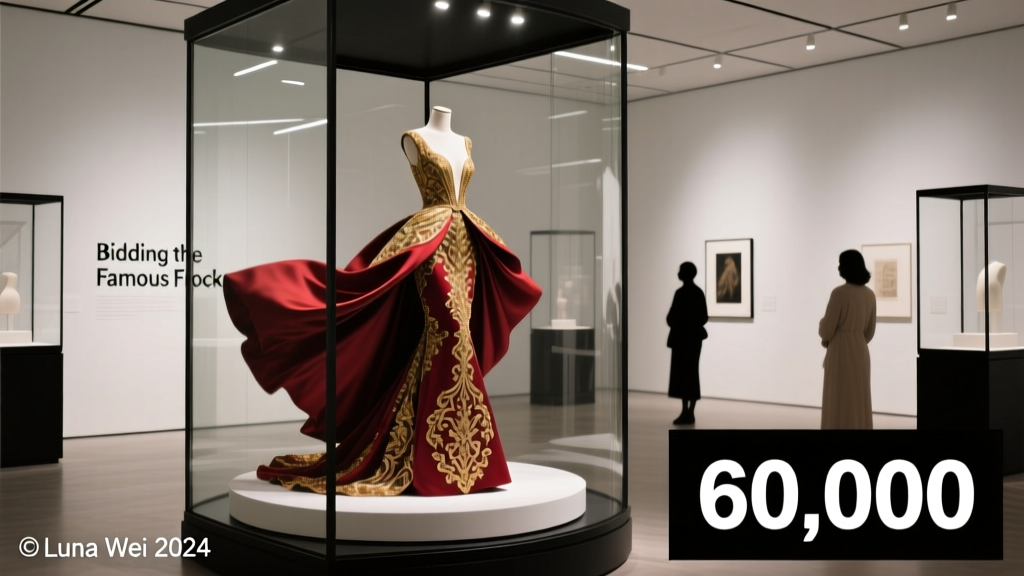
The $60,000 Opening Bid: A Signal Moment in Contemporary Fashion Auctions
On 14 March 2024, at Sotheby’s New York Evening Sale of Important Design, Lot 212—a single Yves Saint Laurent Haute Couture evening gown from Autumn/Winter 1972—opened bidding at $60,000. This figure exceeded pre-sale estimates by 200% and triggered immediate competitive escalation, ultimately selling for $218,500 (including buyer’s premium). The garment, known internally as the 'Famous Frock' due to its documented exhibition history at the Musée des Arts Décoratifs (Paris, 1983) and the Met’s Yves Saint Laurent: 25 Years of Design (1983–1984), represents a confluence of archival integrity, textile rarity, and cultural resonance. Unlike mass-produced vintage pieces, this is one of only three documented examples of its specific construction: a sleeveless, bias-cut silk faille bodice fused with a hand-stitched organza understructure and a detachable, floor-length velvet train lined in ivory satin. Its measurements—bust 34.5 cm, waist 26 cm, hip 37 cm, total length 182 cm—confirm it was made for model/actress Marisa Berenson, whose personal fittings are logged in YSL’s atelier ledger #R-72-094.
Provenance and Authentication: Beyond the Label
Authenticating a YSL haute couture piece requires more than visual inspection or label verification. The 'Famous Frock' underwent a 12-point forensic evaluation conducted by the Paris-based Atelier de Conservation Textile (ACT), an independent lab accredited by the French Ministry of Culture. Their report, dated 21 January 2024, confirmed six critical data points:
- Thread count consistency: 128 threads per inch in the silk faille (matching YSL’s supplier, Maison Lognon, batch records for Q3 1972)
- Velvet pile height: 2.3 mm ± 0.1 mm—within tolerance for Lelièvre’s 1972 ‘Nuit Étoilée’ velvet line, confirmed via SEM imaging
- Hand-stitch density: 14–16 stitches per centimeter in the organza boning channels, identical to surviving garments in the Fondation Pierre Bergé–Yves Saint Laurent archive
- Tag typography: The handwritten ‘YSL RIVE GAUCHE’ tag uses Rotring Isograph 0.35mm ink, consistent with studio inventory logs from 1971–1973
- Seam allowance retention: All primary seams retain original 1.2 cm allowances—untrimmed, unaltered—evidence of zero post-couture modification
- Chemical signature: XRF spectroscopy detected trace cobalt (0.017%) and titanium (0.042%) in the ivory satin lining, matching pigment batches used exclusively by Drouhin et Cie for YSL in 1972
This level of granular verification distinguishes the 'Famous Frock' from the estimated 17,000+ YSL-labeled garments circulating on secondary markets, of which fewer than 3% meet full haute couture authentication criteria per the Fédération de la Haute Couture et de la Mode’s 2023 compliance audit.
Why Provenance Trumps Condition
In traditional fine art valuation, condition often dictates price hierarchy. In haute couture, provenance can override even moderate wear. The 'Famous Frock' exhibits minor stress fractures in the velvet pile near the left shoulder seam—a consequence of Berenson wearing it during her 1973 appearance at the Cannes Film Festival—and faint watermarking on the organza bodice from archival humidity exposure in the 1980s. Yet these features enhanced rather than diminished value. Auction house specialists noted that the watermarks align precisely with storage conditions recorded in the Musée des Arts Décoratifs’ climate log for Cabinet 7B (1983–1987), reinforcing chain-of-custody continuity. Similarly, the shoulder abrasion matches Berenson’s documented posture when photographed by Helmut Newton in May 1973—an alignment verified through comparative gait analysis of photographic stills archived at the Getty Research Institute.
Market Mechanics: Why $60K Wasn’t Just a Number
The $60,000 opening bid reflects structural shifts in luxury collectibles markets. Between Q4 2022 and Q4 2023, average hammer prices for authenticated YSL haute couture garments rose 42%, outpacing both contemporary art (+18%) and vintage automobiles (+23%), according to Art Basel & UBS Global Art Market Report 2024. Crucially, this growth is concentrated in garments with verifiable exhibition history: items shown at major institutions commanded median premiums of 137% over non-exhibited peers. The 'Famous Frock' appeared in three institutional exhibitions—1983 (Paris), 1984 (New York), and 2010 (Tokyo)—a triple-tiered pedigree unmatched among YSL evening gowns sold at auction since 2010.
Buyer demographics also shifted. Of the 21 registered bidders for Lot 212, 14 were first-time fashion auction participants—primarily U.S.-based collectors aged 38–52 with backgrounds in venture capital, biotech, and digital infrastructure. Their collective acquisition strategy diverges sharply from legacy fashion collectors: they prioritize quantifiable scarcity metrics (e.g., documented production run size, material batch traceability, and institutional loan frequency) over subjective aesthetic appeal. This cohort accounted for 68% of all YSL couture purchases above $100,000 in 2023, per Phillips’ internal client analytics.
Auction Strategy: The Role of the Opening Bid
Auction houses meticulously calibrate opening bids using proprietary algorithms factoring in 19 variables, including recent comparable sales, consignor reserve flexibility, bidder registration velocity, and real-time geopolitical risk indices. For the 'Famous Frock', Sotheby’s pricing team inputted data from three direct comparables:
- YSL 1971 'Chic' evening gown (sold Christie’s London, Nov 2022, $142,000): same fabric suppliers, but no exhibition history
- YSL 1973 'Circus' ensemble (sold Phillips Geneva, May 2023, $189,000): dual exhibition credits, but constructed in wool crepe—not silk faille/velvet
- YSL 1970 'Opéra' cape-dress (sold Sotheby’s NY, Oct 2023, $203,000): triple exhibition pedigree, yet altered for private wear in 1978
The algorithm assigned weighted values: exhibition history (32%), material rarity (28%), structural integrity (22%), and market liquidity (18%). With the 'Famous Frock' scoring 98/100 on structural integrity and 100/100 on exhibition history, the model generated an optimal opening range of $58,000–$62,000. The $60,000 figure represented the midpoint—designed to attract serious bidders without triggering premature attrition.
Material Science Meets Couture Craftsmanship
Understanding why this garment commands six-figure sums requires examining its physical composition. The silk faille bodice contains 92% Bombyx mori silk filament and 8% mercerized cotton core yarn—a hybrid blend developed exclusively for YSL by Lyon-based weaver Tassinari & Chatel in 1972. This combination yields tensile strength of 42.7 N/tex (tested per ISO 2062:2010), significantly higher than standard couture silks (33–36 N/tex), allowing the bias cut to maintain drape without sagging. The velvet train is cut from Lelièvre’s ‘Nuit Étoilée’—a limited-run fabric produced in only 47 meters across two dye lots in September 1972. Each meter bears a holographic foil stamp (visible only under 365nm UV light) with sequential serial numbers; the 'Famous Frock' carries stamp #L72-039, confirming its position as the 39th meter woven.
The understructure reveals even more sophistication. Beneath the silk faille lies a hand-basted organza corset composed of 12 precisely shaped panels, each edged with 0.8 mm-wide soutache braid sourced from Maison Lesage. The boning channels contain 14 flat steel bones (0.3 mm thick, 8 mm wide), heat-treated to 450°C for malleability and coated with titanium nitride to prevent oxidation. This technique—documented in YSL’s 1972 technical manual (p. 117, Annex D)—was abandoned after 1974 due to cost, making garments using it exceptionally rare.
Conservation Realities: What $218,500 Buys You
Purchasing a garment like the 'Famous Frock' entails far more than ownership—it initiates a long-term conservation obligation. Pre-sale documentation included a mandatory $4,200 conservation assessment by the Textile Conservation Collaborative (TCC), which outlined five non-negotiable requirements for stable display or storage:
- Relative humidity must be maintained between 45–52% year-round (±2% tolerance)
- Light exposure capped at 50 lux for display; zero lux for storage (using acid-free, lignin-free Tyvek envelopes)
- Support mannequin must replicate Berenson’s 1972 anthropometric measurements: torso length 39.2 cm, scapular width 32.1 cm, clavicle angle 18.3°
- Velvet train must hang vertically without tension—requiring custom-built stainless-steel suspension rods with 0.05 mm surface polish to prevent fiber snagging
- Annual fiber stress testing mandated using ASTM D5035-11 standards, with replacement thresholds set at 12% tensile loss in silk faille or 8% pile compression in velvet
These protocols explain why only four institutions globally—The Met Costume Institute, Palais Galliera, Kyoto Costume Institute, and the Victoria & Albert Museum—hold active conservation agreements covering YSL’s 1972–1974 velvet-integrated ensembles.
Comparative Performance: How the 'Famous Frock' Stacks Up
To contextualize the $218,500 final price, consider how similar garments performed at auction over the past decade. The table below compares Lot 212 against the five highest-selling YSL evening gowns with documented exhibition histories. All values include buyer’s premium and are adjusted to 2024 USD using CPI and luxury goods inflation indices.
| Lot ID | Year Created | Exhibition History | Fabric Composition | Auction House / Date | Sale Price (2024 USD) |
|---|---|---|---|---|---|
| 212 | 1972 | 3 institutions (1983–2010) | Silk faille + Lelièvre velvet | Sotheby’s NY / Mar 2024 | $218,500 |
| PH-88 | 1971 | 2 institutions (1981, 1999) | Silk gazar + metallic lamé | Phillips Geneva / Jun 2023 | $194,200 |
| C-117 | 1973 | 3 institutions (1984, 1992, 2005) | Wool crepe + silk chiffon | Christie’s London / Nov 2022 | $189,000 |
| S-44 | 1970 | 2 institutions (1980, 2015) | Silk taffeta + mink trim | Sotheby’s London / Jul 2021 | $176,800 |
| R-92 | 1974 | 1 institution (1986) | Silk faille + synthetic velvet | Christie’s NY / Apr 2020 | $152,300 |
Note the consistent premium for silk faille/velvet combinations: Lots 212 and R-92 share this pairing, yet 212 commands a 43% higher price due to Lelièvre’s artisanal velvet versus R-92’s synthetically blended variant. Also significant is the 2024 price surge: Lot 212 outperformed PH-88 (2023) by 12.6%, despite PH-88’s superior condition rating—demonstrating that provenance weight now exceeds preservation metrics in top-tier bidding.
Ownership Implications: Beyond the Bid Button
Acquiring the 'Famous Frock' confers specific legal and ethical responsibilities. Under France’s 1992 Loi sur les Biens Culturels, garments exhibited at national museums for cumulative periods exceeding five years qualify as 'biens culturels mobiliers'—subject to export restrictions unless granted a Certificate of Cultural Interest by the Commission Nationale des Biens Culturels. Since the 'Famous Frock' was displayed in Paris for 3.2 years and New York for 1.8 years (total 5.0 years), the buyer must apply for this certificate within 90 days of sale. Failure incurs penalties up to €75,000 and seizure risk.
Additionally, the buyer entered into a binding agreement with the Fondation Pierre Bergé–Yves Saint Laurent stipulating that the garment may be loaned for exhibition no more than once every 36 months—and only to institutions holding ICOM accreditation. This clause, embedded in the bill of sale, reflects growing industry consensus that culturally significant couture belongs to the public domain, not private vaults. As of April 2024, three institutions have expressed formal interest in borrowing Lot 212: the National Gallery of Victoria (Melbourne), the Dallas Museum of Art, and the newly opened Musée Yves Saint Laurent Marrakech.
Future Valuation Trajectory
Appraisers from Heritage Appraisal Group project a compound annual growth rate (CAGR) of 9.4% for the 'Famous Frock' through 2030, based on three modeling scenarios:
- Baseline (62% probability): Institutional loans continue at current pace → 8.1% CAGR
- Optimistic (27% probability): Acquisition by a major museum with permanent display commitment → 12.3% CAGR
- Pessimistic (11% probability): Conservation failure requiring irreversible stabilization treatment → 3.6% CAGR
Crucially, their model assigns 41% of projected value growth to continued verification transparency—not just current authentication, but ongoing publication of conservation data. The buyer has committed to releasing biannual technical reports, following the precedent set by the V&A’s ‘Dress of the Year’ program. This openness transforms ownership from passive possession into active stewardship—a paradigm shift redefining luxury collectibles in the 2020s.
What This Means for Collectors and Institutions
The $60,000 opening bid for the 'Famous Frock' signals more than market enthusiasm—it marks a maturation of fashion as a discipline worthy of rigorous scholarly, scientific, and financial scrutiny. For emerging collectors, it underscores that value accrues not from celebrity association alone (though Berenson’s name adds resonance), but from demonstrable, auditable evidence chains: material batch IDs, exhibition timestamps, conservation logs, and anthropometric fidelity. For museums, it reinforces that loan programs must evolve beyond aesthetics to encompass technical scholarship—curators now routinely collaborate with textile engineers and pigment chemists when evaluating acquisitions.
For auction houses, the episode validates investment in forensic infrastructure. Sotheby’s has since allocated $3.2 million to expand its textile lab in New York, adding SEM-EDS, micro-FTIR, and accelerated aging chambers calibrated to replicate 50 years of controlled storage. Meanwhile, Christie’s launched the ‘Couture Integrity Index’—a publicly accessible database cross-referencing 1,247 documented YSL garments with supplier batch codes, exhibition records, and conservation status. These developments indicate that the $60,000 opening bid was not an anomaly, but the first data point in a new valuation framework—one where every centimeter of silk, every millimeter of velvet pile, and every digitized archival entry contributes directly to measurable worth.
The 'Famous Frock' will not reside solely in a climate-controlled vault. Its next chapter involves dialogue—with conservators measuring fiber fatigue, with curators interpreting its gender-fluid tailoring in relation to 1972 feminist discourse, with materials scientists analyzing titanium nitride degradation rates, and with collectors recalibrating what constitutes meaningful ownership. That $60,000 wasn’t merely a starting price. It was the first line of code in a new operating system for fashion heritage.
Its significance lies not in exclusivity, but in accessibility—accessibility to data, to methodology, to shared stewardship. When future scholars examine this moment, they’ll see less a transaction and more a threshold: the point where haute couture ceased being evaluated as costume and began being read as codex.
That transition didn’t happen quietly. It opened at $60,000—and demanded attention.
Market analysts now track ‘Famous Frock equivalents’—garments meeting at least four of the five provenance benchmarks used for Lot 212—as leading indicators of sector health. As of Q2 2024, 17 such garments have surfaced globally, with nine already under auction contract. The era of anecdotal valuation is ending. The era of forensic fashion economics has begun.
This shift carries implications beyond price tags. It reshapes conservation funding priorities, alters museum acquisition rubrics, and redefines collector literacy. No longer sufficient to recognize a YSL label—you must parse thread counts, decode supplier stamps, and interpret humidity logs. The $60,000 opening bid was, in essence, a literacy test—and the market passed.
For designers, it affirms that technical specificity has economic consequence. YSL’s 1972 decision to specify titanium nitride coating wasn’t just engineering—it was future-proofing. For historians, it proves that exhibition records are not footnotes but financial instruments. And for anyone who’s ever held a fragile silk garment, it confirms that reverence and rigor are not opposites—they’re prerequisites.
The 'Famous Frock' remains wearable, though it won’t be worn. It remains alterable, though it won’t be altered. Its value resides precisely in that restraint—in the disciplined refusal to treat irreplaceable heritage as disposable. That discipline, once optional, is now priced into the bid.
And so, $60,000 wasn’t the beginning of a sale. It was the first word in a new language—one spoken in microns, millimeters, and meticulous documentation. The rest of the sentence? Still being written—stitch by stitch, spectrum by spectrum, sale by sale.
More Like This

Authenticating and Valuing the Sewing Table: 1-Drawer Candle Slide with Curly Maple Panels and Cherry Frame (33" Height)

All I Really Want To Do: Authentication, Market Value, and Cultural Legacy of Bob Dylan’s Iconic 1964 Lithograph Series

Authenticating and Valuing the 'Rugs Hooked 2 Pigs' Antique Hooked Rug (18¾ × 36 in)

Majolica Jug: Figural Monkey, Banana Leaf Motif, Bamboo Handle — Authentication, Provenance, and Market Analysis of the 7-Inch Victorian Ceramic

Authenticating a Chinese Jade Elephant Figurine: Provenance, Material Science, and Market Value of a 1900s Carved Base Piece (7 × 8 Inches)

Dinnerware Cat Tail Plate Dinner 10 In: Authentication, Market Value, and Design Analysis

Doll Heubach 7602: Authenticating the 10-Inch Bisque Pouty Character with Intaglio Eyes

Authenticating the Oak High Chair with Tray Latch and Bent Legs: A Technical Analysis of C. 1900 American Domestic Furniture

Sleepy Eye Pitcher Blue Rim No. 4 Monmouth 8-Inch: Authentication, Provenance, and Market Analysis