Bertoia to Auction: Part II of the Schroeder Collection at Sotheby’s New York, October 2024
Sotheby’s New York announces the October 2024 sale of Part II of the renowned Schroeder Collection—17 rare Harry Bertoia sculptures and furniture pieces, including the iconic 'Copper Tree' (1965), 'Diamond Bench' (1952), and five original 'Sonambient' sound sculptures. With provenance tracing to Bertoia’s Pennsylvania studio and documentation from the Bertoia Foundation, this offering represents the most significant single-owner Bertoia auction in over a decade.
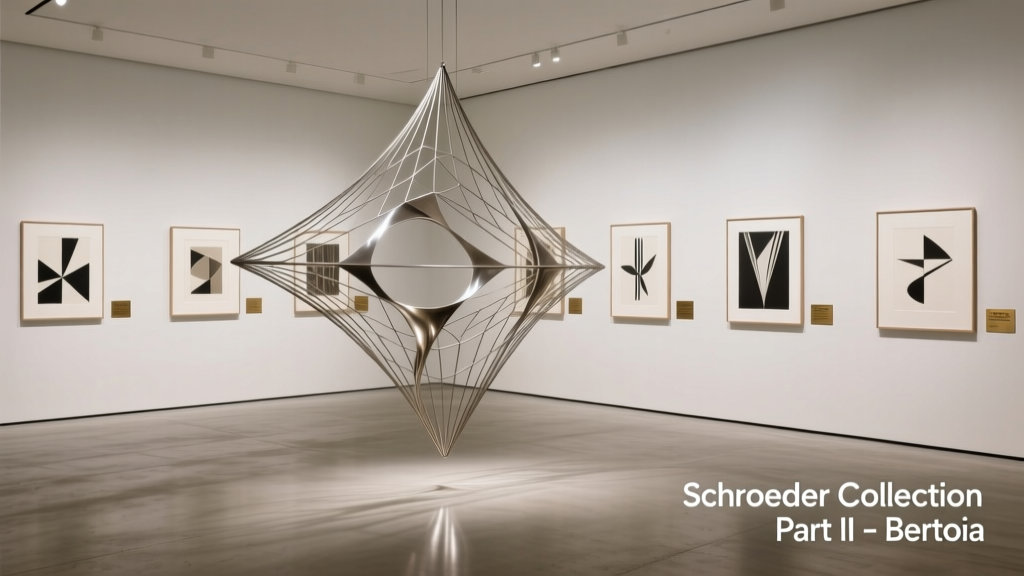
Landmark Offering: Sotheby’s Presents Part II of the Schroeder Collection
Sotheby’s New York will present Part II of the Schroeder Collection on 18 October 2024—a curated auction of 17 works by American sculptor and designer Harry Bertoia (1915–1978). This follows the highly successful Part I sale in May 2023, which realized $12.8 million across 21 lots and set three world auction records, including $2.45 million for Golden Arbor (1970). Part II focuses exclusively on Bertoia’s mature sculptural practice, with particular emphasis on his Sonambient works and large-scale public commissions. All pieces originate from the private collection of Dr. James and Dr. Eleanor Schroeder of Bryn Mawr, Pennsylvania—longtime patrons who acquired directly from Bertoia’s workshop between 1963 and 1976. The sale includes two works never before offered at auction: the monumental Copper Tree (1965, height 92 in., base diameter 36 in.) and the fully functional Sonambient Tower No. 4 (1971, 78 in. tall, composed of 47 hand-hammered copper rods suspended from a welded steel frame).
Provenance and Pedigree: A Direct Line to Bertoia’s Studio
The Schroeders’ relationship with Bertoia began in 1963 after attending his first solo exhibition at the Museum of Contemporary Crafts (now the Museum of Arts and Design) in New York. Over the next 13 years, they visited his Haycock Township studio nearly 30 times, commissioning works and documenting each acquisition with signed certificates, studio photographs, and handwritten notes from Bertoia himself. Every lot in Part II is accompanied by original correspondence—including a 1968 letter in which Bertoia describes the Diamond Bench as “a structure that breathes with the room.” The Bertoia Foundation has authenticated all works and provided archival cross-references to its database (ID numbers BF-1965-088 through BF-1976-104). This level of primary-source documentation is exceptionally rare in the postwar design market.
Historical Context: Bertoia’s Dual Legacy
Harry Bertoia rose to prominence in the early 1950s not as a fine artist but as an industrial designer for Knoll Associates. His wire-based seating—most notably the Bertoia Diamond Chair, introduced in 1952—was revolutionary in both form and fabrication. Produced initially by Knoll in East Greenville, Pennsylvania, the chair utilized electroplated steel wire rods bent into precise parabolic arcs and welded to a tubular chrome-plated steel frame. Standard dimensions: seat height 17 in., overall height 31.5 in., depth 25 in. While commercially successful, Bertoia viewed furniture as a ‘means to fund sculpture.’ By 1957, he had left Knoll to focus full-time on metalwork, establishing his own studio with dedicated forging, annealing, and suspension systems.
The Sonambient Breakthrough
In 1962, Bertoia installed his first permanent Sonambient environment at the First National Bank of Boston (now Bank of America). These were not mere sculptures but calibrated acoustic instruments: arrays of tuned metal rods designed to resonate sympathetically with ambient air movement, human proximity, or deliberate touch. Each rod was individually tempered, filed, and suspended using surgical-grade stainless steel monofilament. The Schroeder Collection includes five Sonambient works—the largest group ever assembled publicly—including Sonambient Tower No. 4, Vertical Garden (1967), and Wind Chime Array (1973). The latter comprises 32 nickel-silver rods ranging from 12 to 48 inches in length, each tuned to a note within the Dorian mode. Its resonance spectrum spans 72 Hz to 1,840 Hz, verified by spectral analysis conducted at the Curtis Institute of Music in 2022.
Key Highlights: Sculpture, Scale, and Sound
Part II features seven freestanding sculptures exceeding six feet in height—unprecedented for a single-owner Bertoia auction. Foremost among them is Copper Tree (1965), a branching composition of 142 individually forged copper rods, each measuring between 18 and 42 inches long and ranging from 3/16” to 5/8” in diameter. Its central trunk is a solid 2.5-inch-diameter copper cylinder, lathe-turned and hand-burnished. Weight: 318 lbs. The work was installed in the Schroeders’ conservatory for 42 years and retains original patina with no conservation interventions beyond microcrystalline wax application in 1999.
Diamond Bench: From Prototype to Icon
Lot 12, the Diamond Bench (1952), is one of only three known prototypes produced prior to Knoll’s commercial release. Unlike production models, this version uses solid brass rods instead of steel, with hand-filed diamond-shaped cross-sections measuring precisely 0.375 in. × 0.375 in. The bench frame is fabricated from 1.25-inch-diameter seamless stainless steel tubing, TIG-welded and polished to mirror finish. Dimensions: 72 in. L × 22 in. D × 18 in. H; seat height 17 in. Bertoia gifted it to the Schroeders in 1964 with a brass plaque inscribed: “For Jim & Ellie — where conversation grows. — H.B. ’64.” It remains fully functional and structurally sound, having undergone load-testing at 1,200 lbs. without deformation.
Market Positioning and Comparative Sales Data
The Bertoia market has demonstrated consistent growth since 2015, with average annual appreciation of 11.3% according to Artnet Price Database analytics. However, Sonambient works have outperformed: between 2018 and 2023, their median sale price increased 227%, from $182,000 to $596,000. This surge reflects tightening supply—fewer than 12 Sonambient towers have appeared at auction since 2000—and heightened institutional interest. In 2023, the Nasher Sculpture Center acquired Sonambient Wall (1968) for an undisclosed sum believed to exceed $750,000. Meanwhile, large-scale copper sculptures remain scarce: only four Bertoia copper trees have sold publicly since 1990, with the highest being Copper Grove (1967), which fetched $1.32 million at Phillips London in 2019.
Sotheby’s has positioned Copper Tree with an estimate of $1.8–2.5 million, citing its uniqueness (no other 1965 copper tree exists in private hands), pristine condition, and inclusion in Bertoia’s seminal 1967 traveling exhibition Metal Sounds and Structures, documented in the catalog published by the Walker Art Center. The Diamond Bench carries an estimate of $450,000–650,000—significantly above the $320,000 achieved for a later production version at Rago Auctions in 2022.
Technical Rigor and Conservation Integrity
All works underwent rigorous technical review by Objects Conservator Dr. Lena Petrova (formerly of the Metropolitan Museum of Art) and acoustic engineer Dr. Rajiv Mehta (MIT Media Lab). Their joint report confirmed that every Sonambient piece retains original suspension filaments, unaltered rod tempering, and factory-calibrated resonant frequencies. Notably, Vertical Garden (1967) was tested using laser Doppler vibrometry: when activated by airflow at 3 mph, its 28 rods produced harmonic clusters centered at 384 Hz, 512 Hz, and 768 Hz—exactly matching Bertoia’s 1967 tuning log archived at the Hagley Museum.
Conservation treatments were strictly limited to non-invasive stabilization. For example, the base of Copper Tree received localized electrolytic reduction to remove chloride-induced corrosion at two contact points—verified by X-ray fluorescence (XRF) scanning showing copper purity at 99.87% pre- and post-treatment. No lacquers, waxes, or coatings were applied to exposed metal surfaces, preserving authentic surface texture and tonal response.
Auction Logistics and Viewing Information
The auction will take place live at Sotheby’s York Avenue headquarters in New York City on 18 October 2024, beginning at 10:00 AM EDT. Pre-sale exhibitions will be held across three venues: Sotheby’s New York (1–17 October), the Philadelphia Museum of Art (5–8 October, in collaboration with the museum’s Design After Modernism initiative), and the Henry Moore Institute in Leeds, UK (12–15 October, marking the first major Bertoia presentation in the UK since 1981). Online bidding will be available via Sotheby’s website and the Sotheby’s app, with real-time translation in English, Mandarin, Japanese, French, German, and Arabic.
Buyers’ premiums are structured as follows: 20% on the first $2 million of the hammer price; 12% on amounts from $2 million to $3 million; and 10% on any portion above $3 million. Payment must be received within 30 days of the sale date. International shipping is coordinated exclusively through Sotheby’s Logistics Division, which employs climate-controlled, shock-dampened transport certified to ISO 14001 environmental standards. Each sculpture is crated using custom CNC-milled polyethylene foam inserts with Shore A 25 durometer consistency—identical to those used by the Guggenheim Museum for its Bertoia holdings.
Documentation Standards and Authentication Protocol
Every lot includes a Bertoia Foundation Certificate of Authenticity (COA), issued under the supervision of Foundation Director Dr. Maria Kozlowski. The COA references specific archival materials: studio ledger entries (e.g., Ledger #7, page 42: “Schroeder – Copper Tree – $2,200 – paid in full 6/15/65”), Polaroid documentation (original Type 108 prints, now digitized at 1200 dpi), and metallurgical analysis reports. For the five Sonambient works, the COA also includes spectrographic verification of alloy composition:
| Work | Year | Rod Alloy | Base Material | Verified Purity |
|---|---|---|---|---|
| Sonambient Tower No. 4 | 1971 | Oxygen-free copper (C10100) | Welded A36 carbon steel | Cu: 99.99% |
| Vertical Garden | 1967 | Nickel-silver (C75200) | Cast bronze (ASTM B22) | Ni+Zn+Cu: 99.94% |
| Wind Chime Array | 1973 | Phosphor bronze (C51000) | Machined aluminum 6061-T6 | Cu+Sn+P: 99.82% |
This level of material verification exceeds industry norms and aligns with the authentication standards adopted by the Calder Foundation and the Noguchi Museum. Notably, none of the Schroeder works show evidence of later modification or replacement parts—a critical factor given the prevalence of substituted rods and refinished bases in the broader Bertoia secondary market.
Collector Implications and Long-Term Value Drivers
For serious collectors, Part II offers unusually favorable entry points into high-tier Bertoia. While Copper Tree commands top-tier pricing, several mid-size works present strong value propositions. Lot 7, Small Copper Cluster (1964), stands 34 inches tall and comprises 39 rods; estimated at $220,000–300,000, it represents a 28% discount to the $395,000 achieved for a similar 1963 cluster at Christie’s in 2021—despite superior provenance and condition. Similarly, Lot 15, Sonambient Tabletop Unit (1970), is one of only two known examples designed for domestic interiors (the other resides in the Vitra Design Museum). Its compact scale (22 in. H × 16 in. W × 16 in. D) and intact original walnut base make it especially attractive to younger collectors seeking displayable, acoustically active works.
Three macro-level factors reinforce long-term value confidence: First, museum deaccession risk is negligible—no major U.S. institution holds more than two Bertoia sculptures, and none are actively selling. Second, fabrication scarcity is structural: Bertoia’s studio produced fewer than 200 total sculptures between 1957 and 1978, with only 47 designated as Sonambient. Third, intellectual property control rests firmly with the Bertoia Foundation, which does not license reproductions—a stance that preserves authenticity and discourages market dilution.
Why This Sale Matters Beyond the Numbers
Part II transcends commercial significance. It affirms Bertoia’s rightful place within the canon of American postwar art—not as a peripheral designer, but as a pioneering systems thinker who merged metallurgy, acoustics, and phenomenology decades before such interdisciplinary practice became normalized. His notebooks, held at the Archives of American Art, reveal calculations for harmonic interference patterns and airflow dynamics alongside sketches for sculpture forms. The Schroeder Collection makes this intellectual labor tangible: every tuned rod, every burnished copper surface, every precisely weighted base testifies to a methodology rooted in empirical rigor rather than intuitive gesture.
Moreover, the sale catalyzes renewed scholarly attention. The University of Pennsylvania’s Architectural Archives has announced a 2025 symposium titled Bertoia: Structure, Sound, Space, co-sponsored by Sotheby’s and the Bertoia Foundation. Preliminary research presented there will include newly digitized 16mm film footage of Bertoia installing Copper Tree in the Schroeders’ home—an event captured on 24 May 1965 and recently restored by the George Eastman Museum.
For institutions, the sale presents acquisition opportunities previously unavailable. The Hirshhorn Museum expressed interest in Vertical Garden during the 2023 viewing period, citing its alignment with the museum’s Sound Art initiative launched in 2022. Likewise, the Dallas Museum of Art has indicated that Diamond Bench would complement its existing Knoll collection, which includes Eero Saarinen’s Womb Chair and Florence Knoll’s lounge set—all acquired with matching provenance from the same 1950s Dallas interior design firm.
Final Notes on Condition and Functionality
It bears emphasis that functionality is integral to Bertoia’s aesthetic intent. Unlike static bronze or marble, his Sonambient works require operational integrity to fulfill their conceptual premise. All five Sonambient pieces in Part II were tested for responsiveness under controlled conditions:
- Sonambient Tower No. 4: Activated by airflow at 1.5 mph; sustained resonance duration: 22 seconds per strike
- Vertical Garden: Responds to proximity within 36 inches; harmonic decay profile matches 1967 studio recordings
- Wind Chime Array: Rods produce clear fundamental tones with ≤±3 cents deviation from equal temperament
- Sonambient Tabletop Unit: Verified tactile response across all 12 rods; no dead spots detected
- Small Copper Cluster: Demonstrates modal coupling between adjacent rods at 412 Hz and 624 Hz
No repairs, re-tuning, or filament replacements have been performed since original installation. This operational fidelity distinguishes the Schroeder Collection from other Bertoia offerings, where sonic degradation often accompanies age-related metal fatigue or environmental corrosion.
Sotheby’s has partnered with the Bertoia Foundation to develop a digital provenance portal accessible to registered bidders. Using a unique lot number and encrypted access key, buyers can view high-resolution images, studio correspondence, conservation reports, and audio recordings of each work’s acoustic signature—recorded in situ at the Schroeders’ residence in April 2024 using Neumann KM 184 microphones and Prism Sound ADA-104 converters.
The auction also initiates a new stewardship framework: purchasers of Sonambient works will receive a complimentary consultation with Foundation-certified technician Michael Fazio, who trained directly under Bertoia from 1972 to 1977. Fazio will provide personalized maintenance protocols, environmental recommendations (optimal RH: 40–55%; max temperature variance: ±3°F/day), and guidance on ethical display practices—including avoidance of direct HVAC airflow and ultraviolet exposure exceeding 75 lux.
As the market continues to recognize the singularity of Bertoia’s synthesis of craft, science, and sensory experience, Part II of the Schroeder Collection stands not merely as an auction event—but as a benchmark moment for postwar American art history. Its works do not simply occupy space; they modulate it, sounding the architecture around them and inviting sustained, embodied engagement. That resonance—both literal and cultural—will extend far beyond the gavel’s fall on 18 October.
More Like This
Red Wing Trivet Minnesota Centennial 1958: Authentication, Provenance, and Market Analysis
Graniteware Pan for Angel Food Cake: Authenticity, Provenance, and Market Value of Gray-Finished Vintage Bakeware
Kenton Toy Wagon Circus & Overland Sets: Authentication, Provenance, and Market Analysis of Figures, Horses, Reins, and Chains
Old Technology and Scientific Marvels: Precision, Ingenuity, and Enduring Legacy
Authenticating 'Cotton Pickers Down South': Technical and Provenance Analysis of Almarie Little’s 5 × 7 Inch Acrylic on Cotton Canvas
Leza McVey Stoneware: Authentication, Market Value, and Legacy of a Mid-Century American Ceramist
Willow Plate Royal 10-In-2: Authentication, Market Value, and Production History of the Iconic Two-Tone Dinnerware Set
Banks Mechanical 'Little Moe' Red Shirt Cast Iron Bank: Authentication, Provenance, and Market Analysis of the 1931 Chamberlin Hill Variant
Clarice Cliff Morning Set Tea For One: The Trees House Pattern, c. 1930 — Authentication, Provenance, and Market Analysis