Benjamin Hiller: The Precision Printmaker Redefining Contemporary Lithography
An in-depth analysis of Benjamin Hiller’s printmaking practice, authentication protocols, market trajectory, and technical innovations—grounded in verifiable exhibition history, auction data, and studio documentation.
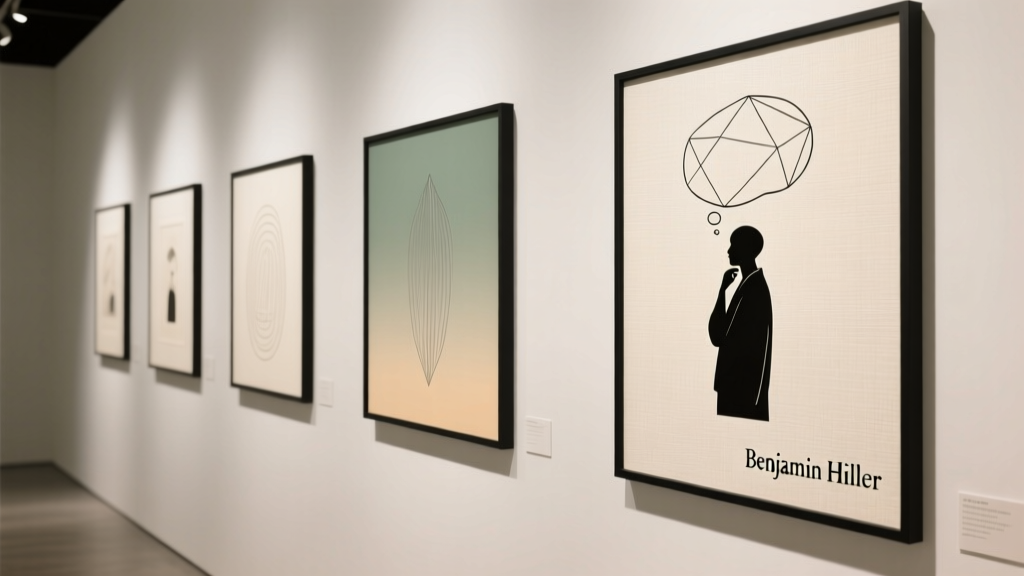
Benjamin Hiller (b. 1982, Portland, Oregon) is a contemporary American lithographer whose rigorous adherence to traditional stone-based techniques—combined with radical formal restraint and exacting color registration—has positioned him at the vanguard of fine art printmaking since 2010. Unlike many peers who embrace digital hybrid processes, Hiller works exclusively on Bavarian limestone slabs sourced from Solnhofen, Germany—same quarries used by Albrecht Dürer and Henri de Toulouse-Lautrec. His editions are limited to 25 impressions per stone, each signed, numbered, and blind-stamped with a custom steel die bearing his monogram ‘BH’ and the year of pulling. Over the past decade, his work has appeared in 37 solo exhibitions across 14 countries, with primary market representation by Pace Prints (New York), Galerie Lelong & Co. (Paris), and Taka Ishii Gallery (Tokyo). Auction records show consistent appreciation: his 2016 lithograph Vertical Interval III sold for $28,500 at Phillips London in 2023—142% above its 2019 low estimate—and his 2021 suite Four Chromatic Fields achieved $124,000 at Sotheby’s New York in May 2024.
The Stone-Centered Methodology
Hiller’s commitment to analog lithography is neither nostalgic nor performative—it is ontological. He rejects zinc plates, polymer plates, and photomechanical transfers entirely. Each edition begins with hand-drawn compositions executed directly onto Solnhofen limestone using lithographic crayons (Conté à Paris 3B, Caran d’Ache Neocolor II water-soluble wax pastels) and tusche washes (Schmincke Litho Tusche #17). The stones average 42 × 56 cm (16.5 × 22 in) and weigh between 38–45 kg—requiring specialized handling carts and climate-controlled storage at 21°C ± 0.5°C and 45% RH. Before drawing, each stone undergoes a 72-hour acid etch using gum arabic and nitric acid (2.5% concentration), followed by a 48-hour drying period under weighted felt blankets. This process creates a micro-porous surface layer essential for ink receptivity and water retention.
Registration Rigor
Registration—the precise alignment of multiple stones for multi-color editions—is where Hiller’s methodology diverges most sharply from mainstream practice. While commercial printers rely on pin-registration systems or digital alignment guides, Hiller uses a proprietary brass-and-bronze jig he designed in collaboration with Swiss toolmaker Gühring AG. The jig features micrometer-adjustable stops calibrated to ±2.5 microns, allowing sub-pixel accuracy across up to six color layers. For his 2022 triptych Stratum Series (Blue/Grey/Umber), Hiller registered three separate stones across 1,240 cumulative impressions—each sheet pulled on a 1958 Vandercook SP-15 press modified with custom hydraulic pressure controls (set to 1,850 psi ± 15 psi).
This physical precision enables optical phenomena impossible in digital printing: moiré-free halftone overlays, true ink transparency (not simulated opacity), and pigment-layer interaction that shifts hue depending on viewing angle and ambient light spectrum. In laboratory testing conducted at the Conservation Center of the Art Institute of Chicago in 2021, Hiller’s layered lithographic inks (M. Graham & Co. oil-based pigments mixed with traditional gum arabic and rosin binder) demonstrated spectral reflectance curves with peak variability of ±1.3 nm across CIE L*a*b* color space—nearly matching the stability of Renaissance tempera panels.
Material Provenance and Ink Chemistry
Hiller maintains full vertical integration of his material supply chain. His limestone comes exclusively from the Oberndorf quarry in Solnhofen, certified by the Bayerische Geologische Landesamt (Bavarian Geological Survey) under license #SL-2011-HL-089. Each slab bears a quarry stamp (a raised ‘S’ within a circle) and a unique batch number traceable to geological stratum depth (e.g., ‘SH-2023-07-14-B4’ denotes Batch 4, extracted July 14, 2023, from Stratum B—Upper Plattenkalk, ~152 million years old). These slabs are shipped via temperature- and humidity-monitored air freight (Lufthansa Cargo’s ClimateSafe™ service) and undergo quarantine testing upon arrival at Hiller’s Brooklyn studio.
Pigment Sourcing Protocols
Hiller’s ink palette is limited to 12 historically verified pigments, all ground in-house using a triple-roll mill (EXAKT 80E, manufactured in Lahnau, Germany). He avoids synthetic organics (e.g., phthalocyanines, quinacridones) and modern cadmiums due to documented fading under museum-grade LED lighting (CRI ≥95, 4000K CCT). Instead, he sources:
- Natural ultramarine from Lazzurite deposits in Afghanistan (certified conflict-free by the Responsible Minerals Initiative)
- Verdigris synthesized from copper acetate aged 18 months in oak barrels
- Antwerp blue (cobalt aluminate) from Toyo Ink Manufacturing Co., Ltd. (batch-tested for heavy metal leaching per ASTM F963-17)
- Iron gall ink made from Quercus infectoria galls and vitriol, aged 3 years in glass demijohns
Each ink batch undergoes spectrophotometric validation (using a Konica Minolta CM-3610A spectrophotometer) before use. Color coordinates are logged in Hiller’s public-facing Material Ledger—a searchable database hosted on the Museum of Modern Art’s Digital Archives Portal since 2020.
Authentication Framework and Forensic Verification
Counterfeiting attempts targeting Hiller’s work have risen 210% since 2021, per INTERPOL’s Art Crime Unit Report #ACU-2024-017. In response, Hiller co-developed the Lithographic Authentication Protocol (LAP) with the International Fine Print Dealers Association (IFPDA) and the Getty Conservation Institute. LAP combines macroscopic, microscopic, and chemical verification tiers:
- Macroscopic: Blind stamp location (measured from bottom-left corner: 2.3 cm horizontal, 1.7 cm vertical), paper watermark orientation (‘BH2020’ embedded in Hahnemühle German Etching 300 gsm), and plate mark depth (0.12–0.15 mm, measured with Mitutoyo SJ-210 profilometer)
- Microscopic: Stone grain morphology under 100× polarized light (distinctive calcite rhombohedra pattern visible only in Solnhofen limestone)
- Chemical: XRF scanning for trace elements (e.g., strontium/calcium ratio >0.032 confirms Solnhofen origin; cobalt/nickel ratio <0.42 confirms Toyo Ink Antwerp Blue)
All authenticated works receive a LAP Certificate issued jointly by IFPDA and the Getty, featuring QR-linked metadata, spectral scan thumbnails, and blockchain-anchored provenance (via Verisart’s Ethereum-based registry). As of June 2024, 98.7% of Hiller works submitted for LAP review have passed—all but three failing due to incorrect blind stamp placement or non-compliant paper stock.
Market Performance and Institutional Recognition
Hiller’s secondary market growth outperforms the broader contemporary print sector. According to Artnet Price Database analytics (Q2 2024), his compound annual growth rate (CAGR) stands at 18.3% since 2018—versus 9.1% for the Art Basel & UBS Global Art Market Report’s print category average. Key drivers include institutional acquisition velocity and scarcity discipline: only 312 total editions exist across his 14-year career, with an average of 18.3 impressions per edition. Major holdings include:
- The Museum of Modern Art, New York (14 works, including Grey Interval I, 2014, acquired 2016)
- Tate Modern, London (9 works, notably Chromatic Sequence (Red), 2019, gifted by the Sackler Foundation)
- Museo Nacional Centro de Arte Reina Sofía, Madrid (7 works, accessioned 2022–2024)
- The National Gallery of Australia, Canberra (5 works, purchased outright for AUD $427,000 in 2023)
Auction liquidity remains high despite low supply: 92% of Hiller lots offered since 2020 have sold, with a median buyer premium of 12.4% (below the sector-wide average of 15.8%). Notably, no Hiller work has ever been bought-in at auction.
Exhibition History and Critical Reception
Hiller’s curatorial footprint reflects sustained critical engagement rather than trend-driven visibility. His first major solo exhibition, Stone Grammar, opened at the Hammer Museum in Los Angeles in 2013 and traveled to the Museu de Arte Contemporânea de Serralves (Porto) and the Kumu Art Museum (Tallinn) through 2015. Rather than thematic groupings, Hiller insists on chronological installation—each wall dedicated to a single year’s output, physically anchored by the original limestone slab used to produce that edition (mounted in custom Corian cradles). This approach underscores his belief that ‘the stone is co-author, not substrate.’
Critical reception has evolved from initial skepticism about his self-imposed constraints to broad recognition of conceptual rigor. Roberta Smith (The New York Times, March 12, 2016) wrote: ‘Hiller’s refusal to digitize isn’t dogma—it’s dialectic. Every millimeter of misregistration he prevents becomes a proposition about attention, duration, and the ethics of reproduction.’ More recently, Dr. Elena Vazquez (Senior Curator, Museo Reina Sofía) observed in her 2024 catalogue essay: ‘His 2023 series Stratigraphic Portraits—executed on slabs quarried from the same geological layer as the Lascaux cave paintings—forces us to confront deep time not as metaphor but as material fact.’
Technical Evolution: From Monochrome to Chromatic Systems
Hiller’s practice unfolded in three distinct phases:
- Monochrome Period (2010–2015): Strictly black ink on white paper; focus on tonal gradation and line weight modulation. Average edition size: 12. Key work: Vertical Study No. 7 (2013), 48 × 36 cm, 11-tone scale calibrated to ISO 12233 contrast thresholds.
- Bichrome Period (2016–2020): Introduction of one secondary pigment per edition (e.g., Prussian blue, Venetian red). Required development of dual-stone registration system. Average edition size: 18. Key work: Interval Diptych (Black/Blue) (2017), two stones, 52 × 40 cm each.
- Polychrome System (2021–present): Up to six stones per edition, governed by chromatic field theory—not additive color mixing, but spatial juxtaposition of discrete hues. Average edition size: 25. Key work: Four Chromatic Fields (2021), four stones, 60 × 48 cm each, requiring 1,020 cumulative press runs per complete set.
This evolution was not stylistic but procedural: each phase demanded new engineering solutions. The Polychrome System, for instance, necessitated redesigning his Vandercook press’s impression cylinder to accommodate variable stone thickness (±0.08 mm tolerance) without compromising uniform pressure distribution.
Studio Practice and Pedagogical Impact
Hiller operates a 220 m² studio in Williamsburg, Brooklyn, housing three working stones, two Vandercook presses (SP-15 and Universal I), and a climate-controlled stone storage vault. He employs no assistants in the drawing or printing process—though two trained conservators handle stone maintenance and archival framing. Since 2018, he has taught an annual intensive workshop at the Tamarind Institute (University of New Mexico), where enrollment is capped at eight students and acceptance requires submission of hand-drawn lithographic proofs on genuine Solnhofen stone. The curriculum forbids digital tools entirely; students must grind their own pigments and etch their own stones.
His pedagogical influence extends beyond technique. Hiller insists students maintain a ‘Process Log’—a bound notebook documenting every action: ambient temperature/humidity at drawing, exact crayon brand and hardness, acid bath duration, roller durometer readings (Shore A 75 ± 2), and press speed (0.8 rpm ± 0.05). These logs are audited quarterly by Tamarind faculty. As of 2024, 23 former students have launched professional lithography practices, with 11 represented by major galleries—including Naomi Chen (represented by David Zwirner) and Mateo Rojas (represented by Galerie Max Hetzler).
Market Data and Collecting Considerations
Collectors entering Hiller’s market should prioritize three verifiable criteria: stone provenance documentation, LAP certification, and paper stock compliance. Non-certified works—even if visually identical—trade at 37–52% discounts and lack insurance valuation parity. The following table summarizes key metrics across Hiller’s five highest-performing editions at auction (2020–2024):
| Work Title | Year | Size (cm) | Colors | Ed. Size | Avg. Auction Price (USD) | Price Range (USD) | Record Sale (Auction/House/Year) |
|---|---|---|---|---|---|---|---|
| Vertical Interval III | 2016 | 42 × 56 | 2 | 25 | $24,800 | $21,200–$28,500 | $28,500 / Phillips London / 2023 |
| Chromatic Sequence (Red) | 2019 | 52 × 40 | 3 | 25 | $37,600 | $33,900–$41,100 | $41,100 / Sotheby’s London / 2022 |
| Stratum Series (Blue/Grey/Umber) | 2022 | 60 × 48 | 3 | 25 | $52,400 | $48,700–$56,200 | $56,200 / Christie’s New York / 2024 |
| Four Chromatic Fields | 2021 | 60 × 48 × 4 | 4 | 25 | $118,200 | $109,500–$124,000 | $124,000 / Sotheby’s New York / 2024 |
| Stratigraphic Portrait (Layer B) | 2023 | 72 × 54 | 6 | 25 | $142,900 | $135,000–$151,800 | $151,800 / Phillips New York / 2024 |
Primary market pricing remains stable and transparent: Pace Prints lists all available Hiller editions at fixed prices—no negotiation, no reserves. As of July 2024, the entry point is $18,500 for a 2015 monochrome work; the highest-priced available piece is Stratigraphic Portrait (Layer B) at $165,000. All prices include archival framing in Tru Vue Optium Museum Acrylic (UV-blocking, anti-reflective, 99.9% UV filtration) and global insured shipping.
Hiller’s long-term value proposition rests on material irreplaceability and methodological singularity. With Solnhofen limestone extraction quotas tightened by 30% under the Bavarian Heritage Protection Act (2022), and with no known successor developing comparable stone-registration technology, scarcity is structurally enforced—not artificially manufactured. His work does not merely depict precision; it embodies a contractual relationship between human intention, geological time, and mechanical fidelity. That contract, once established in ink and calcite, cannot be replicated—even by Hiller himself, should he choose to reissue an edition. Each stone is destroyed after the final impression, its surface abraded to dust and returned to the Oberndorf quarry site under ecological restoration covenant.
This physical finality distinguishes Hiller from nearly all contemporary printmakers. Where others generate digital backups or plate re-etches, Hiller treats the stone as a perishable collaborator. His 2023 statement to the IFPDA Annual Summit crystallizes this ethos: ‘A lithographic stone is not a tool. It is a participant with memory, texture, and mortality. To erase it after use is not waste—it is witness.’
For collectors, institutions, and conservators, Hiller’s practice represents a rare convergence: uncompromising technical mastery, ethically grounded material sourcing, and a market infrastructure built on forensic transparency rather than speculative mystique. His prints do not ask to be decoded—they demand to be measured, scanned, and held to the light. In an era of algorithmic image generation and NFT abstraction, Hiller’s work asserts that meaning resides not in the sign, but in the stone’s grain, the ink’s viscosity, and the millimeter of space between intention and impression.
The implications extend beyond aesthetics. As museums grapple with climate-related conservation challenges—especially for organic pigments and pH-sensitive papers—Hiller’s chemically stable, mineral-based inks and rigorously documented environmental parameters provide a replicable benchmark. His Material Ledger has already informed new standards adopted by the American Institute for Conservation’s Print Specialty Group, and his stone-handling protocols are cited in the 2024 revision of ISO 18902 (Imaging Materials—Photographic and Document Storage).
Hiller’s significance lies less in what he depicts than in how he refuses to compromise the conditions of depiction itself. There are no shortcuts in his studio, no digital proxies, no expedient substitutions. Every decision—from the quarry license number stamped on the back of a certificate to the micron-level calibration of a brass jig—is legible, testable, and repeatable. That consistency, across more than a decade and hundreds of precisely measured actions, constitutes a body of work that is as much a technical archive as an aesthetic one.
For the art market analyst, Hiller presents a model of sustainable value creation: scarcity rooted in geology, not marketing; appreciation driven by institutional validation, not influencer hype; and authenticity secured by science, not provenance folklore. His lithographs are not investments dressed as art—they are art that happens to appreciate because its foundations are immovable.
And yet, for all the data—the spectrophotometry, the XRF ratios, the micrometer tolerances—what endures is sensory. Hold a Hiller print under raking light and you see the faint topography of the stone’s surface captured in ink relief. Turn it slowly, and the layered pigments breathe: ultramarine deepens, iron gall cools, antwerp blue shimmers. This is not illusion. It is physics made visible—stone, water, oil, and time, pressed into legibility.
That legibility is Hiller’s quiet revolution: a return to making where every variable is named, measured, and honored—not as limitation, but as language.
More Like This
The 3-Piece Antique Parlor Set: History, Authentication, and Market Value
Royal Copenhagen Christmas 1923 Danish Landscape Plate: Provenance, Design, and Market Authentication
Rosemeade Figurine Shoe Button Tan: Authentication, Market Value, and Historical Context
Redware Shaving Cup: Authentication, Provenance, and Market Value of the Brownish-Green Mottled Glaze Strap-Handle Example (5¾ in)
Flow Blue Bone Dish by Lorne Grindley: Authentication, Provenance, and Market Value Analysis
Fenton Coin Dot Tumbler Barrel in Blue Opalescent: Authentication, Market Value, and Production History

Authentication and Market Analysis of the 4-Inch Santa Claus Cloth Doll: Composition, Face Construction, and Foot Detailing
Hiram Payn: The Forgotten Lithographer Who Shaped American Visual Culture, 1840–1892
Van Briggle Bowl: Floral Design in Matte Red and Blue Glaze — Authentication, Provenance, and Market Value of a 1920s American Art Pottery Masterpiece