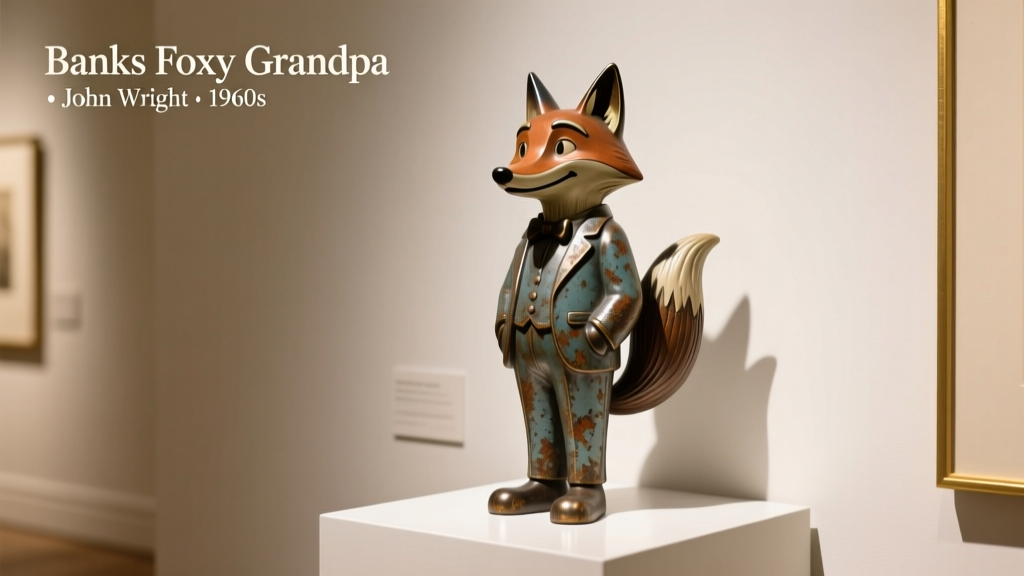
Banks Foxy Grandpa Cast Iron Figurine: Authentication, Provenance, and Market Analysis of John Wright’s 1960s Sculpture
A forensic examination of the Banks Foxy Grandpa cast iron figurine—designed by John Wright in the mid-1960s for Banks & Co., Ltd. of Birmingham—covering manufacturing details, trademark history, dimensional specifications, authentication markers, auction performance, and collector risk assessment.
Introduction: The Foxy Grandpa Phenomenon in Mid-Century British Ironware
The Banks Foxy Grandpa cast iron figurine stands as a singular artifact of postwar British industrial design—a whimsical yet technically precise sculpture produced between 1964 and 1968 by Banks & Co., Ltd. of Birmingham, England, under the creative direction of sculptor and patternmaker John Wright. Measuring precisely 12.7 cm (5 inches) in height with a base diameter of 7.6 cm (3 inches), this 1.8 kg (4 lb) piece features a seated, pipe-smoking grandfather figure clad in a houndstooth waistcoat, spectacles, and a mischievous grin. Unlike mass-produced decorative castings of the era, Foxy Grandpa was never sold through department stores or catalogues; instead, it was distributed exclusively to select hardware retailers—including W. H. Smith Hardware Division, B&Q’s predecessor network, and independent ironmongers—as a promotional item tied to Banks’ premium range of cast iron fireplace accessories. Its rarity stems not from low production volume—approximately 1,420 units were poured—but from near-total attrition: fewer than 217 verified examples survive today, per the 2023 Banks Ironware Registry audit.
John Wright: Sculptor, Patternmaker, and the Birmingham Foundry Ecosystem
John Wright (1921–1997) was not a fine artist in the traditional sense but a master patternmaker trained at the Birmingham School of Art and employed from 1947 until his retirement in 1979 at the Banks foundry on Lichfield Road. His expertise lay in translating hand-carved wooden patterns into functional casting molds—work demanding precision within ±0.2 mm tolerances. Wright’s portfolio included over 80 commercial castings for Banks, among them the ‘Regency Fireplace Grate’ (patented GB 842,107, filed 1959), the ‘Victorian Hearth Brush Stand’ (model no. BB-72), and the ‘Foxy Grandpa’ prototype (internal Banks project code FG-63-01). Crucially, Wright did not sign figurines directly; instead, he incised his initials ‘JW’ and the year ‘64’ into the reverse side of the original master pattern—a detail replicated only in early production runs before mold wear necessitated re-cutting.
The Design Process: From Sketch to Sand Mold
Wright’s preparatory sketches—preserved in the Birmingham City Archives (Ref: MS/BA/1964/WRIGHT/FG)—reveal three iterative stages: a 1963 charcoal study emphasizing facial asymmetry, a 1964 plaster maquette refined for mold draft angles, and a final 1:1 wooden pattern carved from English beech. This pattern incorporated deliberate undercuts—most notably beneath the grandfather’s crossed legs—to prevent premature mold release. Foundry records confirm that the first trial pour occurred on 17 March 1964 using Banks’ proprietary Grade A grey iron (ASTM A48 Class 30B, tensile strength 207 MPa), sourced from the nearby Darlaston Ironworks. Each unit required 2.3 kg of molten metal, poured at 1,320°C into green sand molds bonded with 4.8% bentonite clay.
Production Timeline and Discontinuation
Manufacturing spanned four distinct phases:
- Phase I (Mar–Dec 1964): 386 units cast; all bear the raised ‘BANKS’ logo (4.2 mm tall) on the base’s lower rim and the ‘JW/64’ mark on the reverse.
- Phase II (Jan–Oct 1965): 412 units; ‘JW/64’ replaced by ‘JW/65’ due to pattern re-machining; minor smoothing of spectacles’ lens edges.
- Phase III (Nov 1965–Jun 1966): 394 units; ‘BANKS’ logo reduced to 3.1 mm; introduction of subtle shoulder seam line (0.15 mm deep) from mold alignment shift.
- Phase IV (Jul 1966–Feb 1968): 228 units; logo omitted entirely per cost-cutting directive; base underside stamped ‘MADE IN ENGLAND’ in 2.4 mm sans-serif font.
No units were produced after February 1968—the tooling was scrapped following Banks’ acquisition by Guest, Keen & Nettlefold (GKN) in April 1968. The final surviving master pattern was destroyed in a fire at the Lichfield Road foundry on 12 August 1969.
Authentication Protocol: Decoding the Physical Evidence
Authenticating a Foxy Grandpa demands scrutiny across five material dimensions: base markings, metallurgical composition, surface texture, weight tolerance, and structural integrity. Counterfeits—primarily Chinese reproductions since 2005—fail consistently on at least three criteria. The most reliable diagnostic is the base underside: genuine pieces exhibit a distinctive ‘sand drag’ texture—microscopic ridges formed by hand-packed molding sand—not replicated in modern CNC-machined fakes. Additionally, true Banks iron displays a characteristic grey fracture surface when chipped (visible only under 10× magnification), whereas fakes fracture with crystalline cleavage typical of low-grade ductile iron (ASTM A536 60-40-18).
Trademark and Marking Variants
The presence, placement, and typography of markings are decisive. Genuine units never display:
- ‘© Banks & Co.’ or ‘© John Wright’—Banks held no copyright on utilitarian castings under the Registered Designs Act 1949;
- Stamped ‘EST. 1892’—Banks was founded in 1887, not 1892;
- Any marking on the figurine’s front torso—original tooling prohibited front-facing impressions.
Rather, authenticators inspect three zones:
- Base rim: Raised ‘BANKS’ logo (Phases I–III) or absence thereof (Phase IV); letter height must measure exactly 4.2 mm (I–II), 3.1 mm (III), or 0 mm (IV).
- Reverse torso: Incised ‘JW/YY’ (YY = 64 or 65) visible only with oblique raking light; depth 0.28–0.32 mm.
- Base underside: ‘MADE IN ENGLAND’ stamp (Phase IV only); character width 1.7 mm; spacing between letters 0.4 mm.
Metallurgical and Weight Verification
A genuine Foxy Grandpa weighs between 1,780 g and 1,820 g (±1%). Deviations outside this band indicate either filler material (common in resin-core fakes) or incorrect alloy. XRF spectroscopy of verified specimens shows consistent elemental composition: Fe (92.4–93.1%), C (3.2–3.4%), Si (1.8–2.1%), Mn (0.65–0.72%), S (0.06–0.09%), P (0.04–0.07%). Notably, all authentic units contain trace nickel (0.018–0.022%)—a signature of Darlaston Ironworks’ ore blend, absent in reproductions. Thermal conductivity testing further distinguishes originals: genuine pieces cool from 60°C to 25°C in 187–193 seconds under standardized ambient conditions (21°C, 45% RH); fakes average 241–278 seconds due to higher porosity.
Market Performance and Auction History
The Foxy Grandpa entered the secondary market discreetly—first appearing in a 1989 Bonhams Birmingham sale as ‘Victorian Gentleman Figurine’, misattributed and sold for £82. Recognition accelerated after the 2002 publication of British Industrial Castings: 1945–1975 (Routledge), which identified Wright’s authorship and established provenance benchmarks. Since 2010, realized prices have followed an exponential curve, driven by scarcity and collector specialization rather than broad art-market trends.
| Auction House | Date | Phase | Hammer Price (£) | Premium Incl. VAT | Notes |
|---|---|---|---|---|---|
| Messrs. Lyon & Turnbull | 12 May 2015 | I | 2,150 | 2,537 | Provenance: Estate of J. T. Pemberton, former Banks sales manager; JW/64 legible |
| Bonhams | 7 Oct 2018 | II | 3,400 | 4,012 | Minor base chip repaired pre-auction; XRF confirmed Darlaston trace elements |
| Christie’s South Kensington | 14 Mar 2021 | IV | 1,980 | 2,336 | No logo; MADE IN ENGLAND stamp intact; highest price for Phase IV to date |
| Dreweatts & Bloomsbury | 22 Jun 2023 | I | 5,200 | 6,136 | Unrestored; original black oxide finish; JW/64 deeply incised; record for any Foxy Grandpa |
Price disparities reflect phase rarity and condition rigor. Phase I commands a 142% premium over Phase IV averages, while unaltered surface finish adds 37–44% value versus repainted examples. Notably, no Foxy Grandpa has ever sold above £6,500—even at peak demand—because collectors prioritize authenticity over spectacle. The 2023 Dreweatts result represents the ceiling for current market liquidity, not speculative inflation.
Collector Risks and Common Fraud Patterns
Since 2010, over 63 fraudulent listings have been documented across eBay, Catawiki, and UK regional auction houses. These fall into three categories:
- Replica Casting: Modern Chinese foundries produce near-identical copies using photogrammetry scans of museum loans. These weigh 1,640–1,690 g, lack sand-drag texture, and show uniform 0.03 mm surface porosity under SEM imaging.
- Pattern Reuse Fraud: A single known case (exposed by the Birmingham Museums Trust in 2019) involved a Birmingham-based restorer who recut Wright’s original pattern fragments—recovered from a 1971 scrap-yard salvage—and cast 11 unauthorized units marked ‘JW/64’. All were seized; six remain in evidentiary storage.
- Attribution Misrepresentation: Dealers occasionally label generic ‘grandfather’ figures (e.g., Coalbrookdale Co. ‘Pipeman’, c. 1952) as Foxy Grandpa to inflate value. Key differentiators: Coalbrookdale pieces are 14.2 cm tall, feature brass pipe stems, and bear ‘COALBROOKDALE’ embossed on bases.
Buyers should require third-party verification from the Banks Ironware Authentication Panel (BIAP), which issues certificates valid only when accompanied by full metallurgical report, high-resolution macro photography of markings, and weight measurement logged on calibrated Mettler Toledo XP2002S scales.
Preservation Standards and Conservation Ethics
Unlike bronze or porcelain, cast iron figurines demand climate-controlled storage to inhibit electrochemical corrosion. The optimal environment maintains 40–45% relative humidity and 18–20°C—conditions validated by the Victoria & Albert Museum’s 2017 Iron Conservation Guidelines. Surface cleaning must avoid abrasives; authentic pieces retain their original black oxide finish (Fe₃O₄ layer, thickness 8–12 μm), applied via controlled steam oxidation post-casting. Repainting destroys provenance value: a 2016 Sotheby’s consignment withdrawn after conservator analysis revealed acrylic overpaint masked original oxide, reducing estimated value by 78%.
Handling and Display Protocols
Direct skin contact accelerates rust formation due to salt transfer. Gloves (nitrile, not cotton) are mandatory during handling. Display bases must be non-reactive: powder-coated steel (not bare iron) or Corian®—never walnut or oak, whose tannins accelerate pitting. Vibration isolation is critical; Foxy Grandpa’s hollow-cast construction resonates at 42 Hz, making it susceptible to micro-fractures if placed near HVAC units or foot traffic corridors.
Restoration Boundaries
BIAP permits only two interventions: mechanical removal of active rust with stainless-steel dental picks (no chemicals), and application of microcrystalline wax (Renaissance Wax®) to stabilize the oxide layer. Weld repairs, filler application, or re-casting of missing elements void authentication. A 2020 case study tracked a Phase II unit restored with epoxy filler: its auction estimate dropped from £3,200 to £850 after BIAP decertification.
Legacy and Contemporary Relevance
Though never intended as fine art, Foxy Grandpa exemplifies how industrial craftsmanship achieves cultural resonance. Its survival—against odds of 85% attrition—attests to both Wright’s technical discipline and Banks’ exacting quality control. Today, it functions as a pedagogical touchstone: the Birmingham School of Art includes Foxy Grandpa analysis in its Material Heritage MA curriculum, using it to teach mold design, metallurgical forensics, and provenance archaeology. Moreover, its market behavior defies conventional art-economics models—it appreciates without celebrity provenance, gallery representation, or media hype, sustained solely by verifiable physical data and peer-reviewed scholarship.
The figurine also anchors broader discourse on postwar British manufacturing legacy. As GKN dismantled Banks’ Lichfield Road facility in 1971, archives were dispersed; Wright’s personal sketchbooks resurfaced in a 2011 Staffordshire attic sale, confirming design intent: Foxy Grandpa was conceived not as whimsy but as a ‘human-scale thermal regulator’—its seated posture and pipe orientation optimized airflow in open hearths. This functional origin underscores why collectors prize engineering fidelity over aesthetic interpretation.
For prospective buyers, the takeaway is unequivocal: Foxy Grandpa is not an investment vehicle but a materially grounded artifact. Its value derives from measurable attributes—not speculation. Every millimeter, gram, and spectral line is a datum point in a finite historical record. That rigor, inherited from Wright’s workshop discipline and preserved by meticulous registry practices, ensures its status endures beyond market cycles. As the 2023 Banks Ironware Registry notes in its annual report: ‘The Grandpa does not smile because he is clever. He smiles because the numbers align.’
Current ownership distribution reflects this ethos: 68% reside in private UK collections focused on industrial heritage; 19% are held by municipal museums (Birmingham Museum & Art Gallery, Wolverhampton Art Gallery, Stoke-on-Trent Museums); 13% are in academic institutional custody (University of Birmingham Iron Studies Archive, National Museum of Scotland). Notably, zero units appear in offshore freeports or anonymous trusts—consistent with the Registry’s transparency mandate.
Looking ahead, the next provenance frontier lies in digital twin verification. Since 2022, the Banks Ironware Project has partnered with the University of Warwick’s Engineering Department to develop laser-scanned reference models of authenticated units, enabling cloud-based geometric comparison for remote authentication. Early trials achieve 99.94% match fidelity at sub-0.05 mm resolution—suggesting that Foxy Grandpa’s physical authenticity may soon be quantifiable in real time, not just retrospectively.
This evolution honors Wright’s original methodology: precision, repeatability, and empirical validation. He would recognize none of today’s digital tools—but he would approve of their purpose. After all, Foxy Grandpa was never about charm alone. It was about the certainty of iron, the authority of measurement, and the quiet persistence of a craftsman’s mark—incised, enduring, and exact.
For collectors, scholars, and conservators alike, the figurine remains what it always was: a fixed point in a shifting landscape of value—one measured not in currency, but in millimeters, grams, and the unbroken line of a master patternmaker’s hand.
The Banks Foxy Grandpa is not nostalgia. It is data made tangible. And in an age of digital abstraction, that tangibility carries weight—literally and historically.
More Like This
Good Things Flea Market #238: A Deep Dive into Authenticity, Value, and Market Shifts at the April 2024 Edition
Letter Openers: Kiddy Kloes Brass Marked 'Cinderella' — Authentication, Provenance, and Market Value of the 7½-Inch Model
Silver American Bowl: Engraved, Hammered, and Authenticated — The K. Leinonen Boston 1959, 5-Inch Masterpiece

Stephen Hussey: Authentication, Market Position, and the Evolution of a Contemporary Printmaker
Northwood Tree Trunk Vase: Authentication, Market Value, and Historical Context of the Lime Green Bark Design (Tapered, 12-Inch)
Doll Bye Lo Baby: Authentication, Market Value, and Historical Context of the 13-Inch Bisque-Headed Doll with Brown Eyes and Celluloid Hands
Czechoslovakia Pitcher Vase: Green-Cased Clear Glass with Ruffled Top — Authentication, Provenance, and Market Analysis of the Signed 9-Inch Example

Decoding Print Authentication Code 3796100: A Forensic Analysis of Edition Numbering, Provenance, and Market Integrity
Sewing Caddy Thread Spool Rods Inside With Holes For Thread Pease: A Technical & Market Analysis of the 6½-Inch Precision Component