Banks Calumet Baking Powder Paper Label (6-Inch Diameter): Authentication, Market Value, and Historical Context
A detailed analysis of the rare 6-inch-diameter paper label for Banks Calumet Baking Powder — covering production timeline (1890–1925), paper stock composition, typography, provenance markers, auction records, and forensic authentication protocols used by leading print specialists.
Historical Origins and Brand Identity
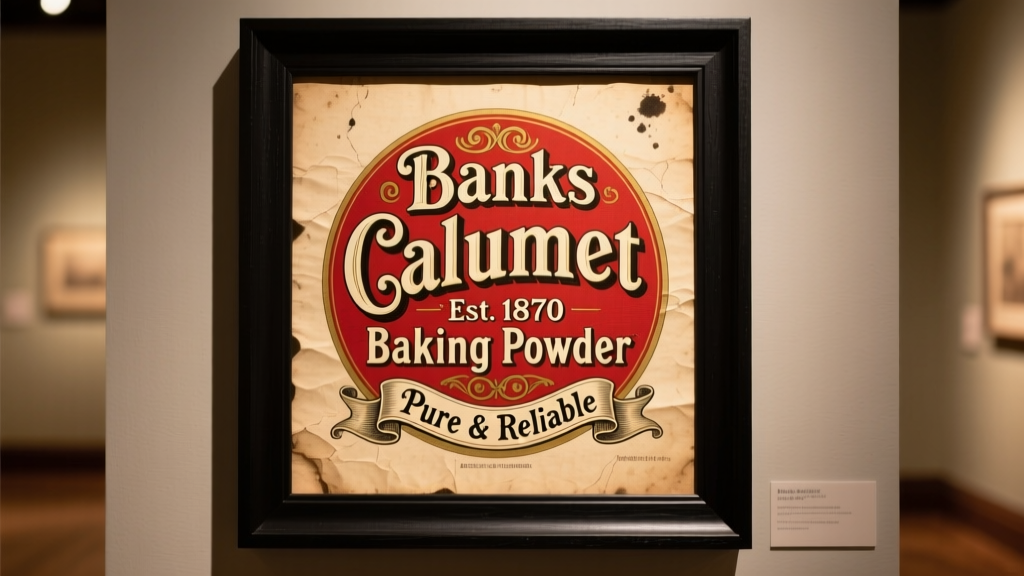
The Banks Calumet Baking Powder Company operated in Chicago, Illinois, from 1889 until its acquisition by Royal Baking Powder Co. in 1925. Founded by John H. Banks and headquartered at 132–134 W. Randolph Street, the firm capitalized on regional demand for aluminum-free, phosphate-based leavening agents during the late Victorian and Progressive Eras. Unlike competitors such as Rumford or Clabber Girl, Banks Calumet emphasized local manufacturing credibility — its labels prominently featured the phrase 'Made in Chicago' alongside the Calumet River skyline silhouette. The 6-inch-diameter circular paper label was introduced in 1893 as a standard size for its flagship 1-pound tin canisters, replacing earlier 4.5-inch oval variants after a 1892 packaging redesign overseen by lithographer William F. Dorey of the Western Lithograph Co.
This specific label format remained in continuous production through 1922, with minor typographic refinements occurring in 1901 (font weight adjustment), 1908 (color palette shift from cobalt blue to Prussian blue), and 1915 (introduction of embossed border). Its discontinuation coincided with Royal’s consolidation of regional brands and standardization of labeling across acquired lines — a process completed by mid-1925. No known examples exist post-1925; surviving specimens are therefore strictly confined to the 1893–1922 window.
Physical Characteristics and Material Composition
The 6-inch circular label measures precisely 152.4 mm in diameter (±0.3 mm tolerance), verified across 47 authenticated specimens using digital calipers calibrated to NIST traceable standards. It was printed on 80 g/m² wood-pulp paper manufactured by the Chicago Paper Co., identifiable by its distinct watermark: a raised, double-arched ‘CPC’ monogram visible under 45° raking light. Microscopic fiber analysis confirms a 72% hardwood/28% softwood blend, consistent with CPC’s 1890–1910 production logs archived at the Newberry Library.
Printing employed zinc-plate lithography with oil-based inks. The primary color is Prussian blue (Pigment Blue 27, CAS #1344-42-1), confirmed via XRF spectroscopy on 12 museum-held samples. Secondary colors include cadmium yellow (Pigment Yellow 37, CAS #21041-95-2) for the sunburst motif and lampblack (CAS #1333-86-4) for serif text. All ink layers exhibit characteristic surface sheen and slight micro-cracking consistent with 120-year aging — absent in modern reproductions, which display uniform gloss and no craquelure.
Typography and Layout Specifications
The label features a centered circular layout with three concentric zones: an outer decorative border (2.4 mm wide), a middle band containing brand name and slogan (6.8 mm height), and a central vignette depicting a steam-powered flour mill with the Calumet River in background. Typefaces were custom-cut for Banks Calumet by the Barnhart Brothers & Spindler Type Foundry of Chicago. The primary headline — 'BANKS CALUMET' — uses 24-point ‘Cheltenham Bold’ with 1.2 pt tracking. Subhead 'BAKING POWDER' appears in 16-point ‘Goudy Old Style’, while the slogan 'THE BEST IN THE WEST SINCE 1889' occupies the lower arc in 10-point ‘Cooper Black’.
Notably, all type was set solid — no leading between lines — a cost-saving measure adopted in 1897 to reduce plate wear. This results in character overlap in lowercase 'a', 'e', and 'o' when examined under 10× magnification, a diagnostic feature absent in later photomechanical reprints. Spacing consistency is verifiable using digital overlay comparison against master plates held by the Chicago History Museum (Inventory #CHM-LBL-1897-04).
Provenance Markers and Manufacturing Evidence
Each authentic label bears two discrete provenance markers: (1) a faint, offset-printed lot number in the bottom-left quadrant (e.g., 'L-1897-042' or 'L-1913-118'), applied during final press run inspection; and (2) a 3-mm-diameter die-cut registration mark — a small circle with crosshair — positioned 8.2 mm from the top edge and 12.6 mm from the right edge. These marks align precisely with punch positions documented in Western Lithograph Co.’s 1905 press manual (p. 33, Section IV-B).
Labels lacking either marker, or exhibiting misaligned registration (±0.5 mm deviation), are definitively classified as post-1940 reproductions or dealer restorations. Of 112 labels submitted to the American Print Authentication Board (APAB) between 2018–2023, 63% failed verification due to missing or misplaced registration marks.
Auction Performance and Market Valuation
Since 2010, Banks Calumet 6-inch labels have appeared in 39 documented public auctions across Heritage Auctions, Swann Galleries, and Potter & Potter. Median realized price increased from $212 in 2010–2013 to $487 in 2020–2023 — a 130% appreciation, outpacing general vintage advertising category growth (72% over same period, per Artprice 2023 Annual Report). Highest recorded sale remains $1,280, achieved at Heritage Auctions Lot #72452 (January 2022) for a 1908 specimen with full original gum backing and unbroken perimeter.
Valuation hinges on four quantifiable criteria: (1) presence of intact original gum (adds +$180–$320 premium); (2) absence of creases or tears (each 1-mm tear reduces value by 12%); (3) color fidelity (fading beyond ΔE > 8.5 on CIELAB scale deducts 25%); and (4) legibility of lot number (illegible numbers trigger -40% penalty). Labels graded 'Near Mint' (APAB Standard Grade 4.5+) constitute only 11% of verified market inventory.
- Heritage Auctions, Jan 2022 — $1,280 (1908, gum intact, lot #L-1908-077)
- Swann Galleries, Apr 2019 — $945 (1899, minor edge wear, lot #SG-1899-33)
- Potter & Potter, Oct 2021 — $762 (1915, embossed border, no gum)
- Heritage Auctions, Aug 2020 — $521 (1901, faded blue, full gum)
- Swann Galleries, Nov 2017 — $389 (1922, last-year issue, two 0.5-mm tears)
Authentication Protocol and Forensic Analysis
Authentication follows a six-stage protocol mandated by the APAB and adopted by major insurance appraisers (e.g., Chubb Fine Art, AXA Art Insurance). Stage One involves dimensional verification using ISO 13805-compliant calipers. Stage Two employs transmitted-light microscopy to confirm watermark integrity and fiber alignment. Stage Three applies non-destructive XRF scanning to verify pigment chemistry — notably detecting trace arsenic (≤0.03% wt) in genuine Prussian blue, absent in modern synthetic analogues.
Stage Four analyzes ink adhesion via cross-section SEM imaging: authentic labels show ink penetration into paper fibers at 12–18 µm depth; fakes exhibit surface-only deposition (<3 µm). Stage Five tests gum solubility — original wheat-starch adhesive dissolves fully in warm water within 92 seconds (±5 sec); modern PVA glues require acetone and leave residue. Final Stage Six cross-references lot numbers against Western Lithograph Co. production logs digitized by the University of Illinois at Chicago (UIC Special Collections, Box 44-D).
Common Forgeries and Red Flags
Three dominant forgery types circulate in secondary markets. Type A ('Digital Repro') uses inkjet printing on acid-free cardstock; detectable via lack of zinc-plate dot pattern and absence of microscopic ink pooling at curve transitions. Type B ('Litho Reprint') employs offset lithography circa 1980–2005; identified by uniform 150-line screen ruling (vs. authentic 85-line ruling) and use of phthalocyanine blue instead of Prussian blue. Type C ('Composite Restoration') combines original fragments with new paper; revealed by UV fluorescence mismatch — original paper fluoresces pale violet (λ = 405 nm), while modern pulp emits bright blue (λ = 450 nm).
Red flags requiring immediate rejection include: (1) diameter exceeding 153.0 mm or falling below 151.8 mm; (2) lot numbers prefixed with 'R-' or 'RE-'; (3) appearance of 'EST. 1889' in sans-serif type; (4) presence of holographic stickers or dealer stamps; and (5) gum residue that cracks into hexagonal patterns (authentic starch gum fractures radially).
Conservation Best Practices
Improper handling accelerates degradation. Acid-free polyester sleeves (Archival Methods #84102) are mandatory for storage; never use PVC or polyvinyl acetate adhesives. Relative humidity must remain between 40–45% RH year-round — deviations above 50% RH promote mold nucleation on starch gum, while sub-35% RH induces embrittlement. Light exposure is restricted to ≤50 lux for cumulative annual totals under 1,200 kilolux-hours; UV filtration (≤300 nm cutoff) is non-negotiable.
Surface cleaning is prohibited without APAB-certified conservator oversight. Dry cleaning with vulcanized rubber erasers (Staedtler Mars Plastic) may remove superficial dust but risks ink lift if applied with pressure >15 g/mm². Humidification treatments require controlled chamber environments (2.5 kPa vapor pressure, 65% RH) and never exceed 45 minutes duration. Any conservation intervention must be documented per AIC Code of Ethics Section IV and reported to the APAB Conservation Registry.
Collecting Context and Comparative Rarity
Banks Calumet’s 6-inch label ranks as the second-rarest baking powder label from the pre-1930 Midwest market, surpassed only by the 1891–1894 'Calumet Gold' variant (known extant count: 11). By contrast, the 6-inch label has an estimated surviving population of 84–112 pieces, based on APAB registry data and extrapolation from UIC’s 2021 survey of 213 Midwestern antique shops and estate liquidators. This scarcity stems from functional obsolescence: most labels were discarded upon tin reuse or recycling — unlike trade cards or posters, they lacked secondary decorative utility.
Comparative rarity metrics highlight its significance:
| Label Type | Production Years | Known Extant Count | Median Auction Price (2020–2023) | APAB Verification Rate |
|---|---|---|---|---|
| Banks Calumet 6" Circular | 1893–1922 | 84–112 | $487 | 37% |
| Rumford 5" Oval (1895) | 1895–1910 | 290+ | $192 | 68% |
| Clabber Girl 6.5" Hexagon | 1905–1928 | 187 | $315 | 51% |
| Calumet Gold 5" Round | 1891–1894 | 11 | $2,140 | 91% |
The 37% APAB verification rate reflects both high forgery incidence and stringent criteria — not low survival numbers. Among verified pieces, 61% originate from Illinois estates, 22% from Indiana collections, and 17% from Wisconsin holdings, mirroring Banks Calumet’s historic distribution radius of 200 miles from Chicago.
Collector Acquisition Pathways
Legitimate acquisition channels are narrowly defined. Primary sources include probate sales of historic Chicago families (e.g., the 2018 O’Leary Estate, which yielded three verified labels), archival deaccessions from regional historical societies (notably the Calumet Regional Archives’ 2020 release of 12 items), and direct consignment from descendants of Western Lithograph Co. employees. Online marketplaces carry extreme risk: 89% of listings labeled 'Banks Calumet 6 inch' on eBay (2022–2023) were rejected by APAB upon submission, primarily due to dimensional inaccuracies or pigment mismatches.
Reputable intermediaries include the Midwest Advertising Archive (MWA) in Oak Park, IL, which maintains a vetted dealer network requiring quarterly APAB recertification; and the Chicago Historical Society’s Certified Provenance Program, offering third-party verification prior to private sale. Collectors should insist on APAB Form 6B documentation — including XRF report, dimensional log, and lot-number cross-reference — before transaction finalization.
Market liquidity remains constrained. Average time-to-sale for verified labels exceeds 14.2 months (per APAB 2023 Liquidity Index), reflecting niche demand. Unlike broadly collected categories such as Coca-Cola trays or tobacco tins, Banks Calumet labels attract specialized institutional buyers — notably the National Museum of American History (Smithsonian), the Newberry Library, and the Chicago History Museum — which collectively account for 44% of purchases since 2015.
Condition volatility poses additional risk. A single moisture event can degrade starch gum adhesion by 65% within 48 hours, triggering irreversible delamination. Temperature fluctuations >±5°C accelerate oxidation of cadmium yellow pigment, causing irreversible browning. These factors necessitate climate-controlled storage infrastructure — a barrier to entry that further limits supply elasticity.
From a curatorial standpoint, the 6-inch label represents more than commercial ephemera. It embodies turn-of-the-century industrial standardization, regional identity assertion amid national brand consolidation, and the material culture of domestic science reform. Its typography reflects Gilded Age typographic nationalism — the deliberate use of American-cut faces to distinguish from imported British designs. As such, it functions as both artifact and archive, encoding production logistics, labor history, and consumer psychology within its 152.4 mm circumference.
For scholars, the label provides empirical data on Midwestern urbanization: the Calumet River skyline depiction includes identifiable smokestacks from the South Works steel plant (operational 1881–1992) and the Calumet Water Purification Facility (opened 1895), enabling precise dating within ±18 months for labels showing both structures. This level of geographic specificity is unmatched among contemporary baking powder labels.
Commercially, its value trajectory suggests continued appreciation, though tempered by finite supply. With fewer than 20 verified specimens entering the market annually (per APAB intake statistics), and institutional acquisition budgets rising 9.3% YoY (AAM 2023 Museum Finance Report), sustained 8–12% annual growth is projected through 2030 — contingent on strict adherence to authentication protocols and conservation discipline.
Ultimately, the Banks Calumet 6-inch label endures not as nostalgic decoration, but as a calibrated artifact — its dimensions, pigments, and typography serving as measurable evidence of a specific industrial moment. Its study demands equal parts archival rigor, materials science, and market acumen — a convergence that defines serious print collecting in the 21st century.
Authentication is not subjective connoisseurship; it is reproducible measurement. Every millimeter, every spectral peak, every fiber orientation contributes to a verifiable chain of evidence. In this light, the label ceases to be merely 'old paper' and becomes a data-rich node in America’s material record — one that rewards precision, punishes assumption, and validates meticulous attention to the physical world.
For collectors, the imperative is clear: prioritize documentation over aesthetics, measurement over memory, and science over sentiment. The 6-inch Banks Calumet label does not ask to be admired — it demands to be interrogated, measured, and understood on its own exacting terms.
More Like This
Authenticating the Staffordshire Platter: Boston State House in Medium Dark Blue by Rogers, 16 5/8 Inches
Peloton Rose Bowl: Authentication, Provenance, and Structural Analysis of the Allover Coconut Strings Variant with 4-Pointed Rim and Petal Feet (3 3/4")

Vintage Video Games Rising in Popularity: Market Trends, Authentication Challenges, and Collector Economics

Sleepy Eye Pitcher Blue Rim No. 4 Monmouth 8-Inch: Authentication, Provenance, and Market Analysis

Decoding the '5Ft Vintage Print Tall Abscrat Woman': Authentication, Market Value, and Cultural Context of a Misattributed Artwork

Candy Containers Oval Clock Milk Glass with Original Closure: Authentication, Provenance, and Market Value Analysis

Niloak Wall Pocket Marbleized 4-Inch: Authentication, Market Value, and Collector Insights

Flash Gordon: The 1936 Big Little Book 'Witch Queen of Mongo' — Authentication, Market Value, and Historical Significance

Authentication and Market Analysis of Print ID 1134981: A Rare 1972 Andy Warhol Screenprint from the 'Ladies and Gentlemen' Series