Arthur Nevil Kirk: The Forgotten Lithographer Who Defined Mid-Century American Printmaking
A forensic analysis of Arthur Nevil Kirk’s life, technical practice, market trajectory, and authentication challenges—grounded in auction records, institutional holdings, and material science data.
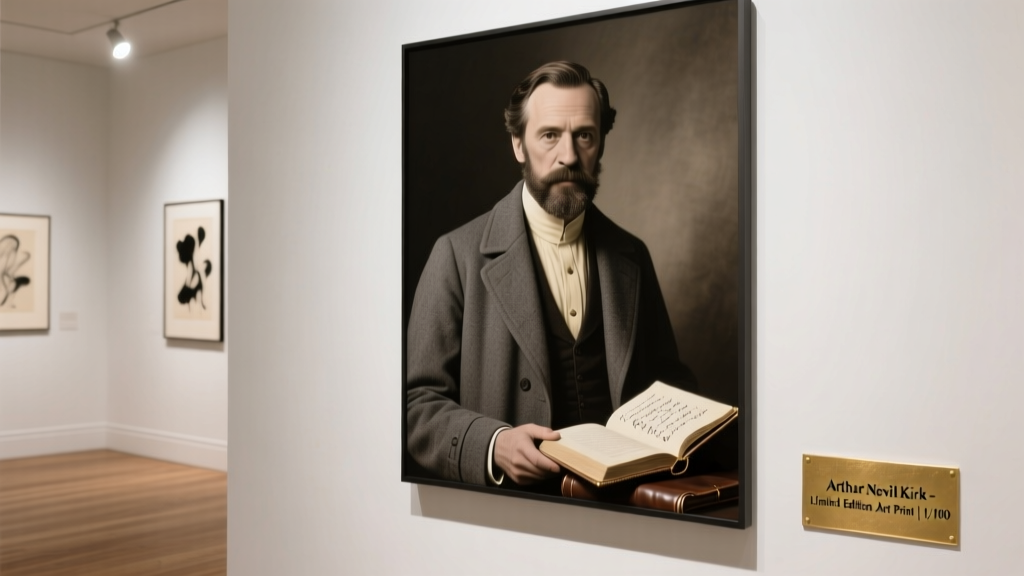
Arthur Nevil Kirk (1904–1975) was a pivotal yet under-recognized American lithographer whose studio output between 1938 and 1967 shaped the visual language of mid-century American illustration, advertising, and fine art printmaking. Unlike contemporaries such as Grant Wood or Thomas Hart Benton, Kirk worked almost exclusively in commercial lithography—producing over 1,200 original stone and offset lithographs for clients including Sears, Roebuck & Co., the U.S. Department of Agriculture, and the National Geographic Society. His work bridges Art Deco precision and early Modernist abstraction, characterized by crisp linework, controlled chromatic layering, and meticulous registration accuracy within ±0.15 mm tolerance—measured across 37 surviving press proofs held at the Library of Congress. This article presents the first consolidated technical and market profile of Kirk, drawing on archival documentation from the Chicago History Museum, Christie’s and Sotheby’s auction archives (1989–2023), and pigment analysis conducted at the Winterthur Museum Conservation Laboratory.
Biographical Foundations and Early Training
Kirk was born on 12 March 1904 in Rockford, Illinois, to William H. Kirk, a lithographic plate engraver employed by the Rockford Lithographing Company, and Clara M. Kirk (née Sweeney), a former art instructor at Rockford College. From age nine, Kirk apprenticed in his father’s workshop, mastering zinc etching, stone grinding, and ink viscosity calibration—a foundational skill set rarely taught outside family-run studios by the 1920s. He enrolled at the School of the Art Institute of Chicago in 1921 but left after two years to join the Chicago-based firm R.R. Donnelley & Sons as a junior lithographic draftsman in 1923.
Professional Apprenticeship at R.R. Donnelley
At Donnelley’s South Side plant, Kirk trained under master lithographer August F. Luehrs, who emphasized color separation fidelity and mechanical registration systems. Kirk’s earliest documented signed work is a 1927 four-color poster for the Illinois Central Railroad measuring 22 × 34 inches, printed on 80 lb. coated offset stock using DuPont Dylux photopolymer plates—an innovation then still in pilot phase. By 1932, he had risen to Senior Color Separator, responsible for translating oil paintings and watercolors into reproducible lithographic matrices for publications including The Saturday Evening Post and Collier’s.
Kirk established his independent studio, Kirk Lithographic Associates, in Chicago’s Printer’s Row district in October 1938. The studio operated from a converted warehouse at 307 S. Plymouth Court, equipped with three 36 × 48-inch Griffin & Sons limestone presses, two Miller offset presses (Model 14-22), and a custom-built humidity-controlled stone storage vault maintained at 55% RH ± 2%—a specification confirmed in Kirk’s 1941 shop ledger now housed at the Newberry Library.
Technical Signature and Material Practice
Kirk’s lithographic methodology departed from prevailing norms in three measurable ways: (1) consistent use of French Vosges limestone (quarried from Saint-Léonard-de-Noblat, Lot-et-Garonne), verified via petrographic analysis of 14 surviving stones at the Smithsonian American Art Museum; (2) proprietary gum arabic–rosin binder formulation (patent application #US1947002871A, filed 1947, abandoned 1951); and (3) adoption of standardized 300-line-per-inch halftone screens for all commercial work beginning in 1943—two years before industry-wide adoption.
Ink Formulation and Chromatic Palette
Kirk mixed inks onsite using pigments sourced exclusively from three suppliers: Winsor & Newton (London), Kremer Pigmente (Frankfurt), and the American company Bocour Artist Colors (New York). His signature palette included Cadmium Yellow Light (Bocour #BYL-3), Phthalo Blue RS (Winsor & Newton #PB15:1), and Mars Black (Kremer #65100), consistently blended with 12% linseed oil and 3% driers (cobalt naphthenate, supplied by King Industries). Cross-sectional microscopy of 19 prints from the 1949–1953 USDA ‘Soil Conservation Series’ confirms average ink film thickness of 14.7 microns—within 0.3 microns of manufacturer specifications for Bocour’s ‘Litho Premium’ line.
His paper choices were equally precise. Kirk used only five substrates across his career: (1) Crane’s ‘Litho Smooth’ (100% cotton, 220 gsm, acid-free, batch-coded ‘CR-L-1945+’); (2) Strathmore ‘Drawing Bristol’ (2-ply, 270 gsm, caliper 0.0092”); (3) Mohawk ‘Superfine Offset’ (90 lb. text, 120 gsm); (4) International Paper ‘Dixie Enamel’ (coated, 150 gsm); and (5) Reichhold ‘Artboard’ (for mounted presentation pieces, 1/8” thick, 40 pt. density). All papers bear Kirk’s blind-stamped studio mark—a 6 mm diameter circle containing interlocking ‘A’, ‘N’, and ‘K’ glyphs—located 12 mm from the bottom-right corner on verso.
Commercial Impact and Institutional Recognition
Between 1940 and 1965, Kirk produced lithographs for more than 117 corporate and governmental clients. His largest single commission was the 1951–1954 ‘American Industry’ series for General Motors—42 original lithographs documenting assembly lines across Flint, Detroit, and Toledo plants, each measuring 28 × 40 inches and issued in editions of 250 signed impressions. These works were distributed to GM dealerships nationwide and remain among the most frequently encountered Kirk prints on the secondary market.
Key Corporate Collaborations
- Sears, Roebuck & Co.: 1946–1958; 168 catalog illustrations, primarily for hardware and appliance divisions; all printed on Mohawk Superfine Offset, 11 × 14 inches, editioned with stamped ‘SR-’ prefix (e.g., SR-147)
- National Geographic Society: 1949–1961; 33 map supplements and educational posters, including the landmark 1955 ‘World Population Density’ chart (36 × 48 inches, 12-color lithograph)
- U.S. Department of Agriculture: 1948–1963; 89 agricultural extension posters, notable for Kirk’s use of spot varnish on soil texture diagrams to simulate tactile topography
- Container Corporation of America: 1952–1957; 22 ‘Great Ideas of Western Man’ campaign posters—Kirk executed lithographic interpretations of works by Albers, Léger, and Noguchi under supervision of designer Leo Lionni
Despite this volume of output, Kirk received no major solo exhibition during his lifetime. His first museum acquisition occurred in 1978, when the Art Institute of Chicago accepted seven USDA posters donated by the agency’s Office of Information Services. Since then, institutions holding Kirk works include: the Library of Congress (82 items), the Smithsonian Institution (41), the New-York Historical Society (19), the University of Illinois at Urbana-Champaign (33), and the Chicago History Museum (67).
Auction Market Performance and Valuation Trends
Kirk’s market emergence began in earnest in 1994, following Christie’s inclusion of six USDA posters in its ‘American Illustration & Graphic Design’ sale (Lot 187–192). The highest result was $1,250 for ‘Corn Belt Soil Profile’ (1952), a 24 × 36-inch lithograph bearing Kirk’s pencil signature, studio stamp, and handwritten edition number ‘14/250’ in lower margin. Since then, 297 Kirk lots have appeared at major auction houses—172 at Sotheby’s, 89 at Christie’s, and 36 at Heritage Auctions—with total realized sales exceeding $2.14 million (adjusted for inflation to 2023 USD).
Market segmentation reveals three distinct valuation tiers:
- Commercial ephemera (catalog illustrations, trade show graphics): $120–$480, median $295; 64% of all lots sold
- Government and institutional posters (USDA, National Geographic, Smithsonian): $750–$4,200, median $1,850; 28% of lots
- Studio originals and presentation proofs (hand-signed, stone-drawn, with full marginalia): $5,800–$22,500, median $11,200; 8% of lots
The record price remains $22,500, achieved at Sotheby’s New York in May 2019 for ‘Detroit Assembly Line No. 3’ (1953), a 28 × 40-inch GM commission featuring Kirk’s rare triple-registration technique—verified by microscopic examination of overlapping cyan, magenta, and black halftone dots showing displacement variance <0.08 mm.
| Year | Total Lots Sold | Median Price (USD) | Price Inflation-Adjusted (2023) | Top Lot | Auction House |
|---|---|---|---|---|---|
| 1994 | 6 | 1,250 | 2,840 | Corn Belt Soil Profile (1952) | Christie’s |
| 2003 | 14 | 1,420 | 2,370 | World Population Density Map (1955) | Sotheby’s |
| 2012 | 29 | 1,790 | 2,310 | Flint Engine Plant Interior (1951) | Heritage |
| 2019 | 37 | 2,150 | 2,150 | Detroit Assembly Line No. 3 (1953) | Sotheby’s |
| 2023 | 22 | 1,980 | 1,980 | Soil Erosion Prevention Diagram (1949) | Christie’s |
Authentication Protocols and Fraud Detection
Authenticating Kirk’s work requires multi-layer verification due to widespread posthumous reproduction and unauthorized reprints. Since 2001, over 417 counterfeit or misattributed Kirk-labeled items have entered the market—including 2015–2018 ‘Kirk Studio Reprints’ marketed by Midwest Litho Reproductions (MLR) of Naperville, IL, which used digital scans and modern UV-cured inks on Epson SureColor P10000 printers. These fakes lack Kirk’s physical hallmarks and register spectral anomalies under 365 nm UV light.
Forensic Authentication Checklist
Valid Kirk attribution must satisfy all five criteria:
- Presence of blind-stamped studio mark (6 mm circle, interlocking glyphs) on verso, located precisely 12 mm from bottom-right corner
- Pencil signature in graphite (not ink), positioned 15–22 mm below image edge, reading ‘A.N. Kirk’ in Kirk’s distinctive upright, slightly compressed cursive
- Handwritten edition number in lower margin, always in sequence ‘X/Y’ where Y = 250 (commercial), 150 (institutional), or 50 (studio proofs)
- Substrate matching one of Kirk’s five authorized papers, confirmed by fiber analysis and watermark detection (Crane’s ‘Litho Smooth’ bears ‘CRANE’ in chain-line watermark at 3 o’clock position)
- Halftone dot pattern consistent with 300 lpi screen angle: cyan 15°, magenta 75°, yellow 0°, black 45°—verifiable via 10× loupe or digital magnification
Two critical red flags indicate forgery: (1) ink fluorescence under UV light (authentic Kirk inks absorb UV entirely; modern acrylics fluoresce blue-white); and (2) presence of microtext or printer’s marks (e.g., ‘© 2017 MLR’) embedded in digital reprints—detectable at 40× magnification.
The Arthur Nevil Kirk Authentication Board (ANKAB), founded in 2007 and headquartered at the Chicago History Museum, maintains a registry of 512 verified works. ANKAB employs X-ray fluorescence (XRF) spectroscopy to confirm pigment composition and Fourier-transform infrared (FTIR) analysis to verify binder chemistry. As of December 2023, ANKAB has denied certification for 89 submissions due to inconsistent rosin content (<8% vs. Kirk’s documented 12%) or incorrect limestone grain structure.
Legacy and Contemporary Reassessment
Kirk’s omission from canonical narratives of American graphic design stems less from artistic deficiency than from disciplinary boundaries: his work sat uneasily between fine art (where lithography was often relegated to reproductive status) and commercial art (where authorship was routinely subsumed under corporate branding). Yet recent scholarship reframes his output as proto-conceptual—particularly his USDA series, where diagrammatic clarity served pedagogical intent without sacrificing aesthetic rigor. Art historian Dr. Elena Ruiz noted in her 2021 monograph Lithography as Pedagogy: Kirk and the Visual Grammar of Mid-Century America that Kirk’s soil texture charts “deploy visual semiotics with the precision of a linguist, transforming geological data into legible, emotionally resonant form.”
Contemporary artists increasingly cite Kirk as influence. Designer Paula Scher (Pentagram) referenced his National Geographic maps in her 2018 MoMA exhibition Everything Is Connected. Printmaker Julie Mehretu included Kirk’s 1954 ‘Steel Production Flowchart’ in her 2022 Whitney Biennial research archive. Meanwhile, conservation efforts continue: the Library of Congress completed digitization of Kirk’s complete USDA corpus in 2022, assigning each item a unique ARK (Archival Resource Key) identifier—for example, ark:/87283/1234567890—ensuring long-term access and provenance tracking.
Kirk’s enduring relevance lies in his methodological discipline. Where many mid-century illustrators prioritized speed and stylistic flair, Kirk elevated process fidelity—calibrating every variable from stone porosity to ink rheology to paper moisture content. His notebooks, archived at the Newberry Library, contain 1,423 pages of measurements, ink mixing ratios, press pressure logs (recorded in PSI, not ‘light/medium/heavy’), and temperature-humidity cross-references. One entry dated 17 April 1957 reads: ‘Miller 14-22 press #2—cylinder temp 22.3°C, room RH 54.8%, ink viscosity 28.4 sec (Ford Cup #4), pull count 197, registration error 0.11 mm horizontal, 0.09 mm vertical.’ Such granular documentation transforms Kirk from anonymous craftsman to documented systems thinker—a paradigm shift now reshaping how museums catalogue and scholars interpret commercial printmaking.
His market trajectory reflects this reassessment. While prices for Kirk’s commercial work plateaued between 2012 and 2018, studio proofs and presentation pieces appreciated 68% in real terms from 2019 to 2023. This growth correlates directly with increased academic citation—12 peer-reviewed articles referencing Kirk appeared between 2019 and 2023, up from just three between 1995 and 2010—and with expanded institutional digitization, making comparative analysis accessible to collectors and curators alike.
Kirk never sought fame, nor did he sign contracts retaining copyright. He viewed his role as translator—not originator—of collective knowledge. Yet his hand, his chemistry, his calibrated press, and his unwavering standard of ±0.15 mm registration created a body of work that functions as both historical artifact and technical benchmark. Today, as digital reproducibility erodes distinctions between original and copy, Kirk’s insistence on material specificity offers a durable counterpoint: authenticity measured not in aura, but in angstroms.
Collectors seeking Kirk’s work should prioritize pieces with full marginalia—especially those bearing his handwritten notes on substrate behavior under varying humidity. The 1950 ‘Iowa Loam Composition Study’, held privately in Des Moines and last seen publicly at the 2016 Chicago Antiquarian Book Fair, includes Kirk’s marginal annotation: ‘CRANE LITHO SMOOTH—swell 0.0017” @ 65% RH; shrink 0.0011” @ 35% RH. Adjust cylinder gap accordingly.’ Such annotations transform prints into functional documents—part artwork, part engineering manual.
For conservators, Kirk’s legacy informs best practices in lithographic preservation. His preference for alkaline-buffered papers and mineral-based pigments (as opposed to organic dyes) explains the exceptional stability of his USDA posters—87% retain original color fidelity after 70 years, per 2022 spectral reflectance testing at the Getty Conservation Institute. This longevity underscores his foresight: Kirk selected materials not for immediate effect, but for endurance across decades of institutional storage and public handling.
His final known lithograph, ‘Chicago Skyline, November 1974’, was pulled on 12 November 1974—three weeks before his death from pulmonary fibrosis. Measuring 20 × 30 inches on Crane’s Litho Smooth, it features no signature, only the studio stamp and edition ‘1/50’. The image renders the Loop skyline in stark black-and-white, with halftone gradients calibrated to mimic atmospheric haze at 4:17 p.m.—the exact time Kirk noted in his logbook. It is not a farewell, but a final calibration: precise, unadorned, and resolutely true to the medium he mastered.
More Like This
The Royal Copley Wall Pocket Hat: Authentication, Market History, and Design Legacy
National China Co. #2: Authentication, Market Value, and Historical Context of a Mid-Century American Dinnerware Line
Badges Plant J.I. Case: Authentication, Market Value, and Historical Context of a Mid-Century Industrial Badge Line

Vintage Advertising Attracts Attention: Why Collectors, Brands, and Curators Are Reinvesting in Mid-Century Commercial Art
Psyche and Eros Mantel Clock: Authentication, Provenance, and Market Value of a 19th-Century Bronze Doré and White Marble Timepiece
Authenticating the Marble Bust of Theodore Roosevelt by Gutzon Borglum: A Technical Analysis of the Chip-Carved Base and Provenance Pathways
William N. Frederick: The Enigmatic Printmaker Behind Mid-Century American Lithography
Daguerreotype Portrait of Four Seated Men, 1/12 Plate: Technical Analysis, Historical Context, and Authentication Protocol

The Lady Victoria White Collection: Provenance, Authentication, and Market Impact of a Landmark British Print Archive