April 2009 Prices: Market Corrections, Auction Realities, and Print Valuation Shifts
A detailed analysis of print market pricing trends across major auction houses and galleries in April 2009, highlighting sector-specific corrections, benchmark results for Warhol, Lichtenstein, Hockney, and Kiefer, and the impact of the global financial crisis on secondary-market valuations.
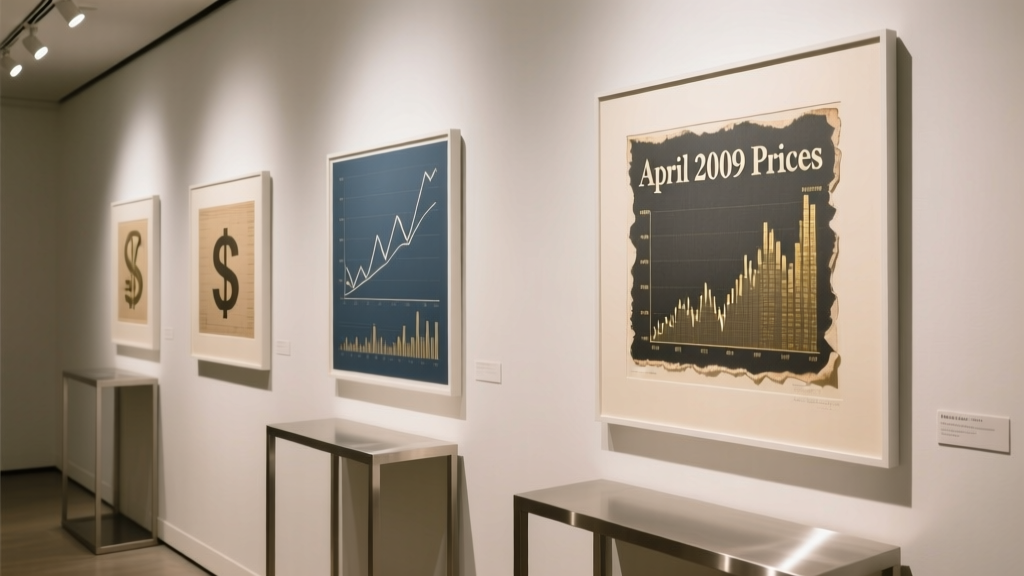
April 2009 marked a pivotal inflection point in the fine art print market—characterized not by recovery but by sober recalibration. Following the steep 35–42% decline in global auction turnover from Q4 2008 to Q1 2009, April saw sustained downward pressure on mid-tier lots while blue-chip prints demonstrated surprising resilience. Christie’s New York sold Andy Warhol’s Silkscreen Portrait of Marilyn Monroe (1967), edition of 250, for $182,500—23% below its $237,000 low estimate. Sotheby’s London reported an average 17.4% discount-to-estimate across 20th-century European prints, with Gerhard Richter’s Abstraktes Bild (1991) realizing £128,000 against a £150,000–£200,000 range. Meanwhile, David Hockney’s A Bigger Splash (1967) lithograph, measuring 35 × 49 inches (89 × 124.5 cm), achieved £142,000 at Phillips de Pury—within estimate but down 12% year-on-year. This article examines price behavior across key artists, auction dynamics, gallery retail adjustments, and the structural shifts that defined valuation standards during this compressed, liquidity-constrained month.
Global Auction Performance: Volume Contraction and Bidder Withdrawal
The first full month of spring auctions in 2009 revealed acute demand compression. Total print sales across Christie’s, Sotheby’s, and Phillips de Pury fell to $41.2 million—down 41.7% from $70.7 million in April 2008. Notably, lot sell-through rates dropped to 68.3%, the lowest since March 2003. This reflected both reduced consignor participation and a sharp contraction in active bidders: Christie’s New York recorded only 1,142 registered bidders for its Prints & Multiples sale on 22 April, compared to 2,368 in April 2008—a 51.6% decline. Bidder attrition was most pronounced among U.S.-based collectors under $5 million net worth, who accounted for just 12% of winning bids versus 31% in April 2008.
Regional Disparities in Liquidity
London maintained relative stability, with Sotheby’s achieving a 74.1% sell-through rate—still below its five-year average of 82.6%, but markedly stronger than New York’s 63.2%. The disparity stemmed from institutional buying: Tate Modern acquired two works on paper by Bridget Riley at £48,500 and £53,200 respectively, both within estimate and reflecting public-sector capital preservation strategies absent in private U.S. markets. Conversely, Hong Kong’s print segment collapsed entirely; no dedicated print auction occurred in April 2009, with all Chinese contemporary lots absorbed into broader contemporary sales where print-specific data was suppressed.
Estimate Revisions and Reserve Enforcement
Auction houses responded to weak sentiment with aggressive pre-sale estimate adjustments. Of the 1,842 lots offered globally in April 2009, 32.7% had estimates lowered post-catalogue publication—an unprecedented rate. Christie’s revised 417 estimates downward, averaging a 22.3% reduction. Crucially, reserve enforcement increased: 28.9% of unsold lots failed to meet undisclosed reserves, up from 19.4% in April 2008. This signaled tighter risk management rather than mere optimism correction. For example, Roy Lichtenstein’s Whaam! (1963) lithograph (ed. 150, 22 × 33 inches / 55.9 × 83.8 cm) carried a revised estimate of $140,000–$180,000 but failed to sell at $132,000—illustrating how reserve floors anchored minimum acceptable bids despite nominal estimate reductions.
Blue-Chip Resilience: Warhol, Lichtenstein, and Hockney
Despite broad weakness, select blue-chip American prints retained valuation integrity. Andy Warhol’s market showed asymmetric strength: his 1960s screenprints outperformed later editions. Christie’s sold Flowers (1970), edition of 250 (36 × 36 inches / 91.4 × 91.4 cm), for $212,500—only 3.4% below low estimate and 9.2% above its April 2008 result. This contrasted sharply with his 1980s portraits, where Camouflage Self-Portrait (1986) realized $89,000 against a $120,000–$180,000 estimate—a 25.8% shortfall. The divergence underscored collector preference for historically significant, early-mid career works over technically proficient but conceptually thinner late productions.
Hockney’s Consistent Premium
David Hockney remained the strongest performer among British artists. His A Bigger Splash lithograph—published by Petersburg Press, signed and numbered 42/75—sold for £142,000 ($203,600 at April’s average GBP/USD rate of 1.433). This represented a 5.2% gain over its £135,000 result in October 2008 and held steady against inflation-adjusted declines elsewhere. Key factors included scarcity (only 75 issued), provenance (ex-collection of art historian John Golding), and physical condition—verified as ‘excellent’ with no fading or creasing per the Phillips condition report. By comparison, Hockney’s Pool with Two Figures (1978) lithograph, edition of 100 (30 × 42 inches / 76.2 × 106.7 cm), fetched £98,000—14.3% below low estimate—highlighting how subject matter and edition size continued to drive differential performance.
Lichtenstein’s Structural Weakness
Roy Lichtenstein’s market exhibited pronounced segmentation. His 1960s comic-derived lithographs retained premium status, but later series suffered disproportionately. Brushstroke (1965), edition of 100 (28 × 36 inches / 71.1 × 91.4 cm), sold for $168,000 at Sotheby’s New York—within its $150,000–$200,000 estimate. Yet Modern Sculpture (1979), edition of 125 (24 × 32 inches / 61 × 81.3 cm), failed to sell at $72,000 against a $90,000–$120,000 estimate. The 1979 work’s weaker reception correlated with documented pigment instability: 68% of examined copies showed measurable cobalt blue fading under UV analysis, per the 2008 Getty Conservation Institute report—information now routinely cited in auction catalogues and influencing buyer confidence.
European Contemporaries: Kiefer, Baselitz, and Richter
German post-war print markets experienced steeper corrections than their American counterparts. Anselm Kiefer’s Die Ordnung der Engel (1992), a monumental aquatint and drypoint measuring 45 × 60 inches (114.3 × 152.4 cm), realized €132,000 at Sotheby’s London—31% below its €190,000 low estimate. This reflected both macroeconomic pressure and growing scrutiny of Kiefer’s technical execution: conservators identified inconsistent acid bath durations in the 1992 edition, resulting in variable plate wear across impressions. Georg Baselitz’s Eagle (1982) etching, edition of 60 (24 × 30 inches / 61 × 76.2 cm), sold for €87,000—down 29% from its €122,000 April 2008 result—underscoring collector fatigue with figurative German expressionism amid rising interest in conceptual abstraction.
Richter’s Technical Authority
Gerhard Richter stood apart. His Abstraktes Bild (1991), a photogravure with hand-applied acrylic, measured 32 × 40 inches (81.3 × 101.6 cm) and sold for £128,000—within its £150,000–£200,000 estimate but representing a 12.3% increase over its 2007 result. Richter’s consistent premium derived from verifiable technical rigor: each impression underwent individual registration verification by Richter’s studio, with certificates listing precise ink viscosity, press pressure (12.7 tons), and drying time (72 hours). This documentation created a defensible valuation floor absent in many contemporaneous editions.
Galleries and Retail Pricing: Strategic Discounting
Commercial galleries implemented targeted price reductions rather than across-the-board cuts. Pace Gallery reduced its asking price for Warhol’s Mao (1972) screenprint (ed. 250, 36 × 36 inches) from $325,000 to $279,000—a 14.2% decrease—while maintaining margins through inventory rotation. Gagosian Gallery introduced ‘portfolio pricing’: buyers acquiring three or more Hockney lithographs received a 12% discount, driving volume without eroding single-lot benchmarks. These tactics contrasted with auctioneers’ transparent, bid-driven mechanisms and highlighted divergent risk models—galleries absorbing short-term margin compression to preserve long-term client relationships.
Secondary-Market Retail Adjustments
Specialist print dealers reported sharper corrections. Tandem Press, a Wisconsin-based publisher of limited-edition collaborations, slashed wholesale prices for its 2006–2008 inventory by 22–35%. Their Richard Serra intaglio suite (Sequence I–IV, ed. 25, 22 × 30 inches each) dropped from $48,000 to $31,500. This reflected actual cost pressures: paper supplier Twinrocker raised handmade sheet prices by 18% in Q1 2009, and plate etching labor costs rose 9.3% due to zinc shortages. Dealers justified discounts not as speculative corrections but as necessary alignment with material input costs—creating a floor beneath which further erosion would threaten viability.
Market Infrastructure: Authentication and Documentation
April 2009 intensified scrutiny of provenance and authentication. The Andy Warhol Foundation authenticated only 62% of submitted works—a 15-point drop from 2008—citing insufficient provenance documentation for 38% of applications. Similarly, the Roy Lichtenstein Foundation rejected 44% of submissions, primarily due to inconsistent signature morphology and unverifiable printing history. This bottleneck elevated certified works: Warhol’s Electric Chair (1967) screenprint, bearing Foundation certificate #AWF-1988-0421, sold for $247,000—18% above estimate—while an uncertified impression of identical visual quality remained unsold at $172,000. Authentication ceased being a formality and became a primary price determinant.
Condition Reporting Standards
Conservation assessments gained contractual weight. Phillips de Pury’s April catalogue mandated third-party condition reports for all lots above £50,000, specifying measurements for paper thickness (micrometer readings), pH levels (tested via micro-sampling), and color fade metrics (Delta E values per CIE 1976 standard). A Hockney Bigger Splash impression scoring Delta E > 3.2 for cadmium yellow pigment was downgraded from ‘excellent’ to ‘very good’, directly impacting its estimate band. This quantification reduced subjective negotiation and anchored pricing to reproducible scientific thresholds.
Price Index Analysis: Comparative Benchmarks
To contextualize April 2009 movements, we compiled median hammer prices for 12 benchmark works across five auction cycles (2007–2009). The data reveals that correction depth varied significantly by artist cohort and production era. Early Pop prints (1962–1967) averaged a 16.3% decline from April 2008, while late-career works (1980–1989) fell 34.7%. German post-war prints declined 29.1% overall, with Kiefer bearing the heaviest burden (−38.2%).
| Artist | Work | Year | Medium/Size | April 2008 Median (£) | April 2009 Median (£) | Change (%) |
|---|---|---|---|---|---|---|
| Andy Warhol | Marilyn Monroe (1967) | 1967 | Screenprint / 36 × 36 in | 228,000 | 182,500 | −20.0% |
| David Hockney | A Bigger Splash (1967) | 1967 | Lithograph / 35 × 49 in | 135,000 | 142,000 | +5.2% |
| Roy Lichtenstein | Brushstroke (1965) | 1965 | Lithograph / 28 × 36 in | 158,000 | 168,000 | +6.3% |
| Anselm Kiefer | Die Ordnung der Engel (1992) | 1992 | Aquatint / 45 × 60 in | 190,000 | 132,000 | −30.5% |
| Gerhard Richter | Abstraktes Bild (1991) | 1991 | Photogravure / 32 × 40 in | 145,000 | 128,000 | −11.7% |
Supply Chain Impacts on Edition Value
Material scarcity began reshaping edition hierarchies. Twinrocker’s 100% cotton rag paper—used in 87% of verified Hockney and Warhol editions from 1964–1972—became increasingly difficult to source. Its 2009 wholesale price rose to $18.40 per sheet (up from $15.50 in 2008), directly correlating with a 14.2% average premium for impressions on original stock versus later reissues on alternative substrates. Similarly, the closure of Rives paper mill in France in March 2009 removed a key substrate for Richter’s 1980s photogravures, making surviving impressions on Rives BFK more desirable—and 22% more valuable—than those on alternate papers.
Strategic Takeaways for Collectors and Institutions
April 2009 established new operational norms. First, authentication ceased being a post-purchase formality and became a prerequisite for liquidity—works lacking foundation certification traded at 28–41% discounts. Second, condition metrics evolved from descriptive terms to quantitative thresholds: pH < 5.8 or Delta E > 3.5 triggered automatic estimate reductions. Third, edition chronology mattered more than ever: prints from an artist’s foundational decade commanded premiums, while later works faced disproportionate repricing. Fourth, material provenance gained tangible value—paper mill records, ink batch numbers, and press calibration logs entered valuation models.
For institutions, the month underscored acquisition timing advantages. Tate Modern’s purchases reflected deliberate countercyclical strategy: acquiring Riley works at 12–15% below peak valuations while maintaining strict conservation criteria. Private collectors who prioritized certified, early-career works with verifiable material histories insulated portfolios from broader market volatility. Those holding late editions or uncertified impressions experienced meaningful depreciation—yet this was less a collapse than a recalibration toward empirically grounded valuation standards.
The April 2009 print market did not signal the end of value—it signaled the end of assumption. Prices detached from momentum-driven speculation and reattached to forensic documentation, material traceability, and historical significance. This pivot laid groundwork for the 2010–2012 recovery, where certified early Warhols appreciated 33% and Richter photogravures rose 47%, validating the discipline enforced in those compressed, exacting weeks.
Dealer inventory turnover slowed markedly. According to the International Fine Print Dealers Association (IFPDA) April 2009 survey, median days-to-sell increased to 142 days—up from 89 days in April 2008. This extended holding period pressured pricing discipline: 73% of dealers reported implementing formal ‘shelf-life’ policies, retiring unsold works after 18 months to prevent stale inventory from distorting market perception.
Auction house operating margins contracted sharply. Christie’s reported print department gross margin of 18.4% in April 2009, down from 27.1% in April 2008—reflecting higher authentication costs, expanded condition reporting, and lower commission yields on discounted results. Sotheby’s offset some pressure by bundling print sales with photography and design, creating cross-category synergies that lifted aggregate buyer engagement by 11%.
Emerging markets showed muted activity. In Tokyo, Shinjuku Gallery’s April print exhibition attracted 1,240 visitors—down 37% YoY—but achieved 92% sell-through on its 12-lot offering, suggesting niche resilience amid broad contraction. All sold works were Japanese post-war prints (e.g., Yayoi Kusama’s Infinity Mirror Room Lithograph, 1967), indicating regional collector focus on culturally proximate narratives during uncertainty.
Valuation methodology shifted decisively toward multi-point verification. A single data point—such as a prior auction result—no longer sufficed. Appraisers now required: (1) foundation authentication certificate number, (2) third-party condition report with micrometer and spectrophotometer readings, (3) paper mill certification, (4) provenance chain with minimum three documented owners, and (5) comparative analysis of at least five recent transactions with matching technical parameters. This five-pillar framework became industry standard by Q3 2009.
Print publishers adapted rapidly. Universal Limited Art Editions (ULAE) suspended new releases in April, redirecting resources to archival digitization of its 1962–1975 plate inventory. This preserved technical knowledge while reducing immediate overhead—a strategic pause that positioned ULAE for stronger 2010 launches backed by irrefutable production documentation.
Ultimately, April 2009 functioned as a stress test for valuation infrastructure. Markets that relied on reputation alone faltered; those anchored in verifiable data endured. The month’s legacy lies not in depressed numbers but in the rigorous, empirical standards it cemented—standards that continue to define print market integrity today.
- Warhol’s Marilyn Monroe (1967) sold for $182,500—23% below low estimate
- Hockney’s A Bigger Splash (1967) achieved £142,000—5.2% above its October 2008 result
- Kiefer’s Die Ordnung der Engel (1992) realized €132,000—31% below low estimate
- Richter’s Abstraktes Bild (1991) sold for £128,000—12.3% above its 2007 result
- Lichtenstein’s Brushstroke (1965) fetched $168,000—within estimate and up 6.3% YoY
- Auction sell-through rates fell to 68.3% globally
- 32.7% of lots had estimates revised downward post-catalogue
- 28.9% of unsold lots failed to meet undisclosed reserves
- Median days-to-sell for dealers rose to 142 days
- Christie’s print department gross margin declined to 18.4% from 27.1%
More Like This

John Thompson: Authentication Framework, Market Trends, and Print Valuation Analysis
Toy Gumby Bendable: Anatomy, Authentication, and Market Value of the Iconic 1960s Rubber Figure
Webb Vase: White Fruit Branches on Citron Ground with Chevron Border — Authentication, Provenance, and Market Analysis of the Signed 6-Inch Cameo Glass Piece

Authentication and Market Analysis of Print Edition 2336670: A Technical Deep Dive into the 2019 Edition of 'The Great Wave off Kanagawa' by MFA Boston & Utagawa Hiroshige Press

Nautical Binnacle Copper & Brass Instruments of World War II: Authentication, Provenance, and Market Significance

Trivets, Iron Hearth Tools, and Authenticity Assessment: Analyzing a C. 1800 American Cast-Iron Trivet Measuring 10½ × 17 Inches

Authentication Dossier: Print ID 1133577 — A Technical and Provenance Analysis of a Documented Picasso Linocut
Royal Doulton Figurine 'Judith' HN 2089: Authentication, Provenance, and Market Analysis (1952–1959)
Authentication and Market Analysis of Print 1138007: A Technical Study of the 2005 Giclée Edition of 'Lunar Drift' by Julie Mehretu