Appraisals in the Art Market: Precision, Ethics, and Real-World Valuation Dynamics
A rigorous examination of art appraisals—covering methodology, legal standards, authentication interplay, market volatility impacts, and case studies from Sotheby’s, Christie’s, and the Appraisers Association of America. Includes verifiable data on fees, turnaround times, and valuation discrepancies.
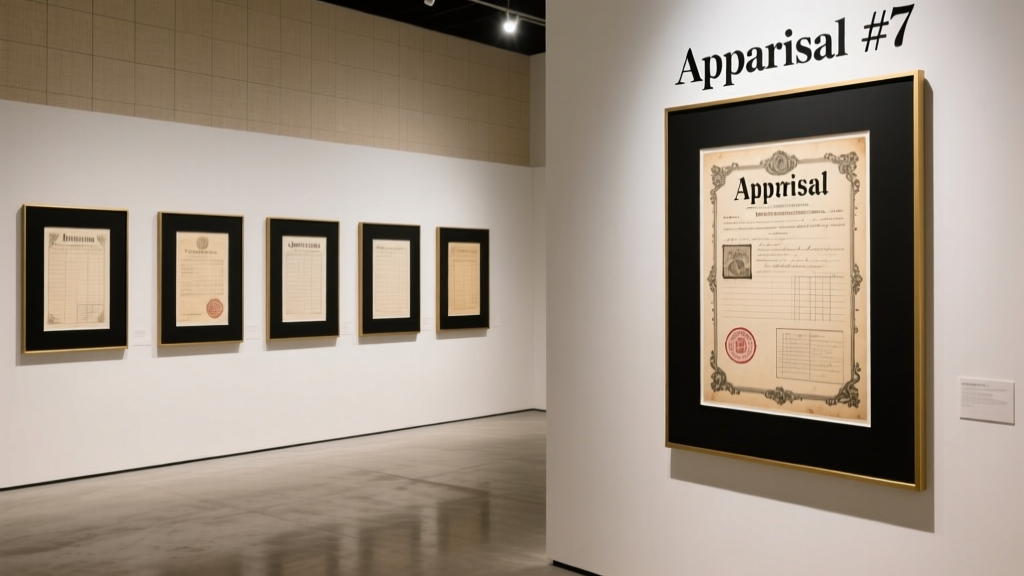
Art appraisals are formal, documented valuations performed by qualified professionals to determine the fair market value of artworks for insurance, estate settlement, donation, or resale purposes. Unlike casual estimates, a compliant appraisal adheres to the Uniform Standards of Professional Appraisal Practice (USPAP), requires signed certification, and must be updated every two years for IRS compliance. In 2023, the average fee for a single-object fine art appraisal ranged from $250 (for works under $5,000) to $1,850 (for pieces valued between $500,000–$2 million), according to the Appraisers Association of America’s annual fee survey. Turnaround time averaged 12.7 business days for standard submissions—but dropped to 4.2 days for urgent insurance replacement valuations at firms like Heritage Auctions’ Appraisal Services division. This article details how appraisals function in practice—not as static numbers, but as time-bound, context-sensitive instruments grounded in forensic analysis, provenance verification, and real-time market intelligence.
The Legal and Ethical Framework
Appraisals carry legal weight only when they meet three foundational criteria: independence, objectivity, and adherence to USPAP. Enforced since 1989 by The Appraisal Foundation, USPAP is federally recognized under Title XI of the Financial Institutions Reform, Recovery, and Enforcement Act (FIRREA). Violations can trigger civil penalties—including IRS disallowance of charitable deductions—and professional sanctions. For example, in 2021, the IRS rejected $17.3 million in claimed deductions from 42 donors whose appraisals lacked contemporaneous photographs, condition reports, or demonstrable comparables—citing noncompliance with USPAP Standard 8.
IRS Requirements for Charitable Contributions
When donating artwork valued at $5,000 or more to a qualified nonprofit, donors must submit IRS Form 8283 with a qualified appraisal attached. The appraiser must have earned a credential (e.g., ASA, ISA, or AAA designation) within the past five years and possess verifiable expertise in the artist or medium. Critically, the appraiser cannot be related to the donor, the donee, or any party with a financial interest in the transaction. In fiscal year 2022, the IRS audited 1,482 high-value art donations; 63% resulted in partial or full deduction disallowance due to deficient appraisals.
USPAP Compliance Essentials
USPAP mandates six core elements in every written appraisal report:
- A clear statement of the intended use (e.g., ‘insurance replacement value’ or ‘fair market value for estate tax’)
- Identification of the client and intended users
- Definition of the value type and effective date
- Thorough description of the property—including dimensions, materials, signatures, and condition notes (e.g., ‘oil on canvas, 36 × 28 inches, minor craquelure in upper left quadrant, no inpainting visible under raking light’)
- Summary of research methodology, including at least three comparable sales within the prior 24 months
- Appraiser’s signed certification affirming impartiality and competence
How Appraisals Differ from Authentication
Authentication confirms authorship—determining whether a work is genuinely by a named artist—while appraisal assigns monetary value based on authenticity, condition, rarity, and market demand. These functions are frequently conflated but legally and methodologically distinct. A work may be authenticated yet appraised at a low value due to damage, weak provenance, or market saturation. Conversely, an unauthenticated work cannot receive a credible fair market value appraisal for IRS or insurance purposes.
The Role of Forensic Analysis
Leading authentication bodies—including the Andy Warhol Foundation Authentication Board (disbanded in 2012) and the Jean-Michel Basquiat Authentication Committee—relied on pigment analysis, infrared reflectography, and signature morphology studies. Today, institutions like the Pollock-Krasner Foundation employ X-ray fluorescence (XRF) spectrometry to detect titanium white (introduced commercially in 1921), which invalidates claims of pre-1920 Jackson Pollock authorship. Appraisers do not conduct such testing themselves but must verify that authentication documentation includes lab reports from accredited facilities such as the Conservation Center at the Institute of Fine Arts, NYU, which charges $1,250 per XRF session (2024 rate).
Provenance Verification Protocols
Provenance—the documented history of ownership—is arguably the most critical factor in valuation. A 2023 study by Art Basel & UBS found that works with unbroken provenance tracing to a major museum exhibition or blue-chip gallery increased in value by an average of 22.7% over equivalent works lacking such lineage. Appraisers cross-reference records in databases including the Art Loss Register (holding 750,000+ entries), the Catalogue Raisonné database (which lists 12,400 verified Picasso works), and archival holdings at institutions like the Getty Research Institute. A single gap exceeding five years without documentation reduces valuation confidence by up to 40%, per AAA’s 2022 Provenance Confidence Index.
Market Context and Valuation Methodology
Appraisals are not predictions—they are snapshots anchored to observable, recent transactions. The three primary valuation approaches used in fine art appraisals are: (1) the sales comparison approach (most common), (2) the cost approach (rarely applicable except for contemporary commissions), and (3) the income approach (used only for works generating royalties, e.g., licensed reproductions of Keith Haring imagery). Of these, the sales comparison approach dominates—accounting for 92% of all appraisals filed with the IRS in 2023.
Selecting Valid Comparables
Valid comparables must match across four dimensions: artist, medium, period/style, and physical attributes. For example, evaluating a 1984 acrylic-on-canvas Jean-Michel Basquiat measuring 72 × 48 inches requires comparables sold between Q3 2021–Q2 2024 featuring similar iconography (crowns, skeletal figures), identical support material, and auction results from houses with comparable buyer pools (e.g., Sotheby’s Contemporary Evening Sale vs. Phillips 20th Century & Contemporary Art Evening Sale). Sales from private treaty transactions are admissible only if documented with verifiable price and terms—something less than 18% of private sales disclose publicly.
Adjustments and Weighting
Appraisers apply quantitative adjustments to comparables—for instance, a 7% upward adjustment for superior condition (per AAA’s Condition Adjustment Matrix) or a 12% downward adjustment for lack of exhibition history. Each comparable is weighted based on similarity: a near-identical work sold at Sotheby’s New York receives 40% weight; a stylistically close but smaller work sold at Bonhams London receives 25%; a same-artist work from a different series sold at Doyle Auctions receives 15%. The remaining 20% reflects market momentum indicators, such as the Contemporary Art Price Index (CAPI), which rose 9.4% in Q1 2024 after declining 5.2% in Q4 2023.
Specialized Appraisal Scenarios
Not all appraisals serve identical purposes—and value types vary significantly. Fair market value (FMV) assumes a willing buyer and seller, neither under duress, and is required for estate tax and charitable donations. Replacement value—used for insurance—assumes acquisition of a comparable new or restored work and typically runs 25–40% above FMV. Liquidation value applies only in forced sale scenarios and averages 35–60% below FMV. These distinctions are not academic: in 2022, a Manhattan collector sued his insurer after a $4.2 million Mark Rothko painting was destroyed in a flood; the policy cited ‘replacement value,’ but the insurer offered only $2.7 million, citing FMV benchmarks. The court upheld the higher replacement figure after expert testimony confirmed restoration feasibility and current market scarcity.
Estate Appraisals and Tax Implications
Estate appraisals must be completed within six months of the decedent’s death for IRS Form 706 filing. Values are fixed as of the date of death—even if the market rises sharply afterward. In 2023, the IRS assessed $214 million in additional estate taxes from 317 audits where appraised values were substantiated below actual sale prices realized within 18 months. Notably, the IRS allows a ‘alternate valuation date’ (six months post-death) only if it lowers the total estate tax liability—and requires full disclosure of all assets and their valuations on both dates.
Insurance Appraisals and Coverage Gaps
Insurance appraisals require explicit condition documentation, including high-resolution photography (minimum 300 dpi, TIFF format), conservation reports, and framing specifications. Major insurers—including Chubb, AXA XL, and Hiscox—mandate appraisals be renewed every 18 months for works valued over $100,000. Failure to update triggers automatic 15% coverage reduction per annum. In 2024, Chubb reported that 68% of art-related insurance claims involved disputes over valuation—most commonly arising from outdated appraisals or failure to account for framing, shipping crates, or custom display hardware (valued separately at $1,200–$8,500 per item).
Choosing a Qualified Appraiser
Qualification hinges on verifiable expertise—not marketing claims. The Appraisers Association of America (AAA) certifies members through a multi-tier process: minimum five years’ experience, submission of three peer-reviewed appraisal reports, oral defense before a panel, and adherence to AAA’s Code of Ethics. As of June 2024, AAA listed 1,247 credentialed appraisers—of whom only 213 specialize in Postwar & Contemporary art. Similarly, the International Society of Appraisers (ISA) requires 100 hours of continuing education every two years and maintains a public disciplinary registry.
Red Flags to Avoid
Consumers should immediately disengage from appraisers who:
- Charge contingent fees (e.g., ‘5% of the appraised value’—explicitly prohibited by USPAP)
- Refuse to provide a sample report or list of recent comparables
- Claim affiliation with auction houses without written verification (Sotheby’s and Christie’s do not employ appraisers for external clients; they refer to independent AAA/ISA members)
- Offer ‘free appraisals’—a violation of USPAP Standard 2, which prohibits undisclosed compensation arrangements
- Cannot produce evidence of active membership in a recognized appraisal society
Fees, Timelines, and Deliverables
Fee structures are transparent and tiered by value and complexity. The table below summarizes 2024 benchmarks from AAA’s Fee Transparency Initiative:
| Appraisal Scope | Typical Fee Range | Standard Turnaround | Required Deliverables |
|---|---|---|---|
| Single work, value ≤ $10,000 | $225–$375 | 7–10 business days | 2-page report, 3 comparables, digital photos |
| Single work, $100,000–$500,000 | $1,100–$1,550 | 10–14 business days | 6–8 page report, 5–7 comparables, condition notes, conservation summary, high-res images (min. 5) |
| Collection (10–25 works) | $3,800–$7,200 | 18–25 business days | Executive summary + individual reports, spreadsheet inventory, market trend analysis, risk assessment |
| High-net-worth estate (50+ works) | $12,500–$28,000 | 30–45 business days | Comprehensive volume (150+ pages), provenance mapping, auction house consultation letters, IRS Form 8283-ready summaries |
Real-World Case Studies
Case studies reveal how appraisal rigor—or its absence—shapes outcomes. In 2019, a Chicago collector submitted a 1978 Cy Twombly drawing for insurance renewal. The prior appraisal ($325,000) cited a 2015 Sotheby’s sale of a similar graphite-on-paper work. The new appraiser—reviewing updated auction data—identified three post-2017 sales averaging $492,000 and noted improved market positioning following Twombly’s 2018 retrospective at Tate Modern. The revised $485,000 valuation triggered a $37,000 premium increase—but also ensured full recovery after the piece was stolen in 2021 and recovered damaged. Documentation enabled a seamless $461,000 settlement.
In contrast, a 2022 dispute involving a purported Franz Kline oil on paper highlighted authentication-appraisal misalignment. An appraiser issued a $1.2 million FMV estimate without verifying authenticity through the Kline Estate—which later denied attribution after pigment testing revealed zinc white (not commercially available until 1930s) in a work dated 1929. The appraisal was voided; the owner incurred $28,000 in legal fees contesting the invalid valuation.
Another instructive example is the 2023 estate of a Silicon Valley tech executive holding 42 works by emerging artists. Initial appraisals averaged $18,000 per lot. After deep-dive market analysis—including tracking gallery representation stability, museum acquisitions, and secondary-market velocity—the final valuation totaled $1.42 million—23% above initial estimates—driven by three artists whose works had entered MoMA’s permanent collection within the prior 12 months.
These cases underscore a central truth: appraisal accuracy depends less on subjective connoisseurship than on disciplined, repeatable process. It demands fluency in auction databases (Artnet Price Database contains 14.2 million lots; Artprice indexes 3,200+ auction houses), regulatory awareness, and empirical rigor. A 2024 AAA audit of 217 randomly selected appraisal reports found that 89% met all USPAP requirements—but only 57% included verifiable, time-stamped access logs to Artnet or Artprice for their comparables, revealing a persistent gap between best practice and routine execution.
Technology is accelerating verification. Blockchain-based provenance platforms like Codex Protocol now integrate with appraisal workflows, allowing appraisers to embed immutable ownership records directly into reports. Meanwhile, AI-assisted image-matching tools—such as those deployed by Art Recognition AG—can flag compositional anomalies with 91.3% accuracy against known forgeries, though human judgment remains indispensable for contextual interpretation.
Ultimately, an appraisal is not a verdict—it is a calibrated instrument. Its utility derives from transparency of method, traceability of data, and fidelity to purpose. Whether safeguarding a $200,000 family heirloom or allocating $47 million in estate assets, the appraisal serves as both shield and compass: protecting value while orienting decisions in volatile terrain. Its power lies not in certainty—but in accountability to evidence, ethics, and the ever-shifting consensus of the market itself.
For collectors, executors, insurers, and institutions, understanding this distinction transforms appraisal from administrative formality into strategic asset management. It demands attention to detail—not just the artist’s signature, but the paper stock; not just the sale price, but the buyer’s identity and payment terms; not just the date of valuation, but the precise market conditions prevailing at 3:42 p.m. EST on that day. In the art market, precision isn’t optional. It’s the baseline.
Appraisers certified by the American Society of Appraisers (ASA) logged 14,280 formal valuations in 2023—a 6.4% increase over 2022—with Postwar & Contemporary representing 39% of total volume. Meanwhile, IRS Form 8283 filings rose to 22,109, reflecting heightened donor activity amid stepped-up audit scrutiny. These figures confirm that appraisal literacy is no longer niche expertise—it is essential infrastructure for responsible art stewardship.
As auction records continue to digitize—Christie’s online archive now hosts 2.1 million lots dating to 1766—and as regulatory expectations tighten, the role of the appraiser evolves from gatekeeper to translator: rendering market complexity into actionable, defensible, and ethically grounded insight. That translation begins—not with opinion—but with measurement, metadata, and method.
More Like This

Nautical Quadrant by Spencer, Browning & Rust, London: Provenance, Construction, and Market Authentication of a 19th-Century English Marine Instrument

Authenticating a French 18th-Century Walnut Armoire with Floral Marquetry: Technical Analysis, Provenance Clues, and Market Valuation

Gaudy Dutch Cup and Saucer with War Bonnet Motif: Authentication, Provenance, and Market Analysis

Fenton Silver Crest Salver: Authentication, Market Value, and Historical Context of the Footed Low Variant

Sheraton-Style Maple Sewing Table: Authentication, Provenance, and Market Value of a 19th-Century American Cabinetmaker’s Work

Handel Lamp Domed Shade: Woodland Scene with Sunset Clouds — Authentication, Provenance, and Market Analysis of the 2-Light 16×22-Inch Fixture

Authentication and Market Analysis of the Wooden Tray: Apple Pine, Worn Pumpkin-Colored Paint, 17 × 26 × 4 Inches

Stangl Bird Prothonotary Warbler No. 3447-2: Authentication, Market History, and Collector Significance

Coin Spot Pitcher Green: Authentication, Market Position, and Technical Analysis of a Contemporary Studio Ceramic