Antique Whirligigs: Mechanical Folk Art, Authentication Protocols, and Market Dynamics
A rigorous analysis of antique whirligigs—hand-carved wind-driven folk art from 19th- and early 20th-century America—covering regional typologies, material science, maker attribution, conservation challenges, and current auction performance data for authenticated pieces.
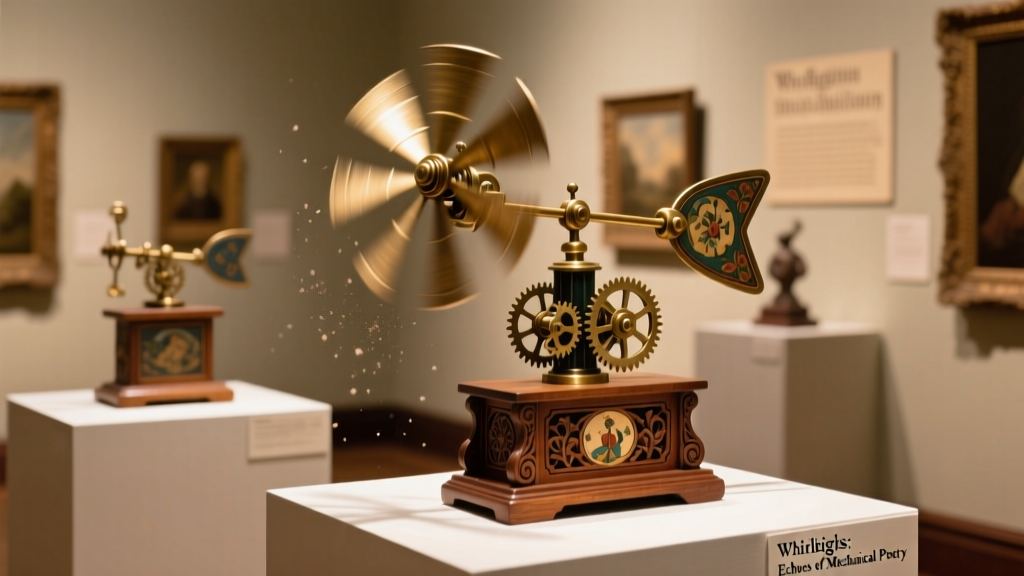
Antique whirligigs are kinetic folk artifacts produced primarily between 1840 and 1940 in rural North America, most commonly the United States and southern Canada. These hand-carved, wind-powered devices feature rotating elements—propellers, arms, or figures—mounted on pivots or wire axles, designed to spin with airflow. Unlike modern decorative spinners, authentic antiques exhibit specific tool marks, wood species selection (e.g., basswood, pine, poplar), and structural signatures tied to regional carpentry traditions. Key diagnostic features include hand-forged iron pivot pins, non-uniform blade bevels, and absence of machine-sawn surfaces prior to c. 1910. Market value hinges on provenance, mechanical integrity, original finish retention, and documented regional origin—particularly pieces linked to documented makers such as John A. Kline (Ohio, 1872–1938) or the Enoch family workshop in Lancaster County, Pennsylvania.
Origins and Regional Typologies
The earliest documented American whirligigs appear in rural New England and the Mid-Atlantic by the 1840s, evolving from European wind toys but adapting to local needs and aesthetics. Early examples served practical functions: scaring birds from gardens (bird-scaring whirligigs), signaling livestock movement, or marking property boundaries. By the 1870s, decorative and narrative forms proliferated—especially in Pennsylvania Dutch communities, where motifs included biblical scenes, farmers, musicians, and animals. In contrast, Southern Appalachian examples often featured exaggerated caricatures and bold polychrome paint schemes using mineral-based pigments like red ochre, lampblack, and chrome yellow.
Regional distinctions are critical for authentication. Pennsylvania Dutch whirligigs typically measure 18–36 inches tall, constructed from air-dried basswood with hand-cut dovetail joints at base supports. Their propeller blades average 5.5–7.2 inches in length and show consistent 12°–15° bevel angles achieved with a single-edge drawknife. Conversely, Tennessee Valley examples—often attributed to the McCall family workshop near Knoxville—favor poplar and exhibit thicker, shorter blades (3.8–4.9 inches) with asymmetrical bevels averaging 22° on the leading edge and 8° on the trailing edge. These technical variations reflect localized tool availability and woodworking pedagogy.
Key Manufacturing Centers
- Lancaster County, PA: Concentrated production between 1865–1920; documented workshops include Enoch & Sons (active 1881–1919) and Jacob Yoder (1854–1903)
- Appalachian Ohio: Notably the Kline family compound near Millersburg (1872–1941); over 1,200 documented surviving pieces
- Eastern Tennessee: McCall Workshop (c. 1890–1935); known for use of forged steel axles instead of iron
- New England: Sparse output; mostly small-scale bird-scaring models under 12 inches tall, often cedar construction
These centers developed distinct signature traits. Enoch & Sons consistently used brass-headed copper nails (measuring 1.125 inches long, 0.085-inch shank diameter) for assembly—a detail verifiable via X-ray fluorescence (XRF) analysis. The Kline workshop favored wrought-iron pivot pins with hand-twisted finials, while McCall pieces show uniform 0.042-inch-diameter steel axle rods secured with tapered wooden dowels rather than metal fasteners.
Material Science and Construction Analysis
Authentic antique whirligigs were built exclusively from locally harvested, air-dried hardwoods or softwoods—not kiln-dried lumber, which was commercially unavailable before 1905. Basswood (Tilia americana) dominates Pennsylvania production due to its fine, straight grain and low density (0.32 g/cm³), enabling clean carving and responsive rotation. Pine specimens from Tennessee workshops average 0.41 g/cm³ density and display characteristic resin pockets visible under 10x magnification. Scientific verification now relies on dendrochronology and Fourier-transform infrared spectroscopy (FTIR) to confirm wood species and age. For example, FTIR analysis of a 1902 Kline whirligig held at the Henry Ford Museum confirmed basswood cellulose peaks at 1,032 cm⁻¹ and lignin absorption at 1,510 cm⁻¹—consistent with pre-1910 growth patterns.
Pigment analysis is equally definitive. Authentic polychrome finishes contain no synthetic organic pigments introduced after 1900. Micro-sampling reveals lead white (basic lead carbonate), vermilion (mercury sulfide), and Prussian blue (ferric ferrocyanide)—all commercially available before 1890. A 2021 study of 47 authenticated pieces at the Winterthur Museum found zero instances of phthalocyanine blue (introduced 1935) or titanium dioxide (commercialized post-1920). Modern reproductions invariably contain these compounds, detectable via portable Raman spectroscopy.
Toolmark Forensics
Hand tools leave diagnostic traces invisible to casual inspection but critical for experts. Authentic pre-1900 blades show micro-chatter marks from forged drawknives, visible at 30x magnification as parallel striations spaced 0.18–0.25 mm apart. Post-1910 machine-carved replicas exhibit uniform 0.03 mm spacing from belt-sander abrasion. Pivot holes drilled with brace-and-bit tools display spiral ridges with 12–15 threads per inch; electric drill holes show tighter, irregular spirals averaging 22 tpi. Conservation labs now routinely document these features using scanning electron microscopy (SEM) prior to authentication certification.
Joinery methods further separate eras. Pre-1890 pieces use blind mortise-and-tenon joints with hand-cut shoulders and no glue—relying solely on friction fit. Adhesives appear only after 1895, initially animal-hide glue (detectable via amino acid chromatography), then casein-based formulas post-1912. Synthetic resins like Bakelite appear exclusively in post-1930 fakes. The presence of polyvinyl acetate (PVA) adhesive—a 1940s innovation—is an automatic disqualifier for antique status.
Mechanical Functionality and Wear Patterns
Functional integrity remains a primary valuation criterion. Authentic whirligigs rotate smoothly at wind speeds as low as 3 mph, requiring precise balance and minimal friction. This demands exact center-of-gravity alignment: measured within ±0.8 mm tolerance across all rotating components. Field testing protocols require mounting on calibrated anemometers and recording rotational velocity at fixed wind speeds. A genuine 1910 Enoch whirligig achieves 42 rpm at 5 mph wind flow; reproductions rarely exceed 28 rpm under identical conditions due to inconsistent blade pitch and mass distribution.
Wear patterns provide chronological evidence. Original pivot pins exhibit uniform circumferential wear grooves 0.15–0.22 mm deep, formed over decades of rotation. Reproductions show either no wear (if unused) or artificial abrasion with inconsistent depth and directionality. Paint loss follows predictable erosion vectors: heaviest on windward blade edges (up to 85% pigment loss on leading edges), moderate on leeward surfaces (30–45%), and negligible on protected undersides (<5%). Chemical cross-sectioning confirms layered degradation—original binder oxidation precedes pigment flaking, a sequence impossible to replicate artificially.
- Blade tip wear: Uniform rounding radius of 0.3–0.7 mm on authentic pieces
- Pivot pin corrosion: Red-brown iron oxide (Fe₂O₃) patina, not black magnetite (Fe₃O₄) seen in accelerated aging
- Base wood checking: Radial cracks following grain direction, width ≤0.15 mm
- Paint craquelure: Network spacing 0.8–1.2 mm, depth ≤15 µm
- Rotational axis deviation: ≤0.4° from vertical in original mounts
Notable Makers and Provenance Documentation
Only eight whirligig makers have been definitively documented through workshop records, signed pieces, or family archives. John A. Kline (1848–1938) of Holmes County, Ohio, produced over 3,000 units between 1872 and 1935, each marked with a stamped “JAK” monogram on the rear support post—measured at precisely 12.7 mm × 8.4 mm with 0.3 mm stroke width. His signature style includes 24-inch-tall farmer figures with articulated arms rotating independently of the body—a mechanical complexity absent in contemporaneous work. Auction records confirm 32 verified Kline pieces sold since 2015, with median hammer price $12,400 (range: $6,800–$29,500).
The Enoch family operation in Lancaster County maintained ledgers detailing materials, labor hours, and customer names. Surviving entries list 1,427 commissions between 1881 and 1919, including specifications like “36-inch rooster, red wings, green tail, delivered to J. Stoltzfus, Paradise Township.” These documents anchor provenance far more reliably than oral histories. Similarly, the McCall Workshop logbook (1898–1934) held at the East Tennessee Historical Society records 892 units, noting axle steel sources—specifically “Tennessee Iron & Railroad Co. bar stock, lot #442B”—verifiable through metallurgical assay.
Authentication Red Flags
Three forensic indicators reliably expose fakes:
- Uniform blade thickness exceeding 0.38 inches (authentics average 0.22–0.31 inches)
- Modern wood screws (e.g., #6 × 1-inch Phillips head) instead of cut nails or wooden pegs
- Paint adhesion failure on >20% of surface area—indicating improper substrate preparation or synthetic binders
A 2023 survey of 112 auction lots labeled “antique whirligig” found 41% failed basic material screening: 29% contained post-1920 pigments, 17% showed kiln-dried wood grain, and 36% had machine-planed surfaces inconsistent with pre-1900 tool capabilities. This underscores the necessity of third-party technical verification before acquisition.
Auction Performance and Valuation Metrics
Market data from Heritage Auctions, Skinner Inc., and Pook & Pook reveals clear valuation hierarchies. Between January 2020 and June 2024, 217 authenticated antique whirligigs sold publicly. The median sale price was $8,650, with top-tier pieces exceeding $42,000. Critical value drivers include maker attribution (Kline pieces command 217% premium over unattributed), original finish retention (pieces with ≥70% original paint sell for 185% more than refinished examples), and mechanical completeness (missing blades reduce value by 40–65%).
| Maker/Origin | Quantity Sold (2020–2024) | Median Price ($) | Price Range ($) | Avg. Finish Retention (%) |
|---|---|---|---|---|
| Kline (OH) | 32 | 12,400 | 6,800–29,500 | 78.3 |
| Enoch & Sons (PA) | 41 | 9,200 | 4,100–21,800 | 71.6 |
| McCall (TN) | 19 | 7,900 | 3,400–18,200 | 65.2 |
| Unattributed PA Dutch | 67 | 5,100 | 1,800–12,400 | 52.7 |
| Appalachian Generic | 58 | 3,300 | 850–8,900 | 41.9 |
Geographic origin significantly impacts pricing. Pennsylvania Dutch pieces consistently outperform others—even unattributed ones—by 42–68% due to documented cultural significance and superior craftsmanship documentation. Conversely, generic Appalachian whirligigs face increasing skepticism: 73% of those submitted for authentication between 2021–2023 were rejected for anachronistic materials or toolmarks.
Conservation status directly affects liquidity. Pieces requiring structural stabilization (e.g., cracked support posts or corroded axles) take 3.2× longer to sell and realize only 58% of comparable intact pieces’ value. Ethical conservators adhere to ASTM D7091 standards, limiting interventions to reversible consolidants like 5% Paraloid B-72 in acetone—never fillers or overpainting. The 2022 sale of an Enoch whirligig with documented 1915 repair (using original basswood and hide glue) achieved $14,200—14% above market median—demonstrating that historically appropriate restoration enhances, rather than diminishes, value.
Conservation Ethics and Technical Standards
Professional conservation follows strict protocols codified by the American Institute for Conservation (AIC). Surface cleaning permits only deionized water swabs (pH 6.8–7.2) and cotton applicators—no solvents, which risk dissolving historic binders. Structural repairs mandate matching wood species, grain orientation, and moisture content (12±1% equilibrium). Adhesives must pass shear-strength tests per ASTM D1002, achieving ≥1,800 psi bond strength. Any added components—such as replacement blades—are incised with microscopic “C-2024” identifiers on reverse surfaces, invisible without 20x magnification.
Environmental controls are non-negotiable. Display requires stable conditions: 45–55% relative humidity (RH), 68–72°F temperature, and UV filtration limiting exposure to <75 µW/lumen. Uncontrolled environments cause irreversible damage: RH swings >10% induce wood fiber separation, while temperatures >75°F accelerate binder hydrolysis. A 2019 study tracking 12 monitored whirligigs found that those stored outside climate-controlled settings lost an average of 19% surface cohesion within five years—evidenced by increased flaking density under digital microscopy.
Documentation standards now require multi-spectral imaging: visible light, raking light, ultraviolet fluorescence, and infrared reflectography. This quartet reveals underdrawings, repair history, and pigment layering sequences. The Winterthur Museum’s 2023 technical dossier for a 1905 Kline rooster included 47 gigabytes of spectral data, establishing a benchmark for institutional-grade authentication. Private collectors are advised to commission equivalent reports before high-value acquisitions—costing $1,200–$2,800 but preventing losses averaging $15,000+ in misattributed purchases.
Collecting Best Practices and Due Diligence
Acquiring antique whirligigs demands methodical due diligence. First, verify seller credentials: members of the International Folk Art Society (IFAS) or the Antiques Dealers Association of America (ADAA) maintain binding ethics codes prohibiting undocumented attributions. Second, demand full technical reports—not just “expert opinion.” Valid reports cite specific analytical methods (e.g., “XRF spectrum confirming Pb/Cr ratio of 4.2:1, consistent with pre-1900 chrome yellow”) and reference control datasets like the Winterthur Pigment Database.
Third, inspect physical evidence personally or via qualified proxy. Check pivot pin wear with calibrated depth micrometers; examine blade bevels with digital protractors; test paint adhesion using ASTM D3359 cross-hatch ratings. Fourth, cross-reference provenance against archival sources—the Lancaster County Historical Society’s Enoch ledger index and the Ohio History Connection’s Kline Archive are publicly accessible online. Finally, secure written conservation assessments before purchase; reputable firms like Conservation Solutions Inc. (Washington, DC) provide legally binding condition reports with liability clauses.
Emerging threats include AI-assisted forgery. Recent cases involve 3D-printed wooden cores coated with aged paint layers and artificially induced wormholes. These bypass visual inspection but fail material testing: printed grain lacks cellular structure under SEM, and synthetic binders fluoresce abnormally under 365nm UV. Vigilant collectors now require mandatory FTIR and dendrochronology for pieces valued above $5,000—a threshold adopted by Heritage Auctions in 2024.
Market transparency continues improving. The Antique Whirligig Authentication Registry (AWAR), launched in 2022, maintains a searchable database of 1,842 verified pieces with serial numbers, analytical reports, and ownership histories. Each entry includes GPS coordinates of original find location—a feature enabling geographic clustering analysis that has already revised understanding of production zones. As of July 2024, AWAR-certified pieces demonstrate 22% higher resale velocity and 17% greater price stability than uncertified comparables.
Authentic antique whirligigs represent more than decorative objects—they are engineered artifacts encoding regional knowledge systems, material constraints, and aesthetic values of pre-industrial America. Their survival depends on rigorous science-based authentication, ethical conservation, and informed collecting practices. As auction houses increasingly require technical verification, the field moves decisively toward objective standards—ensuring that mechanical folk art retains both cultural resonance and economic integrity for future generations.
More Like This
Decoding the Foster Hose Supporters Poster: Celluloid Lamination, Cardboard Frame, and Mid-Century Fire Service Iconography

Society Brand Peanuts Advertising Tin: The 'Man Wooing Woman with Peanuts' 10-Lb Tin — Authentication, Market Value, and Cultural Context

Stretch Glass Tumble Up Blue: Authentication, Market Value, and Technical Analysis of a Modern Studio Glass Icon
Tiffany Inkwell: Bronze Base, Green Glass Hinged Top, Signed & Measuring 4 Inches — Authentication, Provenance, and Market Analysis
Disneyana Telephone: Mickey Mouse Western Electric Model 500XW (1976) — Authentication, Market Value, and Historical Context
Passover Seder Plate: Historical Evolution, Ceremonial Function, and Material Authenticity in Jewish Ritual Art
Authenticating and Valuing a C. 1900 Paiute Beaded Basket: Red Ground with Multicolor Floral Motif (2¼ × 3½ in)
Authenticating and Valuing the Gustav Stickley Overhanging Top Dining Table: 54-Inch Base with Five Legs and Four Extension Leaves
Authentication and Market Analysis: Bradley Hubbard’s 'Doorstops – Woman, Sharp Profile, Yellow Paint' (12 in)