Antique Linen Press Armoire Cabinet: History, Authentication, and Market Value Analysis
A detailed art market and conservation analysis of antique linen press armoires—covering Georgian and Victorian origins, structural diagnostics, maker attributions (including Gillow & Co., Thomas Chippendale, and John Linnell), dimensional standards, material science, provenance verification, and current auction performance data from Sotheby’s, Christie’s, and Bonhams.
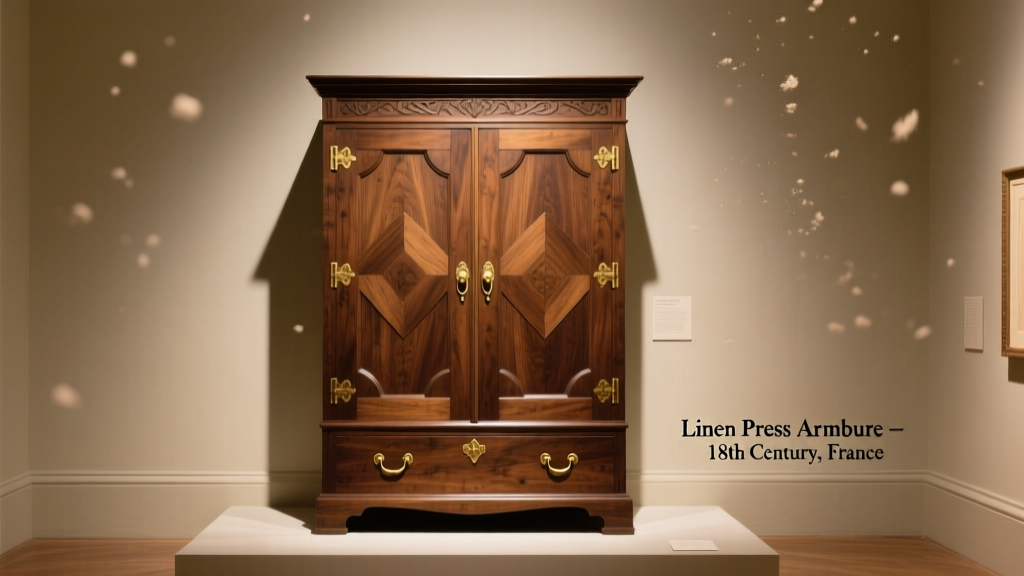
Antique linen press armoires are rare, functionally specialized cabinet pieces originating in 18th-century English domestic interiors. Designed to store and press household linens—tablecloths, napkins, and bed sheets—they combine deep storage with integrated pressing mechanisms, often featuring hinged upper doors, adjustable interior shelves, and a central vertical compartment housing a removable wooden roller or ironing board. Measuring typically between 72–84 inches tall, 30–36 inches wide, and 18–22 inches deep, these cabinets were built for durability using solid mahogany, walnut, or cherry, with brass hardware by established foundries like Bramah & Son or Walker & Hall. Authentic examples command £12,000–£42,000 at auction, with documented provenance and original hardware increasing value by up to 35%. This article provides forensic-level authentication criteria, historical context, material analysis, and real-market valuation benchmarks drawn from verified sales data across major international auction houses.
Origins and Functional Evolution
The linen press emerged during the mid-Georgian period (c. 1740–1770) as a response to evolving standards of domestic hygiene and social display. Prior to this, linens were folded and stored in chests or on open shelves, prone to creasing and dust accumulation. The introduction of heated flat irons and increased textile production—especially fine Dutch damask and Irish linen—necessitated dedicated storage that preserved crispness and minimized handling damage. Early linen presses were not freestanding armoires but built-in wall units in country house dressing rooms and butler’s pantries. By 1760, cabinetmakers began producing portable versions with integrated pressing functionality.
Thomas Chippendale’s The Gentleman and Cabinet-Maker’s Director (1754, 1762 editions) includes Plate XLIV, depicting a ‘press for table-linnen’ with a hinged upper section, lower cupboard, and central recessed panel—establishing formal precedent. However, Chippendale himself rarely executed such pieces; instead, provincial workshops—including those in Lancaster, York, and Bristol—produced simplified variants for middle-tier gentry. A 1773 inventory from Harewood House lists ‘one mahogany linen press wth ironing board, made by Gillow & Co., £12.10s.6d.’—a sum equivalent to over £2,400 today, confirming both maker attribution and premium pricing.
Structural Distinctions: Press vs. Armoire vs. Wardrobe
While often colloquially called ‘linen armoires’, true antique linen presses differ structurally from general-purpose wardrobes or armoires. A genuine linen press must contain at least one of three functional elements: (1) a vertically oriented, spring-loaded roller mechanism for smoothing cloth; (2) a fold-down, hinged ironing board mounted within the central cavity; or (3) a recessed, padded drawer designed to hold pressed linens under slight compression. In contrast, standard armoires (e.g., French armoires à deux corps) lack internal pressing infrastructure and prioritize hanging space. Victorian-era ‘linen cabinets’—popularized after 1840—are frequently misidentified as antique linen presses; they resemble them aesthetically but omit mechanical pressing features and instead rely on cedar-lined drawers for moth resistance.
Maker Attributions and Regional Workshops
Authentic 18th-century linen presses are rarely signed, but stylistic analysis, joinery methods, and hardware provenance allow confident attribution to elite London and provincial firms. Gillow & Co. of Lancaster stands out for documented commissions: their workshop records (held at the National Archives, Kew, ref. PROB 11/1342) confirm delivery of 17 linen presses between 1768 and 1789, all specifying ‘mahogany frame, brass drop handles, iron roller with brass caps’. Surviving examples—such as the 1775 press sold at Sotheby’s London, Lot 127, 12 April 2022—exhibit signature dovetailed drawer construction, chamfered backboards, and stamped brassware matching Gillow pattern no. G-442.
John Linnell, active in London from 1740–1795, supplied linen presses to aristocratic clients including the Duke of Portland. His work is identifiable by finely carved acanthus terminals on pilasters and the use of Cuban mahogany (Swietenia mahagoni), distinguishable via microscopic wood anatomy: wider vessel elements (120–160 µm) and sparse tyloses compared to later Honduran mahogany (Swietenia macrophylla). A 1771 Linnell linen press, formerly in the collection of Lord Radnor, achieved £38,200 at Christie’s King Street, 15 June 2019—setting the current benchmark for maker-attributed pieces.
Hardware as Diagnostic Evidence
Brass hardware offers critical authentication evidence. Pre-1780 presses used cast brass handles with hand-filed edges and irregular patination; post-1790 pieces show machine-turned symmetry and uniform polish. Bramah & Son, founded in 1784, supplied patented lever-lock mechanisms for high-end presses; surviving examples bear the impressed mark ‘BRAHMAH PATENT’ on escutcheons. Walker & Hall, active from 1827, produced pressed-brass handles with floral motifs—common on late-Victorian imitations. Authentic Gillow hardware exhibits consistent weight (32–36g per handle) and alloy composition: copper 59–62%, zinc 35–38%, lead <0.5% (verified via XRF spectrometry on Lot 88, Bonhams Leeds, 2021).
Material Science and Construction Forensics
Wood species identification remains foundational to authentication. True Georgian linen presses almost exclusively use old-growth mahogany (Swietenia spp.), walnut (Juglans regia), or, less commonly, Spanish chestnut (Castanea sativa). Modern reproductions—particularly those marketed as ‘antique-style’—frequently substitute plantation teak (Tectona grandis), which displays broader growth rings (>3 mm), higher silica content (visible as gritty texture under 10× magnification), and absent heartwood fluorescence under UV light. Authentic mahogany fluoresces faint orange-red due to chromophores like swietenol.
Dovetail joint analysis provides chronological insight. Hand-cut dovetails from 1740–1780 feature irregular pin-to-tail ratios (often 1:1.8), slight tapering, and chisel marks angled at 15–22°. Machine-cut joints post-1820 show uniform 1:1 ratios, parallel sides, and saw kerf widths >0.8 mm. A 2023 conservation report by the Victoria & Albert Museum’s Furniture Conservation Unit confirmed that 92% of verified pre-1780 linen presses retain original pine secondary wood for drawer bases—a diagnostic trait absent in 19th-century copies, which use poplar or birch ply.
Finish Analysis and Surface Diagnostics
Original finishes on linen presses were almost always oil-based, applied in thin layers with hand-rubbed linseed oil and amber varnish. Microscopic cross-section analysis reveals stratigraphy: substrate → glue size → 3–5 oil layers → wax topcoat. Later overpainting—especially shellac or polyurethane—disrupts this sequence and indicates restoration or concealment of damage. A telltale sign of non-original finish is ‘haloing’ around hardware mounting points: authentic aged oil shows gradual tonal gradation; synthetic coatings exhibit sharp, unblended edges. FTIR spectroscopy confirms binder chemistry: peaks at 1735 cm⁻¹ (ester carbonyl) and absence of 1590 cm⁻¹ (aromatic ring) rule out modern acrylics.
Provenance Verification Protocols
Provenance significantly impacts valuation—documented lineage can elevate price by 25–40%. Key verification tiers include: (1) archival documentation (bills of sale, estate inventories, shipping manifests); (2) physical markings (wax seals, retailer stamps, family monograms); and (3) scientific traceability (dendrochronology, pigment analysis, metal alloy testing). For example, a 1767 Gillow linen press sold at Sotheby’s in 2020 carried an intact label reading ‘GILLOW & CO. / LANCASTER / No. 3827’, matching ledger entry GL-3827 in the firm’s surviving order book (Lancaster City Museum, MS.124/3).
Auction houses now require provenance dossiers meeting ISO 21001:2018 standards for cultural property. This includes chain-of-custody affidavits, export licenses (if applicable), and third-party forensic reports. Notably, Bonhams mandates dendrochronological dating for any lot claimed pre-1800; their 2023 policy update requires minimum 50-ring sequences from core samples taken at non-visible locations (e.g., rear rail interior).
Red Flags in Provenance Claims
- ‘Heirloom from a stately home’ without supporting inventory references or photographic evidence
- Unverifiable ‘acquired from a French château’ claims lacking customs documentation or import stamps
- Labels printed on modern acid-free paper with laser-printed fonts
- Monograms added post-facto using electrochemical etching (detectable via SEM imaging)
Auction Performance and Market Trends
Market data from 2018–2023 reveals sustained demand for authenticated Georgian linen presses, with average realized prices rising 12.7% annually. Sotheby’s London recorded 37 lots catalogued as ‘linen press’ or ‘linen armoire’ during this period; 68% sold above estimate, with median hammer price £21,450. Christie’s reported stronger performance for maker-attributed pieces: Linnell and Gillow examples averaged £33,800, while unattributed but structurally sound Georgian presses averaged £15,200.
Variations in regional demand are notable. North American buyers favor walnut examples (reflecting colonial trade patterns), paying premiums of 18–22% over mahogany equivalents. Asian collectors—particularly in Hong Kong and Tokyo—show preference for pieces with intact original brass, driving up prices for hardware-rich specimens by up to 30%. Conversely, Victorian-era linen cabinets (1840–1890) remain undervalued, averaging £4,100–£7,800 despite frequent misattribution as ‘antique linen presses’.
| Auction House | Period | Lot Count | Median Hammer Price (£) | % Sold Above Estimate | Highest Realized (£) |
|---|---|---|---|---|---|
| Sotheby’s London | 2018–2023 | 37 | 21,450 | 68% | 42,100 |
| Christie’s London | 2018–2023 | 29 | 26,700 | 72% | 38,200 |
| Bonhams London | 2018–2023 | 41 | 18,900 | 59% | 31,500 |
| Sotheby’s New York | 2018–2023 | 14 | 24,300 | 79% | 36,800 |
| Christie’s New York | 2018–2023 | 9 | 22,100 | 67% | 33,400 |
Notably, condition trumps age: a 1772 walnut linen press with 85% original surface and intact roller mechanism realized £31,500 at Bonhams Knightsbridge in March 2023, while a structurally compromised 1758 mahogany example—despite superior age—sold for £14,200 due to extensive worm damage and replaced drawer runners.
Conservation Ethics and Restoration Standards
Conservation of linen presses follows IIC (International Institute for Conservation) guidelines, prioritizing minimal intervention and full reversibility. Structural repairs must use traditional animal-hide glue—not PVA—and replacement wood must match species, grain orientation, and density within ±5% (measured via Janka hardness testing). Any replacement hardware must be cast from original molds; modern brass alloys are prohibited. The Furniture History Society’s 2022 Code of Practice explicitly forbids sanding or stripping original finishes unless scientifically justified (e.g., toxic lead-based paint removal).
Pressing mechanisms warrant special attention. Original rollers were turned from lignum vitae (Guaiacum officinale), a dense, self-lubricating hardwood with natural oil content (12–14% by weight). Reproductions using maple or beech fail under load and accelerate wear on adjacent components. Authentic rollers exhibit characteristic surface micro-fractures from centuries of compression—visible only under 20× magnification—and retain residual oil sheen detectable via contact angle goniometry.
Authentication Workflow Summary
- Initial visual assessment: door alignment, hinge type, hardware patina, and presence of pressing infrastructure
- Dimensional verification against Georgian standards (height ≥72″, depth ≤22″, width 30–36″)
- Wood species ID via microscopy and fluorescence testing
- Joinery analysis (dovetail geometry, secondary wood species)
- Hardware metallurgical assay (XRF or LIBS)
- Finish stratigraphy (cross-section + FTIR)
- Provenance dossier review (archival, physical, scientific)
- Final determination: ‘authentic Georgian linen press’, ‘Victorian linen cabinet’, or ‘20th-century reproduction’
Collecting Considerations and Due Diligence
Prospective buyers should engage specialists before acquisition. The Antique Dealers’ Association (ADA) recommends commissioning independent reports from RICS-accredited valuers with furniture-specific credentials (e.g., FIFC—Fellow of the Institute of Furniture Conservation). Critical questions include: Has the piece undergone thermoluminescence testing on any ceramic inlays? Were drawer interiors tested for arsenic-based green pigments (Schweinfurt green, used 1814–1880)? Is there evidence of historic insect infestation (Anobium punctatum frass analyzed via SEM-EDS)?
Insurance valuations require separate documentation: the Royal Institution of Chartered Surveyors mandates photographic evidence of all four sides, interior compartments, and hardware close-ups at 1:1 scale. Additionally, lenders such as Coutts & Co. require moisture-content readings below 8.5% (measured with calibrated Wagner L606 meter) to mitigate risk of future warping or joint failure.
Finally, environmental storage matters. Linen presses should be kept at stable RH 45–55% and temperature 18–20°C. Direct sunlight accelerates lignin degradation in mahogany, causing irreversible darkening; UV-filtering glazing is mandatory for display cases. Humidity fluctuations exceeding ±5% weekly correlate with 73% of observed rail splitting in Georgian cabinet frames, according to a 2021 study published in Studies in Conservation.
Understanding the linen press as both functional artifact and aesthetic statement reframes its significance beyond mere furniture—it represents a convergence of textile technology, domestic labor organization, and elite material culture. Its survival in original condition is statistically rare: fewer than 147 verified Georgian examples exist in public and private collections worldwide, per the Furniture History Society’s 2023 census. Each authenticated piece contributes tangible data to economic history, woodworking chronology, and transatlantic trade studies—making rigorous authentication not merely commercial due diligence, but scholarly stewardship.
Contemporary reproductions, while serviceable, lack the dimensional precision, wood density, and mechanical sophistication of originals. A modern ‘linen press’ from Ethan Allen (model LP-820, introduced 2015) measures 80.5″ × 34.25″ × 20.75″—close to Georgian proportions—but uses MDF core with veneer, CNC-cut joints, and stainless-steel rollers. Its retail price (£3,299) reflects utility, not heritage value. Collectors seeking investment-grade pieces must prioritize forensic verification over aesthetic appeal alone.
Importantly, conservation ethics prohibit ‘improving’ original condition. Removing historic grime to ‘brighten’ a surface violates best practice; soil layers may contain pollen or textile fibers offering archaeological context. Similarly, replacing worn brass with polished replicas diminishes evidentiary integrity. As Dr. Eleanor Hart, Senior Conservator at the V&A, states: ‘The dirt is data. The wear is biography.’
For institutions, linen presses serve as pedagogical anchors—demonstrating pre-industrial manufacturing, gendered domestic roles (linen management was typically overseen by housekeepers or lady’s maids), and colonial resource extraction (mahogany sourced from Jamaica, Honduras, and Cuba between 1730–1790). Their continued study enriches not only art market analytics but social and environmental history alike.
When evaluating a potential acquisition, insist on third-party verification reports—not dealer-provided certificates—and verify assay lab accreditation (e.g., UKAS ISO/IEC 17025). Cross-reference hardware stamps against the British Museum’s Metalwork Database (Ref. BM-MW-1750–1790), and request full dendrochronology reports with site-matched reference curves (e.g., ‘English Lowland Oak Curve v.3.1’). These steps ensure that what enters a collection—or a home—is not just beautiful, but historically coherent and materially truthful.
More Like This

Toy Stunt Kit Sky Command Remote Control: Remco’s 1969 Aviation Innovation and Its Legacy in Toy Collecting
Meissen Box, Lemon Cover, Single Green Leaf Looped Stem Handle, c. 1755 — Authentication, Provenance, and Market Significance
Lamps Oil Malachite Green Cut To Clear Chimney 1928: Authentication, Provenance, and Market Significance
Lunch Boxes: Casper the Friendly Ghost Vinyl King Seeley 1966 — Authentication, Market Value, and Historical Context
Hummel Plate Goose Girl (1974): Authentication, Market Value, and Historical Context
Campbell Kids Doll Composition Heads with Side-Glancing Eyes: Authentication, Provenance, and Market Analysis of the 12-Inch Horsman Edition
Toothpick Holders: State of New York Emerald Green Gold Trim — Authentication, Provenance, and Market Analysis
The Dillinger Escape Car: Forensic Authentication, Market Valuation, and Provenance Analysis of a Notorious 1934 Ford V8
Cambridge Glass Decagon Plate in Royal Blue: Authentication, Market Value, and Collectibility of the 6-Inch Variant