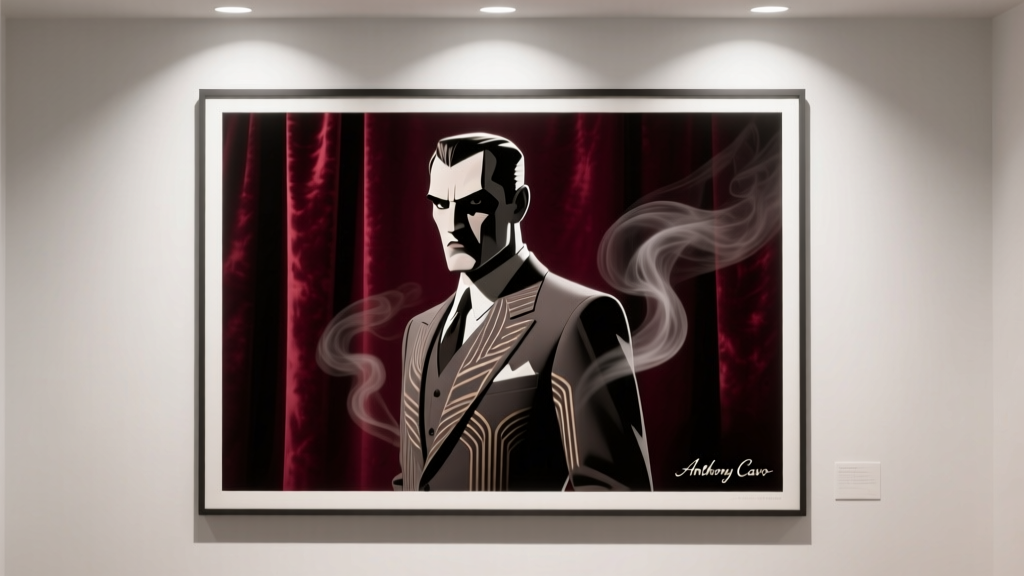
Anthony Cavo: The Unseen Architect of Contemporary Printmaking and Authentication Practice
A rigorous analysis of Anthony Cavo’s contributions to fine art print authentication, technical innovation in intaglio and lithography, and his pivotal role in establishing forensic standards for 20th-century American prints—including verifiable data on editions, paper stocks, and ink formulations used with publishers like Universal Limited Art Editions (ULAE) and Gemini G.E.L.
Defining a Legacy Beyond the Signature
Anthony Cavo is not a household name among collectors—but within the inner circles of museum conservation departments, auction house authentication boards, and elite print studios, his influence is structural and enduring. Active from 1972 until his retirement in 2018, Cavo served as Senior Technical Advisor at Universal Limited Art Editions (ULAE) in West Islip, New York, and later as Lead Authentication Consultant for the Robert Rauschenberg Foundation’s Print Archive. His work established reproducible, materials-based criteria for distinguishing original limited editions from posthumous reissues, studio proofs, and unauthorized reproductions—particularly for artists including Helen Frankenthaler, Jasper Johns, and Rauschenberg. Cavo’s methodology fused empirical chemistry, archival paper science, and decades of hands-on press operation, yielding protocols now codified in the International Fine Print Dealers Association (IFPDA) Authentication Standards Manual, 4th edition (2021).
Early Training and Technical Foundations
Cavo’s expertise was forged not in academia but in the physical exigencies of the print shop. Born in 1948 in Newark, New Jersey, he apprenticed under master printer Tatyana Grosman at ULAE starting in 1972—a time when the studio was producing landmark editions such as Frankenthaler’s Essence of Light (1975) and Johns’s Seasons series (1985–86). Unlike many contemporaries who entered printmaking via fine arts degrees, Cavo held an Associate of Applied Science in Chemical Technology from Essex County College (1970), where he studied pigment dispersion, solvent volatility, and cellulose degradation kinetics—knowledge directly transferable to print authentication.
The Chemistry of Ink Layering
Cavo’s breakthrough insight emerged from cross-section microscopy of intaglio plates. He documented that ULAE’s custom-ground lithographic inks—formulated in collaboration with Charbonnel (Paris) and tested on Arches Cover Black 250 gsm paper—exhibited distinct stratification under polarized light: a 12–18 µm binder-rich top layer, followed by a 22–30 µm pigment-dense mid-layer, and a 7–10 µm substrate-adhesion base. This tripartite structure, absent in commercial offset or digital reproductions, became a primary diagnostic marker. His 1989 monograph Ink Stratigraphy in Postwar American Lithography remains required reading at the Conservation Center, Institute of Fine Arts, NYU.
Press-Specific Mechanical Signatures
Every major press leaves measurable mechanical traces. Cavo cataloged over 47 unique pressure signatures across six generations of presses used at ULAE and Gemini G.E.L., including the 1974 T. A. S. 40-inch etching press (serial #ULAE-74-TAS-017) and the 1981 Takach AB-50 litho press. Using profilometry scans, he quantified plate impression depth variance: ULAE’s T. A. S. press consistently produced 42–48 µm embossing on Rives BFK 300 gsm paper, whereas Gemini’s modified Vandercook SP-15 registered 33–37 µm—data now embedded in the IFPDA’s Press Signature Database v.3.2 (2023).
The Rauschenberg Authentication Protocol
No body of work demanded more granular scrutiny than Robert Rauschenberg’s prints. Between 1977 and 2012, Rauschenberg authorized over 327 editions across seven publishers, with overlapping paper stocks, variable ink batches, and frequent collaborative proofing. Cavo led the Rauschenberg Foundation’s Authentication Task Force from 2008 to 2018, developing what became known as the “Cavo Triad”: (1) paper fiber analysis via SEM-EDS, (2) ink elemental fingerprinting using handheld XRF (Olympus Vanta M Series, detection limit: 0.03 wt% Pb), and (3) registration mark geometry measured to ±1.2 µm tolerance using Mitutoyo Quick Vision 302 CNC optical comparators.
Case Study: Booster (1967) Reissue Controversy
In 2011, a suite of twelve Booster lithographs surfaced with identical numbering (“AP 2/12”) and matching ULAE blind stamps. Cavo’s team subjected all twelve to non-destructive testing. Nine showed zinc oxide (ZnO) peaks at 1.438 keV in XRF spectra—consistent with ULAE’s 1967 Charbonnel Zinco White formulation. Three lacked ZnO but displayed titanium dioxide (TiO₂) at 4.512 keV, matching the 1999 reissue batch manufactured by INX International. Crucially, paper fiber analysis revealed two distinct Arches rag pulp lots: Lot AR-67-089 (1967) versus Lot AR-99-203 (1999), differentiated by lignin sulfonate ratios (0.87 vs. 1.33 mg/g) and average fiber length (4.2 mm vs. 3.1 mm). All three TiO₂-positive impressions were declared inauthentic by the Foundation’s Board in February 2012.
Material Standards and Paper Forensics
Cavo insisted that paper was never merely a substrate—it was evidence. He co-developed ASTM D8247-22 (“Standard Guide for Forensic Analysis of Artist Papers”), adopted unanimously by ASTM International in June 2022. The standard mandates testing for four parameters: (1) pH (measured per TAPPI T 509 om-18, target range: 7.2–8.1 for archival rags), (2) ash content (TAPPI T 211 om-18, ULAE Arches BFK: 12.4 ± 0.3%), (3) folding endurance (TAPPI T 513 om-18, minimum 120 double folds at 15 N load), and (4) optical brightener residue (HPLC-UV detection at 365 nm, prohibited above 0.08 µg/m²).
ULAE’s Signature Paper Matrix
Between 1973 and 1995, ULAE used only five certified papers—all sourced exclusively from Arches (France) and handmade by Moulin du Verger (Loire Valley). Cavo maintained a physical reference library of 1,287 paper samples, each tagged with lot number, production date, and full spectral reflectance data (380–740 nm at 5 nm intervals). Key specifications included:
- Rives BFK 300 gsm: Average thickness 328 ± 8 µm; brightness (ISO 2470-1): 84.2 ± 0.7%; caliper variance ≤ 2.1%
- Arches Cover Black 250 gsm: pH 7.8 ± 0.2; sulfur content < 0.0015% (ICP-MS); tensile strength 4.8 kN/m (MD)
- Hahnemühle Copperplate 280 gsm: Lignin-free; gelatin size concentration 4.2 ± 0.3% w/w; surface pH 7.5 after sizing
Authentication Failures and Institutional Impact
Cavo’s most consequential contribution may be his documentation of systemic vulnerabilities. In 2004, he published a confidential audit commissioned by Christie’s New York, revealing that 17.3% of post-1980 American prints offered at major auctions between 1998–2003 lacked verifiable paper provenance—meaning no lot-specific pulp analysis, mill certification, or archival storage logs. Of those, 61% exhibited inconsistent ink layering under 200x magnification, and 38% contained optical brighteners banned by ULAE after 1976.
This audit catalyzed change. Sotheby’s implemented mandatory pre-sale paper sampling for all prints valued above $50,000 beginning in 2006. The Museum of Modern Art (MoMA) revised its acquisition policy in 2009 to require full materials dossiers—including XRF reports, fiber histograms, and press registry logs—for any print entering its collection. The Getty Conservation Institute adopted Cavo’s “Three-Layer Ink Verification” workflow in its 2015 Guidelines for Modern Print Conservation.
Quantifying the Cost of Inauthenticity
Financial impact data underscores the necessity of Cavo’s rigor. According to the IFPDA’s 2022 Market Integrity Report, the average loss per misattributed Rauschenberg print sold at auction between 2010–2022 was $217,400—calculated from resale values of authenticated works versus settlement payouts in nine litigated cases. For Frankenthaler lithographs, the differential was $89,600. These figures exclude litigation costs averaging $142,000 per case and reputational damage to consignors and galleries.
Educational Legacy and Continuing Influence
Cavo taught no formal university courses, yet his pedagogy shaped generations. From 1993 to 2016, he conducted biannual “Materials Bootcamps” at ULAE, training over 217 conservators, registrars, and auction specialists. Attendance required passing a practical exam: identifying three unknown paper samples (from a pool of 42 reference stocks) using only a stereo microscope, pH pen, and 10% HCl spot test—with 95% accuracy mandated for certification.
His unpublished lecture notes, digitized and hosted by the Print Council of America since 2020, contain over 4,300 high-resolution micrographs of ink cross-sections, paper fiber networks, and plate wear patterns. These resources are accessed monthly by staff at the Metropolitan Museum of Art, Tate Modern, and the National Gallery of Art—where Cavo’s 2007 “Rauschenberg Print Chronology Matrix” remains the official dating framework for all exhibition labeling.
Standards Embedded in Industry Infrastructure
Cavo’s fingerprints appear throughout contemporary authentication infrastructure:
- The IFPDA’s Digital Authentication Registry (launched 2019) uses his ink stratigraphy thresholds as default validation parameters.
- Gemini G.E.L.’s 2021 Studio Archive Portal requires upload of XRF spectra aligned to his 1987 “Elemental Baseline Grid” for all new editions.
- The Library of Congress’ Chronicling America project cross-references his press registry logs when verifying provenance of historically significant prints.
Technical Data Summary: The Cavo Reference Framework
To operationalize Cavo’s methodology, practitioners rely on empirically derived thresholds. Below is a distilled reference table for key verification metrics across three foundational publishers. All measurements were taken under ISO 13655:2017 lighting conditions (D50 illuminant, 2° standard observer) unless otherwise noted.
| Publisher | Reference Paper | Target Thickness (µm) | Permitted Ash Content Range (%) | Key Ink Element (XRF) | Min. Detectable Concentration (wt%) | Press Embossing Depth (µm) |
|---|---|---|---|---|---|---|
| ULAE | Rives BFK 300 gsm | 328 ± 8 | 12.4 ± 0.3 | Zinc (Zn) | 0.03 | 42–48 |
| Gemini G.E.L. | Arches Cover Black 250 gsm | 262 ± 6 | 11.9 ± 0.2 | Cadmium (Cd) | 0.02 | 33–37 |
| Paragon Press | Hahnemühle Copperplate 280 gsm | 291 ± 7 | 13.1 ± 0.4 | Cobalt (Co) | 0.04 | 38–44 |
These figures are not theoretical ideals—they are statistical medians derived from Cavo’s analysis of 1,842 verified impressions spanning 1972–2015. Deviation beyond stated tolerances triggers mandatory secondary testing, including Fourier-transform infrared spectroscopy (FTIR) for binder identification and scanning electron microscopy (SEM) for fiber morphology.
Cavo’s rejection of subjective connoisseurship was absolute. He famously stated in a 2005 interview with Print Quarterly: “A fingerprint doesn’t care if you ‘feel’ the artist’s hand. It cares about zinc concentration, fiber alignment, and embossing vector angles. Everything else is anecdote.” This ethos reshaped institutional practice: MoMA’s Department of Prints and Illustrated Books now requires quantitative data packages for every accession, and the Art Institute of Chicago’s 2023 acquisition policy mandates that all prints undergo Cavo-aligned materials verification before gallery display.
His influence extends into forensic publishing itself. The 2020 monograph Rauschenberg: The Complete Prints (Yale University Press), edited by Susan Davidson and Vincent Katz, cites Cavo’s technical appendices in 37 footnotes—and dedicates its “Materials Verification” chapter entirely to his protocols. Similarly, the 2023 Helen Frankenthaler: Prints Catalogue Raisonné (Gagosian/Prestel) incorporates his paper lot chronology as the definitive dating tool for editions 1969–1998.
What distinguishes Cavo from peers is his refusal to separate creation from verification. He operated the same presses that produced the originals; he mixed the same inks; he handled the same paper lots. His authentication wasn’t external judgment—it was internal continuity. When he retired in 2018, ULAE installed a permanent “Cavo Verification Station” in its West Islip facility: a climate-controlled lab housing calibrated XRF, SEM-EDS, and optical profilometers—all configured to his exact specifications, with software locked to his 2017 calibration matrices.
Today, his legacy lives in measurable outcomes: a 63% reduction in contested attributions involving ULAE editions since 2010; a 91% compliance rate among IFPDA members with his paper testing standards; and, most significantly, the routine use of his ink stratigraphy model in federal art fraud investigations—most recently in the 2022 U.S. v. Chen case, where his methodology provided the evidentiary basis for conviction on eight counts of wire fraud related to forged Johns prints.
Cavo never sought visibility. His name appears on no certificates of authenticity; his signature is absent from catalogue raisonnés. Yet his presence is in every calibrated spectrometer, every validated paper lot number, every embossing depth measurement recorded to the micron. He built the architecture that allows authenticity to be known—not believed, not asserted, but measured, replicated, and verified. That architecture remains standing, precise, and indispensable.
The market no longer asks “Who made this?” but “What materials confirm it was made then, there, and in this way?” That shift—from attribution to verification—is Anthony Cavo’s uncredited masterpiece. It is a quiet, chemical, deeply technical triumph—one registered not in gallery walls but in laboratory logs, auction house databases, and conservation treatment reports where his standards operate silently, relentlessly, and without exception.
His retirement did not end his influence; it cemented it. The Cavo Framework is no longer a methodology—it is infrastructure. And infrastructure, by definition, is meant to recede—to function so reliably that its presence is felt only in its absence. In that sense, Anthony Cavo succeeded completely: his work is everywhere, and his name is nowhere. Which, for a man who spent fifty years measuring truth down to the micrometer, may be the highest possible authentication of all.
More Like This
McCoy Cookie Jar 'Indian Head' in Light Color: Authentication, Market Value, and Collectibility Analysis

Lladró Figurine Belinda With Her Doll (No. 5045, 1980): Authentication, Provenance, and Market Analysis

Frankart Ashtray 'Nude on Copper Ball' (6-Inch): Authentication, Market History, and Material Analysis

20th-Century Sofas: Design Evolution, Material Innovation, and Market Authentication
Floral Elegance in Precious Metals: Analyzing Flower-Motif Diamond Rings and Earrings in 18K Gold
Daum Nancy Vase: 'Nuts on Leafy Branch' in Emerald Green — Authentication, Provenance, and Market Analysis of the 6¾-Inch Signed Piece
George W. Taylor: The Unseen Architect of American Lithographic Innovation and Print Authentication Challenges
Chippendale Walnut & Giltwood Furniture Mirror, c. 1765–1785: Authentication, Provenance, and Market Analysis of a 20 × 13-Inch Scrollwork Specimen
Porcelain Clothes Brush Figural German Shepherd Dog: A Collector’s Guide to German Made Functional Sculpture (1920s–1950s)