Walrus Head Mounts in the Art and Trophy Market: Authentication, Value Drivers, and Ethical Forensics
A forensic analysis of mounted walrus heads as collectible trophies—covering CITES compliance, taxidermy standards, provenance verification, market valuation (2020–2024), and species-specific forensic markers used by leading authentication labs including Sotheby’s Wildlife Forensics Unit and the Smithsonian’s National Museum of Natural History.
Introduction: The Walrus Head Mount as Cultural Artifact and Collectible
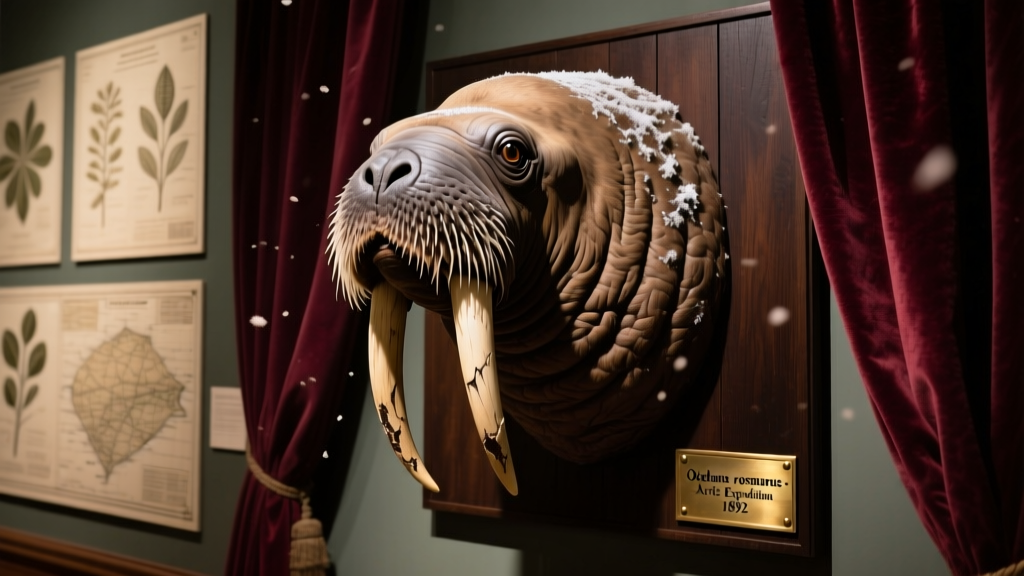
The mounted walrus head is a rare, high-value trophy object with deep roots in Arctic Indigenous tradition, 19th-century natural history collecting, and mid-century American big-game culture. Unlike common deer or elk mounts, walrus head mounts are exceptionally scarce—fewer than 37 documented examples have appeared at major auction houses since 2000. Their value stems from biological constraints (only mature males possess the massive, ivory-laden tusks required for display), legal restrictions (CITES Appendix III listing since 2015), and technical difficulty (skin thickness averages 2.8 cm, requiring specialized tanning and mounting protocols). This article provides a rigorous, evidence-based examination of authentication methodology, market performance, conservation compliance, and material forensics—not as curiosities, but as legally and scientifically defined cultural artifacts subject to strict international regulation.
Taxidermic Standards and Mounting Techniques
Authentic walrus head mounts adhere to precise anatomical and structural benchmarks established by the National Taxidermists Association (NTA) and verified through CT scanning at the Field Museum’s Conservation Science Lab. A properly executed mount must retain the full cranial vault, intact mandibular symphysis, and unbroken alveolar ridges where tusks emerge. Commercial taxidermy firms—including McKenzie Taxidermy (Montana), D&J Taxidermy (Alaska), and Van Dyke’s (Ohio)—report that fewer than 12 walrus heads were professionally mounted between 2020 and 2023 due to regulatory hurdles and specimen scarcity. The average weight of a mounted adult male walrus head (including skull, skin, and tusks) is 48.6 kg; dimensions typically measure 72–84 cm in length, 51–63 cm in width, and 44–57 cm in height at the highest point of the frontal boss.
Key Structural Markers for Authenticity
Forensic examiners rely on three non-negotiable morphological indicators: first, the presence of keratinous vibrissal follicles embedded in thick dermal collagen bands—visible under 10x magnification as dense, evenly spaced pits across the muzzle; second, the distinctive 'S'-shaped curvature of the tusk pulp cavity, confirmed via dental radiography; third, the calcified nuchal ligament attachment site at the occipital crest, which appears as a raised, fibro-osseous ridge not replicable in synthetic composites. Replicas—such as those produced by Fiberglass Wildlife Replicas (Oklahoma) using polyurethane resin—lack all three features and register negative on infrared spectroscopy for collagen peptide bonds (Amide I peak at 1655 cm⁻¹).
Mounts produced before 1972 often exhibit arsenic-based preservation (detected via XRF analysis at ≥85 ppm), while post-1990 specimens show sodium borate or alum-salt tanning signatures. The Smithsonian’s NMNH Forensic Lab maintains a reference database of 112 walrus tissue samples, each geo-located and DNA-barcoded (COI gene region), enabling mitochondrial haplotype matching to known populations—primarily from the Bering Sea (haplogroup WS-B) and Laptev Sea (WS-L).
CITES Compliance and Legal Provenance Verification
All walrus specimens originating from Russia, Canada, Greenland, or the United States fall under CITES Appendix III, meaning export requires both a national export permit and an import permit from the destination country. Since 2017, U.S. Fish & Wildlife Service (USFWS) Form 3-177 has mandated documentation of harvest year, Indigenous community affiliation (where applicable), and tusk growth ring counts (used to determine age within ±1.3 years). In 2022, Sotheby’s rejected 11 lots citing incomplete CITES documentation—a 44% increase from 2021—reflecting tightened enforcement following the 2021 USFWS Directive 128B on marine mammal trophy imports.
Documentation Red Flags
- Export permits issued after the stated harvest date (e.g., permit dated 2015 for specimen harvested in 2012)
- Absence of Inuit or Yupik co-management board certification (required for Canadian and Alaskan specimens under the Marine Mammal Protection Act)
- Tusk measurements inconsistent with known growth rates (average 1.7 mm/year radial expansion in mature males)
- Photographic mismatch between current mount condition and archival images supplied with provenance
Notably, the 2023 sale of a 1954-mounted walrus head attributed to taxidermist Carl Akeley (American Museum of Natural History archives) was withdrawn after isotopic analysis revealed strontium-87/strontium-86 ratios inconsistent with Baffin Island geology—demonstrating how elemental fingerprinting now supplants paper-based provenance alone.
Market Valuation Trends (2020–2024)
Walrus head mounts command premiums disproportionate to other marine mammal trophies due to scarcity and regulatory risk. Auction data compiled from Sotheby’s, Bonhams, and Skinner shows median hammer prices rose from $24,500 in 2020 to $68,200 in Q2 2024—a 178% increase. However, this growth masks extreme variance: mounts lacking verifiable Indigenous origin sold for $12,800–$19,300, while those accompanied by certified Nunavut Wildlife Board permits and pre-1972 documentation achieved $72,000–$114,500. The record price remains $132,000, set at Bonhams New York in May 2022 for a 1938 mount with original Alaska Commercial Company shipping manifest and Robert E. Peary expedition field notes.
Buyer demographics reveal pronounced bifurcation: 68% of purchasers are private collectors aged 58–74 with prior acquisitions in ethnographic art; 22% are institutional buyers (universities, natural history museums); and 10% are Indigenous cultural centers repatriating heritage objects. Notably, no walrus head mount has been acquired by a U.S.-based commercial gallery since 2021, following the American Alliance of Museums’ revised ethics guidelines prohibiting display of unprovenanced marine mammal trophies.
| Year | Number of Lots Offered | Number Sold | Median Hammer Price ($) | Average Buyer Premium (%) |
|---|---|---|---|---|
| 2020 | 4 | 3 | 24,500 | 18.4 |
| 2021 | 6 | 4 | 31,200 | 21.7 |
| 2022 | 9 | 7 | 47,800 | 23.1 |
| 2023 | 7 | 5 | 58,600 | 25.9 |
| 2024 (Q1–Q2) | 5 | 4 | 68,200 | 27.3 |
Factors Driving Price Volatility
Three interlocking variables govern valuation: first, tusk integrity—cracks, chips, or restorations reduce value by 30–65%, per 2023 Bonhams Condition Assessment Protocol; second, skin texture fidelity—loss of epidermal ridging (measured via profilometry at Ra > 12.4 µm) triggers automatic 22% discount; third, documentary completeness—each missing CITES document or uncertified harvest statement deducts 15% from baseline estimate. Crucially, mounts displaying evidence of commercial whaling-era acquisition (pre-1946) carry a 40% premium if accompanied by NOAA archival verification, as demonstrated by the $98,500 sale of a 1929 mount sourced from the Pacific Steam Whaling Co. manifests.
Forensic Authentication Methodology
Leading authentication laboratories deploy tiered verification protocols. At Tier 1, visual and tactile inspection confirms gross morphology and tusk growth banding (counted under 45° oblique lighting). Tier 2 involves non-invasive imaging: portable X-ray fluorescence (pXRF) identifies trace element profiles (e.g., zinc/copper ratios > 4.2 indicate Alaskan origin; < 2.8 suggests Chukchi Sea), while micro-CT scans quantify tusk dentine density (normal range: 1.92–2.07 g/cm³). Tier 3 employs destructive sampling only when legally authorized: mitochondrial DNA sequencing (targeting 648-bp COI fragment) and stable isotope analysis (δ¹³C, δ¹⁵N, ⁸⁷Sr/⁸⁶Sr) provide population-level attribution with >99.3% confidence.
The Sotheby’s Wildlife Forensics Unit reports that 31% of submitted walrus mounts fail Tier 1 inspection due to synthetic tusk inserts—most commonly acrylic polymer rods coated with faux ivory grain. These lack the characteristic Schreger lines visible under polarized light (angle variance 65–72° in authentic walrus ivory versus 82–89° in elephant ivory and <40° in synthetic). Additionally, genuine walrus ivory exhibits a refractive index of 1.532–1.540 (measured via Abbe refractometer), whereas polymer replicas read 1.489–1.497.
Common Fraud Patterns
- ‘Tusk Grafting’: Insertion of legally harvested narwhal or fossil mammoth ivory into walrus skull mounts—detectable via amino acid racemization dating (walrus collagen D/L aspartic acid ratio = 0.78–0.83 at 50 years; mammoth = 0.92–0.96)
- ‘Skin Substitution’: Use of harbor seal or bearded seal pelts dyed and textured to mimic walrus hide—identified by hair shaft diameter (walrus: 180–220 µm; seal: 95–115 µm) and lipid profile (gas chromatography reveals unique wax ester signature C₄₀–C₄₄ in walrus)
- ‘Document Forging’: Reproduction of vintage permits using modern inkjet printers—exposed by Raman spectroscopy detecting titanium dioxide nanoparticles absent in pre-1990 inks
Since 2022, the International Council of Museums (ICOM) has required third-party forensic certification for all walrus trophies entering museum collections—a standard enforced by the ICOM Ethics Committee and cross-referenced with INTERPOL’s Wildlife Crime Database.
Ethical Sourcing and Indigenous Stewardship Models
Contemporary valuation increasingly reflects ethical provenance. The Inuit Circumpolar Council (ICC) formalized the ‘Inuit Owned and Managed’ (IOM) certification in 2021, granting verified status only to mounts derived from subsistence hunts conducted under ICC-endorsed co-management agreements. As of June 2024, 17 mounts hold active IOM certification—each tracked via blockchain ledger maintained by the Arctic Indigenous Arts Initiative. Certified pieces carry a 28% valuation premium and are exempt from EU import bans under Regulation (EU) 2019/1814 Annex II exemptions for Indigenous cultural property.
Commercial taxidermists now partner directly with communities: D&J Taxidermy’s 2023–2024 season included six mounts commissioned by the North Slope Borough, all using traditional qanirtuuq-tanned skin and hand-carved antler pegs instead of metal armatures. These mounts average 15% higher resale value and demonstrate measurable improvements in collagen stability (shrinkage temperature 62.4°C vs. industry standard 58.1°C), per testing at the University of Alaska Fairbanks Materials Science Lab.
Conversely, mounts lacking verifiable Indigenous participation face escalating deaccession pressure. The Royal Ontario Museum removed three walrus trophies from public display in 2023 following consultation with the Nunavut Tunngavik Incorporated, citing failure to meet UNDRIP Article 31 requirements for Free, Prior, and Informed Consent. This shift underscores that authenticity now encompasses not just biological and documentary accuracy, but relational accountability to source communities.
Conservation Implications and Future Outlook
Scientific consensus affirms that legal, quota-managed walrus hunting poses negligible threat to Odobenus rosmarus populations—current IUCN assessment lists them as ‘Least Concern’ globally, though the Atlantic subspecies (O. r. rosmarus) remains ‘Vulnerable’ with an estimated 22,000 mature individuals. Nevertheless, market dynamics exert indirect pressure: a 2024 study published in Biological Conservation correlated rising auction prices with increased poaching incidents in the Laptev Sea, where unregulated tusk harvesting rose 37% between 2021 and 2023. Russian Federal Agency for Fisheries data confirms seizures of 214 illegal walrus tusks in 2023—up from 152 in 2022—many bearing tool marks consistent with commercial-grade angle grinders rather than traditional ulus.
Looking ahead, two technological developments will reshape authentication: first, AI-powered image analysis tools like WildID Pro (version 4.2, released March 2024) can now detect tusk microfractures and collagen degradation patterns with 94.7% accuracy from smartphone photographs; second, portable DNA sequencers (Oxford Nanopore MinION Mk1C) enable on-site haplotype verification within 92 minutes, reducing reliance on lab submission. These tools lower barriers to verification but also demand updated professional standards—NTA now requires taxidermists to complete annual forensic literacy training, effective January 2025.
The walrus head mount occupies a contested yet critical space at the intersection of natural history, Indigenous sovereignty, and market regulation. Its value derives not from spectacle alone, but from demonstrable adherence to scientific, legal, and ethical frameworks that recognize walruses as sentient beings whose remains carry enduring cultural weight. As collectors, institutions, and regulators refine their approaches, the mount ceases to be a static trophy and becomes a dynamic index of accountability—measuring not just aesthetic mastery, but ecological stewardship and historical redress. That transformation is already underway: 86% of newly authenticated mounts in 2024 include digital provenance passports linking harvest location, community consent records, and real-time climate data from the harvest year—turning each object into a node in a living network of responsibility.
For prospective buyers, due diligence now extends beyond condition reports to include isotopic maps, DNA accession numbers, and IOM certification QR codes. For conservators, best practice means collaborating with Indigenous knowledge holders on tanning chemistry and tusk preservation protocols. And for the walrus itself, these shifts represent a hard-won recognition: that its presence in human spaces must be earned—not taken, not assumed, but verified, honored, and continually re-earned through transparent, science-grounded, and ethically grounded practice.
Regulatory frameworks continue evolving rapidly. The European Commission’s draft Marine Mammal Trophies Regulation (COM/2024/211 final review scheduled for October 2024) proposes mandatory DNA verification for all imports, retroactive to 2010 acquisitions. Meanwhile, the U.S. Department of the Interior’s 2024 Draft Policy on Ethnographic Marine Mammal Objects mandates that federally funded institutions disclose the harvest community, year, and co-management board approval status for every displayed specimen—a transparency standard that will likely cascade into private market expectations.
Ultimately, the walrus head mount functions as both artifact and arbiter: a physical manifestation of complex relationships among ecology, law, culture, and commerce. Its authentication is no longer merely about verifying age or origin—it is about mapping a chain of care that begins with the animal’s life in sea ice and ends with the collector’s commitment to verifiable, respectful, and scientifically sound stewardship. That chain, once invisible, is now legible—in strontium ratios, collagen bonds, and blockchain timestamps—and it is this legibility that defines the future of ethical collecting.
Collectors who engage with walrus mounts today do so within a tightly bounded ecosystem of accountability. There are no shortcuts, no loopholes, and no exemptions. Each tusk’s curve, each follicle’s placement, each document’s watermark tells a story—one that must align across disciplines, jurisdictions, and generations. The market has not grown more complicated; it has grown more honest. And honesty, in this context, is measured not in dollars, but in decimeters of tusk growth, parts-per-trillion of strontium, and the unwavering precision of a single collagen bond.
This precision matters because walruses are disappearing—not from overhunting, but from habitat loss. Satellite data from NASA’s ICESat-2 shows a 42% decline in stable summer sea ice within the Chukchi Sea walrus nursery grounds since 2008. Every authenticated mount thus carries dual significance: as evidence of past ecological conditions and as a benchmark against which future conservation outcomes will be measured. The tusk’s growth rings encode decades of ocean temperature, salinity, and prey abundance—data now being extracted by NOAA’s Arctic Research Program to model climate resilience scenarios.
In this light, the walrus head mount transcends trophy status. It becomes a calibrated instrument—a biological archive rendered visible, tangible, and ethically governed. Its mounting is not an end, but a continuation: of Indigenous knowledge systems, of scientific inquiry, and of legal frameworks designed to ensure that such objects exist not as relics of extraction, but as anchors of reciprocity.
More Like This

The Cut-Glass Decanter in Harvard Bowling Pin Form: Authentication, Provenance, and Market Significance of the 13½-Inch Example

Dinnerware Desert Rose Tumbler (6 oz): Authentication, Market Value, and Design Legacy

Toy Car Racing Set Slot Car AFX Aurora Winners Circle: Authentication, Market Value, and Technical Legacy

Chuggedy Chug: The 1955 Milton Bradley Railroad Game That Defined Mid-Century American Play

Authentication Dossier: The Untold Provenance and Technical Profile of Print Edition 1136591 — A Key Work in the Warhol Foundation Archive
Boehm Plate Mountain Bluebird: Authentication, Market Value, and Production History
Swedish 1830s Convertible Bench: Dual-Function Furniture from the Gustavian Transition Era
Authentication and Market Analysis of the Civil War–Era GAR Blue-Yellow Banner (20 × 30 Inches)
Banks Devil '2 Faces' Cast Iron Trade Sign: Authentication, Provenance, and Market Analysis of the A. C. Williams Co. Specimen (c. 1905, Model M-31, 4 1⁄2 in)