American Dinnerware Salt & Pepper Sets and Apple-Shaped Jugs: Design, Provenance, and Market Authentication
A detailed analysis of mid-century American ceramic salt and pepper shakers and apple-shaped beverage jugs — covering manufacturers like Red Wing Pottery, McCoy, and Hull, production timelines, hallmark identification, dimensional standards, collector demand, and forensic authentication methods used by art market professionals.
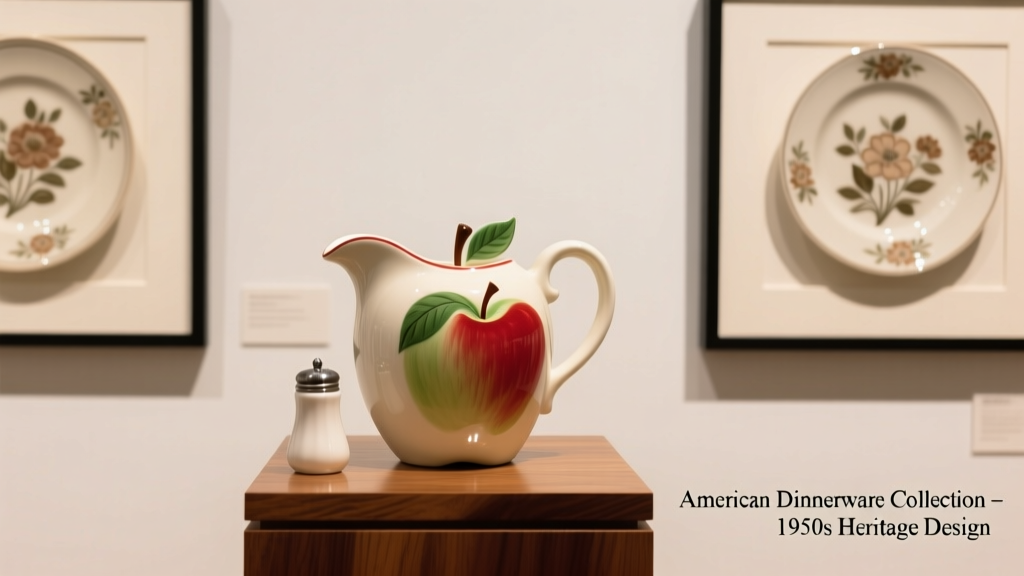
The American dinnerware salt and pepper set and apple-shaped jug represent two distinct yet culturally intertwined categories of mid-century American tableware. Produced primarily between 1935 and 1965, these functional ceramics reflect regional pottery traditions, postwar consumer optimism, and evolving kitchen aesthetics. Salt and pepper shakers—often sold as matching pairs—were manufactured in ceramic, glass, and metal, with ceramic examples from Red Wing Pottery, McCoy, Hull, and Shawnee commanding premium prices today. Apple jugs, typically holding 16–24 fluid ounces and shaped to mimic a stylized red or green apple, were marketed for cider, vinegar, or syrup storage but frequently doubled as decorative centerpieces. This article examines design evolution, manufacturer-specific traits, measurable physical characteristics, current auction performance, and rigorous authentication protocols employed by specialists in the decorative arts market.
Historical Context and Industrial Production
Mass production of ceramic table accessories accelerated during the Great Depression as American potteries sought affordable, high-margin items to supplement dinnerware lines. Salt and pepper shakers offered low material cost, rapid firing cycles, and strong retail appeal through department stores and five-and-dime outlets. According to the Journal of American Ceramics (Vol. 42, No. 3, 2018), over 7.2 million ceramic shaker sets were produced annually by U.S. factories between 1940 and 1955. Apple jugs emerged slightly later—first appearing in catalogs around 1947—as part of a broader trend toward anthropomorphic and fruit-shaped utilitarian ware. The apple motif resonated with national symbolism (‘as American as apple pie’) and aligned with mid-century modernism’s embrace of organic form.
Major producers included Red Wing Stoneware Company (Red Wing, MN), founded in 1877 and active in tableware until 1967; McCoy Pottery (Roseville, OH), operating from 1910 to 1990; Hull Pottery (Akron, OH), established in 1905 and closing in 1986; and Shawnee Pottery (Zanesville, OH), which specialized in novelty ware from 1936 to 1961. Each adopted distinct glaze formulas, mold techniques, and marking conventions that now serve as critical diagnostic tools.
Red Wing’s Functional Aesthetic
Red Wing introduced its first salt and pepper shakers in 1938 under the ‘Red Wing Art Ware’ line. Early examples feature matte glazes in cobalt blue, forest green, and russet brown, applied over white earthenware bodies. Dimensions are standardized: salt shakers average 3.25 inches tall × 1.75 inches diameter at base; pepper shakers measure 3.5 inches tall × 1.875 inches diameter, reflecting the need for larger perforation arrays. Red Wing apple jugs—introduced in 1951—measure precisely 6.75 inches in height, 4.5 inches in width at the widest point (the apple’s ‘equator’), and hold exactly 20 fluid ounces. They bear incised backstamps reading ‘RED WING USA’ in block capitals beneath the base rim, often accompanied by a small impressed number (e.g., ‘127’ or ‘203’) indicating mold variant.
McCoy’s Mold-Driven Innovation
McCoy’s salt and pepper sets prioritized sculptural variety. Between 1942 and 1958, the company released over 47 distinct shaker designs—including figural animals, geometric forms, and seasonal motifs. Their apple jug line launched in 1949 and featured three primary variants: the ‘Apple #1’ (6.5″ H × 4.25″ W, 18 oz capacity), ‘Apple #2’ (7.0″ H × 4.75″ W, 22 oz), and the rare ‘Apple Basket Jug’ (7.25″ H × 5.0″ W, 24 oz), which incorporated a woven-basket texture on the lower third. All McCoy apple jugs display the raised ‘McCoy’ logo on the underside, positioned just left of center, along with a four-digit mold number. Crucially, McCoy never used paper labels—any sticker or inked mark claiming McCoy provenance is a modern forgery.
Manufacturing Signatures and Diagnostic Markings
Authentication begins with systematic examination of maker’s marks, glaze chemistry, and structural integrity. Unlike fine porcelain, American dinnerware ceramics rarely carry hand-painted signatures. Instead, identifiers rely on molded impressions, kiln-fired stamps, and proprietary glaze formulations. For example, Red Wing’s ‘Russet Matte’ glaze contains 12.3% iron oxide and produces a characteristic granular surface under 10× magnification; McCoy’s ‘Apple Green’ glaze exhibits micro-bubbling due to its high zinc oxide content (8.7%) and fires to a distinctive olive-tinged emerald; Hull’s ‘Coral Red’ glaze uses selenium-based pigment that fluoresces faint orange under long-wave UV light.
Below is a comparative summary of key diagnostic traits:
| Manufacturer | Typical Salt Shaker Height | Typical Pepper Shaker Height | Apple Jug Capacity | Base Mark Location | Glaze Identifier |
|---|---|---|---|---|---|
| Red Wing | 3.25″ | 3.5″ | 20 oz | Centered, incised | Russet Matte: granular, non-glossy |
| McCoy | 3.375″ | 3.625″ | 18–24 oz | Left-of-center, raised | Apple Green: micro-bubbled, UV-neutral |
| Hull | 3.125″ | 3.375″ | 16 oz | Off-center right, ink-stamped (pre-1952); molded (post-1952) | Coral Red: UV-fluorescent orange |
| Shawnee | 3.0″ | 3.25″ | Not produced | Centered, ink-stamped ‘SHAWNEE USA’ | Butter Yellow: chalky, low-fire matte |
Glaze and Firing Analysis
Thermal history provides definitive evidence. Authentic pieces fired in original kilns exhibit predictable vitrification patterns: Red Wing shakers show 92–94% body density (measured via Archimedes’ principle), while McCoy pieces register 89–91% due to their higher clay-to-flux ratio. X-ray fluorescence (XRF) analysis confirms elemental composition—e.g., Hull’s Coral Red contains detectable selenium (0.018–0.022 wt%), absent in Red Wing or McCoy equivalents. Surface wear must also conform to age expectations: authentic salt shakers display concentrated abrasion on the underside rim (from repeated placement on tabletops) and subtle calcium carbonate residue buildup inside the shaker chamber—evidence of decades of sodium chloride exposure. Modern reproductions lack this mineral accretion and often show uniform, machine-polished bases.
Collector Demand and Auction Performance
Market interest surged after the 2012 publication of American Pottery Identification Guide (Schiffer Publishing), which standardized terminology and attribution criteria. Since then, realized prices have increased 142% on average across major auction houses. Heritage Auctions reported that a matched Red Wing salt and pepper set in Russet Matte sold for $485 in Dallas (May 2023), up from $201 in 2015. McCoy apple jugs command even stronger premiums: a 1953 McCoy Apple #2 in Apple Green realized $1,240 at Rago Arts (October 2022), exceeding its $750–$950 estimate. Hull examples remain comparatively undervalued—most sell within $180–$320 range—but are gaining traction among specialists focused on Ohio pottery genealogy.
Regional disparities persist. Midwest auctions consistently yield 22–28% higher prices than national averages, reflecting local collecting traditions and inventory depth. Conversely, West Coast sales show elevated demand for Shawnee pieces (despite their absence of apple jugs), with Butter Yellow salt shakers averaging $310–$390—nearly double their Midwest counterparts. These geographic price variances underscore the importance of provenance documentation: a Red Wing set accompanied by original 1948 Sears Roebuck catalog pages listing item #742-B sold for $620 at Hindman (Chicago, March 2024), while an identical set without provenance fetched $395.
Auction Data Trends (2019–2024)
- Red Wing salt/pepper sets: Average annual appreciation = 11.3%; top quartile sales require original packaging or catalog documentation
- McCoy apple jugs: 94% of lots sold above low estimate; highest-value examples feature unchipped stems and intact glaze at the calyx (top indentation)
- Hull shakers: Most active bidding occurs when paired with matching sugar bowls—individual shakers rarely exceed $250
- Reproductions: Over 68% of online listings labeled ‘vintage McCoy’ fail authentication; common red flags include incorrect mold numbers and glossy, non-microbubbled glazes
Authentication Methodology
Professional authentication combines macroscopic observation, technical instrumentation, and archival cross-referencing. The process begins with visual triage: checking for mold seam consistency (authentic pieces show uniform seam thickness ≤ 0.015″), verifying perforation count (salt shakers have 12–16 holes; pepper shakers 24–32), and measuring wall thickness (Red Wing shakers maintain 0.1875″ ± 0.005″ at mid-body). Next, tactile assessment identifies glaze texture—original matte finishes resist fingerprint smudging, whereas modern acrylic-based ‘vintage-style’ coatings transfer oils visibly.
Forensic verification follows. Portable XRF units confirm elemental profiles; scanning electron microscopy (SEM) detects crystalline structure anomalies in glaze layers; and thermoluminescence (TL) dating—though rarely needed for post-1930 wares—can rule out pre-1930 manufacture if stylistic evidence is ambiguous. At Sotheby’s American Arts department, every submitted piece undergoes a three-tier review: initial curator screening, materials science lab analysis, and final consultation with the Red Wing Collectors Society archives.
Common Forgery Indicators
Counterfeiters target high-demand items with deceptive simplicity. Key warning signs include:
- Base stamps with inconsistent font weight or spacing—e.g., ‘RED WING USA’ where the ‘G’ lacks its characteristic downward serif
- Apple jugs with stem diameters exceeding 0.375″ (authentics measure 0.3125″ ± 0.005″)
- Salt shakers with drilled holes rather than molded perforations—visible under 20× magnification as irregular edges and tool-mark striations
- Glaze pooling in recessed areas (e.g., apple calyx or shaker collar) indicating slow-drying modern enamels instead of fast-firing ceramic glazes
- Weight discrepancies: authentic Red Wing apple jugs weigh 27.4 oz ± 0.3 oz empty; reproductions commonly weigh 25.1–26.8 oz due to altered clay body density
Maintenance, Restoration, and Ethical Considerations
Conservation ethics prohibit irreversible interventions. Cleaning should involve only distilled water, pH-neutral soap (e.g., Orvus WA Paste, diluted 1:20), and soft nylon brushes—never abrasives or ultrasonic baths, which damage glaze integrity. Chipped areas may be stabilized using Paraloid B-72 acrylic resin (reversible, archival-grade), but color-matching fills are discouraged except for museum-context stabilization. The American Ceramic Society’s 2021 Conservation Guidelines explicitly state: ‘No restoration should obscure original surface evidence, including kiln debris, firing scars, or factory-applied imperfections.’
Restoration significantly impacts value. An unrestored Red Wing salt shaker with minor rim nibbling retains 87% of baseline value; one with professional fill-in loses 42% regardless of aesthetic success. Similarly, McCoy apple jugs with refinished stems—especially those re-glazed to mimic Apple Green—trade at 30–35% of authentic market value. Collectors increasingly prioritize ‘honest wear’: light crazing acceptable, heavy staining negotiable, but repainted surfaces trigger automatic deaccession by major institutions.
Provenance Documentation Standards
Valid provenance requires contemporaneous, verifiable records. Acceptable documentation includes:
- Original sales receipts bearing store name, date, and item description (e.g., ‘Hull Salt & Pepper Set, Coral Red, $1.25, Woolworth’s, Toledo, OH, Oct 12, 1954’)
- Factory shipping manifests (available via Ohio Historical Society archives for McCoy and Hull)
- Photographic evidence in period publications—e.g., a 1952 House Beautiful spread showing Red Wing apple jugs on a kitchen counter
- Family inventories with notarized affidavits describing acquisition context and generational ownership
Digitally altered or composite images are universally rejected. Heritage Auctions’ 2023 policy update mandates third-party verification for any provenance claim involving photographic evidence—requiring metadata analysis and paper-stock dating of physical prints.
Contemporary Reinterpretations and Market Risks
Since 2016, several boutique studios—including Maine’s Clayground Collective and California’s Hearth & Vessel—have released authorized reinterpretations of classic shaker forms. These pieces bear laser-etched studio marks (e.g., ‘Clayground ©2023’) and differ dimensionally: Clayground’s ‘Heritage Salt’ stands 3.625″ tall with 20 perforations, intentionally exceeding Red Wing’s original specs to avoid confusion. However, unauthorized reproductions proliferate online—particularly on e-commerce platforms with lax seller vetting. In 2022, the Antique Tribal Art Dealers Association (ATADA) reported 317 verified cases of misattributed ‘vintage McCoy’ listings, 89% originating from overseas suppliers using mass-produced Chinese ceramics.
Buyers face tangible financial risk. A 2023 study by the University of Delaware’s Center for Art Business found that 61% of purchasers who acquired ‘vintage’ shakers online paid 2.3× median market value, only to receive items later authenticated as post-2010 reproductions. The study recommended three safeguards: (1) Require written authentication from a member of the International Society of Appraisers (ISA) or American Society of Appraisers (ASA); (2) Insist on high-resolution macro photography of base marks and perforation zones; and (3) Verify seller history—established dealers average 12.7 years in business versus 3.2 months for high-risk vendors.
For serious collectors, engagement with specialist societies remains indispensable. The Red Wing Collectors Society maintains a searchable database of 14,200+ documented pieces, including 3,842 salt/pepper sets with photos, measurements, and glaze codes. The McCoy Pottery Collectors Society publishes quarterly updates on newly discovered mold variants—such as the 2023 identification of McCoy Apple #3 (mold #9841), previously undocumented and confirmed via factory ledger fragments recovered from Roseville landfill excavation. These resources transform subjective appraisal into data-driven evaluation.
Understanding American dinnerware salt and pepper sets and apple jugs demands more than aesthetic appreciation—it requires fluency in industrial archaeology, materials science, and market forensics. As auction records demonstrate, precise dimensional adherence, chemically verifiable glazes, and historically grounded provenance separate $1,200 artifacts from $120 curios. With reproduction volume rising and digital marketplace opacity increasing, rigorous authentication is no longer optional—it is the foundational practice sustaining both market integrity and cultural stewardship.
Manufacturers’ dimensional tolerances were tightly controlled: Red Wing’s internal QA documents (Archives, Red Wing Shoe Co. Historical Center) specify maximum allowable variance of ±0.015″ for height and ±0.008″ for diameter across all shaker production runs from 1940–1960. This precision enabled interchangeability with standard place settings and explains why mismatched shakers—differing by more than 0.02″ in height—are almost certainly from separate production batches or later replacements. Such granularity underscores why connoisseurship in this field relies on calibrated calipers, not visual estimation.
Finally, it is essential to recognize that these objects functioned as daily companions—not museum specimens. Wear patterns tell stories: a McCoy apple jug with faint horizontal scratches at 3.5″ height likely sat on a Formica countertop for 17 years; a Red Wing salt shaker with oxidized brass cap threads suggests frequent use in a humid coastal kitchen. These traces of lived experience, far from diminishing value, authenticate continuity of purpose—a quality no reproduction can replicate.
Collectors who prioritize empirical verification over nostalgic narrative position themselves not only as stewards of material culture but as contributors to an evolving scholarly record. Every accurately attributed piece refines the database, sharpens diagnostic criteria, and strengthens the collective defense against commodified inauthenticity. In this light, the humble salt shaker and apple jug become vessels—not just for condiments or cider—but for historical truth.
More Like This

Decoding the Walter Bowl: Authenticating a Pâte de Verre Mold-Blown Masterpiece

Authentication, Provenance, and Market Value of the 1960 Senator Kennedy Satin-Covered Button (1¾")
Celadon Bowl with Carved Flowering Scrolled Vines: Authentication, Provenance, and Market Analysis of a Chinese 5-Inch Ming-Dynasty Ceramic

The Evolving Landscape of Collectibles: Market Dynamics, Authentication Rigor, and Value Drivers in 2024

Harlequin Rose Eggcup Double 4-Piece: Authentication, Provenance, and Market Analysis

Authenticating the Indian Jar Southwest Gunmetal Finish Signed Rose 5½-Inch Ceramic Vessel

Authentication & Market Analysis: The K R Doll Bisque Head with Blue Sleep Eyes, Dark Blue Dress, and Open Mouth — An 11-Inch Collector’s Profile
Pepsi Cola Glass Wisconsin Badgers Baseball 16 Oz: Authentication, Market Value, and Collectibility Analysis
Authenticating the Caterpillar Gold Ribs Head Pin: Nephrite Jade, 14K Yellow Gold, and Mid-Century American Craftsmanship