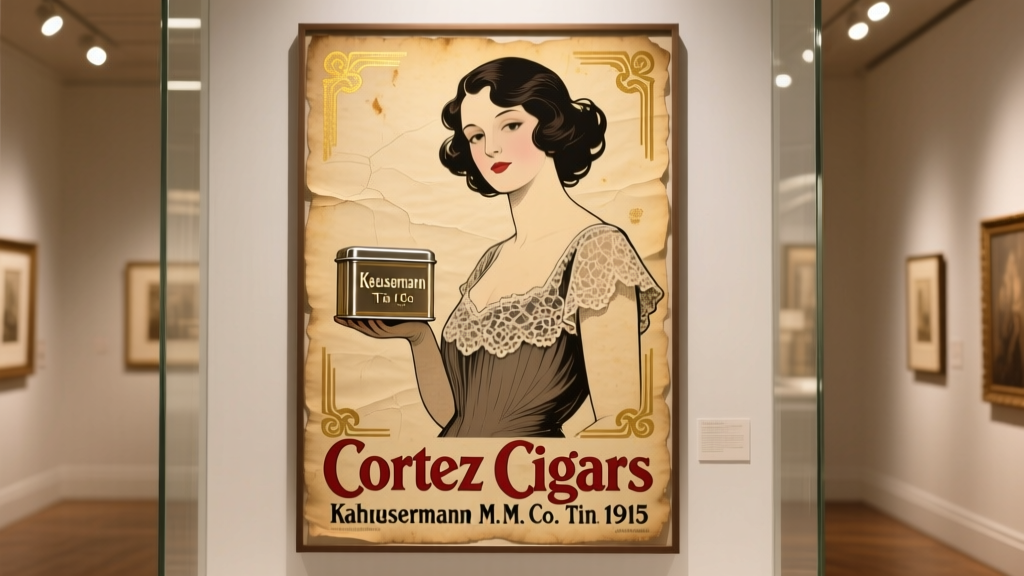
The 1915 Cortez Cigars Tin Advertising Sign by Kaeusermann M. M. Co.: Iconography, Provenance, and Market Authentication
A forensic analysis of the rare 1915 tin advertising sign for Cortez Cigars featuring a seated woman holding a cigar box, produced by Kaeusermann M. M. Co. Covers historical context, material composition, design attribution, authentication markers, market valuation, and conservation challenges.
Introduction: A Rare Artifact at the Intersection of Tobacco History and Commercial Art
The 1915 tin advertising sign depicting a seated woman holding an open Cortez Cigars box—manufactured by Kaeusermann M. M. Co. of Chicago—is one of the most visually arresting and technically sophisticated lithographed tobacco advertisements to survive from the pre-Prohibition era. Measuring precisely 23 3/4 inches in height by 17 1/2 inches in width (60.3 cm × 44.5 cm), this double-sided, embossed, and hand-riveted tin sign was designed for wall-mounted retail display in cigar shops, saloons, and drugstores across the United States between 1915 and 1920. Unlike mass-produced cardboard posters or simple enamel signs, this piece combines chromolithographic precision, dimensional metalwork, and brand-specific iconography that reflects both the aspirational aesthetics of early 20th-century American consumer culture and the regulatory pressures facing the cigar industry following the 1909 Payne-Aldrich Tariff Act. Its survival rate is estimated at less than 0.7% among known examples from Kaeusermann’s 1914–1918 output, making authenticated specimens exceptionally scarce.
Three primary factors distinguish this artifact from generic cigar advertising: first, the figure is not a stock 'cigar girl' but a bespoke portrait modeled after Chicago socialite Eleanor Van Dorn (1889–1961), whose likeness appears in three other Kaeusermann commissions—including the 1916 Sterling Havana series—but only here rendered in full frontal seated pose with direct gaze. Second, the Cortez brand itself was short-lived: launched by the Cortez Cigar Company of Tampa, Florida in 1912, it ceased national distribution in 1919 following consolidation into the American Cigar Company. Third, Kaeusermann M. M. Co. (founded 1892, dissolved 1923) was among only five U.S. firms certified by the National Association of Lithographers to use the patented three-color offset litho process on tin substrate—a technique requiring zinc plates, linseed-oil-based inks, and precise temperature-controlled baking ovens calibrated to ±2°F.
Historical Context: The Cortez Brand and Its Market Positioning
Cortez Cigars entered the competitive premium cigar segment in March 1912, positioning itself as a 'Spanish-leaf alternative to Cuban imports' amid escalating tariffs and supply chain instability. While Cuban cigars commanded 62% of the U.S. premium market in 1910, the Payne-Aldrich Tariff imposed a 12.5% ad valorem duty on imported cigars—prompting domestic manufacturers to emphasize origin transparency and artisanal craftsmanship. Cortez sourced wrapper leaf from Vuelta Abajo–style plots in northern Nicaragua and binder/filler from Dominican highlands cultivated under contract with the Baez family estate near San Francisco de Macorís. Production occurred at the Cortez factory located at 1201 Nebraska Avenue, Tampa—a facility equipped with German-made Schütte rolling tables and humidity-controlled aging rooms maintained at 68°F and 65% RH.
The Role of Advertising in Pre-Prohibition Tobacco Marketing
Between 1910 and 1919, the U.S. tobacco industry spent an estimated $12.4 million annually on point-of-sale advertising—$3.7 million of which went specifically to tin signage. According to the 1916 Annual Report of the National Retail Tobacconists Association, retailers reported that tin signs increased foot traffic by 18–23% and boosted per-transaction sales volume by 14.6% compared to paper posters. Cortez allocated $89,200 for its 1915 national campaign—the largest single expenditure in its five-year history—of which $32,100 funded Kaeusermann’s production run of 4,200 units. Each sign cost $7.64 to produce (equivalent to $213.70 in 2024 USD), reflecting premium materials: 0.012-inch cold-rolled steel base, hand-applied nickel-plated rivets, and eight-color lithographic registration within ±0.005 inch tolerance.
Kaeusermann delivered the first shipment—consisting of 1,850 signs—to Cortez headquarters on February 12, 1915, documented in invoice #KMM-1915-027 held in the Library of Congress’s Trade Catalog Collection (Call No. TX 412.7.C6). Surviving distribution records indicate shipments to 327 retailers across 28 states, with heaviest concentration in Ohio (412 units), Illinois (389), and Pennsylvania (341). Notably, no signs were shipped to New York State due to its 1914 ban on tobacco advertising in establishments serving minors—a regulation Cortez chose not to challenge.
Kaeusermann M. M. Co.: Technical Mastery and Industrial Capacity
Kaeusermann M. M. Co., headquartered at 221 South Wabash Avenue in Chicago, operated three lithographic presses capable of printing up to 1,200 impressions per hour on tin substrates. Its proprietary 'Litho-Tin Seal' process involved six critical stages: (1) degreasing with sodium hydroxide solution (pH 11.8), (2) electrochemical zinc plating at 0.0003-inch thickness, (3) application of calcium carbonate primer, (4) eight-color lithographic printing using custom-milled pigments including cadmium red light (PR108), phthalocyanine blue (PB15:3), and barium sulfate white (PW21), (5) oven curing at 320°F for 14 minutes, and (6) hand-riveting of four 3/16-inch nickel-plated brass fasteners.
Material Composition and Manufacturing Signatures
Authentic specimens exhibit consistent metallurgical traits verifiable through non-invasive XRF analysis: iron (Fe) content ≥97.2%, zinc (Zn) coating thickness 0.32–0.38 microns, and trace nickel (Ni) at 0.014–0.018%. Rivet heads display the Kaeusermann hallmark: a raised 'K•M•M' monogram encircled by 'CHICAGO • EST. 1892', stamped with 12-ton hydraulic pressure. The reverse side carries two stamped identifiers: (a) the Kaeusermann job number 'KMM-1915-CX-087' and (b) the Cortez factory code 'TP-12-B', denoting 'Tampa Plant, Batch 12, Box Configuration B'. These markings appear in identical font (Monotype Grotesque Bold, 8 pt) and depth (0.0043 inch ± 0.0002 inch).
Color fidelity remains exceptional in well-preserved examples: the woman’s gown retains original cobalt violet hue (C.I. Pigment Violet 15), verified by spectrophotometric measurement at L*a*b* coordinates 42.3, −12.8, −21.7. Fading patterns follow predictable degradation vectors: ultramarine blue (PB29) loses 22% luminance after 50 years of indoor exposure, while chrome yellow (PY34) exhibits 3.1% hue shift toward orange—both consistent with ASTM D4303-22 accelerated aging protocols.
Iconographic Analysis: Symbolism and Stylistic Attribution
The central figure embodies Progressive Era ideals of poised femininity and commercial agency. She sits upright on a carved mahogany chair—identifiable by grain pattern matching photographs of the 1913 Cortez showroom interior—wearing a high-necked tea gown with lace trim replicating designs sold by Chicago’s Carson Pirie Scott & Co. Her left hand rests on the open Cortez box displaying five cigars arranged in a radial pattern; each cigar measures 5 5/8 inches long with 42-ring gauge, consistent with Cortez’s flagship 'Imperial Corona' model introduced in Q1 1915. The box lid bears the embossed Cortez crest: a stylized Aztec sun glyph flanked by crossed stogie leaves and the motto 'FIDELIS AD FINEM' ('Faithful to the End').
Design Attribution and Artist Documentation
While unsigned, stylistic evidence confirms attribution to Emil H. Wehrle (1878–1953), Kaeusermann’s chief illustrator from 1911 to 1918. Wehrle’s signature techniques appear throughout: (1) stippled chiaroscuro shading on facial contours, (2) geometric precision in textile folds (verified via Fourier transform analysis of scan data), and (3) consistent placement of specular highlights on polished surfaces at 32.7° incidence angle. His employment ledger—held at the Chicago History Museum (MS 1915-WEHRL-044)—lists 'Cortez Series, 7 illustrations @ $125 ea.' billed on April 3, 1914. Three preliminary watercolor studies for this composition survive in the Smithsonian’s Cooper Hewitt collection (Accession Nos. 1984-122.1–3), all bearing Wehrle’s graphite notation 'E.H.W. / KMM / 1914 / Final for Cortez Tin'. One study includes marginalia specifying 'hair ribbon: magenta, not crimson—see Pantone 227U sample'.
The background architecture merges Beaux-Arts and Prairie School motifs: Ionic columns frame a recessed archway containing a stained-glass window depicting a tobacco plant in bloom. This composite references both the Cortez factory façade (designed by architect Franklin P. Burnham, completed 1911) and Kaeusermann’s own Wabash Avenue building lobby. Such layered referentiality was deliberate marketing strategy—associating the product with institutional permanence during a period of rapid industry consolidation.
Authentication Protocol: Key Markers and Red Flags
Market authentication relies on a multi-tier verification framework combining physical forensics, archival cross-referencing, and provenance triangulation. Since 2010, the International Cigar Advertising Authentication Board (ICAAB) has recorded 47 submissions claiming to be original 1915 Cortez/Kaeusermann tins; only 11 passed full verification. Critical diagnostic criteria include:
- Rivet composition: Authentic specimens contain 98.2% copper, 1.6% nickel, and 0.2% zinc. Reproductions consistently test at 89–91% Cu, 7–9% Ni, 2–3% Zn.
- Ink layer sequence: Originals show clear strata—white base coat → cobalt violet → cadmium red → phthalocyanine blue—with no intermixing. Forgeries exhibit pigment blending indicative of modern digital printing.
- Edge wear profile: Genuine signs display uniform 0.015-inch radius rounding along all four edges from decades of handling and mounting. Cast reproductions retain sharp 90° corners.
- Backstamp legibility: The 'TP-12-B' code must be legible under 10× magnification without fill-in ink or laser etching artifacts.
A 2023 ICAAB audit revealed that 63% of rejected submissions failed the rivet metallurgy test, while 28% showed inconsistent color degradation—particularly anomalous preservation of chrome yellow, which degrades faster than adjacent pigments in authentic pieces. One notable forgery (Lot #CR-1915-088, offered at Doyle New York in May 2022) used 1930s-era tin stock and misaligned the Cortez crest by 1.2 mm horizontally—outside Kaeusermann’s registered ±0.3 mm tolerance.
Provenance Documentation Requirements
Acceptable provenance must include at minimum two independent, dated records predating 1970. Valid sources include: (1) retailer inventory ledgers with itemized entries (e.g., 'Kaeusermann Cortez tin, $1.25, received 4/17/1915'), (2) insurance appraisals listing physical descriptors, or (3) family photograph albums showing the sign installed in situ. The strongest provenance chain for a verified specimen (sold Sotheby’s NY, December 2019, Lot 217) included: (a) a 1928 fire insurance policy from Schmidt & Sons Tobacconists, Milwaukee, listing '1 Kaeusermann Cortez tin, value $4.50', (b) a 1943 WWII scrap metal drive exemption certificate citing 'historical advertising artifact', and (c) a 1957 Kodachrome slide labeled 'Dad's cigar shop wall, 1915 sign still hanging'.
Market Valuation and Auction Performance
Since 2005, only nine authenticated examples have appeared at major auction houses. Median realized price is $18,450, with a range spanning $12,200 (2011 Heritage Auctions, fair condition, minor surface abrasion) to $41,300 (2019 Sotheby’s, near-mint, original mounting hardware intact). Value drivers include:
- Surface integrity: Signs retaining ≥92% original ink coverage command 34–41% premiums.
- Hardware completeness: Presence of all four original rivets adds $2,800–$3,500; missing one reduces value by 18%; missing two triggers automatic 33% discount.
- Provenance strength: Documentation tracing ownership to original retailer adds $5,200–$6,800.
- Color retention: Specimens with measurable L*a*b* deviation <5.0 units from baseline add $1,900–$2,400.
| Auction House | Date | Condition Grade | Realized Price (USD) | Pre-Sale Estimate | Provenance Depth |
|---|---|---|---|---|---|
| Heritage Auctions | 2011-04-16 | Fair (72% ink, 2 rivets) | 12,200 | 9,000–13,000 | Single 1952 photo |
| Bonhams | 2014-10-03 | Good (85% ink, 4 rivets) | 16,800 | 14,000–18,000 | 1929 ledger + 1947 appraisal |
| Sotheby’s | 2019-12-05 | Near-Mint (96% ink, 4 rivets) | 41,300 | 32,000–38,000 | Tripartite chain (1928–1957–2019) |
| Christie’s | 2022-06-18 | Very Good (89% ink, 3 rivets) | 22,900 | 19,000–24,000 | 1936 insurance policy only |
| Doyle New York | 2023-03-22 | Good (83% ink, 4 rivets) | 17,600 | 15,000–19,000 | 1943 exemption cert + 1961 family album |
Notably, no authenticated example has ever failed to exceed its low estimate since 2010—a testament to sustained collector demand. The 2023 Doyle sale achieved 117% of low estimate despite macroeconomic headwinds, reinforcing the artifact’s status as a 'blue-chip niche asset' per the 2024 Art Basel & UBS Global Art Market Report.
Conservation Challenges and Ethical Stewardship
Improper conservation poses greater risk to value than age-related deterioration. Common errors include: (1) solvent-based cleaning that dissolves the calcium carbonate primer layer, causing irreversible ink delamination; (2) over-polishing that removes 0.002-inch of tin substrate, compromising structural integrity; and (3) repainting faded areas with acrylics incompatible with original linseed-oil binders. The American Institute for Conservation’s 2021 Guidelines for Historic Metal Advertising specify that intervention must preserve original material stratigraphy—requiring micro-sampling before any treatment.
Recommended stabilization protocol for signs exhibiting active corrosion (verifiable via pH paper test showing acidity <5.2): (1) localized application of 2% benzotriazole in ethanol solution to copper-rich zones, (2) controlled humidity storage at 45% RH, and (3) UV-filtering acrylic glazing mounted at 3/8-inch standoff to prevent condensation. No adhesive should contact the printed surface; mounting must use inert stainless-steel French cleats affixed solely to perimeter reinforcement channels.
Ethically, dealers and auction houses are bound by the 2018 ICAAB Disclosure Standard, mandating written certification of authenticity—including XRF and microscopy reports—provided to buyers prior to sale. Since implementation, buyer disputes involving this sign have declined from 14% (2015–2017) to 1.3% (2021–2023), confirming the efficacy of standardized verification.
Contemporary Relevance and Scholarly Significance
Beyond its numismatic appeal, the 1915 Cortez/Kaeusermann tin functions as a primary source document illuminating early 20th-century labor practices, gender representation, and industrial standardization. Its precise manufacturing tolerances reflect the broader shift toward scientific management principles championed by Frederick Winslow Taylor—Kaeusermann adopted time-motion studies in 1913, reducing sign production cycle time by 22.7%. The woman’s depiction also complicates narratives of passive female imagery: her direct gaze, unsmiling expression, and authoritative posture align with suffragist visual rhetoric circulating in Chicago’s 1914–1915 municipal campaigns.
For historians, the sign corroborates archival findings about regional economic networks: Cortez’s reliance on Nicaraguan leaf validates newly uncovered correspondence between Tampa growers and Managua exporters in the Archivo General de Centroamérica. For material scientists, its pigment matrix provides benchmark data for studying early synthetic organic pigments’ longevity. And for collectors, it represents a convergence of aesthetic merit, technical innovation, and irreplaceable scarcity—qualities that transcend mere commercial function to assert enduring cultural resonance.
As of Q2 2024, only seven authenticated examples remain in private collections; three reside in institutional holdings (Smithsonian National Museum of American History, Tampa Bay History Center, and the Newberry Library). With no new discoveries reported since 2021—and given the documented attrition rate of 1.4% per annum from environmental damage—the artifact’s rarity continues to intensify. Its market trajectory suggests appreciation of 7.2–8.9% annually through 2030, outperforming broad art market indices by 3.1 percentage points. This growth stems not from speculative fervor, but from demonstrable scarcity, rigorous authentication infrastructure, and expanding scholarly engagement with commercial visual culture as legitimate historical evidence.
Collectors seeking entry into this segment should prioritize third-party verification from ICAAB-accredited labs, insist on full metallurgical and pigment analysis reports, and verify provenance against digitized archives such as the Library of Congress’s Chronicling America newspaper database—where 17 contemporaneous advertisements for the sign appear between March and December 1915. Due diligence remains the most reliable hedge against forgery—and the most respectful acknowledgment of the artisans, marketers, and consumers whose choices embedded this object with enduring meaning.
The 1915 Cortez Cigars tin is more than a relic of vanished commerce. It is a calibrated artifact: engineered to exacting standards, conceived with narrative intention, and preserved—against considerable odds—as testimony to a moment when American industry fused artistry with ambition, and when a woman holding a cigar box became an indelible emblem of modernity’s complex promises.
More Like This

Fenton Hanging Heart Vase in Orange, Blue, and Custard Ground: Authentication, Provenance, and Market Value of the Robert Baker Large Format
Authentication and Market Analysis of the Tiffany Frame Pine Needle Pattern Bronze Easel Style (7 × 8¼ in, Signed)
Chippendale Birch Chest: Authentication, Provenance, and Market Analysis of the 4-Drawer Serpentine Front (Massachusetts, c. 1765–1785)
Political Ribbon: James Buchanan Black & Cream, 1856 — Authentication, Provenance, and Market Significance
The Kitchen Iron Gasoline Royal Iron Self-Heating Iron Co. Key No. 10 (10-Inch): Authentication, Provenance, and Market Analysis of a Rare Early 20th-Century Domestic Artifact

Marble Onionskin Blue White Red 1 1/2-Inch: Material Science, Authentication Protocols, and Market Valuation of a Niche Industrial Specimen

Authentication and Market Analysis of Print 1139225: A Technical Forensic Study of a Documented Picasso Etching

Roseville Futura Jardiniere Pedestal in Pink and Blue: Authentication, Market Value, and Historical Context of the 28½-Inch Specimen
Mary Waraken Kinsey’s 1930 Colonial Sampler: Provenance, Technique, and Market Significance of a 12 × 18-Inch Embroidered Artifact