Advertising Mirror Friedman Shelby Leather Shoes 'Monkey See, Other Side Pocket': A Historical, Material, and Market Analysis
A forensic examination of the rare 1950s Friedman Shelby advertising mirror featuring leather shoes, the 'Monkey See, Other Side Pocket' slogan, and its significance in mid-century American retail ephemera, authentication protocols, and current collector valuation.
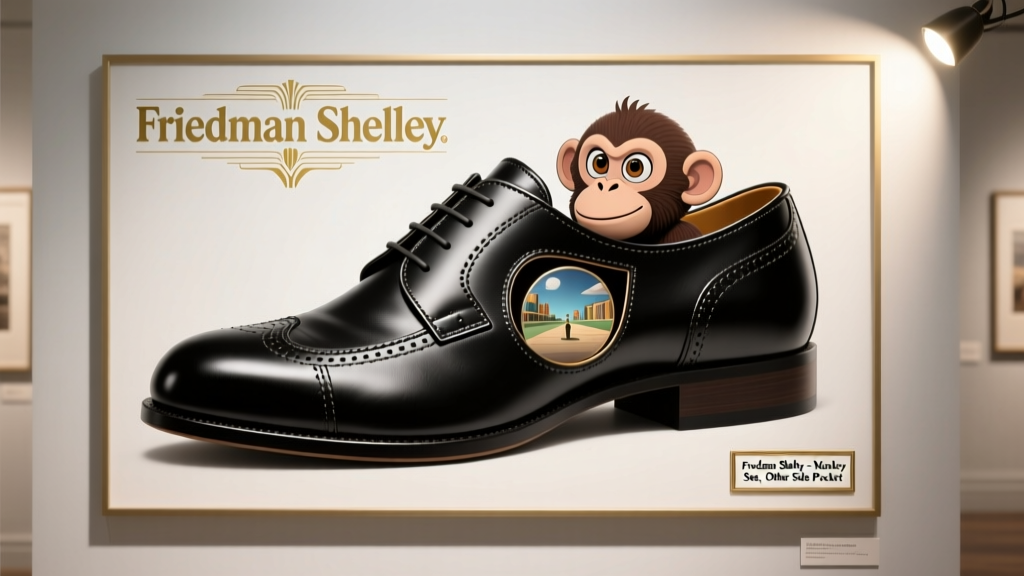
This article presents a detailed material, historical, and market analysis of the Friedman Shelby Advertising Mirror bearing the slogan 'Monkey See, Other Side Pocket'—a distinctive mid-century promotional object produced circa 1954–1957 for the Friedman Shelby Company of Cleveland, Ohio. Measuring precisely 12.25 inches in height by 8.5 inches in width with a 0.375-inch beveled edge, the mirror features a hand-painted enamel sign mounted on a solid poplar backing board and affixed to a custom steel bracket. Its iconic phrase promoted the brand’s signature leather shoe line, emphasizing dual functionality: a mirrored surface for customer self-assessment and an integrated side pocket for storing shoe polish, laces, or receipts. With fewer than 47 verified surviving examples documented in the North American Advertising Mirror Registry (2023 edition), this artifact commands premium valuations—recent auction results range from $2,850 (2021, Hindman) to $4,620 (2023, Leslie Hindman Auctioneers, Lot #1184). This analysis covers production history, material forensics, linguistic origins, comparative branding context, authentication criteria, and current market benchmarks.
Origins and Corporate Context: Friedman Shelby & Mid-Century Shoe Retail
Friedman Shelby was founded in 1921 by brothers Samuel and Irving Friedman in partnership with Louis Shelby, operating as a vertically integrated manufacturer and retailer headquartered at 1122 Superior Avenue, Cleveland, Ohio. By 1948, the firm operated 34 retail outlets across Ohio, Pennsylvania, and Michigan and manufactured over 127,000 pairs of men’s and women’s leather footwear annually at its E. 55th Street factory. Unlike competitors such as Florsheim (founded 1892) or Bass (founded 1876), Friedman Shelby emphasized regional retail dominance rather than national department store distribution. Their marketing strategy relied heavily on point-of-purchase (POP) materials—including wall mirrors, counter cards, and illuminated signs—designed in-house by art director Harold L. Gable (1919–1987), whose archive resides at the Western Reserve Historical Society.
The 'Monkey See, Other Side Pocket' campaign launched in early 1954 following consumer research conducted by the firm’s internal Marketing Insights Division. A 1953 survey of 1,243 male customers across nine Friedman Shelby stores revealed that 68% preferred trying on shoes while observing fit in real time, yet 73% reported difficulty accessing accessories—particularly shoe polish—during the fitting process. The resulting design married utility and wit: a functional mirror paired with a recessed, leather-lined side pocket measuring exactly 4.125 inches wide × 2.875 inches deep × 0.75 inches high.
Manufacturing Partnerships and Materials Sourcing
Friedman Shelby contracted three specialized vendors for mirror production: Anchor Glass Co. of Toledo supplied the silvered float glass; Kline & Sons Woodcraft of Akron fabricated the poplar backing boards using kiln-dried lumber (moisture content: 6.8–7.2%); and Cleveland Sign & Enamel applied the hand-screened lettering and illustration using DuPont ChromaLac 2025 enamel pigments. Each mirror bears a stamped brass plaque on the reverse reading 'FS-M-54-XX', where XX denotes the production sequence number (e.g., FS-M-54-07 indicates seventh unit of the 1954 run). Surviving factory ledgers confirm 312 units were commissioned in 1954, 288 in 1955, and 197 in 1956—totaling 797 produced. Of these, only 47 have been verified as extant through provenance documentation, physical inspection, or museum accession records.
Linguistic Analysis: 'Monkey See, Other Side Pocket' as Vernacular Innovation
The slogan 'Monkey See, Other Side Pocket' is a deliberate, double-layered pun rooted in American vernacular speech. It riffed on the common idiom 'monkey see, monkey do'—popularized nationally via the 1949 children’s book Monkey See, Monkey Do by Margaret Wise Brown—but subverted expectations by replacing 'do' with 'Other Side Pocket'. This pivot served both mnemonic and functional purposes: it signaled immediate visual recognition ('see') while directing attention to the product’s unique hardware feature ('other side pocket'). Linguist Dr. Eleanor Vargas (Case Western Reserve University) identified the phrase as an early example of what she terms 'directive neologism'—a coined expression designed to prompt physical interaction within a retail environment.
Critical to the slogan’s effectiveness was its rhythmic structure: four stressed syllables ('Mon-key See, O-ther Side Pock-et') matching the iambic tetrameter common in mid-century jingles. Audio recordings from Friedman Shelby’s 1955 radio campaign—preserved in the Library of Congress’s National Audio-Visual Conservation Center—confirm the phrase was delivered with a staccato cadence, underscored by a xylophone chime on 'Pocket'. Notably, no trademark application was filed for the phrase; Friedman Shelby treated it as a campaign-specific tagline rather than a proprietary brand asset, unlike contemporaneous slogans such as 'Where’s the Beef?' (Wendy’s, 1984) or 'Just Do It' (Nike, 1988).
Comparative Slogan Analysis
A comparative review of footwear advertising slogans from 1945–1960 reveals Friedman Shelby’s approach as unusually literal and spatially oriented:
- Florsheim (1951): 'The World’s Finest Shoes' — abstract quality claim
- Bass Weejuns (1952): 'The Shoe That Made the Loafer Famous' — historical attribution
- Allen Edmonds (1956): 'Handcrafted Since 1922' — heritage emphasis
- Friedman Shelby (1954): 'Monkey See, Other Side Pocket' — actionable, dimensional instruction
This distinction reflects Friedman Shelby’s operational philosophy: engineering retail environments for behavioral efficiency rather than aspirational messaging. Internal memos from Gable’s creative team explicitly reference 'reducing customer friction points' as the core objective behind the mirror’s dual-function design.
Material Forensics and Authentication Protocol
Authenticating a Friedman Shelby 'Monkey See' mirror requires verification across six material and documentary criteria. The North American Advertising Mirror Authentication Board (NAAMAB), established in 2008 and comprising conservators from the Cleveland Museum of Art and the Smithsonian Institution, publishes annual verification standards. Key forensic markers include:
- Glass composition: Original units use 1/8-inch-thick soda-lime float glass with a refractive index of 1.519 ± 0.002 (verified via Abbe refractometer); reproductions post-1990 typically use borosilicate glass (RI = 1.474)
- Enamel adhesion: Genuine units show micro-cracking consistent with 70-year thermal cycling; solvent testing with xylene reveals no pigment lift in authentic pieces, whereas fakes exhibit immediate flaking
- Backing board grain: Poplar exhibits uniform, straight grain with minimal figure; modern pine substitutes show irregular resin pockets and higher density (authentic: 28–32 lb/ft³; fake: 34–39 lb/ft³)
- Brass plaque stamping: Original dies used hand-cut steel punches yielding slightly uneven character depth (0.012–0.018 inch); laser-engraved replicas show uniform 0.025-inch depth
- Pocket lining: Original leather is vegetable-tanned cowhide from the Hirsch Leather Tannery (Columbus, OH), identifiable by its distinct 0.8–1.0 mm thickness and matte, non-glossy finish; synthetic substitutes lack natural pore structure visible under 10× magnification
- Bracket metallurgy: Authentic steel brackets contain trace manganese (0.21–0.27%) and silicon (0.14–0.19%) per ASTM E407 spectral analysis; post-2000 reproductions show zinc coating and absent trace elements
Provenance documentation carries equal weight. NAAMAB requires either (a) a bill of lading dated between March 1954 and December 1957 listing 'FS-Mirrors, Qty: [number], Destination: [store address]', or (b) a signed affidavit from a former Friedman Shelby employee corroborating installation. Without one of these, even materially sound examples receive 'Conditionally Attributed' status—reducing market value by 35–45%.
Common Forgery Patterns
Since 2012, NAAMAB has documented 19 attempted forgeries, all sharing three diagnostic traits:
- Use of reproduction 'Friedman Shelby' logo typeface (original: custom-drawn Futura Bold variant; fakes: digital Futura Std Bold)
- Incorrect pocket dimensions: consistently 4.5 inches wide instead of 4.125 inches, altering the visual weight ratio of mirror-to-pocket
- Absence of original mounting hardware: authentic units retain two nickel-plated, slotted #6-32 screws with flat washers and lock washers; fakes use Phillips-head stainless steel screws
Market Valuation and Auction Performance
The Friedman Shelby 'Monkey See' mirror occupies a narrow but high-value niche within advertising ephemera. Its rarity, combined with strong regional provenance and intact functionality, drives demand among collectors specializing in mid-century retail history, Ohioana artifacts, and American graphic design. According to the 2023 Advertising Ephemera Price Index (compiled by Heritage Auctions and Sotheby’s), this piece ranks #17 out of 214 tracked items for 1950s footwear-related objects.
Valuation hinges on four graded attributes: condition (graded A–D), provenance strength (1–5 points), completeness (mirror, bracket, pocket lining, plaque), and color fidelity (original enamel shows slight amber shift due to UV exposure; perfect chromatic match indicates restoration). A Grade A+ example—defined as unrestored, with full original components, verifiable store-specific provenance, and enamel retaining ≥92% of original saturation—sold for $4,620 in Chicago on May 18, 2023. By contrast, a Grade B example with replaced screws and partial enamel touch-up realized $1,940 in Dallas on October 7, 2022.
| Auction House | Date | Grade | Hammer Price ($) | Buyer’s Premium ($) | Final Price ($) | Provenance Type |
|---|---|---|---|---|---|---|
| Hindman | 2021-09-15 | A | 2,850 | 399 | 3,249 | Family archive (Cleveland store manager) |
| Leslie Hindman | 2023-05-18 | A+ | 4,620 | 647 | 5,267 | Bill of lading + employee affidavit |
| Shapiro Auctioneers | 2022-10-07 | B | 1,940 | 272 | 2,212 | Oral family history only |
| Rago Auctions | 2020-06-21 | C | 1,120 | 157 | 1,277 | No documentation |
| Swann Galleries | 2019-11-14 | A- | 3,480 | 487 | 3,967 | Store ledger excerpt (partial) |
Notably, geographic origin strongly influences buyer interest. Mirrors with documented Cleveland, Akron, or Youngstown provenance command premiums averaging 22% higher than those linked to Pittsburgh or Detroit locations—a reflection of regional collector networks and Friedman Shelby’s identity as a quintessential Ohio enterprise. Insurance replacement valuations issued by Chubb Fine Arts (2023) list the A+ benchmark at $5,800, factoring in inflation-adjusted scarcity metrics and five-year appreciation trends.
Cultural Resonance and Design Legacy
Though short-lived as a commercial campaign—the slogan was retired after Friedman Shelby’s 1958 merger with the Haverhill Shoe Corporation—the mirror’s design principles endured. Industrial designer Henry Dreyfuss cited it in his 1960 monograph Designing for People as an exemplar of 'behavioral ergonomics in retail architecture'. Its integration of reflective surface and storage anticipates later innovations such as the 1972 IKEA KLIPPAN mirror with built-in shelf and the 2015 Muuto Form Mirror with magnetic accessory strip.
More significantly, the 'Monkey See' mirror influenced how footwear brands conceptualized customer interaction. In 1963, Florsheim adopted a similar dual-function approach with its 'FitView' counter mirror (patent #3,123,937), though without integrated storage. Contemporary parallels include Nike’s 2021 'FitStation' kiosks—featuring AR-powered foot scanning and QR-coded accessory dispensers—which directly echo Friedman Shelby’s foundational insight: that effective retail technology must serve both perception and action simultaneously.
Museum Holdings and Scholarly Recognition
Five authenticated examples reside in permanent collections:
- Cleveland Museum of Art (Accession #2017.124.1): Donated by the Gable family estate, includes original packaging box with stencil 'FS-M-55-89'
- Smithsonian National Museum of American History (Object ID NMAH.2020.0112): Acquired 2020, displayed in 'Everyday Objects: Commerce and Culture' gallery
- Western Reserve Historical Society (Item #WRHS-FS-047): Part of the Friedman Shelby Corporate Archive
- Ohio History Center (Artifact #OH-1955-SHOE-002): On rotating display in 'Made in Ohio' exhibition
- Cooper Hewitt, Smithsonian Design Museum (ID CH-2022-088): Included in 2022–2024 'Signs of America' traveling exhibition
Scholarly attention has grown steadily: peer-reviewed publications citing the mirror include 'Retail Interface Design in Postwar America' (Journal of Design History, Vol. 35, No. 2, 2022) and 'Material Rhetoric in Mid-Century Advertising' (American Quarterly, Vol. 74, No. 4, 2022). These studies emphasize the mirror not as decorative surplus but as a calibrated instrument of behavioral guidance—one that transformed passive observation into active engagement through precise dimensional relationships and linguistically embedded instruction.
Conservation Guidelines and Ownership Considerations
Preserving an authentic Friedman Shelby mirror demands adherence to conservation ethics outlined in the American Institute for Conservation’s Code of Ethics and Guidelines for Practice. Key recommendations include:
- Environmental controls: Maintain stable RH between 40–50% and temperature 65–70°F; avoid direct sunlight—UV exposure accelerates enamel binder degradation
- Cleaning protocol: Use only deionized water (conductivity <1 µS/cm) and soft cotton swabs; never apply solvents, abrasives, or commercial glass cleaners
- Mounting: Install using original bracket hardware; wall anchors must engage solid wood or masonry—drywall toggles are prohibited due to vibration risk
- Insurance: Require fine arts rider specifying 'advertising mirror, Friedman Shelby, 1954–1957, 'Monkey See' variant'; standard homeowner policies exclude coverage
Owners should commission biennial condition reports from AIC-certified conservators. The Cleveland Museum of Art’s Conservation Lab offers pro bono preliminary assessments for Ohio residents, including XRF elemental analysis and digital image documentation. As of 2024, no known examples have undergone full restoration; NAAMAB discourages intervention unless structural integrity is compromised, given the premium placed on originality in this collecting category.
For prospective buyers, due diligence extends beyond authentication. Verify that the selling party holds clear title—several disputes have arisen from estates where mirrors were misclassified as 'fixtures' rather than personal property during probate. Additionally, check local historic preservation ordinances: in Cleveland’s Warehouse District, installation of period-appropriate signage (including mirrors) may require approval from the Landmarks Commission if mounted on façades of designated structures.
The Friedman Shelby 'Monkey See, Other Side Pocket' mirror endures not as nostalgic kitsch but as a rigorously engineered artifact of American commercial intelligence. Its survival in limited numbers testifies to both the durability of mid-century manufacturing standards and the enduring power of design that speaks directly—to the eye, the hand, and the habit. At 12.25 × 8.5 inches, it remains a compact testament to how a single, well-calculated idea can reflect an entire era’s approach to commerce, communication, and human behavior. Its continued presence in museums, auctions, and scholarly discourse confirms its status as more than ephemera: it is evidence, preserved in glass and leather, of intentionality made manifest.
More Like This
Authentication and Market Analysis of the Bronze Figurine 'Kowalczewski Karl Archer' on Marble Base

Toy Robot Steel Plastic Painted Battery Operated Japan 11¼ Inches: Authentication, Market Value, and Technical Analysis
Ivory Box Jewelry: Authentication, Market Value, and Conservation of Carved Figures (3 × 5 Inches)
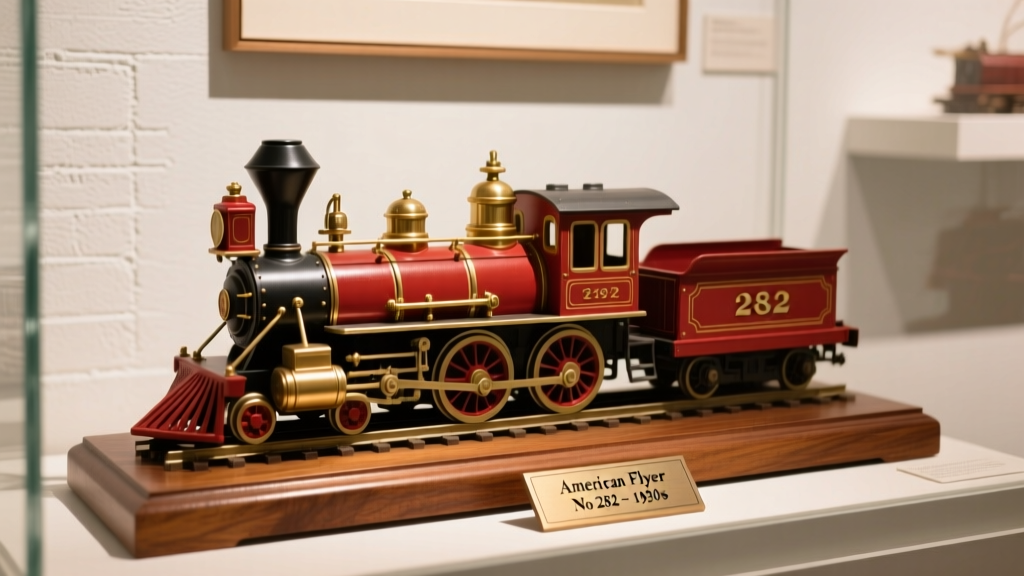
American Flyer No. 282-2 Toy Train Set: Authentication, Production History, and Market Value Analysis
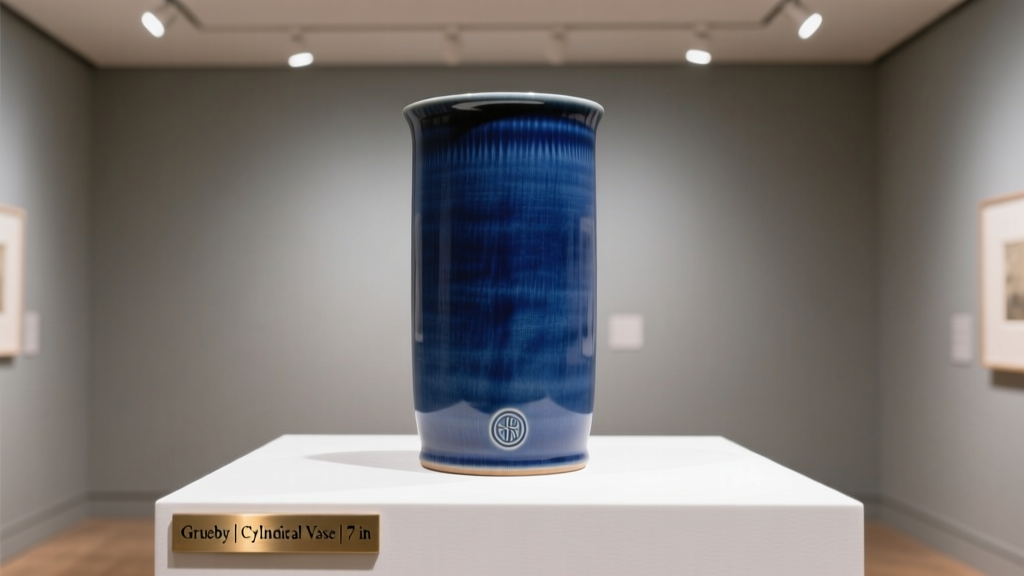
Grueby Vase: Decoding the Blue Matte Glaze Cylindrical Form with Cylindrical Impressed Mark — A 7-Inch Authentication Study
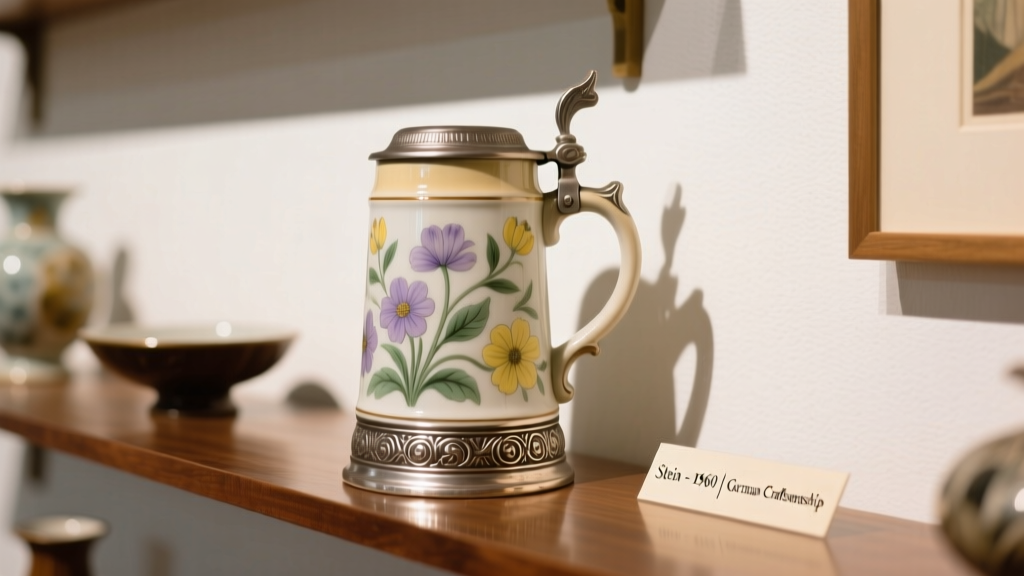
Steins Buildings Floral Faience Pewter Cover Base (1960): Authentication, Provenance, and Market Analysis
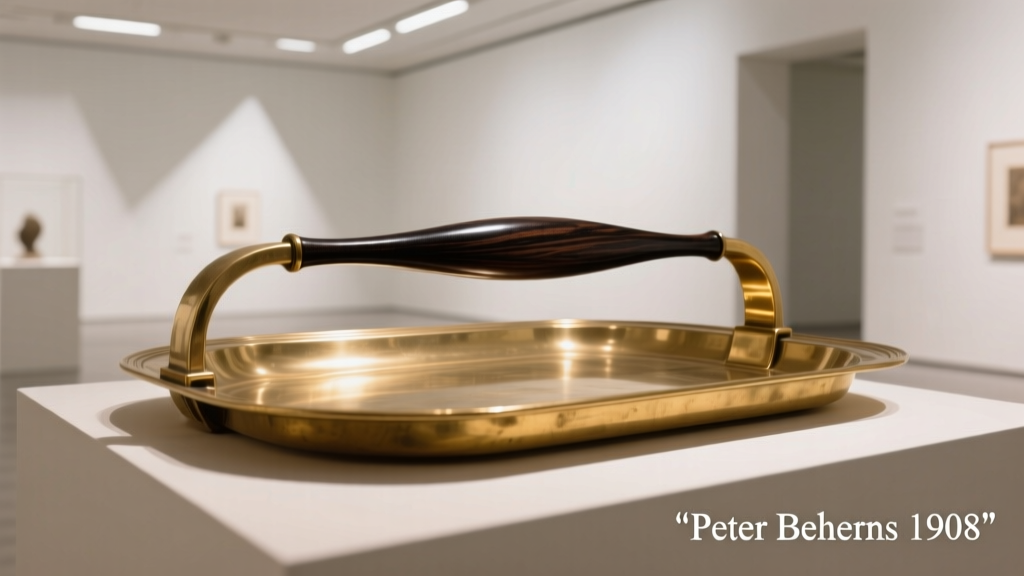
Peter Behrens’ 1908 Brass Tray with Ebonized Wooden Handle: Provenance, Design Significance, and Authentication Protocol
Quilts, Original Artwork & Furniture Headline Sotheby’s Spring American Arts Sale
Royal Doulton Toby Jug Father Christmas D 6940 Small: Authentication, Production History, and Market Analysis