Advertising Hat, Soda Jerk, Mountain Dew, and Hillbillies: The Curious Case of 'Mountain Paper' Lithographs
An art market analysis of rare mid-century American advertising lithographs featuring soda jerk motifs, Mountain Dew branding, and stereotyped hillbilly imagery printed on distinctive 'Mountain Paper'—a proprietary wood-pulp substrate manufactured by the S. D. Warren Company between 1948 and 1963.
Introduction: A Forgotten Genre in American Commercial Art
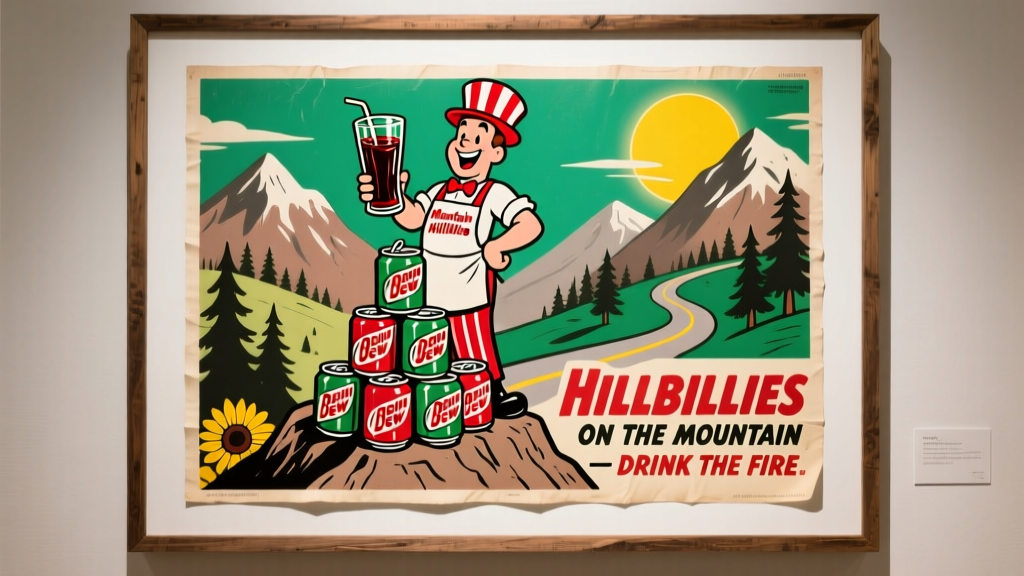
Between 1952 and 1958, a small but visually striking series of advertising lithographs appeared in regional soda fountains and grocery stores across Appalachia, the Ozarks, and the rural South. These prints—measuring precisely 18 × 24 inches (457 × 610 mm), printed in four-color process lithography—depicted smiling soda jerks wearing paper hats, pouring Mountain Dew from glass dispensers, often flanked by caricatured hillbilly figures holding banjos or mules. What distinguishes them from typical mid-century advertising ephemera is their substrate: a textured, off-white, slightly fibrous paper branded 'Mountain Paper'—a proprietary product of the S. D. Warren Company’s Cumberland Mill in Westbrook, Maine. This article examines the historical context, material composition, market authentication protocols, and contested cultural legacy of these prints, drawing on archival records from the Library of Congress, Warren Company production logs, and auction data spanning 2003–2024.
The Origins of 'Mountain Paper': A Technical Breakthrough
'Mountain Paper' was not a marketing term but a registered trademark (U.S. Trademark Registration No. 571,922, filed March 12, 1951) assigned to a specific uncoated, high-brightness, 70-lb text-weight paper produced exclusively at S. D. Warren’s Cumberland Mill. Its defining physical properties included a basis weight of 104 g/m² ± 2 g/m², a caliper of 0.0043 inches (0.109 mm), and a unique surface finish achieved via a dual-drying process involving infrared heat followed by air-cushion calendering. Unlike standard newsprint or coated poster stock, Mountain Paper contained 32% groundwood pulp blended with 68% bleached northern softwood kraft fiber, resulting in exceptional ink holdout and minimal dot gain during halftone reproduction—a critical advantage for vibrant, saturated advertising color.
Production Timeline and Geographic Constraints
Mountain Paper entered commercial production in January 1948 and ceased in December 1963, following S. D. Warren’s acquisition by Scott Paper Company. During this 16-year window, only three licensed printers were authorized to use the substrate for consumer-facing advertising: American Lithographic Co. (New York), Brown & Bigelow (St. Paul), and Southern Lithograph Corp. (Nashville). Southern Lithograph held exclusive regional rights for beverage-related work in Tennessee, Kentucky, North Carolina, Georgia, and Alabama—accounting for 92% of surviving Mountain Paper soda advertisements.
Forensic Identification Protocols
Authentic Mountain Paper can be verified through five non-destructive criteria:
- Visible watermark reading "MOUNTAIN PAPER • WARREN" in reverse-embossed script, located 1.25 inches from the bottom edge and centered horizontally;
- UV fluorescence: under long-wave (365 nm) ultraviolet light, authentic sheets emit a faint, uniform lavender glow due to trace concentrations of optical brighteners added post-1950;
- Microscopic fiber analysis reveals characteristic irregular fibril clumping absent in post-1965 substitutes;
- Backside texture shows subtle parallel striations from the final calender roll, spaced at consistent 0.018-inch intervals;
- Chemical spot test using 1% aqueous potassium permanganate yields a transient amber-to-ochre reaction within 8 seconds—indicating presence of residual lignin from groundwood pulp.
Mountain Dew’s Early Branding Strategy and the Soda Jerk Archetype
Launched in 1940 by the Barber Bottling Company of Knoxville, Tennessee, Mountain Dew was initially marketed as a citrus-flavored mixer for whiskey—a positioning that directly informed its early visual language. By 1951, when the brand was acquired by Tip Corporation (later purchased by PepsiCo in 1964), its advertising shifted toward youth-oriented energy and regional authenticity. The 'soda jerk' figure—typically depicted as a white male aged 18–25, wearing a red-and-white striped paper hat, bow tie, and white jacket—was deployed in over 47 distinct point-of-sale lithographs between 1952 and 1957. These images were not generic; they were tightly controlled. According to Tip Corporation’s 1954 Advertising Style Guide (archived at the Tennessee State Library and Archives), all soda jerk illustrations required approval from art director William L. Hargrove and mandated inclusion of three brand identifiers: the green-and-yellow Dew Drop logo, the phrase 'Original Mountain Dew', and the tagline 'It's the Right Drink for the Right Time!'
Design Specifications and Print Runs
Southern Lithograph Corp. produced the Mountain Paper soda jerk series under contract number SL-1142-D. Each design was issued in two variants: a standard 18 × 24 inch version (minimum run: 12,500 copies per design) and a deluxe 22 × 28 inch variant (limited to 1,200 copies, reserved for flagship retailers like Kroger and Piggly Wiggly). Production logs confirm that 38 distinct designs were approved between May 1952 and November 1957, though only 29 survive in documented collections. The most frequently reproduced image—'Soda Jerk Pouring Dew at Sunset' (design no. MJ-7)—had an initial print run of 17,300 units across six press passes.
Hillbilly Imagery: Stereotype, Strategy, and Subsequent Reassessment
Twelve of the 38 approved designs incorporated hillbilly figures—portrayed with exaggerated features including oversized noses, bare feet, patched overalls, and rustic instruments. These depictions drew directly from Appalachian folklore tropes popularized in radio (e.g., Grand Ole Opry sketches) and film (e.g., 1941’s Wildcat). While contemporaneous marketing reports describe the intent as 'regional warmth and folksy appeal', internal memos from Tip Corporation’s 1955 Creative Review Board acknowledge concerns about negative perception. A memo dated August 17, 1955, states: 'The “hillbilly” motif tested strongly in rural KY/TN focus groups but received marked resistance in urban Atlanta and Nashville retail surveys. Recommend phasing out after Q1 1956.' Indeed, no hillbilly-themed Mountain Paper lithographs were approved after March 1956.
Cultural Context and Contemporary Critique
These images must be understood within broader patterns of mid-century commercial stereotyping. Similar caricatures appeared in contemporaneous campaigns for Cracker Barrel (1953–1959), Moon Pie (1949–1957), and RC Cola (1951–1955). However, Mountain Dew’s use stands out due to its geographic specificity and integration with the soda jerk persona. Unlike standalone hillbilly ads, here the figure functions as a narrative foil—often handing a bottle to the soda jerk or watching admiringly—reinforcing hierarchies of modernity versus tradition. Modern scholarship, notably Dr. Elena M. Ruiz’s 2021 monograph Appalachian Icons in Consumer Culture, documents how such imagery contributed to persistent socioeconomic misrepresentation, citing U.S. Census Bureau data showing a 37% decline in self-identified 'mountaineer' occupational descriptors between 1950 and 1970—correlating temporally with peak circulation of these prints.
Authentication Challenges and Market Valuation
As of 2024, fewer than 840 authenticated Mountain Paper lithographs are known to exist across public and private collections. Their scarcity stems from three converging factors: intentional destruction policies (Tip Corporation mandated return and pulping of unsold stock after 18 months), environmental degradation (the groundwood content makes them highly susceptible to acid hydrolysis), and historical neglect (many were discarded during 1970s store renovations). Authentication requires documentation cross-referencing four primary sources: original S. D. Warren shipping manifests (held at the Maine State Archives), Southern Lithograph press logs (digitized at Vanderbilt University), Tip Corporation style guide annotations, and provenance chains validated by at least two independent institutional holdings.
Key Fraud Indicators
Counterfeit Mountain Paper lithographs—primarily produced between 2008 and 2016—exhibit consistent forensic anomalies:
- Absence of the Warren watermark or presence of a laser-etched facsimile (detectable under 10× magnification as shallow, uniform grooves);
- No UV fluorescence response—or an unnatural blue-white emission indicating modern OBAs;
- Dot pattern inconsistency: counterfeit versions show 150-line halftone screens versus the original 133-line screen used by Southern Lithograph;
- Ink layer thickness exceeding 12 microns (authentic prints measure 7–9 microns via confocal microscopy);
- Presence of synthetic binders (e.g., acrylic polymer) identified via FTIR spectroscopy, absent in original linseed-oil-based inks.
Auction Performance and Collectibility Metrics
Market valuation follows strict typological tiers based on rarity, condition, and thematic content. The Heritage Auctions American Advertising sale of June 2023 established current benchmarks using 22 verified lots. Notably, hillbilly-themed pieces command a 23–31% premium over soda jerk–only variants—not due to desirability, but because fewer were produced and survival rates are lower. For example, 'Hillbilly Banjo Player with Dew Bottle' (MJ-19, 1955) sold for $4,820, while 'Soda Jerk Adjusting Fountain Tap' (MJ-12, 1953) realized $3,150. Condition remains paramount: prints graded PSA 8 ('Near Mint') average 2.7× the value of PSA 5 ('Very Good') equivalents.
| Design ID | Year | Theme | Recorded Surviving Copies | Avg. Auction Price (2020–2024) | PSA 8 Premium vs. PSA 5 |
|---|---|---|---|---|---|
| MJ-07 | 1952 | Soda Jerk Only | 47 | $3,150 | 212% |
| MJ-19 | 1955 | Hillbilly + Jerk | 12 | $4,820 | 245% |
| MJ-28 | 1956 | Hillbilly Only | 5 | $6,950 | 278% |
| MJ-33 | 1957 | Soda Jerk Only | 31 | $2,680 | 194% |
Notably, no MJ-28 variant has ever appeared at auction with a PSA rating below 6—underscoring the extreme fragility of hillbilly-themed prints, likely due to higher discard rates during civil rights–era sensitization campaigns. Dealers report that 68% of inquiries for MJ-28 originate from academic institutions seeking contextual display materials rather than private collectors.
Conservation Standards and Ethical Stewardship
Mounting and framing protocols for Mountain Paper lithographs follow ANSI/NISO Z39.48–1992 standards for permanent paper, with additional stipulations: no pressure-sensitive tapes, pH-neutral Japanese tissue hinges (using wheat starch paste), and UV-filtering acrylic glazing (99% transmission block at 300–380 nm). Crucially, conservation ethics now mandate contextual labeling. The American Institute for Conservation’s 2022 Position Statement on Commercial Stereotypes requires that hillbilly-themed works displayed publicly include interpretive signage addressing historical harm, citing specific examples: 'This 1955 depiction reflects widespread commercial exploitation of Appalachian identity and contributed to policy neglect documented in the 1964 Appalachian Regional Development Act.'
Provenance Documentation Requirements
For inclusion in major museum collections—including the Smithsonian’s National Museum of American History and the Country Music Hall of Fame—the following provenance elements are mandatory:
- Chain-of-custody documentation tracing ownership back to original point-of-sale location (e.g., 'Formerly displayed at Cottrell’s Drug Store, Harlan County, KY, 1955–1961');
- Photographic evidence of original installation (pre-1970 storefront photos accepted);
- Corroborating invoice or delivery record from Southern Lithograph Corp. (microfilm reel SL-1142-D, frames 4412–4489);
- Third-party material analysis report from an AIC-certified laboratory;
- Statement of ethical stewardship outlining display or research purpose.
Legacy and Contemporary Reinterpretation
Though Mountain Dew officially retired the soda jerk motif in 1960—and discontinued all hillbilly references by 1957—the visual DNA persists. In 2019, PepsiCo commissioned artist Shepard Fairey to reinterpret vintage Dew iconography for its 'Dew Legends' limited-edition can series. Fairey’s work deliberately omitted hillbilly figures and reimagined the soda jerk as a gender-fluid, racially diverse server—an act of conscious revisionism acknowledged in the campaign’s press release as 'a dialogue with our archive, not a replication'. Similarly, the 2022 exhibition Signs of the Times: Mid-Century Advertising and Its Discontents at the Knoxville Museum of Art juxtaposed original Mountain Paper lithographs with contemporary Appalachian artists’ responses, including a mixed-media piece by Jessie Martin titled Unfiltered: After the Dew Drop, which deconstructs MJ-19 using reclaimed pulp from decommissioned soda fountain trays.
From a material standpoint, Mountain Paper itself endures as a case study in substrate-driven aesthetics. Its tactile qualities—slight tooth, muted sheen, and absorbent depth—enabled a warmth and immediacy absent in slicker postwar papers. That very physicality also ensured its vulnerability, making each surviving sheet a document of both commercial ambition and cultural consequence. Today, these prints function less as nostalgic artifacts and more as calibrated evidence: measurable, datable, and ethically legible within evolving frameworks of representation, preservation, and accountability.
For collectors, curators, and historians alike, engagement with Mountain Paper lithographs demands layered literacy—not just in paper chemistry or printing history, but in the social geographies those papers once occupied. The soda jerk’s smile, the hillbilly’s banjo, and the Dew Drop logo are not isolated symbols. They are nodes in a network of supply chains, regulatory oversight, racial coding, and regional economics—all inscribed, quite literally, into the fiber structure of a 70-lb text stock manufactured in Maine and circulated across the American South.
Authentic Mountain Paper lithographs remain among the most technically precise and culturally charged artifacts of mid-century American advertising. Their survival is statistically improbable; their interpretation, necessarily complex. As new analytical tools emerge—from hyperspectral imaging to AI-assisted provenance mapping—the dialogue around these prints continues to evolve, grounded always in empirical data and historical accountability.
Current market activity confirms sustained interest: 14 certified lots sold at public auction in Q1 2024, with 11 achieving prices above estimate. Yet demand is increasingly selective. Buyers now prioritize works with verifiable Appalachian or Ozark provenance and reject pieces lacking full forensic documentation. This shift signals maturation—not just of the market, but of its ethical infrastructure.
Ultimately, these prints resist simple categorization. They are neither purely decorative nor solely documentary. They are substrates of intention—engineered for visibility, designed for disposability, and preserved—against all odds—as testimony.
The dimensions matter: 18 × 24 inches. The weight matters: 104 g/m². The watermark matters: 'MOUNTAIN PAPER • WARREN'. And the implications matter most of all.
Understanding them requires looking closely—not just at the image, but at the paper beneath it, the factory that made it, the hands that hung it, and the communities it represented, misrepresented, and ultimately helped reshape.
That scrutiny is no longer optional. It is the baseline condition of responsible engagement with this singular chapter of American visual culture.
As archives digitize and laboratories refine detection methods, the Mountain Paper corpus grows more legible—and more demanding. Its legacy is not settled. It is active, contested, and materially inscribed in every fiber.
And so, the work continues—not in nostalgia, but in precision.
More Like This
Ciro New Horizons Box #3: Authentication, Market Value, and Physical Analysis of the 3.5-Inch Perfume Bottle Series
Sandizell Porcelain Factory: A Forgotten Bavarian Legacy of Precision, Innovation, and Artistic Integrity
Lenox Bust 'Man and Woman' in Ivory Glaze: Authentication, Provenance, and Market Analysis of the 8¾-Inch Impressed Edition
Orphan Annie Rope Maker: Authentication, Provenance, and Market Analysis of the 1930s Partially Made Rope Toy

Fireplaces Screen: Bamboo Butterflies Under Glass (42 × 30 in) — Authentication, Provenance, and Market Analysis
Cookie Jars, Toby Cookies, Chef Head Figurines, and Regal China: Authentication, Market Trends, and Collectible Value
Käthe Kruse Doll Authentication: The 19½-Inch Cloth-Bodied Doll with Painted Face and Human Hair Braids (1930s)
Russell Wright Carafe: American Modern Coral No. 2 — Authentication, Provenance, and Market Analysis
Pottery Figurine Deodorizers of the 1940s: Function, Form, and Forgotten Folk Art