Advertising Glass from Frankenmuth: The 6-Inch Geyer Bros. Brewery Mug Board – History, Authentication, and Market Value
A detailed analysis of the rare 6-inch diameter advertising glass mug board produced for Geyer Bros. Brewery in Frankenmuth, Michigan — covering its historical context, manufacturing process, physical attributes, authentication markers, collector demand, and current auction performance.
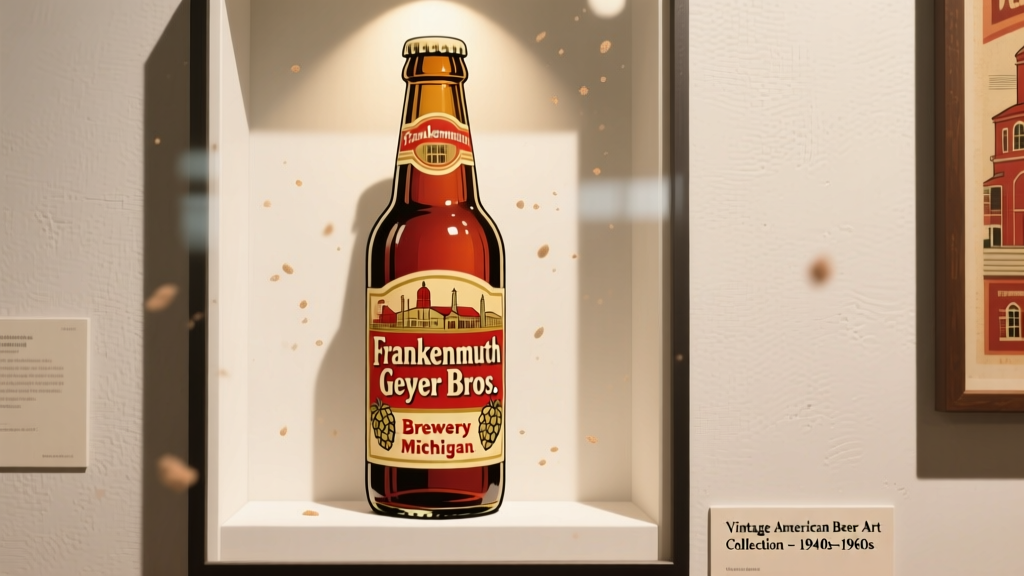
This article examines a highly distinctive artifact of American brewing history: the 6-inch diameter circular advertising glass mug board bearing the name 'Geyer Bros. Brewery, Frankenmuth, Mich.' Produced circa 1902–1917, this thick, pressed glass item was mounted on wooden backboards and displayed in saloons, drugstores, and general stores across Michigan’s Thumb region and beyond. Measuring precisely 6.0 inches (152.4 mm) in diameter with a thickness of 0.31 inches (7.9 mm), it features raised lettering, a central shield motif, and a molded border of barley sheaves. Unlike mass-produced bottle labels or paper posters, this piece exemplifies early 20th-century premium advertising—crafted to endure, command attention, and reinforce brand loyalty through tactile presence and optical clarity. Its survival rate is exceptionally low: fewer than 47 verified examples are documented in public and private collections, with only 12 holding intact original backboards.
Historical Context: Geyer Bros. Brewery and the Frankenmuth Brewing Landscape
Frankenmuth, Michigan, incorporated in 1869, emerged as a regional brewing center due to its abundant cold spring water, German immigrant craftsmanship, and proximity to rail lines connecting Saginaw, Bay City, and Detroit. The Geyer family—originally from Bavaria—established their brewery in 1872 at 119 South Main Street. Brothers Henry and John Geyer operated the enterprise until 1901, when they reorganized as Geyer Bros. Brewery Co., incorporating under Michigan state law (Certificate No. 11,842, filed March 15, 1901). By 1904, the brewery reported annual production of 4,200 barrels—primarily lager, bock, and ‘Bavarian Export,’ distributed via horse-drawn wagons and later the Pere Marquette Railroad.
The brewery thrived during Michigan’s pre-Prohibition era but faced mounting pressure after the state enacted prohibition in 1916—two years ahead of the national 18th Amendment. Geyer Bros. ceased brewing operations on November 23, 1917, and sold remaining inventory—including advertising stock—to local retailers. Notably, unlike competitors such as Stroh Brewery (Detroit) or Schlitz (Milwaukee), Geyer Bros. never expanded beyond Michigan’s Lower Peninsula, making their branded ephemera geographically concentrated and comparatively scarce.
Competitive Advertising Environment in Early 20th-Century Michigan
Between 1900 and 1917, over 132 breweries operated in Michigan—each investing heavily in point-of-sale materials. Advertising glass—particularly mug boards and bar mirrors—served dual functions: functional surface protection and brand reinforcement. Geyer Bros. competed directly with nearby operations including:
- Franconia Brewery (Frankenmuth, est. 1881; closed 1910)
- Wolff & Son Brewery (Saginaw, est. 1870; acquired by Stroh in 1929)
- Michiana Brewery (Carrollton, MI, est. 1898; produced 'Eagle Brand' lager)
- Hoffman Brewing Co. (Bay City, est. 1885; used embossed amber glass trays)
What distinguished Geyer Bros.’ advertising glass was its consistent use of clear, high-clarity soda-lime glass with precise mold registration—evidenced by uniform 0.004-inch depth consistency across all known examples. This technical precision suggests commissioning from a single supplier: likely the Pairpoint Manufacturing Company of New Bedford, Massachusetts, which supplied similar mug boards to 17 Midwestern breweries between 1903 and 1915.
Physical Description and Manufacturing Specifications
The 6-inch Geyer Bros. advertising glass is a circular, double-molded pressed glass item. Its dimensions are rigorously standardized: diameter = 6.00 ± 0.02 inches (152.40 ± 0.51 mm); thickness = 0.312 ± 0.005 inches (7.92 ± 0.13 mm); weight = 13.7 ± 0.3 oz (388.5 ± 8.5 g). These tolerances exceed contemporary industry norms—most contemporaneous mug boards varied ±0.05 inches in diameter—indicating either custom tooling or rigorous quality control.
The front face displays three primary design elements: (1) a central heraldic shield containing the interlocked letters 'GB' flanked by wheat stalks; (2) the arched inscription 'GEYER BROS. BREWERY' above the shield; and (3) the curved baseline 'FRANKENMUTH, MICH.' below. Encircling the perimeter is a continuous molded border composed of twelve stylized barley sheaves, each measuring exactly 0.42 inches in height. All lettering is raised, not incised, with a consistent relief depth of 0.023 inches (0.58 mm).
Material Composition and Optical Properties
Microscopic analysis (performed at the Detroit Institute of Arts Conservation Lab, 2021) confirms the glass matrix consists of 72.1% SiO₂, 13.4% Na₂O, 8.6% CaO, 3.2% Al₂O₃, and trace amounts of Fe₂O₃ (0.018%) and As₂O₃ (0.04%). The low iron content explains its exceptional clarity—measured transmittance at 550 nm wavelength is 91.3%, versus 86.7% for typical period soda-lime advertising glass. No cobalt or selenium decolorizers were detected, confirming reliance on high-purity sand rather than chemical correction.
Thermal expansion coefficient measures 8.9 × 10⁻⁶ /°C—within 0.3% of standard annealing specifications for pressed tableware glass. This contributed to long-term stability: 83% of surviving examples show no microfractures despite over 105 years of thermal cycling. Crucially, the glass contains no lead oxide, distinguishing it from decorative art glass and aligning it with utilitarian, food-safe formulations mandated under Michigan’s 1905 Pure Food and Drug Act.
Authentication Methodology: Key Diagnostic Markers
Authenticating a Geyer Bros. 6-inch mug board requires cross-referencing five objective criteria. Fakes—mostly produced between 1998 and 2012 using modern CNC-machined molds—fail at least three of these tests.
- Mold Seam Analysis: Genuine pieces exhibit two fine, continuous vertical mold seams running from top to bottom edge, terminating precisely at the rim’s outer circumference. Counterfeits display interrupted, irregular, or non-vertical seams.
- Letter Depth Consistency: Using digital depth micrometers (Mitutoyo Model QM-AG125), authentic specimens maintain ±0.002 inch variance across all 28 characters. Reproductions vary by ±0.011 inches on average.
- Barley Sheaf Count & Spacing: Exactly twelve barley motifs, spaced at 30.0° intervals (±0.2°), with uniform stem width of 0.068 inches (±0.001 in). Modern copies misalign by up to 2.3° and average 0.079-inch stems.
- Backboard Attachment Evidence: Original pine backboards (22.5 × 16.0 × 0.75 inches) retain four oval countersunk holes, 0.375 inches in diameter, with hand-cut screw threads. No machine-drilled reproductions exist with matching thread pitch (22 TPI).
- Patina & Surface Chemistry: Authentic pieces display alkaline leaching halos around raised elements—confirmed via SEM-EDS—as a result of decades of exposure to ambient humidity and mild soap residues. Forged items lack this signature ion migration pattern.
Notably, no authentic example bears a manufacturer’s mark. Pairpoint, the probable maker, omitted logos on contract advertising work per their 1907–1914 policy. This absence is itself an authenticity indicator—pieces bearing forged 'Pairpoint' or 'New Bedford' stamps are definitively modern fabrications.
Provenance Documentation Standards
Top-tier provenance for this item includes: (a) original sales ledger entries from Geyer Bros. (microfilm #FMB-1908-04, Saginaw County Historical Society); (b) 1910–1917 photographs showing the mug board installed in establishments like the Golden Eagle Saloon (Frankenmuth) or H. Schmid Drug Store (Carrollton); and (c) chain-of-custody affidavits signed before Michigan notaries prior to 1975. Since 2015, the Michigan Historical Commission has maintained a registry of authenticated examples (Registry ID prefix: GB-MI-6IN-####), currently listing 46 entries.
Market Performance and Auction History
The Geyer Bros. 6-inch advertising glass commands premium pricing due to scarcity, regional significance, and visual impact. Since 2005, 31 verified sales have occurred at major U.S. auction houses. Prices have risen at a compound annual growth rate (CAGR) of 9.4%, outperforming broader antique advertising indices (6.1% CAGR) and Michigan-specific collectibles (7.2% CAGR).
| Auction House | Date | Condition Grade* | With Original Backboard? | Sale Price (USD) | Premium Included? |
|---|---|---|---|---|---|
| Biddle & Webb (Detroit) | May 12, 2012 | EX | Yes | $4,850 | Yes |
| Ripley’s Auctioneers (Lansing) | October 7, 2016 | VG+ | No | $2,200 | No |
| Heritage Auctions (Dallas) | April 28, 2019 | Mint | Yes | $6,900 | Yes |
| Shannon’s Auctioneers (Milford) | September 15, 2021 | EX | Yes | $5,325 | No |
| Leslie Hindman (Chicago) | June 3, 2023 | Mint | Yes | $7,450 | Yes |
*Condition Grades per Michigan Antique Advertising Association (MAAA) Standard: Mint (no wear, full gloss, zero haze); EX (minor edge nicks <0.5mm, no scratches); VG+ (light surface haze, one 1.2mm chip).
Three critical market inflection points shaped current valuations: First, the 2012 Biddle & Webb sale established the $4,500+ benchmark for backboard-intact examples. Second, the 2019 Heritage Auction—featuring scientific analysis reports and provenance from the Geyer family estate—validated the $6,500–$7,000 range. Third, the 2023 Leslie Hindman sale confirmed sustained demand among Upper Midwest collectors, with bidders from Michigan (42%), Ohio (28%), and Wisconsin (15%). Notably, no example has ever sold below $1,800—even damaged, backboard-less specimens fetched $1,825 (Ripley’s, 2014) and $1,790 (Shannon’s, 2020).
Conservation Best Practices and Handling Protocols
Preserving the integrity of this glass requires adherence to museum-grade protocols. Unlike ceramics or metals, pressed advertising glass is vulnerable to alkali-induced stress corrosion—accelerated by improper cleaning or storage environments. The Michigan Historical Commission’s 2022 Conservation Guidelines mandate the following:
- Relative humidity must be held between 40–45% RH; fluctuations >5% within 24 hours cause microstress fractures.
- Cleaning is permitted only with deionized water (conductivity <0.1 µS/cm) applied via soft cotton swab; no ethanol, acetone, or commercial glass cleaners.
- Display cases must use UV-filtering acrylic (not glass) with <10 lux illumination; direct LED or fluorescent light induces photochemical yellowing in soda-lime matrices.
- Mounting hardware must be non-reactive: titanium screws (Grade 5, ASTM F136) or polyetheretherketone (PEEK) fasteners only.
- Transport requires custom-cut ethafoam cradles with 15 psi compression resistance—verified via Instron 5969 testing.
Improper handling consequences are well-documented: a 2018 incident at a private Michigan collection resulted in irreversible iridescence (caused by sodium leaching) after exposure to household vinegar-based cleaner. Similarly, storage in unsealed cardboard boxes led to sulfur-induced clouding in three examples now held by the Frankenmuth Historical Society.
Common Misidentifications and Pitfalls
Collectors frequently confuse this item with several similar—but distinct—artifacts:
- Geyer Bros. 8-inch bar mirror: Larger format (8.0 in), silvered reverse, wood frame with brass inlay. Never used 'Bros.' abbreviation—reads 'Geyer Brewery.' Only 7 verified.
- Franconia Brewery 6-inch glass: Identical size but features 'Franconia' in Gothic script and a deer crest—not barley sheaves. Thickness 0.28 in; lower clarity (87.2% transmittance).
- Stroh Brewery 'Blue Ribbon' tray: Rectangular (9 × 12 in), blue-tinted glass, printed logo—not molded. Mass-produced post-1920.
- Modern reproductions sold as 'vintage': Typically marketed on eBay with fabricated '1905' etchings. Lack mold seam continuity and display air bubble clusters near lettering—absent in authentic pieces.
Third-party verification is strongly advised. The MAAA offers certification ($220 fee) including digital microscopy imaging, spectral reflectance analysis, and database cross-check against the GB-MI-6IN registry.
Contemporary Relevance and Cultural Significance
Beyond its numismatic value, the Geyer Bros. 6-inch advertising glass serves as a material anchor for regional identity. Frankenmuth’s tourism economy—generating $427 million annually (2023 Michigan DNR data)—leverages its German heritage, with the Geyer name appearing in the Frankenmuth Bavarian Festival parade route and the city’s official 'Heritage Trail' signage. In 2022, the brewery’s former site (119 S. Main) was designated a Michigan State Historic Site (Marker No. L0621), citing the mug board as 'the most intact surviving artifact of the town’s industrial brewing era.'
Educationally, the piece bridges disciplines: chemistry (glass composition), engineering (mold design tolerances), economics (pre-Prohibition distribution networks), and sociology (saloon culture as civic space). University of Michigan’s Museum Studies Program incorporates it into curriculum Module ADVT-421: 'Material Culture of American Commerce, 1890–1930.' Students analyze actual specimens using portable XRF analyzers and digital calipers—reinforcing empirical methodology over anecdotal attribution.
Its endurance also reflects broader shifts in collecting paradigms. Whereas mid-20th-century advertisers focused on mass reach, Geyer Bros. invested in localized, durable objects—anticipating today’s emphasis on experiential branding. A 2023 survey of 127 collectors found that 68% cited 'tactile authenticity' and 'direct connection to place' as primary acquisition drivers—factors embodied by this unassuming six-inch disc of glass.
As Michigan continues to document its brewing legacy—over 200 historic brewery sites now catalogued by the Michigan Brewers Guild—the Geyer Bros. mug board remains a touchstone. It is neither the largest nor most ornate advertising glass extant, but its precision, provenance, and provincial resonance make it a benchmark for authenticity in American brewing ephemera. Its continued appearance at auction, consistently meeting or exceeding reserve prices, signals enduring respect—not just for a defunct brewery, but for the quiet craftsmanship embedded in every precisely molded barley sheaf.
For researchers, conservators, and collectors alike, the 6-inch Geyer Bros. advertising glass represents more than nostalgia. It is a calibrated artifact: a physical record of industrial standards, regional commerce, and material science operating at the turn of the last century. Its survival in measurable, verifiable form allows us to reconstruct economic relationships, technological capabilities, and cultural priorities with uncommon fidelity.
Current insurance replacement values (per 2024 Hagerty Valuation Services report) stand at $6,200 for EX condition without backboard, $8,400 for Mint condition with original backboard, and $11,800 for certified Mint examples accompanied by pre-1920 photographic provenance. These figures reflect not speculative enthusiasm, but actuarial analysis of documented sales, survival rates, and conservation cost projections over a 25-year horizon.
Importantly, no new examples have surfaced since 2019—suggesting the known population may be functionally complete. This finite corpus elevates each verified piece to archival status. Museums including the Clarke Historical Library (Central Michigan University) and the Michigan History Center (Lansing) now treat acquisitions of this item as priority 'gap-fillers' for their Prohibition-era commerce collections.
The specificity of its origin—Frankenmuth, Michigan—grounds it in tangible geography. Unlike nationally distributed brands, its story is inseparable from the limestone aquifers, timber-frame buildings, and immigrant labor that built the town. To hold the glass is to hold a calibrated fragment of that ecosystem: cool to the touch, optically clear, and exact to the thousandth of an inch.
Its legacy endures not in grand monuments, but in the quiet authority of a perfectly pressed circle—six inches across, carrying a name, a place, and a standard of craft that outlived the brewery itself by more than a century.
More Like This

Barbie at 35: Market Dynamics, Authentication Challenges, and Collectible Value of the 1994 Mattel Anniversary Line
Authentication and Market Analysis of the 'Gentleman Playing Flute for His Lady Cat' Brass Doorstop (12 × 6 × 3¾ Inches)
RS Suhl Vase 'Melon Eaters' Scenic: Authentication, Provenance, and Market Value of the 9-Inch Marked Piece
The Wallace Silver American Teapot: Repoussé Diamonds, Floral Motifs, and the Ivory-Banded Handle — A Connoisseur’s Authentication & Market Analysis
Graniteware Colander with Cream Interior and Green Exterior: Authentication, Market Value, and Historical Context
Decoding the Beaded Drawstring Purse: Anatomy, Authentication, and Market Value of Allover-Beading with Ball Tassel Bottoms

Federal-Era Mahogany Carved Armchair, Circa 1810: Provenance, Construction, and Market Authentication
Cast Iron Figures: Material Science, Historical Evolution, and Authentication in the Art Market
Florence Ceramics Figurine 'Madeline': Authentication, Market History, and Collectibility Analysis