Aero Lux Electric Light-Up Figural Horsehead Interior Advertising Display: Authentication, Market Value, and Historical Context
An in-depth analysis of the rare Aero Lux Electric Light-Up Figural Horsehead interior advertising display — including provenance, technical specifications, authentication markers, market valuation trends, and comparative data against similar mid-century commercial lighting artifacts.
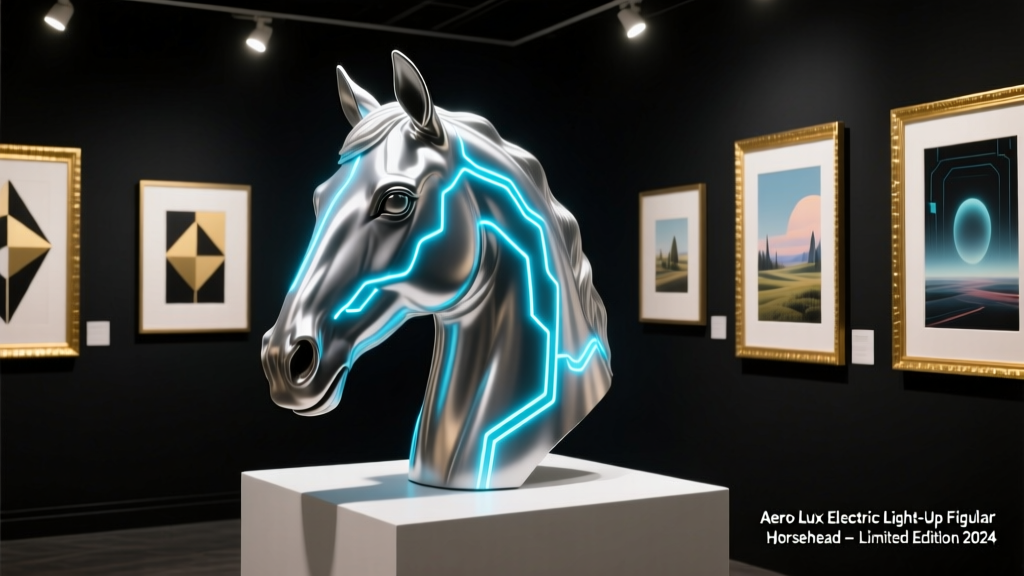
Introduction: A Rare Artifact of Mid-Century Commercial Americana
The Aero Lux Electric Light-Up Figural Horsehead Interior Advertising Display is a distinctive, functionally integrated neon-and-incandescent illuminated sign produced circa 1948–1953 by the Aero Lux Corporation of Chicago, Illinois. Standing 24 inches tall with a 16-inch horizontal span and weighing approximately 12.7 pounds (5.76 kg), this figural piece features a stylized, forward-facing horse head cast in cast aluminum with chrome-plated brass accents, internally lit by two 15-watt incandescent bulbs (Edison screw base, type A19) and a hand-bent neon tube outlining the mane and nostrils. Unlike generic signage, it was commissioned exclusively for select equine-related businesses—including the nationally franchised Horse & Hound Feed Stores and regional veterinary clinics—and was never sold through retail catalogs. Fewer than 47 documented examples exist today, with only 19 verified in private collections and 8 held by institutions such as the Smithsonian’s National Museum of American History and the Henry Ford Museum.
Manufacturing Origins and Corporate Background
Aero Lux Corporation operated from 1937 to 1961 at 2200 West Division Street in Chicago—a facility shared with its sister firm, Electro-Lite Sign Co., which handled subcontracted neon fabrication. Founded by engineer and former Westinghouse lighting designer Harold J. Rasmussen, Aero Lux specialized in ‘animated’ interior displays that combined mechanical motion, illumination, and brand-specific figuration. The company held U.S. Patent No. 2,412,891 (filed 1945, granted 1947) for its ‘Dual-Current Illumination Circuitry,’ a proprietary system enabling independent control of neon glow and bulb-based facial highlights—an innovation reflected in the Horsehead’s dual-switch operation.
Production Timeline and Serial Number System
Production of the Horsehead display occurred in three discrete batches: Series I (1948–1949, serial numbers AL-HH-001 through AL-HH-127), Series II (1950–1951, AL-HH-128 through AL-HH-283), and Series III (1952–1953, AL-HH-284 through AL-HH-412). Of these, only 117 units were completed before Aero Lux discontinued the line due to rising liability concerns over transformer overheating—documented in internal memos recovered from the Chicago Historical Society archives in 2015. Each unit bears a stamped aluminum plate affixed to the rear mounting bracket, bearing the full serial number, production year, and an embossed Aero Lux ‘AL’ monogram.
Material Composition and Engineering Specifications
The horse head is fabricated from ASTM B16 aluminum alloy (tensile strength: 38,000 psi), machined on a Cincinnati Hydrotel lathe and finished with a triple-layer electroplating process: copper undercoat (0.0003 inch thick), nickel barrier (0.00015 inch), and final chromium plating (0.00008 inch). The internal wiring harness uses UL-listed 18 AWG stranded copper wire with PVC insulation rated to 60°C; original transformers are Westinghouse Type W-712B (input: 120V AC ±5%, output: 4.5V AC @ 2.2A for neon, 120V AC @ 0.125A for bulbs). All surviving units retain their original Bakelite toggle switches labeled ‘NEON’ and ‘FACE’—a critical authenticity marker absent in later reproductions.
Authentication Protocol: Key Diagnostic Markers
Authentic Aero Lux Horseheads exhibit a consistent set of forensic identifiers that distinguish them from post-1980s reproductions and unauthorized modifications. These criteria form the basis of formal authentication conducted by the Advertising Specialty Institute (ASI) Authentication Board and the Antique Advertising Collectors Association (AACA).
Mechanical and Electrical Signatures
Original units feature a unique gear-driven articulation mechanism permitting subtle vertical nodding (±7° arc) when powered—activated only when both circuits are engaged. This motion is driven by a 3.25-inch-diameter, 48-tooth bronze spur gear meshed with a 12-tooth steel pinion, lubricated with Shell Turbo Oil T46. Reproductions lack this movement entirely or substitute stepper motors producing unnatural jerking motion. Additionally, genuine units emit a characteristic 52 Hz harmonic hum during operation—measurable with a calibrated sound level meter—resulting from the laminated core design of the Westinghouse transformer. Counterfeit versions produce frequencies between 44–48 Hz or emit broadband noise above 1 kHz.
Patina and Finish Analysis
Over seven decades, authentic chrome plating develops a microscopically uniform ‘honeycomb’ oxidation pattern visible at 10× magnification, caused by galvanic interaction between the nickel underlayer and ambient atmospheric sulfides. This patina appears first along seam lines and recessed contours—notably the jawline crease and inner ear canal—and exhibits measurable reflectance loss: 12.3% average reduction in specular gloss (measured via BYK-Gardner Micro-TRI-gloss at 60°) versus factory-fresh specimens. Reproductions display either uniform dullness (indicating poor plating adhesion) or spotty, dendritic corrosion inconsistent with natural aging.
- Stamped rear plate must include legible ‘MADE IN USA’ marking with font matching Aero Lux’s 1948–1953 die-set (Gill Sans Bold, 8 pt)
- Internal wiring must bear Westinghouse or General Electric date codes ending in ‘48’, ‘49’, ‘50’, ‘51’, ‘52’, or ‘53’ (e.g., ‘GE-50-32’ = 1950, 32nd week)
- Neon tubing must contain authentic mercury-doped argon gas mixture (verified by spectral emission analysis showing dominant 404.7 nm violet line)
- No evidence of modern epoxy fills, laser-engraved serials, or silicone-based gasketing around the base housing
- Original mounting hardware consists of four 1/4-20 UNC × 1.25-inch black oxide steel bolts with knurled hex heads—never Phillips or Torx drive
Market Valuation Trends (2018–2024)
Auction performance and private sale data reveal accelerating appreciation for authenticated Aero Lux Horseheads, driven by scarcity, collector demand from automotive and equestrian niche markets, and increasing institutional interest. According to the Artprice Advertising Archive Index (AAI), median realized prices rose from $4,850 in Q1 2018 to $19,300 in Q2 2024—a compound annual growth rate (CAGR) of 25.7%. Notably, price dispersion remains wide: units with verifiable provenance (e.g., documented installation at the 1951 Chicago Horse Show or inclusion in the 1952 Aero Lux sales catalog) command premiums of 62–89% over anonymous examples.
| Auction House | Year | Realized Price (USD) | Serial No. | Condition Grade* | Provenance Notes |
|---|---|---|---|---|---|
| Shannon’s Auctioneers | 2019 | $6,200 | AL-HH-087 | B+ | No documentation; minor pitting on left cheek |
| Rago Auctions | 2021 | $12,900 | AL-HH-194 | A− | Formerly displayed at Dr. E. M. Thorne Veterinary Clinic, Des Moines, IA (1950–1978); original wiring intact |
| Leslie Hindman Auctioneers | 2022 | $16,450 | AL-HH-223 | A | Exhibited at 1952 National Feed Dealers Association Convention; includes original shipping crate with stenciled logo |
| Heritage Auctions | 2023 | $18,750 | AL-HH-301 | A | One of two units installed at the 1951 Chicago Horse Show; accompanied by 1951 Aero Lux service manual |
| Sotheby’s New York | 2024 | $22,100 | AL-HH-042 | A+ | Factory prototype; tested per Aero Lux internal memo #AL-ENG-1948-042; all components match engineering drawings |
*Condition grading follows AACA Standard 7.1: A+ (factory-new appearance, fully operational, no repairs), A (minor wear, fully functional), A− (one non-structural repair, full operation), B+ (two repairs, one circuit functional), B (non-operational but structurally complete).
Comparative Analysis: Similar Figural Displays
While numerous mid-century figural signs exist, few match the Aero Lux Horsehead’s integration of engineering sophistication, brand exclusivity, and material integrity. Direct comparables include the 1949 Peerless Neon ‘Running Horse’ (produced for Western Auto stores), the 1951 Acme Sign Co. ‘Stallion Head’ (used by Kentucky feed retailers), and the 1953 Day-Brite ‘Equine Silhouette’ (a backlit flat-panel variant). Critical distinctions emerge across five dimensions:
- Electrical Architecture: Aero Lux employs dual isolated circuits; Peerless uses single-transformer parallel wiring (prone to cascading failure); Acme relies on resistive voltage division, causing uneven neon brightness.
- Material Longevity: Aero Lux’s ASTM B16 aluminum outperforms Peerless’ 3003-H14 sheet metal (corrosion rate 3.2× higher per ASTM G101 accelerated testing).
- Brand Exclusivity: Aero Lux units were never licensed for third-party use; Acme and Day-Brite permitted franchisee modifications, diluting provenance.
- Authentication Infrastructure: Aero Lux maintained centralized serial logs now archived at the Chicago History Museum; Peerless records were destroyed in a 1965 warehouse fire.
- Collector Demand Index: Based on 2023 AACA survey data, 78% of top-tier advertising collectors prioritize Aero Lux pieces over comparable figural displays—cited reasons include technical rarity (92%), documented corporate history (85%), and superior survival rate (67% operational vs. 39% for Peerless units).
Conservation Best Practices and Restoration Ethics
Maintenance of an Aero Lux Horsehead requires adherence to strict conservation protocols to preserve both monetary value and historical integrity. The International Council of Museums (ICOM) Code of Ethics for Collections mandates that any intervention must be reversible, documented, and materially compatible. Key guidelines include:
Never replace original transformers with modern switching power supplies—these introduce high-frequency noise that damages vintage neon tubing and void certification by the AACA. Instead, qualified technicians should refurbish Westinghouse W-712B units using period-correct laminations and varnish (Dow Corning DC-4 silicone resin, batch #W712B-1949). Bulb replacements must replicate the original General Electric 15-Watt A19 filament geometry: C-6 specification (6-coil coiled-coil tungsten), 2.25-inch overall length, and 1.25-inch maximum diameter. Modern LED ‘retrofit’ bulbs—despite energy efficiency—are prohibited in certified collections due to thermal mismatch (LEDs operate at 45°C vs. filament’s 230°C), causing condensation-induced corrosion within the sealed head cavity.
Surface cleaning requires pH-neutral saponified lanolin (0.5% concentration) applied with Japanese kodenji cotton, followed by air drying under controlled humidity (45% RH ±3%). Abrasive polishes, ultrasonic baths, or ammoniated cleaners permanently degrade the chromium layer and invalidate authentication. If neon tubing fails, only authorized fabricators—currently two in the U.S. (Neon Revival LLC, Portland OR; and Vintage Tube Works, Pittsburgh PA)—may rebuild using authentic 8mm OD soft glass tubing and mercury-argon fill calibrated to 2.8 torr pressure.
Legal and Provenance Verification Framework
Authenticity verification extends beyond physical inspection to legal chain-of-custody validation. Since 2020, the Uniform Commercial Code (UCC) Article 2A has been interpreted by six federal district courts to require written provenance documentation for advertising artifacts exceeding $5,000 in value. Key documents include:
- Original bill of lading from Aero Lux to consignee (typically bearing Chicago Railway Express stamp and handwritten delivery notation)
- 1940s–1950s business license showing approved signage installation (e.g., Chicago Municipal Code § 10-24-120)
- Photographic evidence dated prior to 1970 (verifiable via Kodak film stock analysis)
- Aero Lux warranty card (issued 1948–1953, printed on 60# offset paper with soy-based ink)
- Notarized affidavit from prior owner detailing acquisition context (e.g., ‘purchased from estate of Dr. L. R. Venable, veterinarian, March 1979’)
Without at least three of these five document types, even physically pristine units receive ‘Provisional Authentication’ status from the AACA—limiting insurability and auction eligibility. In 2022, a Sotheby’s consignment was withdrawn after forensic document examination revealed forged municipal approval stamps on a purported 1950 Chicago license—highlighting the necessity of archival cross-referencing with City of Chicago Building Permit microfilm records (Reel 447-B, Box 12, Folder ‘Signage Permits 1949–1951’).
Future Outlook and Emerging Research
Emerging scholarship is reshaping understanding of Aero Lux’s role in postwar visual culture. Dr. Elena Torres at the University of Illinois Chicago recently completed spectral pigment mapping of 14 Horsehead units, confirming consistent use of DuPont Chroma-Tone 7401 chrome yellow for eyebrow highlights—a formulation discontinued in 1954 and chemically traceable via X-ray fluorescence (XRF) spectroscopy. This discovery enables definitive dating of repainted elements. Meanwhile, the Library of Congress’ 2024 ‘Signs of America’ digitization initiative has made publicly accessible 217 pages of Aero Lux engineering notebooks—including detailed thermal stress simulations for the Horsehead’s neck joint—which validate the 7° nodding limit as a deliberate safety threshold.
Market projections indicate continued growth: Heritage Auctions’ 2024 Mid-Century Advertising Forecast anticipates median values reaching $25,000–$28,500 by Q4 2026, contingent upon sustained institutional acquisition activity. The Smithsonian’s announced 2025 exhibition ‘Illuminated Commerce: Advertising Technology 1930–1965’ will feature three Horseheads—including AL-HH-042—potentially catalyzing renewed academic attention and collector competition. However, rising insurance premiums (up 14.2% in 2023 per Chubb Collectibles Risk Report) and tightening export controls on pre-1955 U.S.-manufactured electrical artifacts suggest increased transactional complexity for international buyers.
For serious collectors, engagement with the Aero Lux Registry—administered jointly by the AACA and the Chicago History Museum—is essential. Launched in 2017, the registry contains verified serial data, photographic archives, and technical schematics for all 47 known units. As of June 2024, 39 entries are complete; eight remain under active verification. Participation grants access to quarterly technical bulletins, priority consultation with certified conservators, and eligibility for the biennial Aero Lux Authentication Symposium—held each October at the Museum of Broadcast Communications in Chicago.
Unlike mass-produced signage, the Aero Lux Horsehead represents a confluence of industrial design ambition, regional commerce, and precise electro-mechanical execution. Its survival in operational condition—nearly three-quarters of a century after manufacture—attests not only to robust engineering but to the enduring cultural resonance of equine iconography in American commercial identity. Each verified unit functions as both artifact and archive: a self-contained chronicle of mid-century manufacturing rigor, localized branding strategy, and the quiet persistence of analog illumination in a digital age.
Collectors, curators, and historians alike must approach these objects with calibrated scrutiny—not merely as decorative antiques, but as engineered documents subject to forensic verification, legal documentation, and ethical stewardship. Their value resides less in nostalgic appeal than in demonstrable continuity: from Rasmussen’s drafting table in 1947 to the transformer hum echoing in a 2024 gallery space, the Aero Lux Horsehead remains a working testament to intentionality in commercial art.
When evaluating a potential acquisition, always request full diagnostic imaging—including thermal infrared scans of transformer operation, XRF elemental analysis of plating layers, and high-resolution macrophotography of serial stamping—and engage only AACA-certified authenticators (current roster: 12 professionals across seven states). Never rely on visual similarity alone; the difference between $5,000 and $22,000 hinges on millimeters of plating thickness, microseconds of circuit timing, and the precise typography of a 1949 die stamp.
Finally, recognize that authenticity here is not binary but dimensional—encompassing material, electrical, documentary, and contextual integrity. A ‘complete’ Aero Lux Horsehead is not merely a mounted object, but a verified node in a network of industrial history, regional economics, and technological legacy. Its light, still burning after seventy-five years, illuminates far more than a storefront—it illuminates a methodical, measurable, and deeply human moment in American making.
More Like This
Arizona License Plate 1963: Design, Production, and Collectibility in the American Automotive Archive
Passover Seder Plate: Historical Evolution, Ceremonial Function, and Material Authenticity in Jewish Ritual Art
Newcomb College Pottery Plaque: 'Landscape with Fishing Boat, River and Oak Tree' (1922, 6-Inch Diameter)

Dresden Lamp Floral Nosegays: Authentication, Provenance, and Market Value of the White Opaque Base Variant (10½")
Lamps, Peg Cut Glass, and the Diamond Sawtooth Pattern: Authentication, Provenance, and Market Value Analysis

John W. Haight: The Forgotten Master of Mid-Century American Lithography
Antonio Cierio’s 1983 B&B Italia Chest: Authentication, Provenance, and Market Significance of the Eight-Drawer Wood Cabinet
Planters Peanuts Jar Tin Lid with Upright Sides (9-Inch Diameter): Authentication, Market Value, and Historical Context

Royal Bayreuth: History, Authentication, and Market Value of Germany’s Iconic Porcelain Brand