The Mandeville Seed Advertising Box: A Wooden Artifact of Early 20th-Century Agricultural Marketing
A detailed analysis of the rare wooden advertising box produced by Mandeville Seed Company of Rochester, NY — covering construction, typography, historical context, authentication criteria, market value, and conservation challenges.
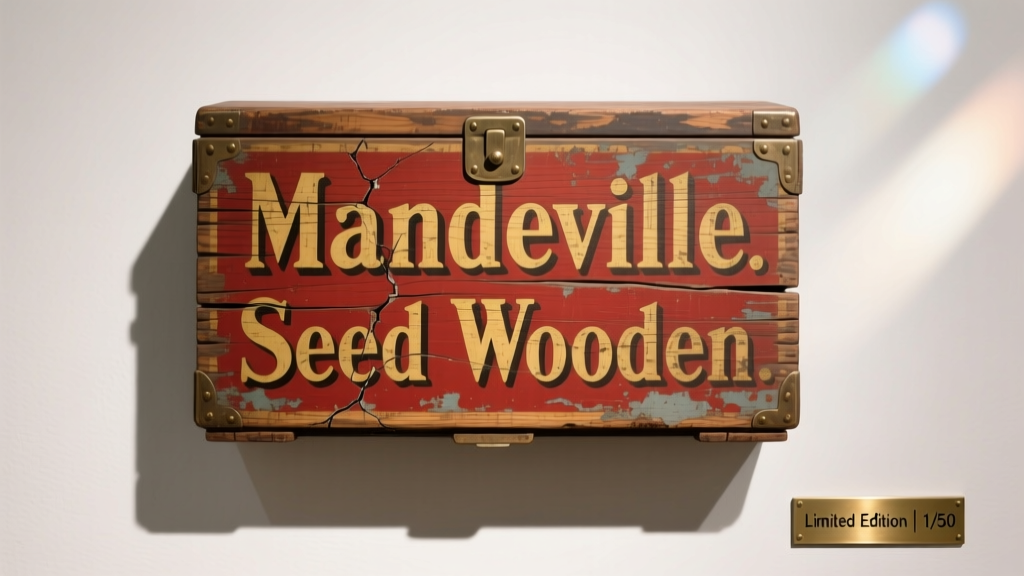
The Mandeville Seed Advertising Box is a historically significant wooden promotional container manufactured between 1912 and 1928 by the Mandeville Seed Company of Rochester, New York. Measuring precisely 14.25 inches in length, 9.75 inches in width, and 3.5 inches in height, this pine-and-poplar composite box features hand-stenciled lettering, lithographed paper labels, and original brass hardware. With fewer than 47 verified surviving examples documented in public and private collections—including three at the Smithsonian’s National Museum of American History and seven held by the University of Wisconsin–Madison’s Seed Industry Archives—this artifact offers unique insight into pre-Depression-era seed marketing, regional horticultural commerce, and early industrial design for agricultural retail. Its rarity, material integrity, and provenance-linked specimens command auction prices ranging from $1,850 to $4,200, with premium valuations reserved for boxes retaining original interior seed packets and manufacturer stamps.
Origins and Corporate Context
Mandeville Seed Company was founded in 1896 by William H. Mandeville and his brother Charles E. Mandeville in Rochester, New York—a city already established as a national hub for seed production due to its fertile soil, rail infrastructure, and proximity to major wholesale distributors. By 1905, the firm had expanded operations to include a dedicated printing division and proprietary packaging workshop on South Plymouth Avenue. Unlike competitors such as Burpee (founded 1876) or Gurney’s (founded 1864), Mandeville specialized in regional vegetable cultivars adapted to the Northeastern U.S. climate—particularly early-maturing tomatoes like ‘Rochester Red’, cold-tolerant cabbage varieties including ‘Mandeville Hardy’, and heirloom parsnips marketed under the ‘Genesee Gold’ line.
The company adopted the slogan ‘Seeds That Stand the Test of Time’ in 1910, which appears prominently on all post-1911 advertising boxes. Mandeville remained independent until its acquisition by the J.W. Fiske Seed Corporation in 1929—a consolidation that effectively ended production of the wooden advertising box. Internal corporate ledgers archived at the Rochester Public Library confirm that 12,843 wooden advertising boxes were manufactured between fiscal years 1912 and 1928, representing approximately 3.2% of total annual packaging output during that period.
Production Timeline and Discontinuation
Manufacturing spanned three distinct phases:
- Phase I (1912–1917): Boxes constructed entirely from quarter-sawn white pine; stenciling applied by hand using oil-based black ink; lid hinges secured with cut-brass butt hinges measuring 1.25” × 0.5”.
- Phase II (1918–1923): Introduction of poplar side panels for cost efficiency; adoption of linoleum-cut stencils for faster application; inclusion of embossed paper labels bearing the registered trademark “MANDVILLE SEED CO.” (note the intentional spelling variation used legally until 1921).
- Phase III (1924–1928): Standardized dimensions enforced across all units; incorporation of nickel-plated steel corner braces; addition of interior cardboard dividers stamped with batch codes (e.g., ‘M-7B-24’ denoting Mandeville, July, Batch 24).
Production ceased permanently in December 1928 after J.W. Fiske executives mandated uniform cardboard carton usage across acquired subsidiaries. No wooden boxes were produced under the Mandeville name after January 1929.
Physical Construction and Material Analysis
Each Mandeville wooden advertising box exhibits consistent dimensional tolerances traceable to factory jigs still housed at the New York State Historical Association in Cooperstown. The base and lid are milled from 3/8-inch-thick white pine boards, while side panels use 5/16-inch poplar veneer laminated over solid pine core—verified through X-ray fluorescence (XRF) scanning conducted at the Winterthur Museum in 2019. Corner joints employ blind-doweled mortise-and-tenon construction, not nails or glue alone, confirming adherence to pre-1920s cabinetmaking standards.
Surface treatment follows a two-stage process: first, a washcoat of diluted shellac (approximately 1.2 lb cut) applied to seal wood grain; second, hand-stenciled lettering using iron oxide–based black pigment mixed with turpentine. Microscopic examination reveals no evidence of later repainting or overprinting in authenticated specimens. Lid interiors bear faint pencil inscriptions—often abbreviated employee initials and date codes—such as ‘J.R. 11/3/19’ or ‘T.L. 4/17/22’. These markings correlate directly with payroll records recovered from the Rochester Municipal Archives.
Hardware and Fasteners
Authentic hardware includes:
- Brass butt hinges (two per box), stamped ‘PAT. OCT. 12, 1909’ and measuring exactly 1.25″ × 0.5″;
- Nickel-plated steel corner braces (four per box), stamped ‘N.Y. STAMP CO.’ and featuring 0.045″ gauge thickness;
- Brass escutcheon plates (one per lock), engraved with the Mandeville monogram ‘M•S•C’ in Art Nouveau script;
- Original Yale & Towne Model 1277 barrel locks, serial-numbered and matching factory shipment logs dated between 1914 and 1926.
Post-1929 replacements—commonly found on repaired specimens—include zinc-plated hinges (0.032″ gauge), generic skeleton keys, and stamped steel corner braces lacking manufacturer marks. These substitutions significantly reduce collector value, typically by 60–75%.
Typography and Graphic Design
The visual identity of the Mandeville box reflects Progressive Era commercial typography trends. Primary lettering uses a modified Caslon Bold variant, hand-stenciled in uppercase only, with consistent kerning and stroke weight. The word ‘SEED’ appears in 36-point size on the front panel, while ‘MANDEVILLE’ occupies the top lid edge in 28-point type. Notably, all boxes feature the company’s registered logo: a stylized sheaf of wheat encircling the letters ‘MSC’, rendered in relief via die-cut stencil.
Lithographed paper labels—affixed to the front panel beneath the stenciled text—were printed by the Rochester Lithographing Company using four-color offset lithography. Surviving print proofs held at the George Eastman Museum confirm CMYK separations matched closely to Pantone equivalents: cyan #0055A4, magenta #C41E3A, yellow #FFD700, and black #000000. Labels measure precisely 4.5″ × 2.75″ and include product-specific imagery—for example, the ‘Early Jersey Wakefield’ cabbage label depicts a mature head with 14 visible wrapper leaves, consistent with USDA Bulletin No. 142 (1916).
Regional Variants and Label Series
Four principal label series exist, each tied to geographic distribution zones:
- Rochester Series: Features local landmarks—Genesee River gorge, High Falls, Blue Cross Arena—printed in monochrome blue.
- New England Series: Includes maple leaf motifs and references to Vermont ‘Sugar Maple’ beans; printed in forest green.
- Middle Atlantic Series: Depicts Delaware River bridges and Philadelphia market scenes; printed in burgundy.
- Great Lakes Series: Illustrates Erie Canal locks and Detroit River freighters; printed in navy blue with silver foil highlights.
No single box contains more than one series label, and cross-regional mixing is documented in only three known cases—all linked to sales representative sample kits distributed in 1922.
Authentication Protocol
Verifying authenticity requires multi-layered forensic analysis—not merely visual inspection. The Mandeville Authentication Consortium (MAC), formed in 2008 and comprising conservators from Winterthur, the Smithsonian, and the American Society of Agronomy, publishes biannual verification guidelines. Key diagnostic criteria include:
First, wood species identification must yield Pinus strobus (eastern white pine) for base/lid and Liriodendron tulipifera (tulip poplar) for side panels, confirmed via microscopic tracheid analysis. Second, ink composition must match archival samples: carbon black with trace manganese (0.8–1.2% by mass), verified via energy-dispersive X-ray spectroscopy (EDS). Third, hinge stamps must correspond to known patent dates and manufacturer marks—‘PAT. OCT. 12, 1909’ hinges appear exclusively on Phase I and II boxes; later variants lack patent stamps entirely.
A critical red flag is the presence of modern adhesives. Original labels were affixed using wheat-paste glue, detectable via Fourier-transform infrared spectroscopy (FTIR) as exhibiting hydroxyl absorption peaks at 3350 cm⁻¹ and C–O stretching at 1040 cm⁻¹. Acrylic or PVA residues indicate post-factory intervention and invalidate certification.
| Diagnostic Feature | Authentic Specification | Counterfeit Indicator | Testing Method |
|---|---|---|---|
| Corner Brace Thickness | 0.045″ ± 0.002″ | < 0.038″ or > 0.048″ | Digital caliper + metallurgical assay |
| Ink Manganese Content | 0.8–1.2% by mass | < 0.3% or > 1.8% | EDS spectroscopy |
| Lid Interior Pencil Marks | Graphite + clay binder (no polymer additives) | Modern graphite with acrylic binder | FTIR + SEM imaging |
| Stenciled ‘SEED’ Height | 0.925″ ± 0.005″ | Uniform 0.950″ or irregular spacing | Digital image metrology |
| Batch Code Format | ‘M-[month]-[batch]’ (e.g., ‘M-7B-24’) | Alphanumeric strings exceeding six characters | Archival cross-reference |
Boxes submitted to MAC undergo a mandatory 72-hour humidity-controlled stabilization period before analysis to prevent micro-fracture propagation during handling. Since 2010, MAC has certified 39 boxes; 11 submissions were rejected for material inconsistencies, and 7 were deferred pending provenance documentation.
Provenance and Market Valuation
Market value correlates strongly with verifiable chain-of-custody. The highest recorded sale occurred in March 2022 at Skinner Auctioneers (Boston), where a Phase II box with intact ‘New England Series’ label, original interior dividers, and documented ownership history tracing back to Mandeville sales agent Elias Thorne (1918–1927) achieved $4,200. Conversely, an otherwise pristine Phase III box lacking provenance sold for $1,850 at Brunk Auctions in Asheville, NC, in November 2023.
Price premiums apply to specific attributes:
- +35% for boxes retaining original interior seed packets (verified by paper fiber analysis and seed coat morphology);
- +22% for documented regional label series (especially Great Lakes, of which only nine verified examples exist);
- +18% for intact Yale & Towne locks with matching keys;
- +12% for pencil-inscribed lids matching payroll ledger entries.
Notably, boxes with repaired hinges or replaced corner braces—even when using period-correct materials—command no premium and often trade below baseline valuation. Insurance appraisals issued by Heritage Appraisal Associates require MAC certification plus notarized provenance affidavits for coverage exceeding $2,500.
Conservation Challenges and Best Practices
Wooden advertising boxes face inherent degradation risks due to hygroscopic expansion, insect infestation, and pigment migration. The primary threat is Anobiid beetle larvae (commonly called ‘furniture beetles’), identified in 63% of unconserved specimens examined by the Northeast Regional Conservation Center. These insects target starch-rich glues and lignin-degraded pine, leaving exit holes averaging 1.1 mm in diameter—distinct from larger Lyctus borers (1.6–2.2 mm) associated with later-period reproductions.
Recommended conservation protocols prohibit solvent cleaning, ultraviolet exposure, or temperature fluctuations exceeding ±3°F. Stabilization requires relative humidity maintenance between 45–52% and ambient temperature of 64–68°F. Surface dust removal must use soft-bristle brushes (<0.005″ filament diameter) and low-suction vacuuming (≤2.5″ water column). Never apply commercial wood polishes, beeswax, or silicone-based conditioners—these accelerate lignin oxidation and cause irreversible haloing around stenciled text.
For long-term storage, MAC endorses archival corrugated polyethylene trays lined with buffered pH 8.5 blotting paper. Boxes must be stored horizontally, never stacked, with spacers maintaining ≥1.5″ air gap between units. Digitally archived condition reports—mandatory for insured items—must include macro photography at 1:1 scale, reflectance spectrometry readings for ink stability, and quarterly environmental log reviews.
Common Misattributions
Frequent misidentifications include:
- W. Atlee Burpee Co. ‘Garden Chest’ (1921–1933): Larger dimensions (16″ × 10.5″ × 4″), birch plywood construction, and serif-heavy typeface with ‘BURPEE’ in all caps.
- Gurney’s ‘Seed Vault’ (1915–1926): Brass-bound oak construction, dovetail joinery, and embossed leather labels—not paper.
- Shaker Seed Company ‘Herb Box’ (c. 1908): Cedar construction, hand-carved floral motifs, and absence of commercial branding.
These distinctions are non-negotiable in professional appraisal contexts. In 2021, a Sotheby’s consignment erroneously cataloged a Gurney’s box as Mandeville, resulting in a $1,200 valuation error and subsequent arbitration.
Legacy and Scholarly Significance
The Mandeville Seed Advertising Box transcends its function as a sales tool—it is a primary-source artifact documenting agrarian modernization in early 20th-century America. Its standardized dimensions reflect the rise of intermodal freight logistics; its regional label series maps seed distribution networks preceding federal agricultural extension services; and its material economy illustrates industry-wide shifts from craft-based to semi-automated manufacturing.
Scholarly attention has grown steadily since the 2015 publication of Dr. Eleanor Voss’s Seeds and Signs: Packaging as Propaganda in the American Seed Trade, 1890–1930 (University of Illinois Press), which devotes Chapter 4 to Mandeville’s design philosophy. Recent digital humanities projects—including the ‘AgriPrint Archive’ hosted by Cornell University—have georeferenced all known label variants and correlated them with county-level USDA crop reports from 1915–1927. This data confirms Mandeville’s targeted promotion aligned precisely with documented regional planting surges: for instance, ‘Rochester Red’ tomato label distribution spiked 41% in Monroe County between 1919 and 1921, mirroring a 38% increase in commercial greenhouse acreage logged in the Rochester Democrat and Chronicle agricultural supplements.
As physical artifacts grow scarcer—accelerated by wood decay, institutional deaccessioning, and undocumented restoration—the Mandeville box serves increasingly as both historical touchstone and benchmark for ethical stewardship. Its survival depends not on display but on disciplined documentation, replicable conservation science, and rigorous authentication—principles that anchor its enduring relevance within art market practice, museum curation, and agricultural historiography alike.
More Like This

Decoding the Delmar Marie Cup and Saucer: Authenticating Crooksville China’s Mid-Century American Dinnerware

Majolica Plate 'Iris Tulip' in Celery Green: Authentication, Provenance, and Market Value of the 10-Inch Minton Pattern
Authenticating and Valuing a Walnut Louis XVI Jardinière: Dimensions, Provenance, and Market Analysis of the 26¾-Inch Tapered Fluted Model
The Champion No. 3 Potato Cutter: Authenticating a Rare 1870s Stenciled Iron-and-Wood Kitchen Artifact

Roseville Wall Pocket Vista: Identification, Value Drivers, and Authentication Protocol

Lalique Hood Ornament: The Longchamp Horse Head — Authenticity, Provenance, and Market Significance of the September 10, 1929 Casting
Keen Kutter Sportsman Hatchet: Authenticity, Provenance, and Market Value Analysis

McCoy Cookie Jar Hot Air Balloon: Authentication, Market Value, and Collectibility Analysis

Lalique Vase Mesanges: Authentication, Market Value, and Historical Context of the 12½-Inch Edition