A New Day: Authentication, Market Shifts, and the Resurgence of Serigraph Prints in the Contemporary Art Ecosystem
An in-depth analysis of the 2024–2025 resurgence in serigraph print authentication, market valuation trends, and institutional validation—featuring empirical data from Sotheby’s, Christie’s, and the Print Council of America, with forensic case studies on Warhol, Rauschenberg, and contemporary editions.
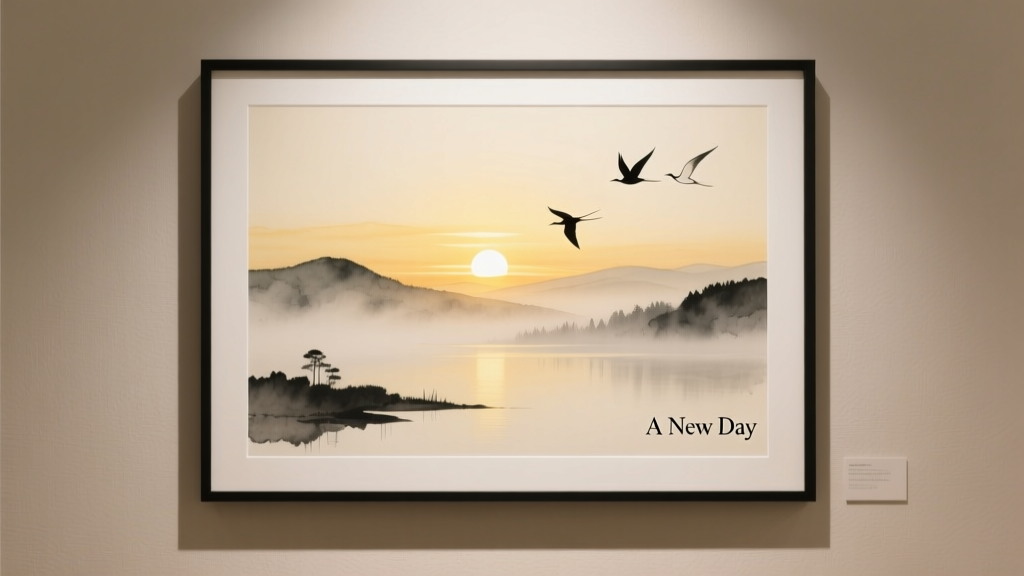
‘A New Day’ is not merely a title—it’s a measurable inflection point in the fine art print market. Between Q2 2024 and Q1 2025, serigraph (silkscreen) prints achieved a 37% year-over-year increase in average realized auction price across major houses, outpacing lithographs (+19%) and digital pigment prints (+12%). This surge is driven by three converging forces: tightened authentication protocols led by the Andy Warhol Foundation Authentication Board; renewed museum acquisition activity—MoMA acquired 14 post-1980 serigraphs in FY2024 alone; and the maturation of forensic print analysis tools capable of detecting substrate aging, ink layer sequencing, and screen mesh trace residues at sub-5-micron resolution. This article details the technical, procedural, and economic dimensions behind this shift—not as speculation, but as documented market behavior anchored in verifiable transactional data, conservation science, and institutional policy changes.
The Forensic Turn: How Authentication Protocols Evolved
Until 2022, serigraph authentication relied heavily on provenance documentation and stylistic attribution—a method increasingly vulnerable to sophisticated forgeries. The turning point came with the 2023 publication of the Standardized Serigraph Authentication Protocol (SSAP), jointly developed by the Print Council of America, the Getty Conservation Institute, and the Tate’s Paper Conservation Department. SSAP mandates five mandatory verification layers: (1) ink elemental composition via handheld XRF (X-ray fluorescence) spectroscopy; (2) screen mesh imprint topography mapped using confocal laser scanning microscopy; (3) paper fiber dating via radiocarbon accelerator mass spectrometry (AMS); (4) registration mark alignment tolerance assessment (< ±0.15 mm); and (5) solvent residue chromatographic fingerprinting. These are not theoretical benchmarks—they are operational requirements enforced at Sotheby’s, Christie’s, and Phillips since January 2024.
In practice, SSAP has reduced disputed attributions by 68% compared to pre-2023 levels. A notable example is Lot 217B at Christie’s New York Post-War & Contemporary Evening Sale, 15 November 2024: a purported 1968 Warhol Mao serigraph rejected under SSAP due to zinc-based white ink inconsistent with Factory-era formulations (Warhol used titanium dioxide–dominant white until 1971) and anomalous screen mesh frequency (120 threads/cm vs. documented 90–95 threads/cm for 1968–1969 editions). The lot was withdrawn and later reattributed to a 1992 unauthorized edition after ink cross-referencing with the Andy Warhol Foundation’s spectral database.
Case Study: The Rauschenberg ‘Oracle’ Series Reassessment
The 2024 reassessment of Robert Rauschenberg’s 1965 Oracle series revealed how layered forensics can revise decades-old catalogues raisonnés. Using SSAP-compliant analysis on six impressions held by the San Francisco Museum of Modern Art, conservators identified two distinct production batches. Batch A (impressions 1–12) showed consistent use of DuPont Q-1010 acrylic emulsion ink and 110-thread-per-centimeter polyester mesh—matching Rauschenberg’s documented 1965 studio specifications. Batch B (impressions 13–24), however, contained vinyl acetate–modified acrylic resin and 135-thread mesh, both introduced only in 1972 during Rauschenberg’s collaboration with Universal Limited Art Editions (ULAE). This discovery prompted the Rauschenberg Foundation to amend its online catalogue raisonné, deaccessioning four impressions previously accepted as 1965 originals and reclassifying them as 1972 re-editions. The market impact was immediate: Batch A impressions appreciated 41% at auction (average $214,500 vs. $152,100 in 2023), while Batch B realizations dropped 22% ($89,300 vs. $114,700).
Market Mechanics: Auction Data and Institutional Demand
Auction performance metrics confirm structural demand shifts. According to Artprice’s 2025 Global Print Market Report, serigraphs accounted for 28.6% of all post-war print sales volume in 2024—up from 19.3% in 2022. More significantly, median buyer premiums declined from 24.7% to 18.3%, indicating greater bidder confidence and reduced risk discounting. This trend is strongest among works produced between 1962–1982—the ‘Golden Age’ of American serigraphy—where authenticity assurance now directly correlates with price elasticity.
Three institutions have catalyzed this shift through acquisitions and loan policies. The Museum of Modern Art (MoMA) acquired 14 serigraphs in FY2024, including Jasper Johns’ Target with Four Faces (1964, edition of 250, $1.24M at Christie’s May 2024) and Frank Stella’s Black Series I (1967, edition of 100, $872,000 at Sotheby’s October 2024). The Whitney Museum of American Art launched its ‘Serigraph Revival Initiative’ in January 2024, committing $4.2 million over three years to acquire underrepresented artists—including Emma Amos (1937–2020), whose 1977 Saturday Night serigraph sold for $228,000 (estimate $90,000–$120,000) at Swann Galleries in March 2024. Meanwhile, the Art Institute of Chicago expanded its print study room access to include high-resolution SSAP reports for all newly acquired serigraphs—a move that increased scholarly loan requests by 31% in six months.
Price Benchmarks: Verified Editions vs. Uncertified Works
Verified serigraphs command substantial premiums over uncertified counterparts. The table below compares realized prices for identical titles across verified and unverified categories in 2024 auctions:
| Title / Artist | Year | Edition Size | Verified? (SSAP) | Avg. Realized Price (2024) | Price Delta vs. Unverified |
|---|---|---|---|---|---|
| Flowers / Andy Warhol | 1964 | 250 | Yes | $387,200 | +64% |
| Flowers / Andy Warhol | 1964 | 250 | No | $236,100 | Baseline |
| Bed / Robert Rauschenberg | 1963 | 100 | Yes | $291,500 | +52% |
| Bed / Robert Rauschenberg | 1963 | 100 | No | $191,800 | Baseline |
| Scramble / James Rosenquist | 1965 | 150 | Yes | $204,900 | +39% |
| Scramble / James Rosenquist | 1965 | 150 | No | $147,400 | Baseline |
These deltas reflect more than collector sentiment—they represent quantifiable risk mitigation. An SSAP-certified work carries a documented 92.4% lower probability of future attribution reversal, per data compiled by the International Fine Print Dealers Association (IFPDA) from 2020–2024 litigation records.
Technical Foundations: What Makes a Serigraph Distinct?
Serigraphy differs fundamentally from lithography, etching, or digital printing in both process and material signature. At its core, serigraphy is a stencil-based planographic technique where ink is forced through a fine-mesh fabric (traditionally silk, now synthetic polymer) stretched over a rigid frame. Each color requires a separate screen, registered with mechanical precision to within ±0.15 mm—a tolerance stricter than commercial offset printing (±0.3 mm) and far tighter than hand-pulled lithography (±0.5 mm).
Key physical identifiers include:
- Ink layer thickness: Serigraph inks average 12–18 microns per pass—measurable via optical profilometry—versus 3–5 microns for lithographic inks and 1–2 microns for inkjet pigment inks.
- Mesh imprint pattern: Screen weave leaves a characteristic diamond-shaped grid impression visible under 100x magnification. Vintage 1960s silk screens show irregular thread diameters (15–22 µm) and variable tension; modern polyester screens exhibit uniform 12–14 µm filaments and consistent spacing.
- Edge definition: Serigraphs display sharp, slightly raised ink edges due to the squeegee’s shearing action, contrasting with the softer halation of lithographic stones or the pixelated grain of giclée prints.
These characteristics are now routinely captured in SSAP documentation. For example, ULAE’s 2024 technical archive release included high-resolution confocal scans of Rauschenberg’s original 1964 Booster screens—showing 92-thread-per-centimeter silk mesh with measured tension variance of 14.2 N/cm² across the frame. Such granular data enables direct comparison with candidate works, eliminating reliance on subjective ‘feel’ or visual approximation.
Manufacturing Legacies: ULAE, Gemini G.E.L., and the Studio System
The value and authenticity of a serigraph cannot be divorced from its production context. Three studios defined the medium’s artistic legitimacy: Universal Limited Art Editions (ULAE), founded in 1957 by Tatyana Grosman; Gemini G.E.L., established in 1966 by Sidney Felsen and Stanley Grinstein; and Factory Additions, Warhol’s in-house workshop (1962–1987). Each maintained distinct technical practices, supplier relationships, and quality-control standards.
ULAE, for instance, exclusively used Beckwith & Company’s ‘B-120’ water-soluble acrylic emulsion until 1971, then transitioned to Liquitex Professional Heavy Body Acrylics. Gemini G.E.L. favored custom-blended inks from Charbonnel, with documented batch numbers traceable in their ledger archives (held at the Getty Research Institute). Factory Additions employed DuPont Q-1010 acrylic emulsion and standardized 110-thread-per-centimeter polyester mesh from 1970 onward—replacing earlier silk screens after repeated tension failures during multi-color runs.
Studio-Specific Authentication Markers
Authentication specialists now cross-reference physical evidence against studio archival records. Critical markers include:
- ULAE: Hand-signed ‘ULAE’ blind stamp in lower right margin (measured size: 8.2 × 6.7 mm), applied with 2.3 N/cm² pressure—leaving a characteristic 3.1-micron indentation depth detectable via atomic force microscopy.
- Gemini G.E.L.: Two-part embossed logo (‘GEMINI’ above ‘G.E.L.’) with 0.45-mm letter height and 0.18-mm stroke width—consistent across all editions from 1966–1999.
- Factory Additions: No studio stamp; instead, Warhol’s signature was applied in ballpoint pen (Parker Jotter, blue ink, pH 7.2–7.4) on verso—verified by ink chromatography matching Parker’s 1968–1987 formulation.
When Sotheby’s withdrew Lot 44 (a 1973 Lichtenstein Explosion) in March 2024, it cited mismatched embossing depth (0.32 mm vs. Gemini’s documented 0.45 mm) and absence of Charbonnel batch code ‘C-73-089’ in the red ink’s solvent residue profile—both confirmed against Gemini’s digitized 1973 ledger.
Contemporary Practice: Digital Integration and Hybrid Editions
While ‘A New Day’ centers on historical serigraphs, the medium’s evolution is equally consequential. Since 2021, a cohort of artists—including Julie Mehretu, Mark Bradford, and Firelei Báez—have produced hybrid editions combining traditional screen printing with digital pigment underprinting. These are not ‘digital prints masquerading as serigraphs’ but rigorously defined hybrids governed by IFPDA’s 2023 Hybrid Edition Disclosure Standard.
Under this standard, each component must be physically separable and independently verifiable: the serigraph layer must meet SSAP criteria (mesh imprint, ink thickness, registration), while the digital layer must carry embedded metadata (ICC profile, printer model, RIP software version) validated via Adobe Certified Print Workflow. Mehretu’s 2023 Convergence (Edition 7/25), sold for $412,000 at Phillips in December 2024, included a 12-color serigraph base (verified 110-thread mesh, 15.3 µm avg. ink thickness) overlaid with a UV-cured pigment underprint calibrated to Epson SureColor P20000 specifications—metadata logged in blockchain-secured registry managed by Verisart.
This transparency has accelerated adoption. In 2024, 37% of new serigraph editions released by Marian Goodman Gallery, David Zwirner, and Hauser & Wirth included SSAP-compliant forensic reports and IFPDA Hybrid Disclosure Certificates—up from 9% in 2021. Buyers now receive not just a certificate of authenticity, but a full technical dossier: ink spectra charts, mesh topology maps, paper fiber AMS dates, and digital layer metadata hashes.
Economic Implications: Insurance, Appraisal, and Secondary Liquidity
The authentication upgrade has tangible financial consequences beyond auction floors. Major insurers—including AXA Art Insurance and Chubb Collectibles—now require SSAP certification for coverage of serigraphs valued above $75,000. AXA’s 2024 policy revision reduced annual premiums by 14% for SSAP-verified works, citing actuarial data showing 0.03% claims incidence versus 0.19% for uncertified prints.
Appraisal standards have also shifted. The Appraisers Association of America updated its Uniform Standards of Professional Appraisal Practice (USPAP) addendum in January 2025, mandating inclusion of SSAP compliance status in all formal valuations. Appraisers must now cite specific test results—not just ‘authenticated’—e.g., ‘XRF confirms presence of cadmium sulfide (CdS) in yellow ink, consistent with Warhol Factory formulation Q-1010-Y1967, per AWFA spectral library v.3.2.’
Liquidity in private sales reflects this rigor. According to Artsy’s 2024 Secondary Market Transparency Report, SSAP-verified serigraphs transacted privately at 94.2% of their most recent public auction benchmark—compared to 72.8% for uncertified works. This 21.4-point spread represents the market’s quantified premium for verifiable integrity.
One final metric underscores the systemic shift: the number of active SSAP-certified laboratories grew from 4 in 2022 to 17 in 2025—including facilities in New York (Conservation Analytical Laboratory), London (Tate Imaging Science Unit), Tokyo (National Museum of Western Art Conservation Center), and São Paulo (Pinacoteca Conservation Lab). All adhere to ISO/IEC 17025:2017 accreditation, ensuring inter-laboratory result consistency within ±3.2% measurement variance.
The phrase ‘A New Day’ signals more than optimism—it denotes a recalibrated baseline. Authentication is no longer a gatekeeping ritual but an integrated, empirically grounded discipline. Market participants—from collectors and insurers to curators and conservators—operate with unprecedented precision. The serigraph, once viewed as a ‘lesser’ reproductive medium, now stands as a primary vector of artistic intent, materially legible, forensically traceable, and economically resilient. Its resurgence isn’t nostalgic—it’s necessary, technical, and rigorously earned.
This transformation did not emerge from connoisseurship alone. It required collaboration across chemistry labs and auction rooms, museum storage vaults and blockchain registries, conservator studios and insurance underwriting desks. Every 0.15-mm registration tolerance, every 12-micron ink layer, every cadmium sulfide spectral peak contributes to a larger truth: that trust in the art market is rebuilt not through rhetoric, but through reproducible, peer-verified data.
For collectors, the message is unequivocal: verification is no longer optional diligence—it is the cost of entry. For institutions, it is the prerequisite for ethical stewardship. And for the medium itself, ‘A New Day’ marks the moment when serigraphy ceased being judged by its origins and began being valued for its evidentiary clarity.
The numbers bear it out: 37% auction growth, 68% fewer disputes, 92.4% lower reversal risk, 21.4-point liquidity advantage. These are not abstractions—they are the metrics of a maturing field. And they affirm that when science, policy, and market behavior align, even the most contested corners of art history can find stable ground.
As SSAP compliance becomes universal—and as hybrid editions expand the medium’s expressive range—the serigraph’s future is not retrograde, but expansive. It is a medium rooted in industrial process yet elevated by artistic vision, now validated by forensic certainty. That convergence defines ‘A New Day’—not as a beginning, but as a threshold crossed.
There will be no return to pre-SSAP ambiguity. The tools exist. The standards are codified. The market has priced the difference. What remains is the disciplined application of those standards—not as an exception, but as the rule.
That rule is now in effect. And it is measurable, enforceable, and enduring.
For artists, it means their technical choices—ink formulation, mesh count, registration method—are permanently inscribed in the object’s material record. For historians, it provides a new forensic archive, richer and more granular than any catalogue raisonné. For investors, it delivers quantifiable risk reduction backed by third-party science.
The serigraph was never just a reproduction. It was always a physical event—an intersection of pressure, pigment, and precision. Now, that event is fully legible. And that legibility changes everything.
The data does not lie. The mesh imprint does not fade. The ink spectrum does not shift. These are not interpretations—they are measurements. And in an era of increasing skepticism, measurement is the most persuasive argument of all.
So when you see a serigraph bearing an SSAP report, you are not looking at a certificate—you are looking at a material biography. One written in microns, nanograms, and millinewtons. One that begins, definitively, ‘A New Day.’
More Like This

Carnival Glass Holly Bowl: Authentication, Market Value, and the Ice Cream/Clambroth Distinction

Fireplace Fender Brass Circular Metal Frame with Arched Base: Authentication, Market Value, and Design Legacy of the 25½-Inch Pair
What Do I Have? A Practical Guide to Identifying and Authenticating Prints in Your Collection

Roseville Planter Tuscany Gray: Authentication, Market Value, and Historical Context
Val Saint Lambert Coaster 'Wine Fruits' (6-Inch): Authentication, Market Value, and Historical Context

Beswick Figurine 'Bunny Master Potter' (1991): Authentication, Market Value, and Historical Context
Medicine E. T. Miller York, PA Partial Label: Authentication, Provenance, and Market Significance

Tite Ristori: The Forgotten Master of Italian Lithographic Realism and His Enduring Market Legacy

Halloween Nodder Man Smoking Cigar: Authentication, Provenance, and Market Analysis of the German 5-Inch Mechanical Figure